Short Description of Each AWS Agentic AI Security Product
Amazon Bedrock Agents
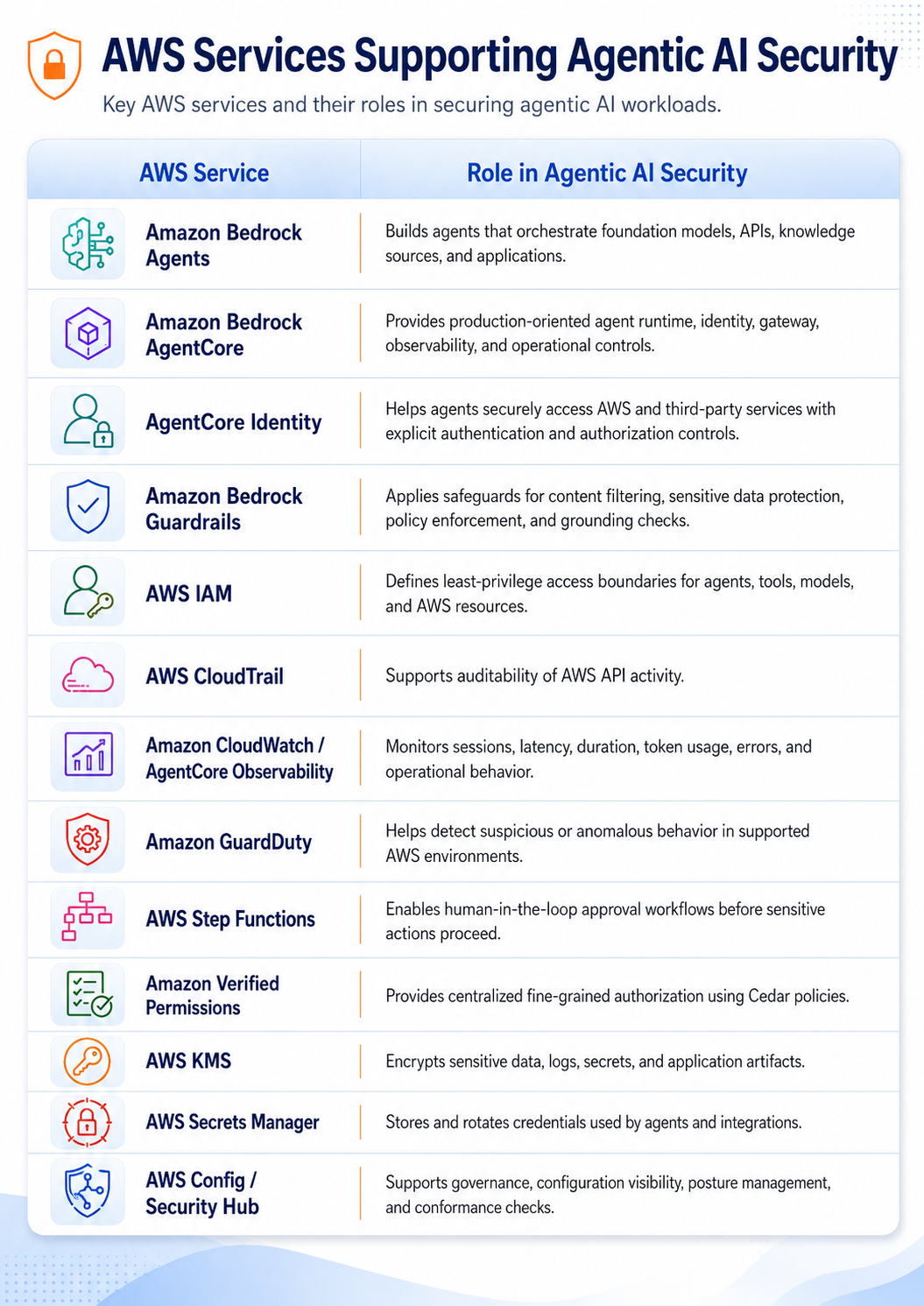
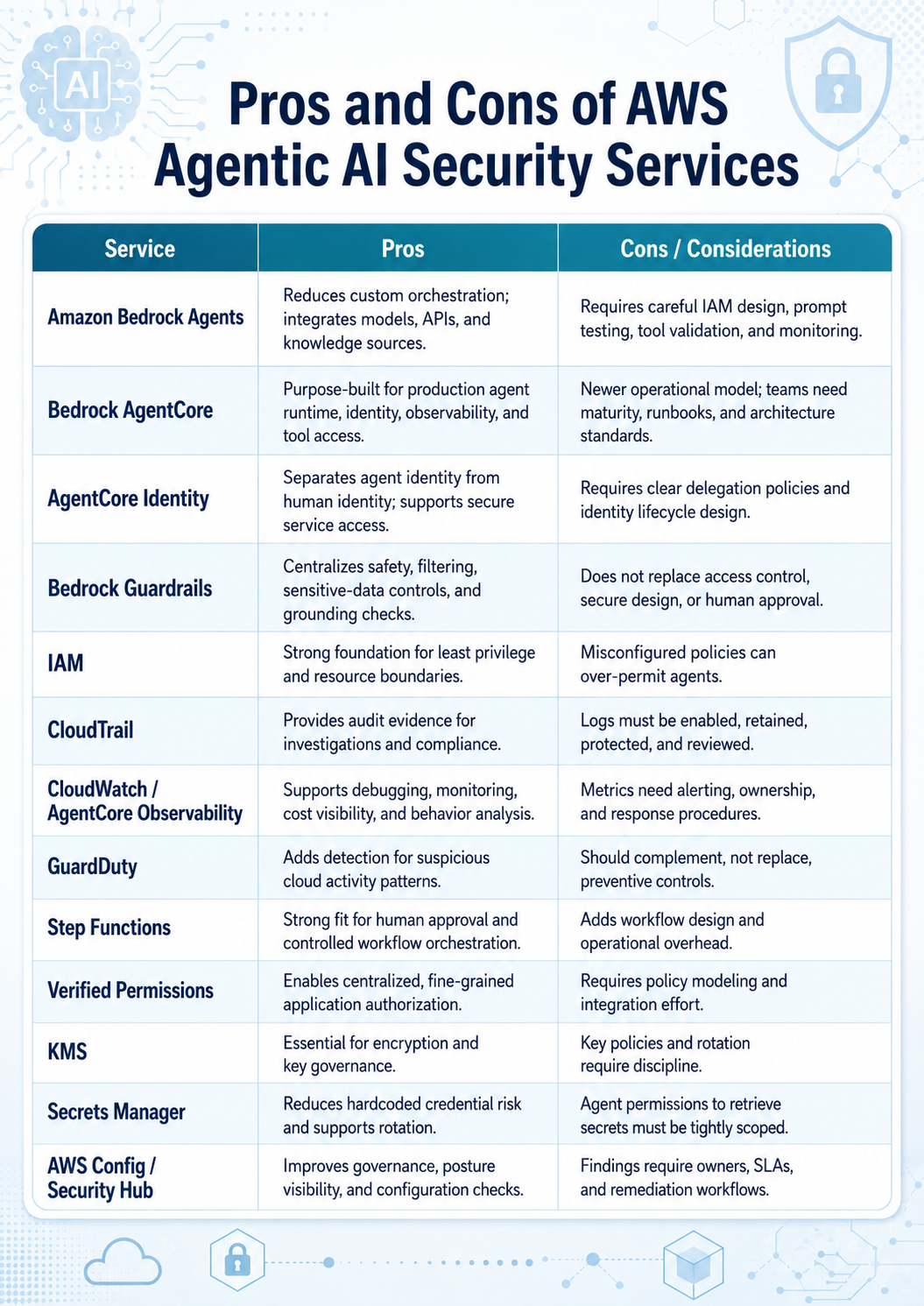
Amazon Bedrock Agents helps teams build agents that can connect foundation models to enterprise data, APIs, and workflows. For SMEs, this reduces custom orchestration effort and speeds up implementation. The main security consideration is that every tool and action exposed to the agent must be deliberately scoped, tested, and monitored.
Amazon Bedrock AgentCore
AgentCore supports production-grade agent operations. It is useful when an SME moves beyond proof of concept and needs controlled runtime execution, identity handling, gateway-based tool access, memory, observability, and operational governance. Because AgentCore is a newer service area, teams should invest in reference architectures, runbooks, and security reviews before broad rollout.
AgentCore Identity
AgentCore Identity helps separate agent identity from human identity. This is critical because agents should not inherit broad user privileges or share static credentials. AWS documentation states that AgentCore Identity implements authentication and authorization controls that verify each request independently and enables agents to access AWS and external tools securely.
Amazon Bedrock Guardrails
Guardrails provide AI-specific policy enforcement. They help filter harmful content, protect sensitive information, and reduce ungrounded responses in supported workflows. For SMEs in healthcare, finance, education, legal services, or customer support, guardrails provide an essential safety layer for public-facing and internal AI applications.
AWS IAM
IAM defines what the agent and its supporting services can do. IAM policies should restrict actions, resources, and conditions. AWS also provides service-specific actions, resources, and condition keys for Amazon Bedrock that can be used in IAM permission policies.
AWS CloudTrail
CloudTrail provides audit evidence for API activity. For agentic AI, it supports incident response, compliance investigations, and operational accountability. Logging should be centralized and protected against tampering.
Amazon CloudWatch and AgentCore Observability
CloudWatch and AgentCore Observability help teams understand how agents behave in production. Metrics such as latency, duration, token usage, error rate, and session count can reveal performance issues, cost spikes, misuse patterns, or integration failures.
Amazon GuardDuty
GuardDuty adds threat-detection coverage for supported AWS environments. For agentic AI workloads, it should complement preventive controls by helping security teams detect suspicious patterns around credentials, workloads, and cloud activity.
AWS Step Functions
Step Functions is valuable for approval workflows. An agent can recommend an action, but Step Functions can pause execution until a manager, finance approver, compliance lead, or system owner approves it.
Amazon Verified Permissions
Amazon Verified Permissions is a managed authorization service that uses the Cedar policy language. It enables centralized, fine-grained authorization and helps applications externalize authorization decisions instead of embedding complex access logic directly in code.
AWS KMS
KMS protects data through encryption and key management. AWS recommends applying least privilege when allowing services to use KMS keys and using controls such as encryption context and source account conditions where appropriate.
AWS Secrets Manager
Secrets Manager helps reduce the risk of hardcoded credentials by storing and rotating secrets. Agents should never have unrestricted access to all secrets. Retrieval permissions should be scoped to the exact integration required.
AWS Config and Security Hub
AWS Config and Security Hub help standardize governance and visibility. AWS Config includes Amazon Bedrock security and governance best-practice conformance guidance for AI, ML, generative AI, agentic AI, and related workloads.