Our Blog

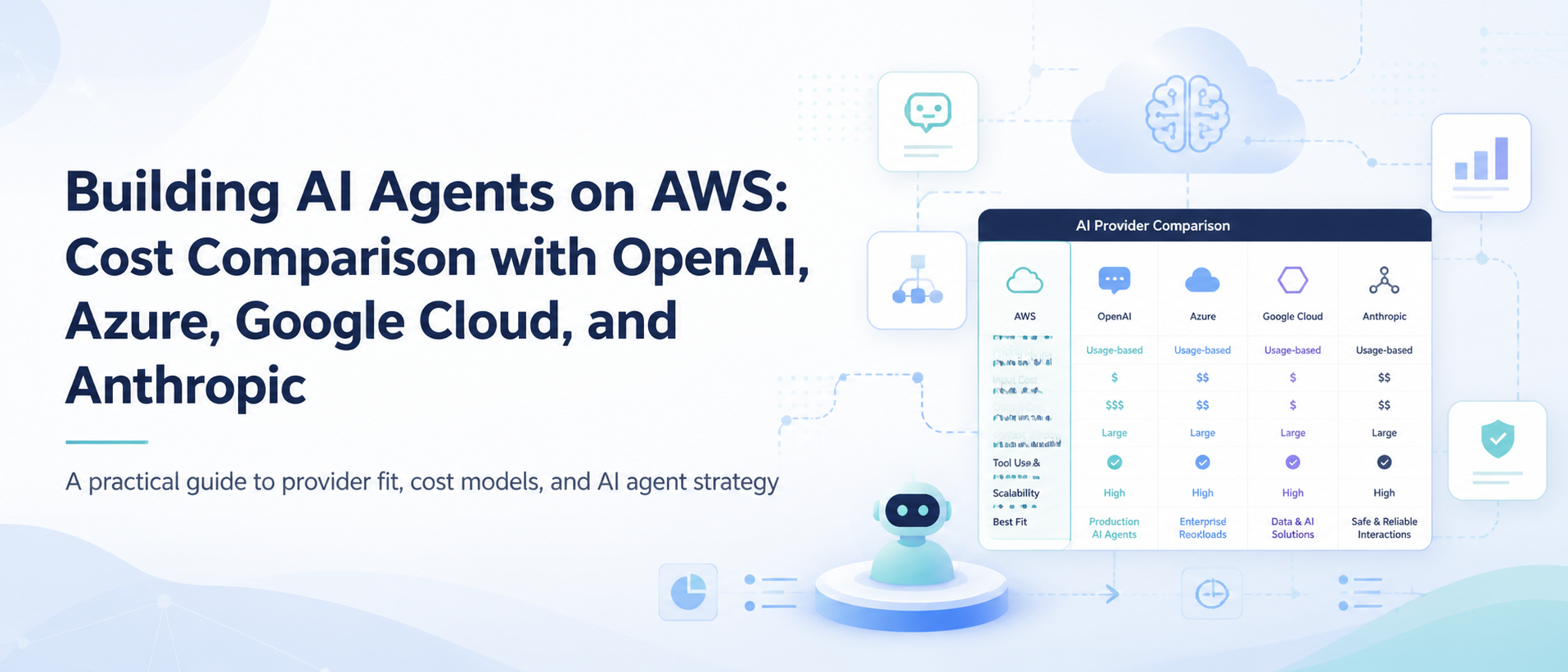
Building AI Agents on AWS: Cost Comparison with OpenAI, Azure, Google Cloud, and Anthropic

Building AI Agents on AWS: Cost Comparison with OpenAI, Azure, Google Cloud, and Anthropic

Agentic AI is moving quickly from proof-of-concept demos into real business workflows. For SMEs and scaleups, the question is no longer simply, “Can we use AI?” The more practical questions are now: Can AI automate internal operations? Can it connect securely to company data and APIs? Can it reduce manual effort without increasing risk? Can it be governed properly? And, most importantly, can the cost be controlled before usage scales across teams, customers, and departments?

This is where cost comparison becomes more complex than reading a token pricing table. AI agents are not just chatbots. A production-grade AI agent may call tools, search documents, retrieve knowledge, execute code, access business systems, maintain memory, trigger workflows, and escalate decisions to humans. That means the real cost is not only “price per million tokens.” It is the cost per completed business task, including infrastructure, retrieval, orchestration, governance, monitoring, and human review.

This article compares AWS agentic AI options with OpenAI, Azure, Google Cloud, and Anthropic from the perspective of SMEs and scaleups planning real-world AI implementations. It follows the supplied article scope and outline for an SME and scaleup audience.
Planning an AWS migration?

FAMRO helps SMEs and scaleups assess whether AWS can reduce infrastructure waste, improve capacity, strengthen resilience, and lower operational risk.

Book a Free AWS Cost & Capacity Review

This Guide Is for You If:

   You are an SME or scaleup exploring AI agents beyond basic chatbots.

   Your team wants to automate workflows but needs cost visibility first.

   You already use AWS and want to understand Bedrock, Agents, AgentCore, or Amazon Q Business.

   You are comparing AWS with OpenAI, Azure, Google Cloud, or Anthropic.

   You need AI to connect securely with company data, APIs, documents, or cloud systems.

   You want to avoid surprise costs from tokens, retrieval, tool calls, retries, and infrastructure.

   You are planning an AWS migration and want your cloud architecture ready for AI automation.

What Are Agentic AI Services?

Agentic AI refers to AI systems that can do more than generate text. An AI agent can understand a request, break it into steps, call tools or APIs, retrieve information, make decisions within defined boundaries, and return a result or trigger an action.

For example, instead of asking a chatbot, “Summarize this customer issue,” an AI support agent could read the ticket, check the customer’s subscription level, search the knowledge base, review recent incidents, draft a response, and escalate the case if the issue is high-risk.

Common SME and scaleup use cases include sales lead enrichment, customer support automation, invoice processing, internal knowledge assistants, DevOps incident assistants, compliance Q&A bots, data analysis assistants, and marketing research agents.

The key point is that agentic AI should be evaluated as a workflow automation layer, not just as a language model.

Frequently Asked Questions About AI Agent Costs

Is AWS cheaper than OpenAI for AI agents?

Not always. AWS may be more cost-effective when your systems, data, and workflows already run on AWS because integration, governance, IAM, monitoring, and infrastructure alignment can be simpler. OpenAI may be faster for custom product development. The real comparison should be cost per completed task, not only token price.

Is Amazon Q Business the same as Amazon Bedrock Agents?

No. Amazon Q Business is mainly for workplace knowledge assistance and business productivity. Amazon Bedrock Agents is better for custom agent workflows that connect models with APIs, tools, and data sources.

What is the biggest hidden cost in AI agents?

Tool calls, retrieval, retries, context size, and human review are often bigger cost drivers than expected. Poorly designed agents can repeatedly call tools, retrieve too much context, or produce outputs that require manual correction.

Should SMEs build custom AI agents or buy SaaS tools?

If the requirement is a standard internal assistant, buying may be faster. If the agent needs custom APIs, workflow automation, strict governance, private data access, or product differentiation, building a custom agent is usually better.

Why use AWS for agentic AI?

AWS is strong when agents need secure access to cloud infrastructure, company data, APIs, logs, and business systems. IAM, CloudWatch, S3, Lambda, ECS, RDS, Bedrock, and Guardrails can support a production-ready AI agent architecture.

How can SMEs control AI agent costs?

Start with one valuable workflow, measure cost per successful task, use smaller models where possible, limit tool calls, reduce context size, use retrieval carefully, monitor retries, cache reusable context, and set budgets before scaling.

AWS Agentic AI Service Landscape

AWS provides several options for building AI agents, depending on whether the goal is a custom workflow agent, an internal workplace assistant, or a secure production-grade agent platform.

Amazon Bedrock Agents are designed to connect foundation models with company systems, APIs, and data sources. AWS describes Bedrock Agents as enabling generative AI applications to automate multistep tasks by connecting with company systems, APIs, and data sources.

Amazon Bedrock AgentCore is aimed at more production-grade agent deployments. AWS positions AgentCore as a platform for building, deploying, and operating agents securely at scale, with capabilities such as memory, gateway access to tools and data, runtime scaling, and production monitoring.

Amazon Q Business is better suited when the requirement is an enterprise workplace assistant over internal knowledge, documents, and connected business systems. Amazon Q Business pricing includes a Lite subscription at $3 per user per month, while Pro is commonly listed at $20 per user per month.

Amazon Bedrock model access gives organizations flexibility across multiple foundation model providers with AWS-native governance. Bedrock pricing depends on the model provider, modality, and service tier selected.

For SMEs already running workloads on AWS, this ecosystem matters. It means agents can be designed close to existing S3 buckets, RDS databases, Lambda functions, ECS workloads, IAM policies, CloudWatch logs, and private APIs.

Reference Architecture: A Practical AWS Agentic AI Stack

A practical AWS AI agent architecture usually looks like this:

User interface → API Gateway or Application Load Balancer → Backend API → Agent orchestration layer → Amazon Bedrock Agent or AgentCore → Foundation model → Knowledge base or vector search → Business tools and APIs → Audit logs, monitoring, and cost tracking.

In this setup, Amazon Bedrock provides model access. Bedrock Agents or AgentCore handles agent orchestration. S3 stores source documents. Amazon OpenSearch, Bedrock Knowledge Bases, or another vector database supports retrieval. Lambda or ECS executes business tools. IAM controls permissions. CloudWatch captures logs and metrics. Guardrails help enforce safety and policy rules. Cost allocation tags and AWS Budgets help track usage before it becomes unpredictable.

This architecture is especially useful when the agent needs to interact with real systems, not just answer questions.

What Actually Drives Agentic AI Cost?

The first mistake many companies make is comparing only model token prices. Tokens matter, but they are only one part of the bill.

   1. Model usage cost

This includes input tokens, output tokens, cached tokens, model choice, and context size. A simple classification task may run efficiently on a smaller model, while a complex reasoning workflow may need a stronger and more expensive model. Long prompts, large retrieved documents, and verbose outputs can increase cost quickly.

   2. Agent orchestration cost

AI agents often perform multiple reasoning steps. They may call tools, retry failed steps, use memory, access gateways, run code interpreters, or browse/search external sources. Amazon Bedrock AgentCore uses flexible consumption-based pricing with no upfront commitments or minimum fees, and its features can be used independently or together.

   3. Knowledge and retrieval cost

Retrieval-augmented generation introduces costs for embedding generation, document ingestion, vector storage, indexing, and search queries. For knowledge-heavy use cases, retrieval can become a major cost center.

   4. Infrastructure cost

Production agents need APIs, databases, queues, containers or serverless functions, monitoring, networking, secrets management, and logging. These costs may be small during a pilot but material at scale.

   5. Human-review cost

For SMEs, the biggest cost is sometimes not the cloud bill. It is the time spent reviewing AI outputs, correcting errors, handling escalations, and maintaining governance. A cheap model that produces unreliable results may be more expensive operationally than a stronger model used carefully.

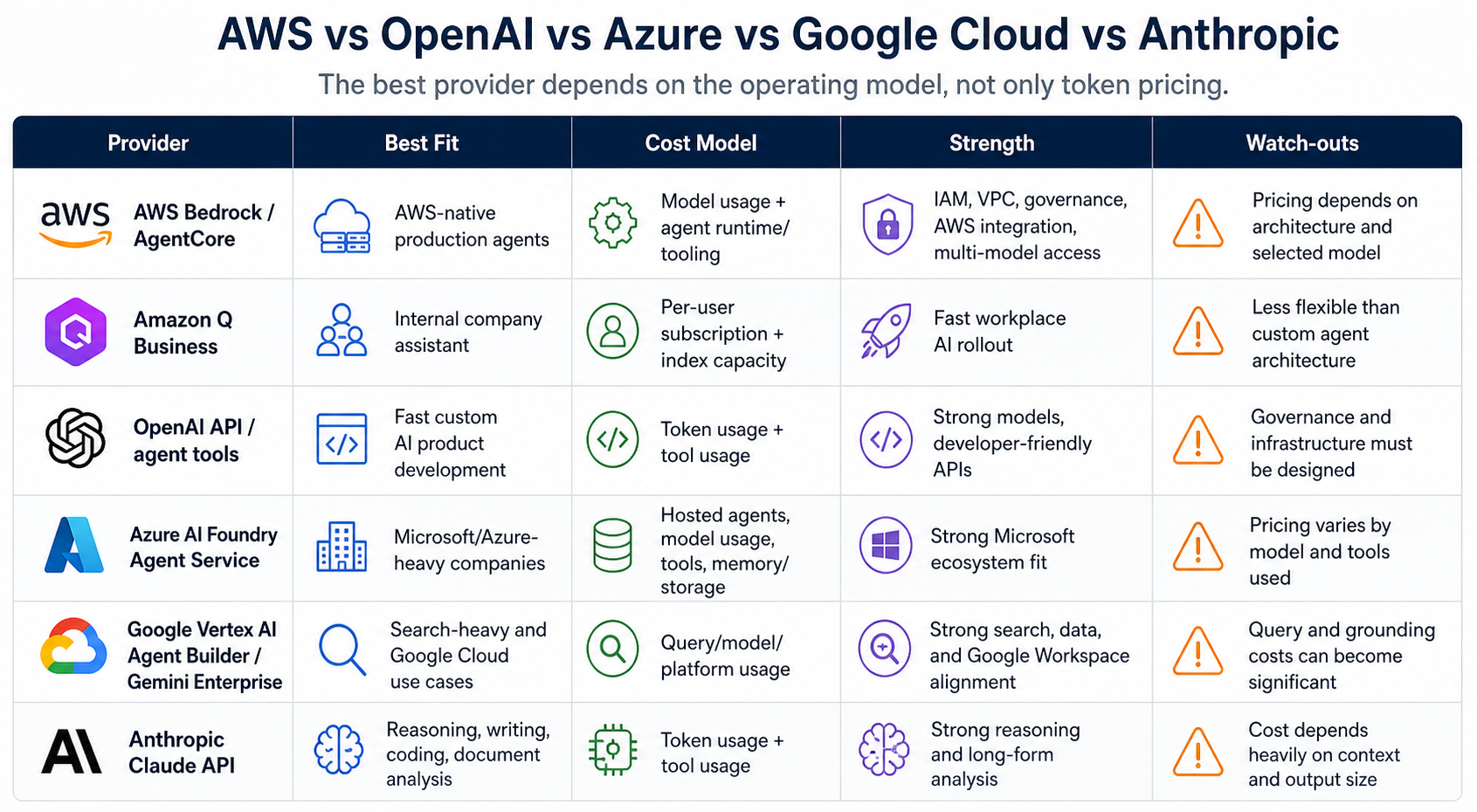
AWS vs OpenAI vs Azure vs Google Cloud vs Anthropic

The best provider depends on the operating model, not only token pricing.

Comparison among different model providers

Example Cost Scenarios for SMEs

Scenario A: Internal Knowledge Assistant

An SME wants employees to ask questions over policies, SOPs, contracts, HR documents, and project files.

For this use case, Amazon Q Business may be attractive because it offers a subscription-based workplace assistant model. A custom Bedrock agent provides more flexibility but requires architecture, retrieval design, permissions, monitoring, and cost controls. OpenAI with a vector database can work well for product teams that want to build quickly, but the company must design authentication, data governance, and retrieval infrastructure. Google Agent Builder can be strong when the organization relies heavily on Google Cloud or search-oriented knowledge experiences.

The key point: when the requirement is mostly internal Q&A, subscription-based tools may be faster and more predictable than building a custom agent from scratch.

Scenario B: Sales Research Agent

A scaleup wants an AI agent to enrich leads, summarize company profiles, generate outreach drafts, and update CRM records.

Here, the cost is often driven by tool calls and external search rather than the base prompt. A Bedrock AgentCore solution can connect securely to CRM APIs, Lambda functions, and internal lead databases. OpenAI’s Responses API and tools may support fast product development. Claude may perform well for reasoning-heavy account research and outreach drafting, especially where long-form synthesis matters. Azure AI Foundry may be the natural fit for Microsoft-heavy sales operations.

The key point: for research agents, web/search usage, CRM calls, retries, and output volume can dominate the cost model.

Scenario C: Operations Automation Agent

A company wants an agent that reads tickets, checks logs, queries databases, recommends actions, and opens Jira tasks.

For AWS-native infrastructure, Bedrock, IAM, CloudWatch, Lambda, and internal APIs can form a secure automation stack. In Microsoft-heavy environments, Azure AI Foundry may integrate more naturally with existing identity and operational tooling. OpenAI or Anthropic can be used for custom orchestration, but the organization must build the surrounding controls.

The key point: for infrastructure-heavy or regulated workflows, governance, permissions, auditability, and failure handling may matter more than raw token price.

When AWS Is the Better Choice

AWS is usually stronger when your infrastructure already runs on AWS, agents need access to AWS services, and security controls are non-negotiable.

It is a strong fit when agents need IAM-based permissions, VPC-aware architecture, audit logs, CloudWatch monitoring, S3 document access, RDS queries, Lambda tools, ECS workloads, or private APIs. It is also useful when the organization wants multi-model flexibility through Bedrock instead of committing to one model provider.

For SMEs and scaleups moving from prototype to production, AWS is often compelling because it provides the surrounding enterprise controls needed to operate AI safely.

When Another Provider May Be Better

OpenAI may be the better choice when the goal is fast product prototyping, user-facing AI features, or developer velocity with simpler APIs.

Azure may be better when the company is already standardized on Microsoft 365, Entra ID, SharePoint, Teams, Dynamics, and Azure infrastructure.

Google Cloud may be better when the use case depends heavily on Google Search, Google Workspace, BigQuery, Vertex AI, or search-first customer experiences.

Anthropic may be better when the workload requires strong reasoning, document review, coding support, long-form analysis, or high-quality writing.

The right decision depends on where your data lives, which systems the agent must access, how much governance you need, and what kind of work the agent performs.

Cost Optimization Strategies for Agentic AI

SMEs should start with one valuable workflow, not a company-wide AI platform. Measure the cost per successful task before scaling.

Use cheaper models for simple classification, extraction, routing, and formatting. Reserve stronger models for reasoning-heavy steps. Keep prompts short. Limit context windows. Use retrieval instead of stuffing entire documents into prompts. Cache repeated system prompts and reusable context where supported. Add tool-call limits so agents do not enter expensive loops. Require human approval for risky or costly actions.

Track token usage per workflow, user, department, and customer. Monitor failed runs and retries. Use AWS Budgets and alerts. Add evaluation tests before production rollout. Batch non-urgent workloads where real-time responses are not required. Review logs regularly to identify expensive prompts, unnecessary retrieval, or repeated tool calls.

Cost control is not a one-time exercise. It is an operating discipline.

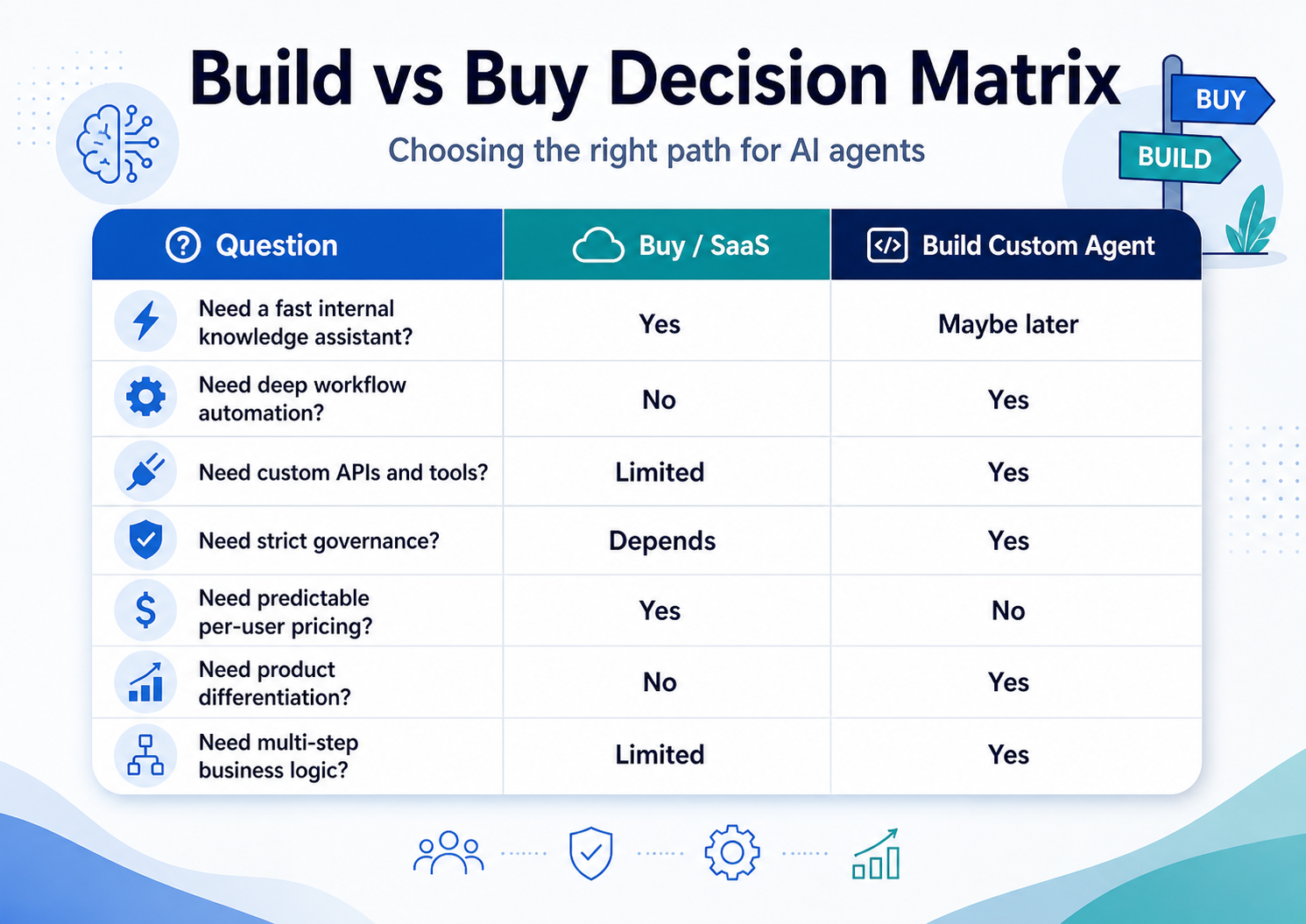
Build vs Buy Decision Matrix

Build vs Buy Decision Matrix

For many SMEs, the best path is hybrid: buy where the workflow is standard, build where the workflow creates competitive advantage.

Suggested Roadmap for SMEs and Scaleups

Start with discovery. Identify two or three workflows with measurable business value, such as reducing support handling time, accelerating sales research, or automating document review.

Next, build a proof of concept around one narrow agent with limited tools and clear success criteria. Then establish a cost baseline by measuring cost per task, cost per user, latency, accuracy, and escalation rate.

Once the business case is proven, harden the solution for production. Add authentication, permissions, logging, monitoring, retries, guardrails, and human review. Only then should the organization scale the agent to more teams, systems, or customer-facing workflows.

Common Mistakes to Avoid

The most common mistake is comparing only token prices. Others include giving agents too many tools too early, ignoring retrieval and storage costs, using the most expensive model for every step, failing to track retries, skipping access control, and treating agentic AI like a chatbot instead of a workflow system.

Another major mistake is moving to production without evaluation datasets. If you cannot measure accuracy, escalation rates, cost per task, and failure patterns, you cannot manage the agent responsibly.

How FAMRO helps

FAMRO supports SMEs and scaleups with cloud infrastructure design, AWS migration, DevOps automation, CI/CD, observability, cost optimization, and technical consulting. We help teams move from fragile infrastructure to scalable, reliable, and cost-aware cloud platforms.

Conclusion

Agentic AI can create real value for SMEs and scaleups, but only when it is treated as a production workflow system rather than a demo chatbot. AWS is especially strong when your company already runs workloads on AWS and needs secure integration with business systems, data, infrastructure, IAM, monitoring, and governance. OpenAI, Azure, Google Cloud, and Anthropic may be better choices depending on speed, ecosystem fit, model preference, search requirements, and pricing model.

The right question is not, “Which model is cheapest?” The better question is: “What is the cost per completed business task with acceptable accuracy, governance, latency, and operational risk?”

Planning an AI agent or AWS Bedrock implementation?

FAMRO helps SMEs and scaleups evaluate AI agent use cases, compare provider costs, design secure cloud-native architectures, and move from prototype to production with controlled spend. Whether you are building an internal knowledge assistant, a sales research agent, or an operations automation workflow, we help you choose the right platform, architecture, and cost-control strategy before the project scales.

To help your organization get started, we offer a free initial consultation focused on your AI agent and AWS Bedrock roadmap—no obligation, no generic pitch.

If your organization is investing in agentic AI and wants confidence, not guesswork, now is the time to act.

🌐 Learn more: Visit Our Homepage

💬 WhatsApp: +971-505-208-240

Our solutions for your business growth

Our services enable clients to grow their business by providing customized technical solutions that improve infrastructure, streamline software development, and enhance project management.

Our technical consultancy and project management services ensure successful project outcomes by reviewing project requirements, gathering business requirements, designing solutions, and managing project plans with resource augmentation for business analyst and project management roles.

Read More
2
Infrastructure / DevOps
3
Project Management
4
Technical Consulting