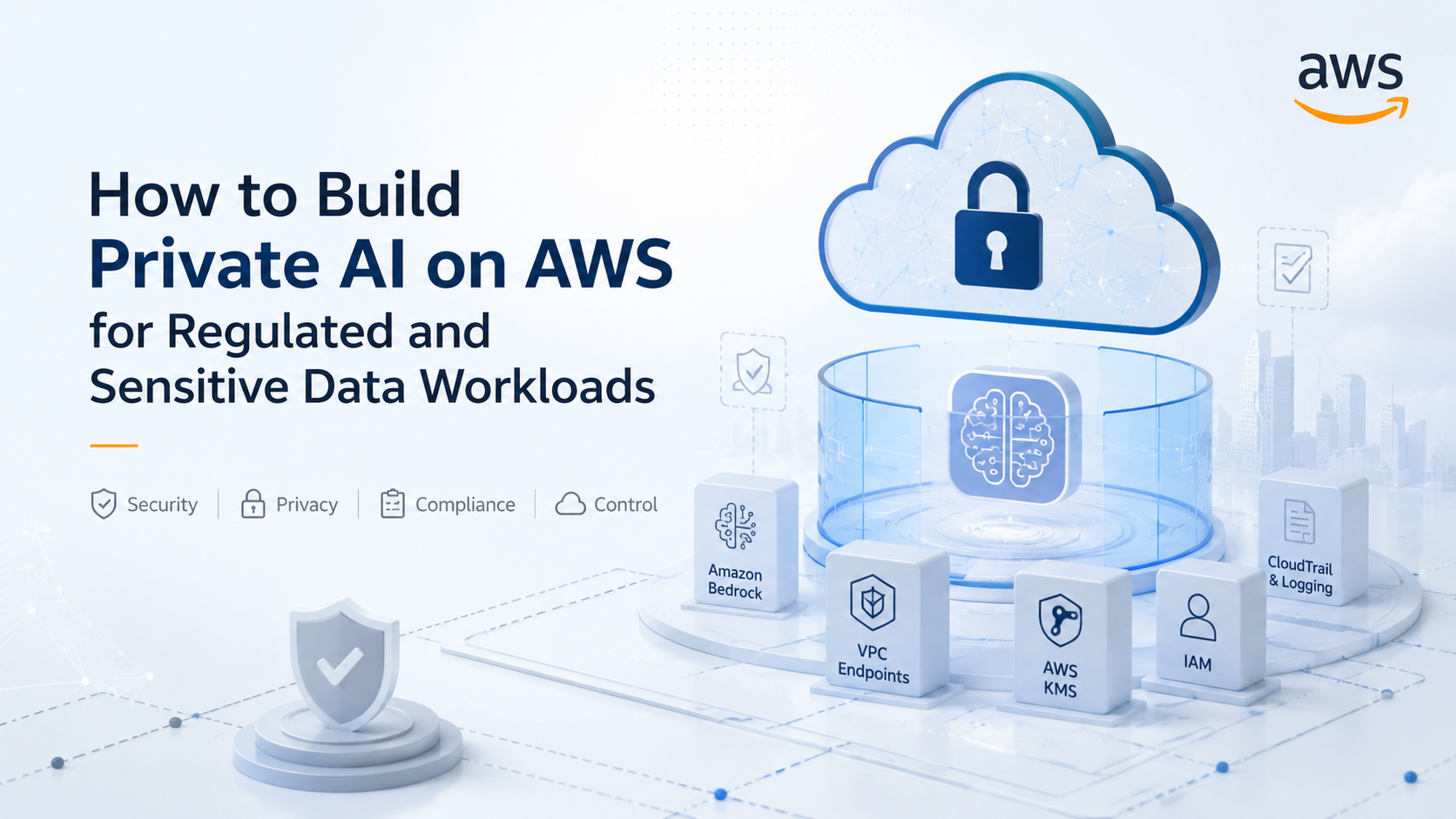
How to Build Private AI on AWS for Regulated and Sensitive Data Workloads
What Is Private AI
Artificial intelligence is rapidly becoming part of mainstream business operations. Organizations are using AI to automate workflows, summarize documents, improve customer support, accelerate software development, and generate operational insights at scale. However, businesses operating in regulated or data-sensitive industries face a major challenge: how to adopt AI without exposing confidential data to public systems or violating compliance requirements.
This challenge is driving growing interest in private AI architectures—AI environments designed to keep sensitive data under organizational control while still enabling advanced machine learning and generative AI capabilities.
For healthcare providers, fintech companies, SaaS vendors, legal firms, enterprise software providers, and government contractors, private AI is becoming a strategic requirement rather than an experimental initiative.
Among cloud platforms, Amazon Web Services has emerged as one of the most practical environments for building secure, scalable, and governance-focused AI systems.
This guide explains how organizations can build private AI on AWS for regulated and sensitive workloads, including architecture patterns, security considerations, core AWS services, and a realistic implementation example.
Private AI refers to AI systems deployed within controlled infrastructure environments where organizations maintain strict governance over data access, model interaction, network exposure, and operational security.
Unlike public AI services where data may traverse shared internet-facing systems, private AI environments are designed to minimize data exposure and maintain enterprise-grade control.
A private AI architecture typically includes:
↠ Restricted network access
↠ Encrypted storage and communications
↠ Identity-based access controls
↠ Isolated compute environments
↠ Audit logging and monitoring
↠ Controlled model access
↠ Internal-only application integration
↠ Compliance-aligned infrastructure deployment
The distinction between public AI and private AI is especially important for organizations handling:
↠ Personally identifiable information (PII)
↠ Protected health information (PHI)
↠ Financial records
↠ Intellectual property
↠ Customer contracts
↠ Internal analytics
↠ Legal documents
↠ Proprietary operational data
Many enterprises are now evaluating private AI deployments because they need AI capabilities without introducing uncontrolled third-party data exposure risks.
This is particularly important as governments worldwide strengthen regulations around data residency, privacy protection, cybersecurity governance, and AI accountability.

