What Are AI Cost Governance Principles?

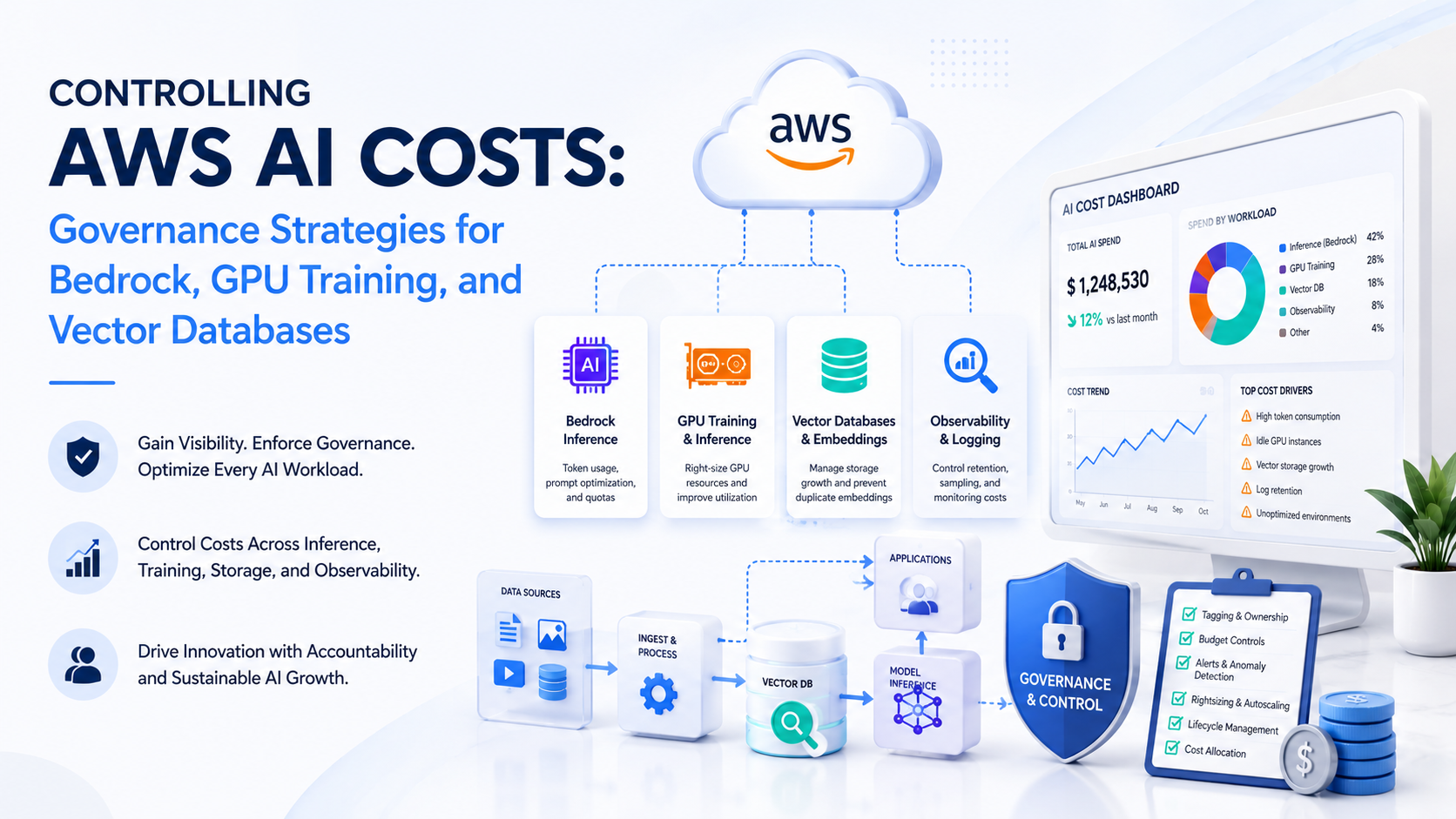
Artificial intelligence workloads are fundamentally changing how enterprises consume cloud infrastructure. Unlike traditional enterprise applications with relatively predictable compute patterns, AI systems introduce highly dynamic consumption models driven by GPU-intensive training, token-based inference pricing, large-scale vector storage, and experimentation-heavy development workflows.
What Are AI Cost Governance Principles?

Artificial intelligence workloads are fundamentally changing how enterprises consume cloud infrastructure. Unlike traditional enterprise applications with relatively predictable compute patterns, AI systems introduce highly dynamic consumption models driven by GPU-intensive training, token-based inference pricing, large-scale vector storage, and experimentation-heavy development workflows.

What are AI cost governance principles?

For enterprise CTOs, CIOs, and CXOs, the challenge is no longer simply enabling AI innovation—it is ensuring that AI adoption remains financially sustainable at scale. Organizations deploying generative AI assistants, Retrieval-Augmented Generation (RAG) platforms, GPU training pipelines, and autonomous AI agents on AWS often discover that operational expenses can escalate rapidly without proper governance controls.

AWS provides powerful capabilities for building enterprise AI platforms through services such as Amazon Bedrock, Amazon SageMaker, Amazon EKS, Amazon OpenSearch, Amazon S3, and GPU-backed EC2 infrastructure. However, these services also introduce new categories of operational complexity. Token consumption can spike unexpectedly. GPU clusters may remain idle while still incurring premium hourly costs. Vector databases can expand exponentially due to uncontrolled embedding growth. AI observability pipelines can quietly become one of the largest recurring operational expenses.

This is why AI cost governance has become a strategic operational discipline rather than a simple budgeting exercise.

Organizations that successfully scale enterprise AI initiatives typically combine governance frameworks, FinOps practices, workload optimization strategies, and automated policy enforcement to maintain visibility and accountability across AI infrastructure consumption.

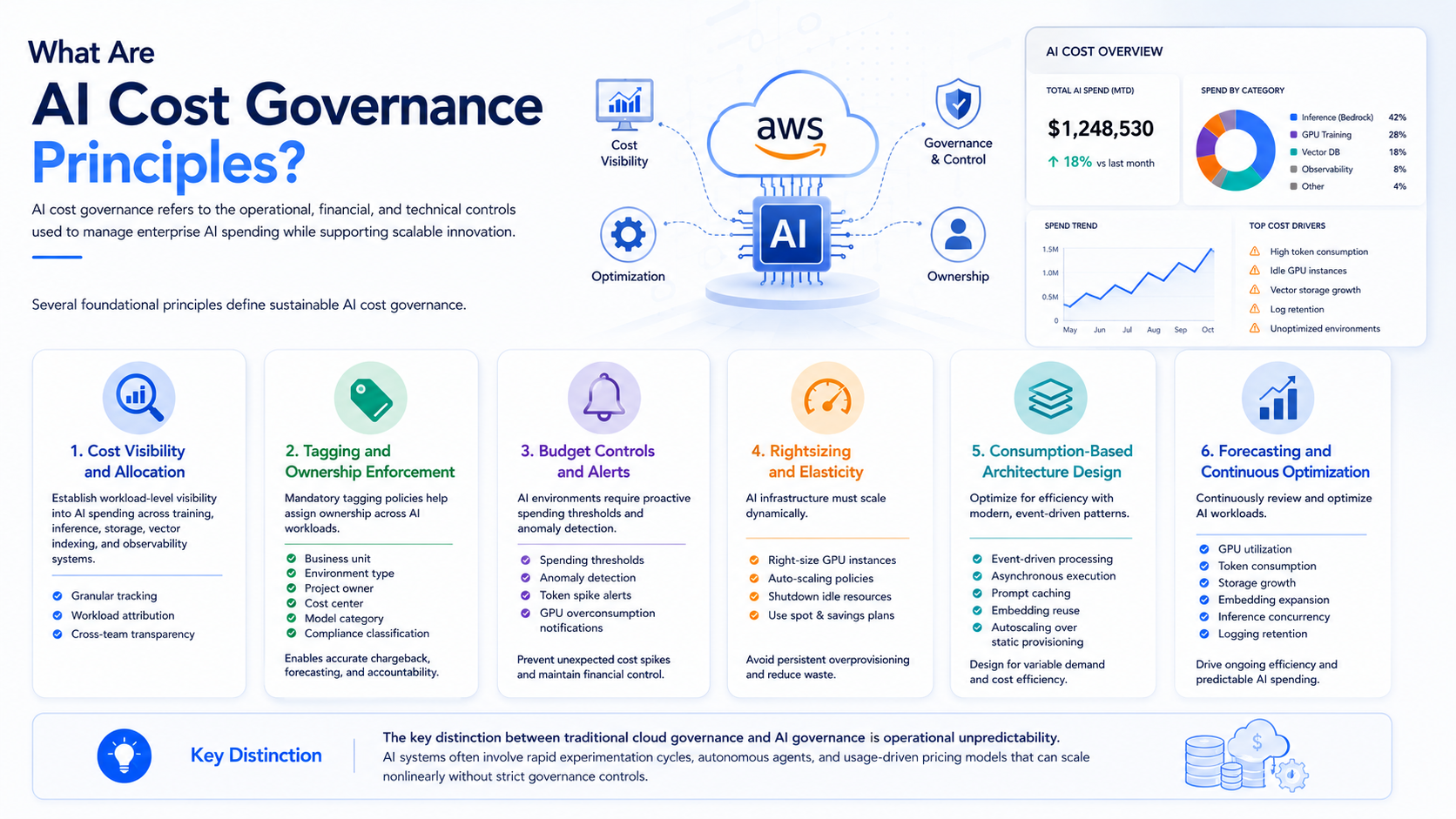
AI cost governance refers to the operational, financial, and technical controls used to manage enterprise AI spending while supporting scalable innovation. Unlike traditional cloud governance, AI governance must account for bursty GPU demand, experimentation-heavy workflows, token-based pricing models, and continuously evolving model architectures.

Several foundational principles define sustainable AI cost governance.

Cost Visibility and Allocation

Enterprises must establish workload-level visibility into AI spending across training, inference, storage, vector indexing, and observability systems. Without granular allocation, organizations struggle to identify which departments, projects, or environments are driving costs.

Tagging and Ownership Enforcement

Mandatory tagging policies help assign ownership across AI workloads. Typical governance tags include:

Business unit

Environment type

Project owner

Cost center

Model category

Compliance classification

Tagging enables accurate chargeback, forecasting, and accountability.

Budget Controls and Alerts

AI environments require proactive spending thresholds and anomaly detection. Token spikes, GPU overconsumption, and uncontrolled experimentation can generate substantial costs within hours.

Rightsizing and Elasticity

AI infrastructure must scale dynamically. Persistent overprovisioning of GPU resources remains one of the most common sources of waste in enterprise AI environments.

Consumption-Based Architecture Design

Modern AI architectures should optimize for event-driven processing, asynchronous execution, prompt caching, embedding reuse, and autoscaling rather than static provisioning.

Forecasting and Continuous Optimization

AI workloads evolve continuously. Governance programs must include recurring reviews of:

GPU utilization

Token consumption

Storage growth

Embedding expansion

Inference concurrency

Logging retention

The key distinction between traditional cloud governance and AI governance is operational unpredictability. AI systems often involve rapid experimentation cycles, autonomous agents, and usage-driven pricing models that can scale nonlinearly without strict governance controls.

Reduce AWS EC2 Costs with a Safer Graviton Migration

FAMRO helps engineering teams assess Django workloads, validate Arm64 compatibility, benchmark performance, optimize containers, and execute phased AWS Graviton migrations with lower operational risk.

This guide is for you if:

  • You are planning to deploy Generative AI workloads on AWS and need predictable cost controls.
  • You are evaluating Amazon Bedrock versus self-managed AI infrastructure.
  • You manage GPU-intensive model training and want to reduce infrastructure spending.
  • You are implementing Retrieval-Augmented Generation (RAG) using vector databases.
  • You need AI FinOps practices for budgeting, monitoring, and governance.
  • You are a CTO, cloud architect, engineering leader, or platform owner responsible for AI costs.
  • You want to scale enterprise AI initiatives without unexpected cloud cost overruns.

Typical AI Workloads and Their Cost Implications

Different AI workloads generate fundamentally different cost patterns. Understanding these patterns is essential for designing governance strategies.

Foundation Model Inference

Generative AI applications using Amazon Bedrock or managed LLM APIs typically incur costs based on token consumption, throughput, and concurrency.

Common cost drivers include:

Large context windows

High-frequency prompting

Unrestricted experimentation

Peak-hour concurrency spikes

Repeated inference requests

Long conversational sessions

Without governance, enterprise-wide generative AI adoption can produce rapidly escalating inference expenses.

Model Training and Fine-Tuning

GPU-based training workloads remain among the most expensive AI operations on AWS.

Cost drivers include:

Idle GPU clusters

Oversized training infrastructure

Distributed training inefficiencies

Duplicate experimentation

Persistent storage of checkpoints

Long-running training jobs

Training environments often suffer from poor lifecycle management, especially during experimentation-heavy development cycles.

Retrieval-Augmented Generation (RAG)

RAG systems combine vector databases, embedding generation, semantic retrieval, and generative inference.

Primary cost areas include:

Embedding generation

Vector indexing

Query amplification

Storage growth

Re-indexing operations

Multi-application retrieval workloads

As enterprises index millions of documents, vector storage expansion can become a significant operational expense.

Data Pipelines and AI Feature Engineering

AI pipelines frequently involve ingestion, preprocessing, streaming, feature engineering, and transformation workloads.

Key cost risks include:

Duplicate data storage

Intermediate processing overhead

Excessive ETL operations

Cross-region data transfer

Persistent temporary datasets

Large enterprises often underestimate the cost impact of data movement and preprocessing operations supporting AI initiatives.

AI Observability and Logging

Modern AI governance requires extensive observability for prompts, traces, hallucination detection, latency analysis, and compliance monitoring.

However, observability pipelines can generate substantial recurring costs through:

High-volume log ingestion

Long-term retention

Duplicate telemetry collection

Excessive debug tracing

Expensive indexing operations

In mature AI platforms, logging expenses can rival application infrastructure costs.

AI Workloads Where Governance Is Most Critical

Certain AI workloads are especially vulnerable to uncontrolled spending.

Bedrock and Generative AI Consumption

Generative AI platforms frequently experience rapid adoption across business units. Without request throttling, prompt optimization standards, or token quotas, operational expenses can rise unpredictably.

Excessively large prompts, unrestricted experimentation, and inefficient context management are common causes of runaway Bedrock spending.

GPU-Based Training and Inference

GPU resources are among the most expensive cloud infrastructure assets.

Organizations commonly face:

Idle GPU fleets

Overprovisioned clusters

Inefficient scheduling

Poor autoscaling policies

Persistent development environments

Even small inefficiencies can produce major financial impact at enterprise scale.

Vector Databases and Embedding Storage

Many organizations underestimate how quickly vector storage expands.

Governance failures often include:

Duplicate embeddings

Frequent unnecessary re-indexing

Poor lifecycle management

Excessive replication

Unbounded retrieval workloads

Without governance controls, semantic search platforms can scale storage and compute costs aggressively.

Logging and Monitoring Pipelines

AI observability systems often collect large-scale prompt traces, security telemetry, debugging data, and compliance logs.

Without retention policies, sampling strategies, or archival controls, observability platforms can become major recurring expenses.

Experimental and Sandbox Environments

Developer experimentation environments frequently bypass enterprise governance standards.

Risks include:

Persistent GPU usage

Untracked AI services

Shadow AI projects

Duplicate testing environments

Unrestricted model experimentation

Strong governance requires clear separation between production and experimentation workloads.

Related FAMRO Resources

AWS Tools That Help Control AI Costs

AWS provides several native governance and optimization services that support enterprise AI cost management.

AWS Budgets

AWS Budgets enables organizations to establish spending thresholds for:

Bedrock consumption

GPU usage

Storage growth

Training workloads

Department-level AI projects

Automated alerts help identify anomalous spending before costs escalate.

AWS Cost Explorer and Cost Allocation Tags

Cost allocation tags enable workload-level accountability across AI systems.

Enterprises typically implement tagging policies for:

Environment separation

Project ownership

Business-unit allocation

Compliance tracking

AI workload categorization

Cost Explorer provides visibility into spending trends and optimization opportunities.

AWS Organizations and Service Control Policies

AWS Organizations allows centralized governance across multiple AWS accounts.

Service Control Policies (SCPs) help enforce:

Approved service usage

Regional restrictions

Resource deployment limitations

Sandbox isolation

Budgetary controls

This becomes especially important in large enterprises with distributed AI teams.

Amazon CloudWatch and Usage Monitoring

CloudWatch enables operational visibility into:

GPU utilization

Token consumption

API concurrency

Queue depth

Storage growth

Inference latency

Anomaly detection policies can identify unusual spikes in AI workload activity.

AWS Compute Optimizer

Compute Optimizer provides rightsizing recommendations for compute-intensive infrastructure.

This helps organizations identify:

Oversized GPU instances

Underutilized compute resources

Inefficient scaling patterns

Optimization opportunities

Auto Scaling and Queue-Based Architectures

Queue-driven AI architectures reduce idle compute costs.

Asynchronous processing using Amazon SQS, Lambda, and autoscaling policies enables organizations to:

Reduce persistent compute usage

Optimize concurrency handling

Improve infrastructure elasticity

Prevent overprovisioning

Amazon S3 Lifecycle Policies

S3 lifecycle management is essential for AI governance.

Policies help automate:

Dataset archival

Checkpoint cleanup

Embedding retention management

Log archival

Cold storage transitions

Without lifecycle automation, AI storage growth becomes difficult to control.

Savings Plans and Reserved Capacity

Predictable AI workloads can benefit significantly from:

Compute Savings Plans

Reserved Instances

Reserved GPU capacity

Long-running inference workloads often justify reserved pricing strategies.

AWS Bedrock Usage Governance

Enterprises using Bedrock should implement:

Model access controls

Request quotas

Token budgets

Prompt optimization standards

Usage monitoring dashboards

Department-level allocation

Bedrock governance is especially important in enterprise-wide generative AI deployments.

Useful References

Third-Party Tools for AWS AI Cost Governance

Many enterprises supplement AWS-native controls with specialized FinOps and observability platforms.

CloudHealth by VMware

CloudHealth provides enterprise cloud financial management capabilities including:

Multi-cloud governance

Budget tracking

Cost optimization recommendations

Executive reporting

Policy automation

Apptio Cloudability

Cloudability supports:

Forecasting

Chargeback models

Financial accountability

Cost analytics

Enterprise budgeting workflows

Large enterprises often use Cloudability to align cloud spending with broader financial governance processes.

Kubecost

Kubecost delivers Kubernetes-level cost visibility for:

GPU clusters

Containerized AI workloads

EKS environments

Namespace-level allocation

Team-level chargeback

This is particularly valuable for AI platforms built on Kubernetes.

Datadog Cloud Cost Management

Datadog combines infrastructure observability with cloud cost analytics.

Organizations can correlate:

Infrastructure utilization

Application performance

AI workload activity

Cost anomalies

Resource inefficiencies

Spot by NetApp

Spot automates infrastructure optimization for compute-heavy workloads.

Capabilities include:

Spot instance automation

Autoscaling optimization

Capacity balancing

Cost-aware workload orchestration

GPU-intensive AI workloads can achieve significant savings through automated optimization.

Finout

Finout focuses on shared-cost allocation and unit economics.

This helps enterprises understand:

AI service profitability

Department-level usage

Shared infrastructure allocation

Product-level AI costs

Harness Cloud Cost Management

Harness provides engineering-focused governance for cloud-native environments.

Its capabilities include:

Kubernetes optimization

Continuous efficiency monitoring

Cost anomaly detection

Engineering accountability

Cloud governance automation

Enterprise AI Cost Governance in Practice

Enterprise Knowledge Assistant Using Amazon Bedrock

A global enterprise deploys an internal AI assistant powered by Amazon Bedrock for HR policies, engineering documentation, and operational procedures.

The environment includes Bedrock inference APIs, Lambda orchestration, API Gateway, vector retrieval systems, and centralized logging.

Initial adoption drives unexpected cost increases due to:

Excessive token usage

Duplicate embeddings

Long prompts

Concurrent usage spikes

Extensive logging retention

The organization responds by implementing governance controls including:

Token quotas per department

Prompt optimization standards

Embedding reuse policies

API throttling

CloudWatch anomaly alerts

S3 lifecycle management

Separate production and sandbox environments

As a result, the enterprise achieves predictable AI operating costs while supporting controlled enterprise-wide adoption.

GPU-Based Model Training Platform

A financial services company operates GPU clusters for fraud detection and risk-analysis model training.

The organization initially experiences:

Idle GPU fleets

Oversized training clusters

Persistent development environments

Duplicate experimentation

Storage growth from stale checkpoints

Governance improvements include:

Queue-based orchestration

GPU autoscaling

Time-limited development environments

Spot instances for non-production workloads

Automated checkpoint cleanup

Chargeback tagging

Budget alerts for training teams

These controls improve GPU utilization while significantly reducing infrastructure waste.

Enterprise RAG Platform with Vector Databases

A large enterprise builds a semantic search and AI copilot platform indexing millions of internal documents.

As adoption grows, vector storage and retrieval costs begin scaling aggressively.

Governance controls are introduced to manage:

Duplicate embeddings

Frequent re-indexing

Unbounded storage growth

High query throughput

Multi-team infrastructure duplication

The organization implements:

Shared embedding services

Scheduled indexing windows

Query rate limits

Tiered storage policies

Deduplication before embedding generation

Department-level cost allocation

This enables enterprise-scale semantic search while preventing uncontrolled infrastructure expansion.

Conclusion

Enterprise AI adoption cannot scale successfully without disciplined cost governance. GPU infrastructure, foundation model inference, vector databases, observability systems, and experimentation-heavy development workflows introduce fundamentally different operational risks compared to traditional cloud environments.

Organizations that treat AI governance as a strategic operational capability—not merely a financial reporting exercise—are significantly better positioned to scale AI initiatives sustainably.

AWS provides a strong foundation through services such as Bedrock, CloudWatch, AWS Budgets, Organizations, and Compute Optimizer. However, successful governance also requires architectural discipline, FinOps maturity, automation policies, and workload-level accountability.

The enterprises achieving long-term AI success are those balancing innovation velocity with visibility, optimization, and operational control.

At enterprise scale, AI cost governance is not about limiting innovation. It is about enabling sustainable AI growth with confidence, predictability, and measurable business value.

To help organizations build scalable and financially sustainable AI platforms, we provide enterprise consulting and implementation services focused on AWS AI governance, Bedrock optimization, GPU infrastructure management, FinOps integration, and AI workload architecture.

Whether your organization is deploying generative AI assistants, RAG platforms, GPU training pipelines, or enterprise AI observability systems, our team helps establish governance frameworks that reduce waste while accelerating responsible AI adoption.

🌐 Learn more: Visit Our Homepage

💬 WhatsApp: +971-505-208-240