
What Is AWS Agent Registry?

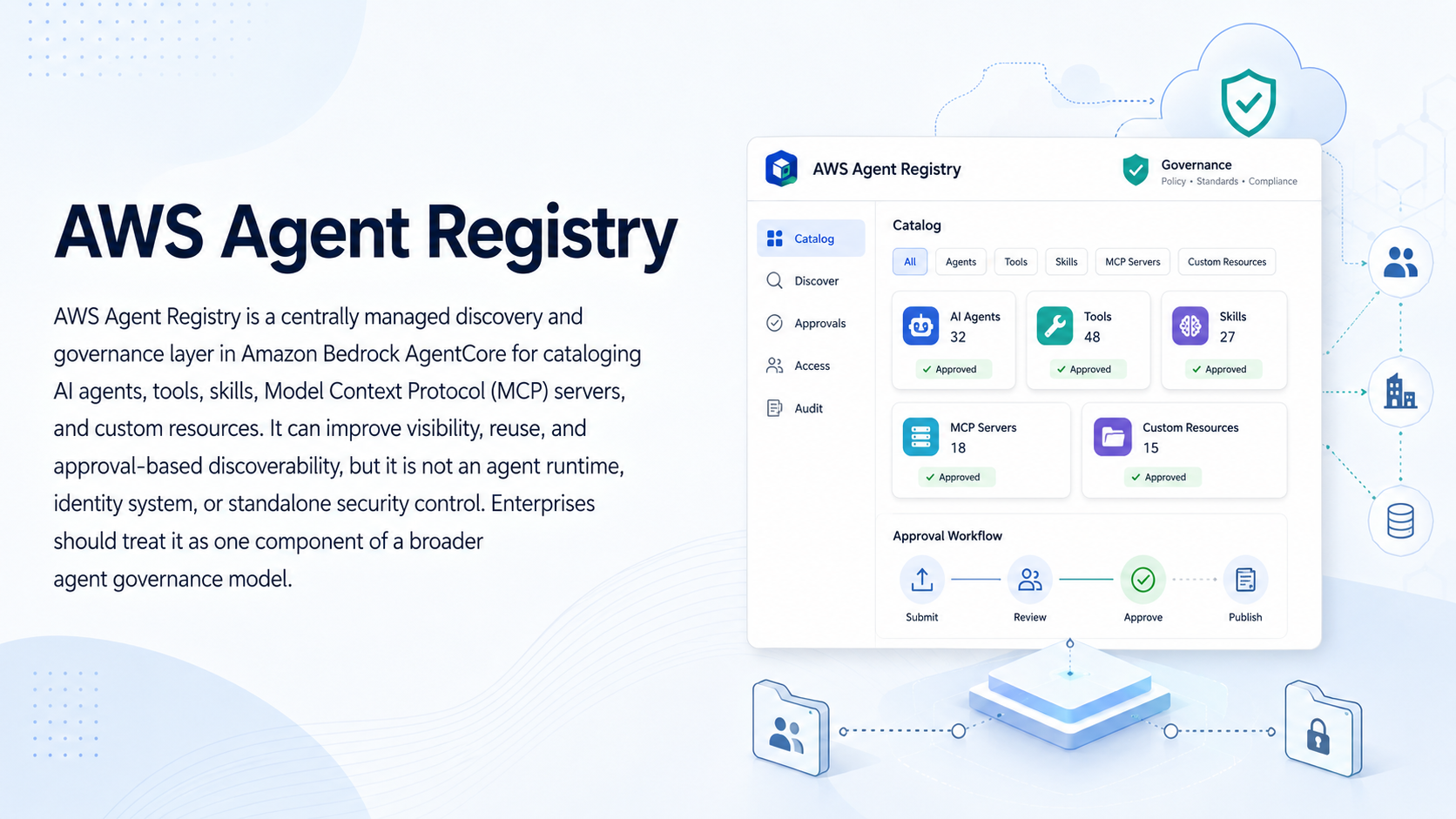
Short answer: AWS Agent Registry is a centrally managed discovery and governance layer in Amazon Bedrock AgentCore for cataloging AI agents, tools, skills, Model Context Protocol (MCP) servers, and custom resources. It can improve visibility, reuse, and approval-based discoverability, but it is not an agent runtime, identity system, or standalone security control. Enterprises should treat it as one component of a broader agent governance model.

What Is AWS Agent Registry?

Short answer: AWS Agent Registry is a centrally managed discovery and governance layer in Amazon Bedrock AgentCore for cataloging AI agents, tools, skills, Model Context Protocol (MCP) servers, and custom resources. It can improve visibility, reuse, and approval-based discoverability, but it is not an agent runtime, identity system, or standalone security control. Enterprises should treat it as one component of a broader agent governance model.

Enterprise AI programs are rapidly moving beyond isolated proof-of-concepts. Finance teams build exception-handling agents. Security teams experiment with investigation assistants. Operations groups create workflow automation tools. Application teams expose APIs and internal knowledge through MCP servers.

That expansion creates a new operational problem: organizations may no longer know which agents exist, who owns them, what tools they can call, what data they can access, or whether they have passed security and compliance review.

AWS Agent Registry is designed to address part of that challenge. Announced in preview on April 9, 2026, it provides a private, governed catalog within Amazon Bedrock AgentCore where organizations can publish, organize, curate, and discover AI-related resources. AWS positions the service as a way to help enterprises discover and reuse approved agents, tools, skills, MCP servers, and custom resources across their environments.

For enterprise technical leaders and CISOs, the strategic value is not simply search. It is the ability to create a more accountable operating model for agentic AI before decentralized development turns into unmanaged agent sprawl.

AWS Agent Registry is a fully managed discovery service in Amazon Bedrock AgentCore. It creates a centralized catalog where teams can publish MCP servers, tools, agents, agent skills, and custom resources, then make those resources discoverable through semantic and keyword search. AWS states that both human users and AI agents can use the registry to find relevant resources.

The key distinction is important:

⇒ AWS Agent Registry is a discovery and governance layer.

⇒ It is not an agent runtime.

⇒ It is not a substitute for authorization or least-privilege access controls.

⇒ It is not a complete AI risk management platform.

⇒ It does not automatically make an approved agent safe to deploy.

Instead, it acts as an organizational system of record for approved AI assets. A registry can contain resource descriptions, ownership details, metadata, approval status, dependencies, capabilities, and lifecycle information. This makes it easier for enterprises to answer operational questions such as:

⇒ Which billing-related agents already exist?

⇒ Which MCP servers have completed internal review?

⇒ Who is accountable for a specific agent or tool?

⇒ Which teams are allowed to discover a resource?

⇒ Which assets should be retired, updated, or re-reviewed?

AWS supports registry-level authorization and approval settings. Organizations can configure authorization using AWS Identity and Access Management (IAM) credentials or JSON Web Tokens from a corporate identity provider, depending on their architecture and access model.
Build a Governed Enterprise AI Agent Strategy

FAMRO helps organizations design practical governance models for AI agents, MCP servers, cloud platforms, identity controls, runtime policies, observability, and secure AWS delivery. Establish discovery and accountability before unmanaged AI assets become an operational risk.

Why Enterprises Need an Agent Registry

Most enterprises do not experience AI sprawl because they lack ideas. They experience it because agent development becomes decentralized faster than governance processes evolve.

A product team may build an internal customer-support agent. A finance team may create a reconciliation assistant. A data engineering group may expose data access through an MCP server. A procurement team may contract for an external AI workflow platform. Over time, the organization accumulates agents, tools, prompts, workflows, connectors, and models that are poorly documented or known only to the teams that created them.

That creates four recurring problems.

Agent and Tool Sprawl

Without a centralized inventory, teams often rebuild capabilities that already exist elsewhere in the enterprise. The result is duplicated engineering effort, inconsistent security practices, and multiple versions of similar workflows operating with different controls.

AWS explicitly identifies visibility, control, and reuse as core enterprise challenges as organizations scale agent adoption. Its launch announcement notes that agent ecosystems can span AWS, other cloud platforms, and on-premises environments, making centralized awareness increasingly important.

Governance Inconsistency

Traditional application governance typically relies on architecture review boards, source control, CI/CD controls, API standards, identity requirements, and production-readiness reviews. Agentic systems require those practices, but they also introduce new concerns: tool permissions, model behavior, prompt injection exposure, delegated authority, autonomous execution, and sensitive data handling.

A registry can establish a defined publication and approval process before a resource becomes broadly discoverable. AWS documentation states that curators can review pending records against internal standards for security, compliance, and metadata quality.

Ownership and Accountability Gaps

An agent without a named business owner, technical owner, support model, data classification, and review cadence is not an enterprise-ready asset. It is an unmanaged dependency.

A well-run registry can require owners to document:

⇒ Business purpose and approved use cases

⇒ Technical owner and escalation path

⇒ Data sources and data classifications

⇒ Allowed actions and restricted actions

⇒ Tool and MCP server dependencies

⇒ Identity and authorization model

⇒ Logging, monitoring, and incident response expectations

⇒ Lifecycle status, version, and next review date

This transforms agent metadata from an afterthought into a governance control point.

Controlled Discovery and Reuse

Informal knowledge sharing does not scale. Relying on chat channels, spreadsheets, wikis, or individual architects to know which tools exist creates a bottleneck and encourages shadow development.

AWS Agent Registry supports both semantic and keyword search, allowing users to search by intent as well as exact names. For example, a procurement operations team might search for “approved invoice exception workflow” rather than needing to know a specific agent name in advance.

As AWS wrote at launch, “No more rebuilding what already exists. No more agents deployed without visibility.”

This guide is for you if:

  • Your organization is building or evaluating AI agents for internal business workflows.
  • You need clearer ownership, approval, and lifecycle controls for AI agents and tools.
  • Your teams are deploying MCP servers, APIs, or reusable agent skills across the business.
  • You want to reduce duplicate AI development and unmanaged agent sprawl.
  • You are responsible for AWS architecture, cloud security, platform engineering, or AI governance.
  • You need to connect AI asset discovery with IAM, runtime authorization, logging, and auditability.
  • You are assessing Amazon Bedrock AgentCore for enterprise agentic AI initiatives.

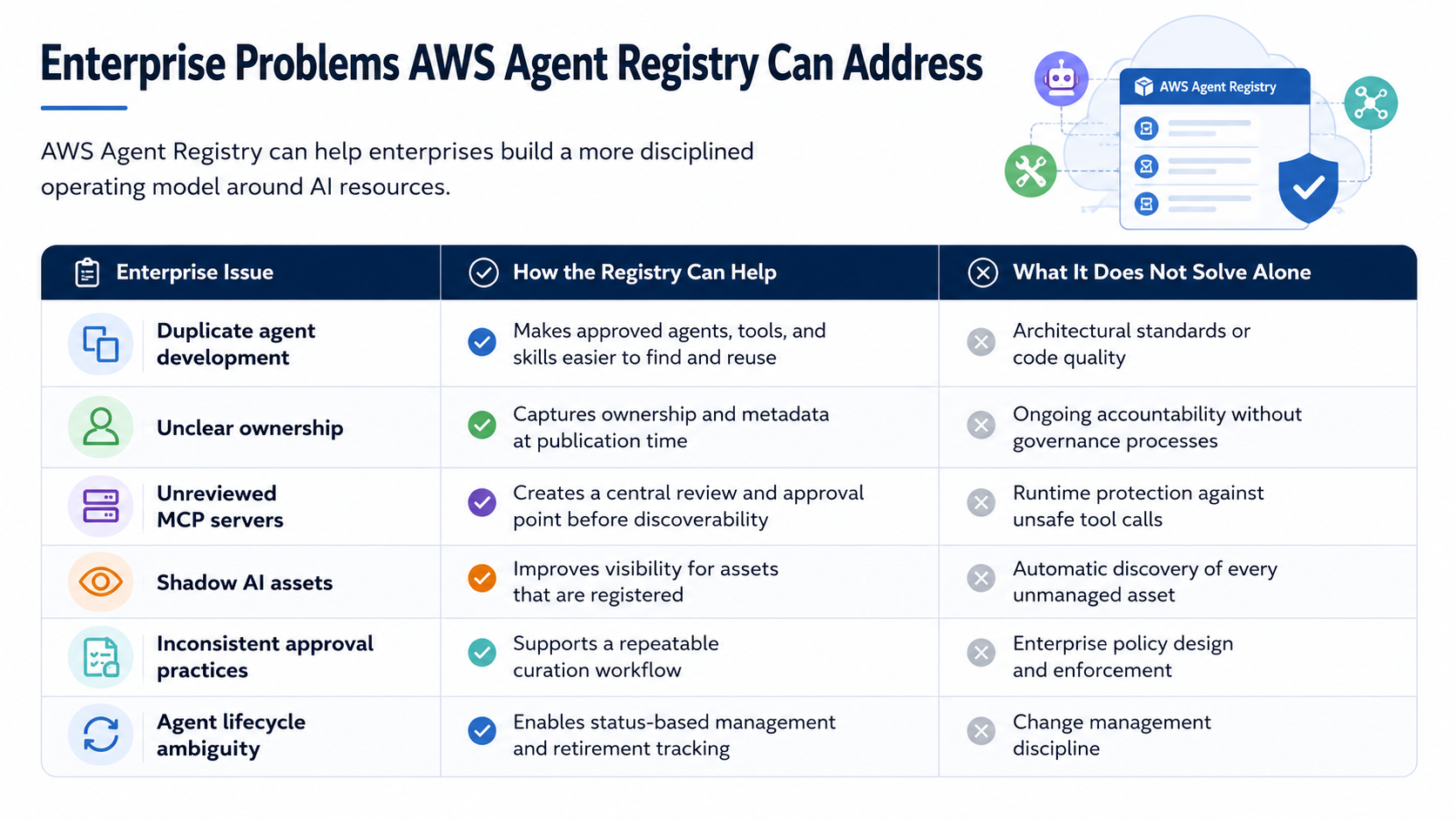
Enterprise Problems AWS Agent Registry Can Address

AWS Agent Registry can help enterprises build a more disciplined operating model around AI resources.

Enterprise Problems AWS Agent Registry Can Address

Related FAMRO Resources

Practical Working Example: Governing an Internal Finance Operations Agent

Consider a multinational enterprise with a finance engineering team that develops an AI agent to summarize approved billing exceptions.

The agent is intended to help analysts review exceptions more quickly. It can read approved billing case data, retrieve supporting documentation, classify exception reasons, and generate a summary for human review. It cannot issue credits, modify invoices, or access unapproved customer data.

A mature registry process could work as follows.

1. Publish the Agent Record

The finance engineering team creates a registry record that includes:

⇒ Agent name, purpose, and business owner

⇒ Technical owner and support contact

⇒ Supported actions and prohibited actions

⇒ MCP servers, APIs, data sources, and model dependencies

⇒ Data-access boundaries and classification labels

⇒ Required identity and authorization mechanisms

⇒ Logging, retention, and monitoring expectations

⇒ Version number, lifecycle stage, and review date

The objective is to make the agent understandable to people outside the original development team.

2. Perform Security, Risk, and Platform Review

Security, risk, privacy, and platform engineering teams review the record against established requirements.

For example, reviewers may confirm:

⇒ The agent uses approved data sources.

⇒ Tool permissions follow least-privilege principles.

⇒ API calls require authenticated and authorized identities.

⇒ MCP server inputs and outputs are documented.

⇒ Sensitive data is not exposed to unauthorized users.

⇒ Activity is logged for investigation and audit.

⇒ A business owner is accountable for future changes.

⇒ The agent has testing evidence for unsafe or unexpected behavior.

AWS Agent Registry can support this approval workflow, but the actual review criteria remain the organization’s responsibility. AWS documentation describes a process in which records move through pending approval and can be approved or rejected with reasons captured in the workflow.

3. Make the Agent Discoverable to Authorized Users

Once approved, the agent becomes searchable for the appropriate internal audience.

A procurement operations team searching for help with billing exceptions discovers the approved finance agent instead of commissioning a separate workflow. The procurement team can evaluate the documented use case, owner, access boundaries, and dependencies before deciding whether reuse is appropriate.

That is where the registry delivers business value: it reduces duplicated development while making governance evidence visible at the point of discovery.

4. Enforce Runtime Controls Separately

Approval in a catalog does not equal authorization at runtime.

The finance agent should still rely on identity, access control, secure credentials, API authorization, data controls, logging, monitoring, and policy enforcement. AWS AgentCore Policy, for example, is designed to evaluate agent-to-tool requests against defined policies before tool access is permitted through AgentCore Gateways.

The practical lesson is simple: catalog approval tells the organization that a resource is known and reviewed; runtime controls determine what that resource can actually do.

5. Review Changes Throughout the Lifecycle

The organization should require re-review when material changes occur, such as:

⇒ New tools or MCP servers are added.

⇒ Permissions expand.

⇒ The agent begins using new data sources.

⇒ The business owner changes.

⇒ The model, prompt strategy, or workflow logic changes materially.

⇒ A security incident or control failure occurs.

Registry governance works best when it is connected to CI/CD, change management, asset inventory, and periodic recertification processes.

Comparable Products and Architectural Alternatives

AWS Agent Registry sits in an emerging category, but it is not the only way to address discoverability and governance.

Service Catalogs

Platforms such as Backstage are designed to centralize ownership and metadata for software components, services, libraries, and data pipelines. Backstage’s software catalog is built around structured metadata and ownership relationships, making it useful for organizations that want to extend an existing developer portal to include AI agents and related assets.

The limitation is that a general service catalog may require custom schemas, plugins, and governance workflows to understand agent-specific concepts such as tools, prompts, MCP servers, model dependencies, and autonomous actions.

API and Integration Catalogs

Platforms such as Apigee, MuleSoft, Kong, and Postman address API discovery, lifecycle governance, reusable integrations, and developer access. Apigee API Hub, for example, provides a searchable catalog for APIs and associated entities such as versions, dependencies, and deployments.

These systems are particularly relevant where agents consume APIs rather than directly invoke MCP servers. However, API catalogs generally focus on interfaces and integrations rather than full agent lifecycle metadata.

AI Governance Platforms

AI governance tools often focus on model inventory, risk assessment, policy evidence, compliance workflows, model monitoring, bias evaluation, and documentation.

These platforms may provide broader governance coverage than an agent registry, especially for regulated industries. However, they may not offer deep operational integration with an agent development platform or agent-specific discovery workflows.

Agent Platform Registries

Some vendors and open-source ecosystems now provide their own ways to catalog agents, MCP servers, prompts, workflows, or reusable skills. MuleSoft, for example, describes Agent Fabric as supporting discovery of agents and MCP servers through a centralized AI asset catalog.

For most enterprises, the question is not whether one registry will replace all others. The question is whether a registry can become the authoritative enterprise index while integrating with broader developer portals, API governance systems, CMDBs, security tooling, and multi-cloud platforms.

Evaluation Criteria for Enterprise Buyers

When evaluating AWS Agent Registry or an alternative, enterprise leaders should assess:

⇒ 1. Multi-framework support: Can the registry represent agents built with different frameworks, clouds, and hosting patterns?

⇒ 2. Metadata quality: Can the organization enforce meaningful fields for ownership, risk, data access, dependencies, and lifecycle?

⇒ 3. Approval workflow: Can security, architecture, compliance, and platform teams participate in review?

⇒ 4. Identity integration: Does the platform work with enterprise IAM, federated identity, and access-control models?

⇒ 5. Policy enforcement: Can registry records connect to runtime authorization and tool-access policies?

⇒ 6. Auditability: Can teams demonstrate who approved a resource, why, and when?

⇒ 7. Portability: Can metadata be exported or integrated with non-AWS systems?

⇒ 8. Operational maturity: Does the service meet requirements for resilience, support, monitoring, and incident response?

⇒ 9. Cloud dependency: Does the platform create unacceptable lock-in for a multi-cloud or hybrid strategy?

NIST’s AI Risk Management Framework provides a useful lens for this evaluation. Its core functions—Govern, Map, Measure, and Manage—reinforce the idea that a registry should support, not replace, enterprise risk management practices.

Pros and Considerations of AWS Agent Registry

Potential Advantages

AWS Agent Registry offers several potential benefits for AWS-centric enterprises:

⇒ Centralized discovery for approved agents, tools, skills, MCP servers, and custom resources.

⇒ Approval-based governance that can reflect enterprise security, compliance, and metadata standards.

⇒ Semantic and keyword search for both technical and business users.

⇒ Alignment with the broader Amazon Bedrock AgentCore ecosystem.

⇒ Potential reduction in duplicated development and unmanaged AI assets.

⇒ Support for AWS IAM or JWT-based authorization models.

⇒ Ability to index agents built or hosted across AWS, other clouds, and on-premises environments, according to AWS.

Considerations and Limitations

The service remains in preview, which means enterprises should validate feature maturity, support commitments, regional availability, pricing, service limits, and production-readiness requirements before broad deployment. AWS currently identifies the registry as a preview offering and lists consumption-based pricing with a free tier.

Other important considerations include:

⇒ Registry governance depends on complete metadata, accountable owners, and disciplined review processes.

⇒ Approval status should never replace runtime authorization, secure credential handling, observability, testing, or incident response.

⇒ A registry does not automatically identify every shadow AI asset. Inventory, network monitoring, procurement controls, and developer governance remain necessary.

⇒ Multi-cloud organizations should assess interoperability carefully and avoid making agent metadata inaccessible outside one platform.

⇒ Security teams must continue to implement least privilege, logging, policy enforcement, and data-protection controls under the shared responsibility model.

Key Takeaways

⇒ AWS Agent Registry is a governed discovery catalog for enterprise AI resources, not a standalone security control.

⇒ It can help reduce agent sprawl, duplicated engineering, unclear ownership, and informal tool sharing.

⇒ MCP servers and agent-facing tools should receive the same rigor applied to APIs, privileged applications, and integration platforms.

⇒ Registry approval should be connected to identity, authorization, policy enforcement, logging, monitoring, testing, and lifecycle management.

⇒ Enterprises should evaluate preview maturity and multi-cloud interoperability before making it a core control plane.

Useful References

Conclusion: Build Agent Discovery Into a Broader Governance Model

AWS Agent Registry has the potential to become a valuable foundation for managing agent discovery and reuse in large AWS-centric environments. Its strongest value is not that it creates another inventory. Its value is that it can help enterprises establish a governed, searchable, accountable catalog for agents, tools, skills, MCP servers, and related AI resources.

For CISOs and enterprise technology leaders, the central principle should be clear: visibility is necessary, but visibility alone is not control.

A mature enterprise agent governance model must combine registry-based discovery with identity and access management, runtime authorization, policy enforcement, secure tool integration, model and workflow testing, centralized logging, continuous monitoring, incident response, and accountable ownership.

To help organizations get started, we offer a free initial consultation focused on your AWS Agent Registry and enterprise AI governance strategy—no obligation, no generic pitch. If your organization is investing in AI agents and wants confidence—not guesswork—now is the time to establish a scalable governance model.

🌐 Learn more: Visit Our Homepage

💬 WhatsApp: +971-505-208-240

References

⇒ 1. AWS, AWS Agent Registry: Discover and manage agents, tools, and resources (Preview). Click here

⇒ 2. AWS, The future of managing agents at scale: AWS Agent Registry now in preview. Click here

⇒ 3. AWS, Policy in Amazon Bedrock AgentCore: Control Agent-to-Tool Interactions. Click here

⇒ 4. AWS, Reviewing registry records. Click here

⇒ 5. National Institute of Standards and Technology, AI Risk Management Framework Core. Click here

Frequently Asked Questions About AWS Agent Registry

What is AWS Agent Registry?

AWS Agent Registry is a managed discovery and governance service in Amazon Bedrock AgentCore. It provides a central catalog for AI agents, tools, skills, MCP servers, and custom resources.

Is AWS Agent Registry a runtime security control?

No. Agent Registry supports discovery, ownership, approval, and governance workflows, but it does not replace runtime authorization, least-privilege permissions, secure credentials, monitoring, or policy enforcement.

What can enterprises publish to AWS Agent Registry?

Organizations can catalog AI agents, agent skills, MCP servers, tools, APIs, knowledge resources, and custom assets that teams need to discover, assess, reuse, and govern.

How does AWS Agent Registry reduce AI agent sprawl?

It gives teams a searchable inventory of approved AI resources, helping them identify existing capabilities before creating duplicate agents, tools, workflows, or MCP integrations.

Can AWS Agent Registry support approval workflows?

Yes. Organizations can use registry workflows to review resource records against internal requirements for security, compliance, ownership, metadata quality, and approved business use cases.

Should MCP servers be included in enterprise AI governance?

Yes. MCP servers can expose data, APIs, and actions to AI agents, so they should be governed with clear ownership, access boundaries, permissions, logging, security review, and lifecycle controls.

Is AWS Agent Registry suitable for multi-cloud or hybrid environments?

AWS states that Agent Registry can catalog resources deployed on AWS, on premises, or in other cloud environments. Enterprises should still validate interoperability, metadata portability, and operating-model fit before making it a core control plane.