
What Are AI Cost Governance Principles?
Artificial intelligence workloads are fundamentally changing how enterprises consume cloud infrastructure. Unlike traditional enterprise applications with relatively predictable compute patterns, AI systems introduce highly dynamic consumption models driven by GPU-intensive training, token-based inference pricing, large-scale vector storage, and experimentation-heavy development workflows.
For enterprise CTOs, CIOs, and CXOs, the challenge is no longer simply enabling AI innovation—it is ensuring that AI adoption remains financially sustainable at scale. Organizations deploying generative AI assistants, Retrieval-Augmented Generation (RAG) platforms, GPU training pipelines, and autonomous AI agents on AWS often discover that operational expenses can escalate rapidly without proper governance controls.
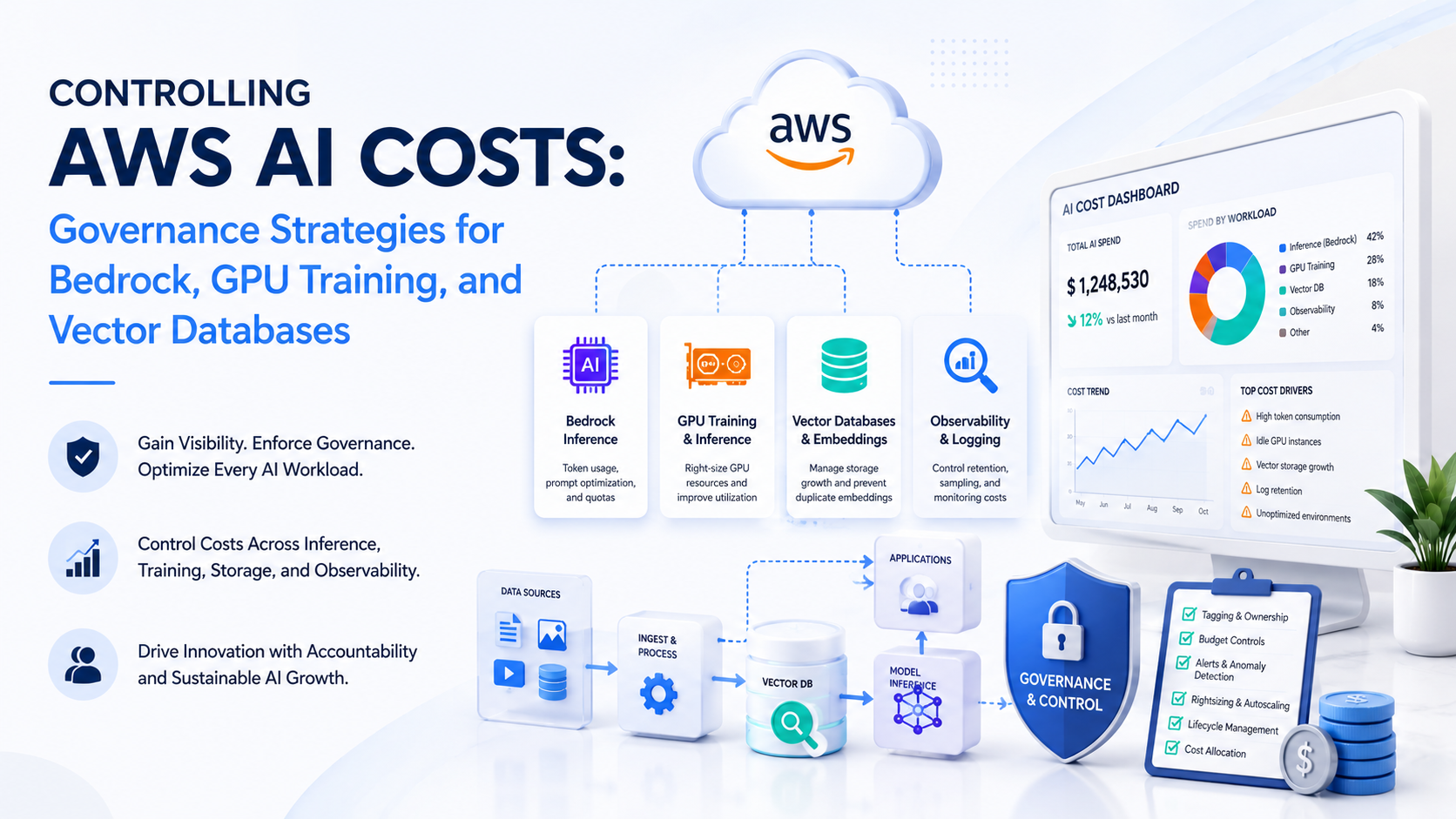
AWS provides powerful capabilities for building enterprise AI platforms through services such as Amazon Bedrock, Amazon SageMaker, Amazon EKS, Amazon OpenSearch, Amazon S3, and GPU-backed EC2 infrastructure. However, these services also introduce new categories of operational complexity. Token consumption can spike unexpectedly. GPU clusters may remain idle while still incurring premium hourly costs. Vector databases can expand exponentially due to uncontrolled embedding growth. AI observability pipelines can quietly become one of the largest recurring operational expenses.
This is why AI cost governance has become a strategic operational discipline rather than a simple budgeting exercise.
Organizations that successfully scale enterprise AI initiatives typically combine governance frameworks, FinOps practices, workload optimization strategies, and automated policy enforcement to maintain visibility and accountability across AI infrastructure consumption.
AI cost governance refers to the operational, financial, and technical controls used to manage enterprise AI spending while supporting scalable innovation. Unlike traditional cloud governance, AI governance must account for bursty GPU demand, experimentation-heavy workflows, token-based pricing models, and continuously evolving model architectures.
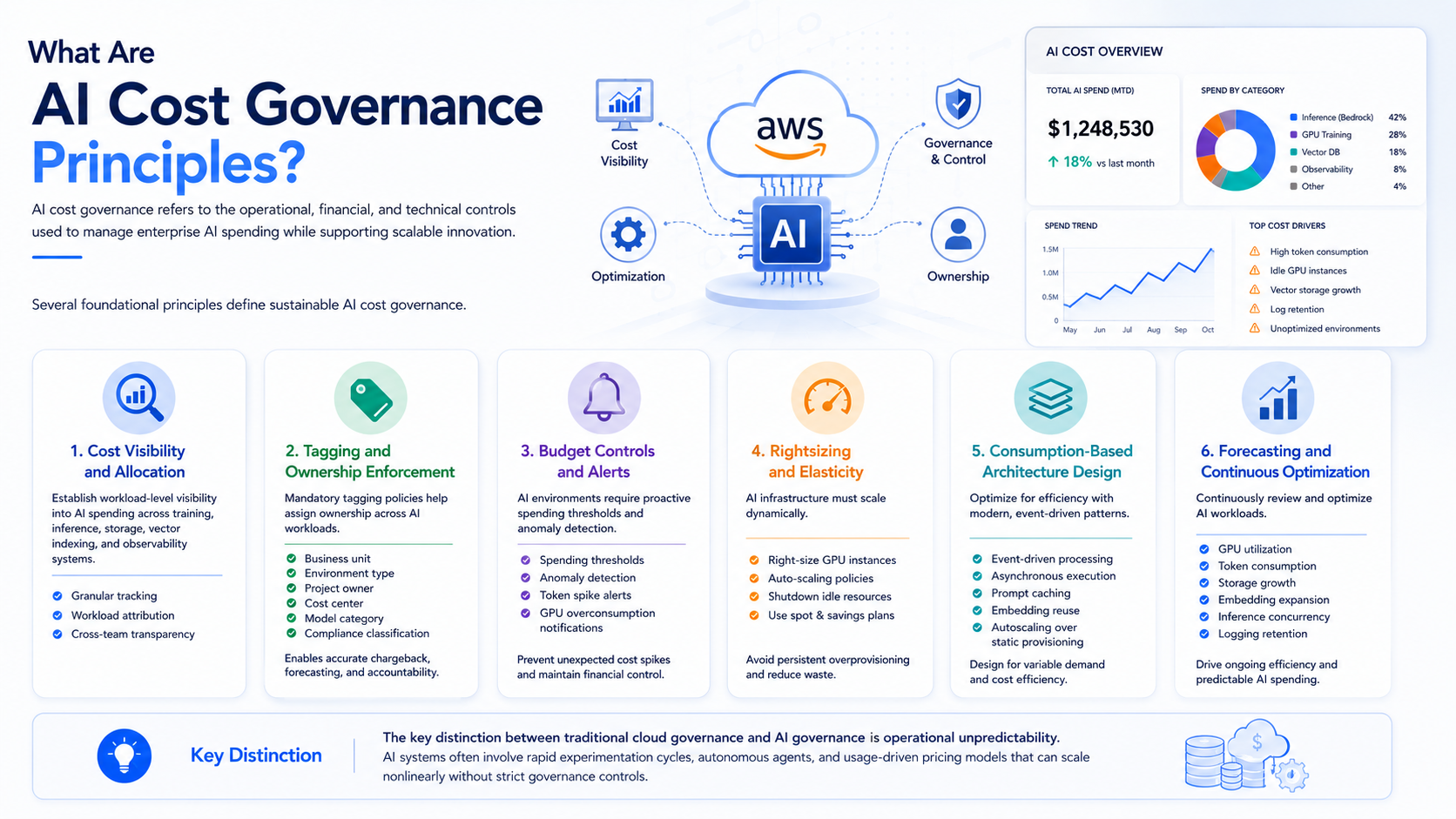
Several foundational principles define sustainable AI cost governance.
Cost Visibility and Allocation
Enterprises must establish workload-level visibility into AI spending across training, inference, storage, vector indexing, and observability systems. Without granular allocation, organizations struggle to identify which departments, projects, or environments are driving costs.
Tagging and Ownership Enforcement
Mandatory tagging policies help assign ownership across AI workloads. Typical governance tags include:
Business unit
Environment type
Project owner
Cost center
Model category
Compliance classification
Tagging enables accurate chargeback, forecasting, and accountability.
Budget Controls and Alerts
AI environments require proactive spending thresholds and anomaly detection. Token spikes, GPU overconsumption, and uncontrolled experimentation can generate substantial costs within hours.
Rightsizing and Elasticity
AI infrastructure must scale dynamically. Persistent overprovisioning of GPU resources remains one of the most common sources of waste in enterprise AI environments.
Consumption-Based Architecture Design
Modern AI architectures should optimize for event-driven processing, asynchronous execution, prompt caching, embedding reuse, and autoscaling rather than static provisioning.
Forecasting and Continuous Optimization
AI workloads evolve continuously. Governance programs must include recurring reviews of:
GPU utilization
Token consumption
Storage growth
Embedding expansion
Inference concurrency
Logging retention
The key distinction between traditional cloud governance and AI governance is operational unpredictability. AI systems often involve rapid experimentation cycles, autonomous agents, and usage-driven pricing models that can scale nonlinearly without strict governance controls.