Our Blog

Zero Trust Architecture

Zero Trust Architecture

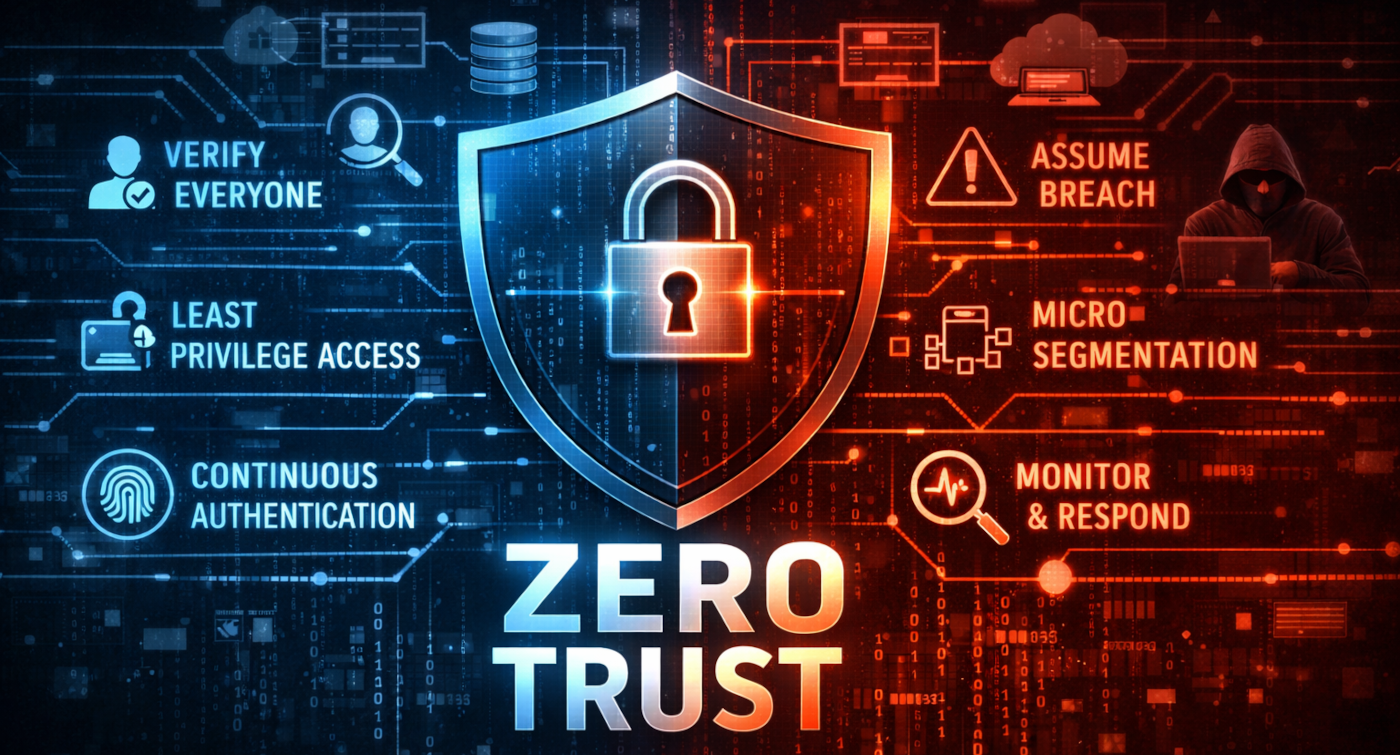
Zero Trust Architecture (ZTA) means never automatically trusting anything — not users, devices, or systems — even if they’re already inside your network. Every access request is checked every time. Only the minimum required access is given, and everything is continuously monitored.

In the past 10 years, IT and Enterprise security has changed tremendously. Cloud adoption, SaaS proliferation, API-driven ecosystems, remote work models, and third-party integrations have fundamentally reshaped the attack surface. For CIOs and CTOs, security is no longer an isolated IT concern—it is a board-level risk management priority.

The perimeter security approach was based on the belief that threats were coming from outside the corporate network. Firewalls, VPNs, and intrusion detection systems were built to create a secure perimeter. Once past the perimeter, users and devices were considered trusted by default. This is no longer a valid assumption in today’s world.

The main catalysts for the strategic adoption of Zero Trust Architecture (ZTA) are:

  - The hybrid work model and distributed endpoints

  - Cloud-first transformation projects

  - Ransomware and identity attacks

  - Regulatory requirements (data protection, privacy, and operational resilience)

  - Supply chain risk visibility

Zero Trust Architecture shifts the focus of cybersecurity from a network to an identity and context-based approach. Zero Trust does not remove trust; it removes implicit trust.

For C-level executives, Zero Trust Architecture is a security transformation initiative, not a product category.

1. What is Zero Trust Architecture

Zero Trust can be summarized as the following phrase:

  “Never trust, always verify.”

  + Zero Trust Architecture (ZTA) is formally described as a cybersecurity paradigm focused on resource protection and assumption of breach.

Core Principles of Zero Trust

1. Continuous Verification
Every access request must be authenticated and authorized based on dynamic context.

2. Least Privilege Access
Users and systems receive only the minimum access required to perform their function.

3. Assume Breach
Architect systems as though attackers are already inside the environment.

4. Explicit Trust Decisions
Access is granted based on identity, device health, location, behavior, and risk signals.

2. Foundational Pillars in Enterprise ZTA

Large organizations typically operationalize Zero Trust across six pillars:

1. Identity
Strong authentication, MFA, conditional access

2. Devices
Endpoint health validation and posture assessment

3. Network
Segmentation and traffic inspection

4. Applications
Application-level access controls

5. Data
Classification, encryption, DLP

6. Monitoring & Analytics
Continuous visibility and risk evaluation

3. Readiness Assessment and Strategic Alignment

Before implementation, large enterprises must assess architectural maturity and organizational readiness.

Key assessment dimensions include:

  + Identity lifecycle management maturity

  + Privileged access governance

  + Network segmentation depth

  + Asset visibility and data classification coverage

  + Incident detection and response capability

2. Approved:
A candidate becomes approved when required evidence is attached and the right stakeholders sign off.

3. Deployed:
Only approved versions can be deployed. Deployment should be standardized:

  + Packaging: consistent runtime containerization or model package format

  + Environment targeting: dev → staging → prod, with parity and immutable versions

  + Configuration: externalized configs, no “one-off” manual edits

  + Repeatability: same promotion mechanism every time, regardless of team

Many organizations discover that their biggest gap is not tooling—it is incomplete asset visibility and inconsistent identity governance.

Stakeholder Alignment

Zero Trust affects multiple domains:

  + IT Infrastructure

  + Cybersecurity

  + Risk & Compliance

  + Application Development

  + Business Units

Without executive alignment, Zero Trust initiatives stall at pilot phases.

Define Measurable Objectives

Zero Trust goals should be quantifiable

Zero Trust affects multiple domains:

  + Reduce lateral movement risk by X%

  + Decrease privileged account sprawl by Y%

  + Improve incident containment time by Z%

  + Achieve regulatory compliance milestones

Zero Trust must map directly to enterprise risk management (ERM) frameworks.

Reducing Risk Without Slowing the Business

Governance fails when it’s heavy, inconsistent, or disconnected from outcomes. The goal is pragmatic control: enough rigor to reduce risk, not enough friction to stop delivery.

A lightweight approval model that works in enterprises

Who signs off

  + Model owner / Product owner: confirms business intent, expected impact, and acceptance criteria

  + ML lead / Engineering lead: confirms technical readiness, test coverage, operational fit

  + Risk/Compliance (as required): only for regulated domains or high-impact models

  + Finance involvement: usually not per-release approval, but as a consumer of cost and predictability reporting (unless the model materially affects financial reporting, pricing, or regulated decisions)

4. Phased Implementation Approach at Scale

Zero Trust cannot be deployed through a single transformation event. It requires a phased, iterative roadmap.

Phase 4.1: Asset and Data Inventory

You cannot protect what you cannot see. You must establish:

  + Authoritative asset inventory (servers, endpoints, applications)

  + Cloud resource visibility

  + Data classification framework

  + Critical business system mapping

This phase often reveals shadow IT and unmanaged identities—both high-risk areas.

Phase 4.2: Identity and Access Modernization

Identity is the control plane of Zero Trust. The key initiatives for this phase include:

  + Enforce Multi-Factor Authentication (MFA)

  + Implement Identity Governance and Administration (IGA)

  + Deploy Privileged Access Management (PAM)

  + Establish conditional access policies

Identity modernization typically delivers the fastest measurable risk reduction, especially against credential-based attacks.

Phase 4.3: Network Segmentation and Micro-Segmentation

Flat networks are an attacker’s advantage.
Micro-segmentation strategies include:

  + Workload-level segmentation

  + East-west traffic inspection

  + Zero Trust Network Access (ZTNA) replacing legacy VPN

  + Software-defined perimeters

For large enterprises with legacy infrastructure, segmentation must be incremental to avoid operational disruption.

Phase 4.4: Continuous Monitoring and Analytics

Zero Trust requires continuous validation. It must have following core capabilities:

  + Security Information and Event Management (SIEM)

  + User and Entity Behavior Analytics (UEBA)

  + Endpoint Detection and Response (EDR)

  + Real-time anomaly detection

Access decisions should be dynamically influenced by risk signals—device health, behavior anomalies, and threat intelligence.

Phase 4.5: Policy Orchestration and Automation

Manual security operations cannot scale in large enterprises.
Policy orchestration includes:

  + Automated policy enforcement

  + Identity-driven access rules

  + Workflow-driven access approvals

  + Security automation (SOAR)

Automation ensures consistency, reduces human error, and accelerates response times.

5. Governance, Risk, and Change Management

Zero Trust implementation impacts organizational culture as much as technology.

Governance Structure
A sustainable model requires:

  + Executive sponsor (CIO/CTO or CISO)

  + Cross-functional steering committee

  + Policy standardization framework

  + Defined accountability model

Risk Integration
Zero Trust should integrate with:

  + Enterprise risk registers

  + Internal audit frameworks

  + Regulatory compliance programs

  + Third-party risk management

When Zero Trust metrics are tied to enterprise risk reporting, executive buy-in increases significantly.

Change Management Challenges
Common friction points:

  + User resistance to MFA

  + Application compatibility issues

  + Legacy system constraints

  + Increased authentication prompts

Executive communication is critical. Employees must understand that friction is proportional to risk mitigation.
A structured change management program should include:

  + Executive messaging

  + Phased rollouts

  + Clear escalation paths

  + User training and awareness campaigns

6. Measuring Outcomes and Ensuring Continuous Improvement

Zero Trust must be measurable to remain strategic. If you can’t quantify progress, Zero Trust becomes a set of tools instead of a risk-reduction strategy.

Key Performance Indicators (KPIs)
Executive dashboards should track:

  + Percentage of MFA-enforced accounts

  + Privileged account reduction metrics

  + Mean Time to Detect (MTTD)

  + Mean Time to Respond (MTTR)

  + Policy compliance rates

  + Unauthorized access attempts blocked

Continuous Validation

Regularly test assumptions so Zero Trust controls stay effective in real-world conditions. Progress accelerates when testing, auditing, and posture checks are built into routine operations.

  + Red team exercises: Simulates real attackers to uncover gaps in identity, access, and detection controls.

  + Penetration testing: Validates whether systems can be exploited and whether segmentation and access policies hold.

  + Continuous compliance audits: Keeps security controls aligned with frameworks and regulatory expectations without last-minute scrambles.

  + Automated posture assessments: Continuously checks devices, identities, and cloud resources for drift and misconfiguration

The architecture must evolve as:

  + Cloud footprints expand: More cloud services increase identity, policy, and visibility requirements across environments.

  + M&A activity introduces new environments: Newly acquired systems create trust and integration risks that must be absorbed safely.

  + Regulatory requirements change: New rules force updates to controls, reporting, and audit readiness.

  + Threat actors adopt new techniques: Adversaries adapt quickly, so controls and detections must be tuned continuously.

Conclusion

Build Zero Trust as a phased, governable program: standardize identity and access baselines, selectively lock down critical trust paths (privileged access, sensitive data flows, and high-risk apps), and continuously validate controls to keep outcomes stable and investments predictable.

  + Pick one domain (Operations or Engineering) and run a high-impact pilot (e.g., privileged admin access for Ops, or secure access to CI/CD and cloud consoles for Engineering).

  + Enforce 2–3 “read-first” controls behind strong identity and audit logging, such as MFA + conditional access, device posture checks, and privileged session governance (PAM).

  + Define measurable outcomes (reduced privileged sprawl, lower MTTD/MTTR, fewer policy exceptions, fewer escalations, and less manual context gathering during incidents).

  + Expand to bounded automation only once governance is proven, then scale into segmentation, SOAR workflows, and policy orchestration with clear change control.

If you can make releases repeatable, approvals lightweight, and rollbacks fast, you convert ML from a variable cost center into a predictable operational capability. That’s the language both CIOs and Finance understand—and it’s where release engineering pays for itself.

Zero Trust’s value proposition is simple: replace implicit trust and perimeter assumptions with continuous, context-driven verification—so users, devices, and workloads can operate safely inside enterprise systems, not around security controls.

This is where FAMRO LLC can help. Based in the UAE, FAMRO LLC supports organizations in turning Zero Trust from a framework into an executable roadmap—combining cloud, security, and delivery execution to reduce risk without slowing the business.
We support Zero Trust implementation end-to-end, including:

  1. Zero Trust readiness & roadmap: maturity assessment across identity, devices, network, apps, data, and monitoring; define phased rollout and success metrics

  2. Identity & access modernization: MFA enforcement, conditional access, IGA foundations, and privileged access governance (least privilege by default)

  3. Segmentation & secure access design: incremental segmentation, ZTNA patterns, and workload access hardening to reduce lateral movement risk

  4. Detection, response & observability: SIEM/EDR alignment, correlation IDs, logging baselines, alert tuning, and operational runbooks tied to MTTD/MTTR outcomes

  5. Policy orchestration & automation: repeatable guardrails, automated posture checks, and controlled remediation workflows once governance is stable

  6. Governance & change management: ownership model, exception handling, audit readiness, and rollout communications to drive adoption at scale

To help teams get started, we offer a free initial consultation focused on your current security posture, Zero Trust priorities, and regulatory exposure—no obligation, no generic pitch.
🌐 Learn more: Visit Our Homepage
💬 WhatsApp: +971-505-208-240

Our solutions for your business growth

Our services enable clients to grow their business by providing customized technical solutions that improve infrastructure, streamline software development, and enhance project management.

Our technical consultancy and project management services ensure successful project outcomes by reviewing project requirements, gathering business requirements, designing solutions, and managing project plans with resource augmentation for business analyst and project management roles.

Read More
2
Infrastructure / DevOps
3
Project Management
4
Technical Consulting