Our Blog

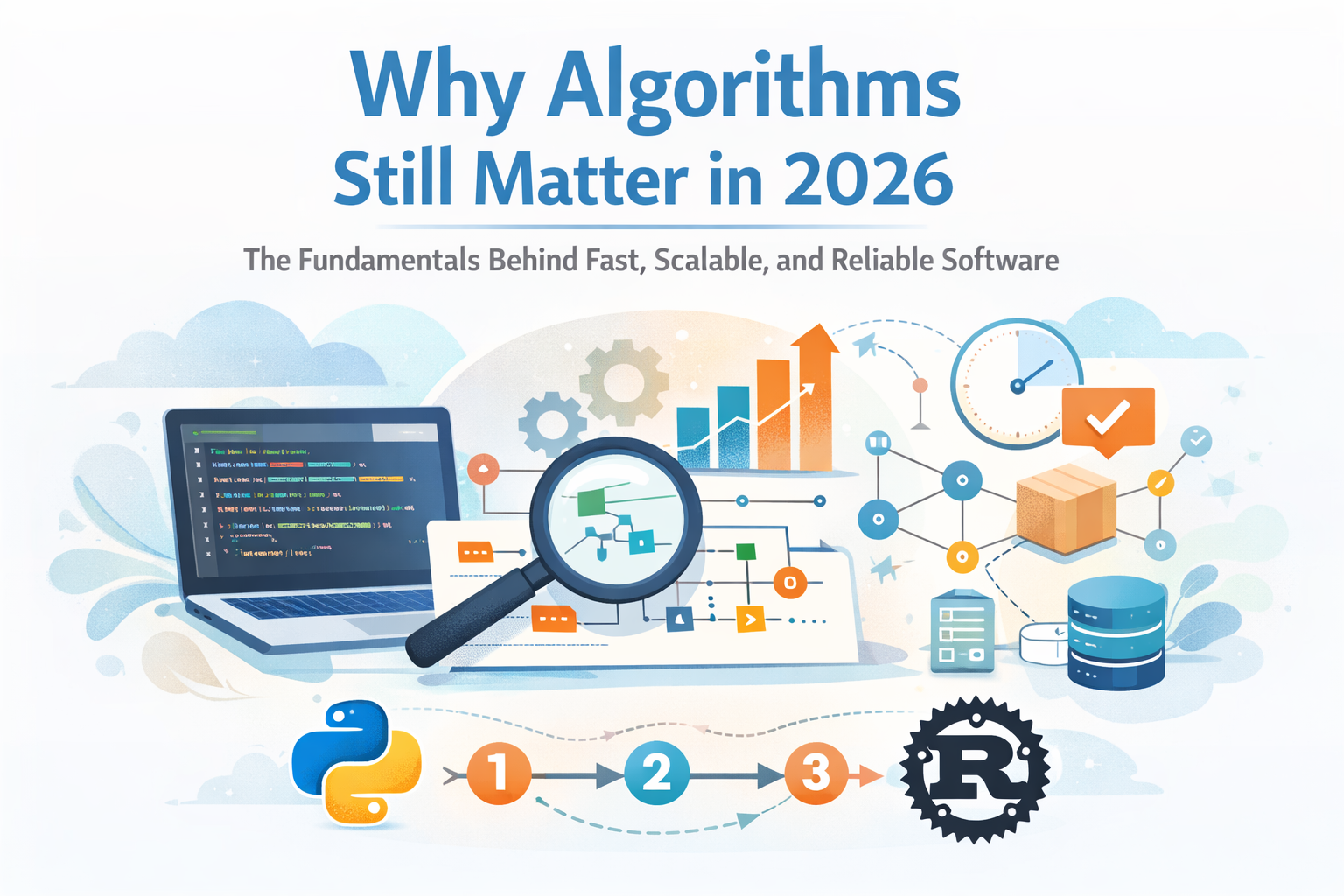
Why Algorithms Still Matter in 2026

Why Algorithms Still Matter in 2026

In every cycle of software hype, one pattern repeats itself: tools change faster than fundamentals. Frameworks evolve, platforms shift, and AI-assisted development speeds up the way teams write code. Yet the systems that perform well, scale reliably, and stay maintainable over time still depend on the same core discipline beneath the surface: algorithmic thinking.

For small and mid-sized enterprises, this matters more than ever in 2026. SMEs are under pressure to deliver digital products that feel fast, accurate, and dependable without carrying the engineering budgets of large enterprises. They need software that can handle more customers, more data, more integrations, and more automation without becoming expensive or fragile. That is exactly where algorithms continue to matter.

Algorithms are not only for computer science classrooms or coding interviews. They are practical tools that help software engineers solve business problems with precision. They shape how quickly a customer can find a product, how efficiently a route is generated, how dependencies are processed, how records are sorted, and how resources are allocated. In real-world systems, good algorithms reduce wasted compute, improve response times, and support better architectural decisions.

This article explains what algorithms are, what they represent in modern software engineering, why they still matter for engineers and SMEs, and which three algorithms remain especially useful in day-to-day development. It also includes short Python and Rust examples so technical teams can compare implementation style and logic in two widely relevant languages.

What Are Algorithms?

An algorithm is a step-by-step method for solving a problem or performing a task. It takes an input, follows a defined sequence of operations, and produces an output. In practical software terms, an algorithm is the logic that tells a system what to do, in what order, and under what conditions.

That definition may sound simple, but its importance is massive. Whenever software searches for a value, recommends an item, checks a route, organizes data, or decides what action to take next, an algorithm is involved. The better the algorithm fits the problem, the more predictable and efficient the system becomes.

For a business audience, one of the easiest ways to understand algorithms is to think of them as repeatable decision procedures. A payroll system uses algorithms to calculate totals and deductions. An e-commerce platform uses algorithms to sort products, filter search results, and estimate delivery windows. A logistics platform uses algorithms to optimize routing and task assignments. A CRM may use algorithms to prioritize leads or surface relevant customer actions.

For a technical audience, algorithms are the operational core of software behavior. They determine time complexity, memory usage, and how a system behaves as data volume grows. Two applications may deliver the same visible result, but the algorithm behind each one can make the difference between smooth scaling and painful infrastructure waste.

In short, algorithms are how software turns logic into repeatable, scalable behavior.

What Algorithms Represent in Modern Software Engineering

In 2026, algorithms represent much more than theory. They are not abstract textbook exercises disconnected from modern product development. They are foundational building blocks that influence how systems perform in production.

What Algorithms Represent in Modern Software Engineering

At the engineering level, algorithms represent structured problem-solving. They help developers break down tasks into repeatable logic and reason about trade-offs. This matters because modern software is no longer just about making features work. It is about making them work efficiently across growing datasets, multiple services, distributed infrastructure, and demanding user expectations.

Algorithms sit behind many of the capabilities that users now take for granted. Search depends on efficient lookup and ranking logic. Recommendation systems depend on selection and scoring methods. Scheduling depends on ordering and constraint handling. Routing depends on graph traversal. Automation depends on predictable branching and state transitions. Even AI-enabled systems rely on algorithmic layers for orchestration, data preparation, retrieval, and decision support.

They also represent engineering maturity. A team that understands algorithms is better equipped to choose the right data structures, improve performance bottlenecks, and avoid “brute force” designs that seem fine in development but fail under scale. That affects product quality directly.

From a software architecture perspective, algorithms influence:

   Performance: How quickly a system responds as data grows

   Maintainability: How clearly the logic can be understood and extended

   Scalability: Whether the system can support more users and transactions

   Reliability: Whether behavior stays predictable under load

   Cost efficiency: Whether infrastructure is being used intelligently

This is why algorithms still matter in modern engineering teams. They are the logic layer that turns business requirements into efficient software behavior.

Why Algorithms Are Important

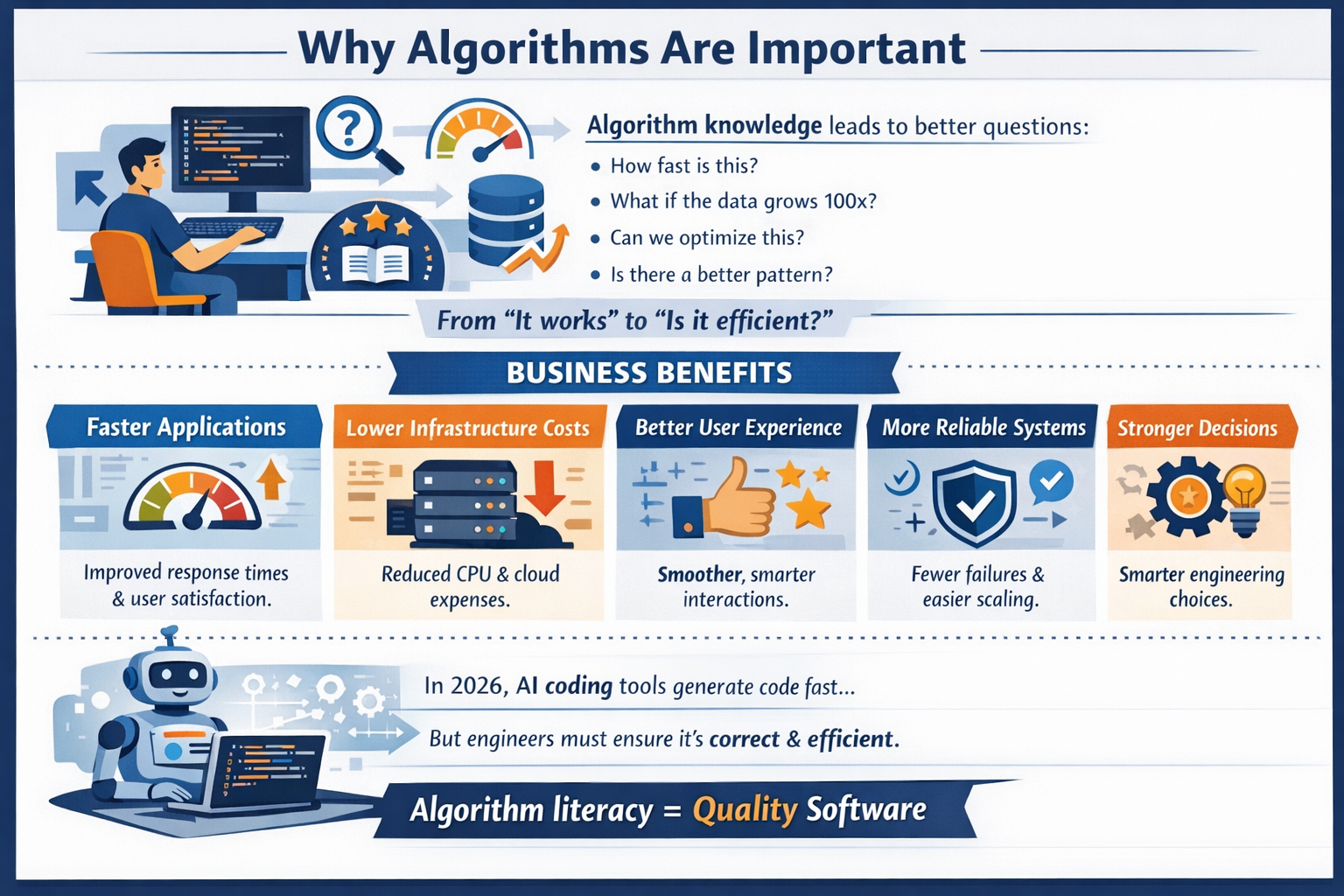
For software engineers, algorithm knowledge improves decision-making. It enables them to look beyond “it works” and ask better questions: How fast is this approach? What happens when the dataset grows by 100 times? Is this operation repeated often enough that optimization matters? Can memory usage be reduced? Is there a more reliable pattern already known for this type of problem?

Those questions are not academic. They are deeply commercial.

For SMEs, efficient algorithms create measurable outcomes. Faster applications improve user satisfaction and reduce abandonment. Better sorting and search improve discoverability and conversion. Smarter processing lowers cloud costs by reducing unnecessary computation. Well-chosen algorithms also reduce the need for reactive rewrites later, which protects delivery timelines and engineering budgets.

Here are the business benefits more directly:

Faster applications:

Response time affects customer trust. Whether it is a dashboard, a booking portal, or a search function, users notice delays quickly. Efficient algorithms keep systems responsive.

Lower infrastructure costs:

Poorly designed logic consumes more CPU, memory, and network resources. Better algorithms can reduce operational overhead without changing hardware.

Better user experience:

Users may never see the code, but they feel its quality. Fast lookups, clean sorting, smooth recommendations, and reliable workflows all come from algorithmic choices.

More reliable systems:

Predictable algorithms are easier to test and reason about. That means fewer edge-case failures and more confidence during scaling.

Stronger engineering decisions:

Teams that understand algorithmic trade-offs make smarter implementation choices earlier, which reduces technical debt.

In 2026, this is even more relevant because developers have access to powerful automation and AI coding tools. Those tools can generate code quickly, but speed of generation does not guarantee quality of logic. Engineers still need to evaluate whether the chosen approach is correct, efficient, and suitable for production. Algorithm literacy remains the difference between generated code and engineered software.

The 3 Key Algorithms Software Engineers Should Know

There are many important algorithms, but three remain especially practical across products, platforms, and business use cases in 2026: A Search*, Breadth-First Search (BFS), and Merge Sort.

A* (A-Star) Search Algorithm

A* is a pathfinding algorithm used to find the most efficient route between a starting point and a goal. It combines the actual cost already traveled with a heuristic estimate of the remaining distance to decide which path to explore next. This makes it both practical and efficient in environments where finding an optimal route matters.

Unlike simpler traversal methods, A* is guided by cost and direction. Instead of exploring blindly, it prioritizes nodes that appear most promising based on both current path cost and estimated distance to the destination. That balance is what makes A* highly effective in real-world systems.

In modern software engineering, A* remains highly relevant because many systems involve path optimization, dependency movement, navigation logic, and state-based progression. It is widely used in situations where software must make efficient route or decision choices without exhaustively exploring every option.

Real-Life Use Cases / Applications of A*

A* is used in many real systems where efficient pathfinding is essential:

   Navigation apps to calculate practical routes between locations

   Game development for NPC movement and intelligent map traversal

   Warehouse robotics to move machines through dynamic floor layouts

   Logistics platforms for delivery route optimization

   Autonomous systems for movement planning in controlled environments

   Workflow engines where software needs to move through optimal decision states

Why it remains relevant in 2026

In 2026, route efficiency, automation, and intelligent system behavior remain central to software products. As businesses build smarter logistics tools, robotics systems, and real-time digital platforms, A* continues to be one of the clearest examples of algorithmic thinking applied to practical engineering.

Breadth-First Search (BFS)

Breadth-First Search traverses a graph level by level, exploring all nearby nodes before moving deeper. It is especially useful for finding the shortest path in an unweighted graph and for understanding connected relationships.

BFS appears in routing, network analysis, dependency exploration, workflow state maps, recommendation adjacency, and permissions traversal. In business systems, it can help answer questions like “What is the closest valid connection?” or “Which dependencies are reachable from this component?”

Real-Life Use Cases / Applications of BFS

BFS is useful anywhere systems need to explore relationships step by step:

   Social networks to discover degrees of connection between users

   IT infrastructure tools to trace service or dependency relationships

   Network broadcasting to spread messages level by level

   Permission systems to discover reachable roles or inherited access

   Recommendation engines to explore related entities in graph structures

   Workflow systems to inspect reachable states from a current process step

Why it remains relevant in 2026

Modern software is full of graph-like relationships, even when teams do not explicitly call them graphs. Service dependencies, user connections, workflow states, and linked records all benefit from traversal logic. BFS remains one of the clearest tools for exploring such structures.

Merge Sort

Merge Sort is a divide-and-conquer sorting algorithm. It splits a list into smaller parts, sorts those parts recursively, and then merges them back together in order.

It is valuable because it introduces a disciplined way of solving larger problems by breaking them down into manageable pieces. It also delivers reliable performance characteristics and helps engineers understand how algorithm design affects predictability.

Real-Life Use Cases / Applications of Merge Sort

Merge Sort is widely applicable in systems that process or organize data at scale:

   Large reporting systems that need consistent sorting across datasets

   Data pipelines that merge sorted records from multiple sources

   Database-related processing where predictable sorting is important

   Log analysis systems that organize events by time or priority

   External sorting workflows for data too large to fit into memory

   Analytics platforms where stable ordering supports downstream processing

Why it remains relevant in 2026

Sorting is still fundamental, but Merge Sort’s importance goes beyond sorting itself. It teaches recursion, decomposition, stable ordering, and performance consistency. These ideas show up across data pipelines, analytics systems, backend services, and large-scale processing workflows.

Short Python and Rust Implementations of Each Algorithm

A* Search in Python

import heapq def astar(graph, start, goal, h): pq = [(h[start], 0, start, [start])] seen = set() while pq: f, g, node, path = heapq.heappop(pq) if node == goal: return path if node in seen: continue seen.add(node) for nxt, cost in graph.get(node, []): heapq.heappush(pq, (g + cost + h[nxt], g + cost, nxt, path + [nxt]))

Brief Code explanation:

   1. heapq is used as a priority queue so the most promising path is explored first.

   2. Each queue item stores total estimated cost f, actual cost g, current node, and path.

   3. h is the heuristic map that estimates distance from each node to the goal.

   4. The algorithm stops as soon as the goal node is reached.

   5. seen prevents repeated work on nodes already processed.

   6. Each neighbor is evaluated with its travel cost added to the current path cost.

   7. A* ranks paths using g + h, combining actual progress with estimated remaining distance.

   8. The result is the discovered path, which makes the example easy to understand educationally.

A* Search in Rust

use std::cmp::Reverse; use std::collections::{BinaryHeap, HashMap, HashSet}; fn astar(graph: &HashMap<&str, Vec<(&str, i32)>>, start: &str, goal: &str, h: &HashMap<&str, i32>) -> Vec<&str> { let mut heap = BinaryHeap::from([Reverse((h[start], 0, start, vec![start]))]); let mut seen = HashSet::new(); while let Some(Reverse((_, g, node, path))) = heap.pop() { if node == goal { return path; } if !seen.insert(node) { continue; } for (nxt, cost) in &graph[node] { let mut p = path.clone(); p.push(nxt); heap.push(Reverse((g + cost + h[nxt], g + cost, *nxt, p))); } } vec![] }

Brief Code explanation:

   1. BinaryHeap is used to prioritize the lowest estimated-cost path.

   2. Reverse turns Rust’s default max-heap into min-heap behavior.

   3. The graph is stored as an adjacency list with neighbor and cost pairs.

   4. The heuristic map h provides estimated remaining distance to the goal.

   5. Each heap entry stores estimated total cost, actual path cost, current node, and full path.

   6. seen ensures the same node is not processed repeatedly.

   7. The path is cloned and extended as neighbors are explored.

   8. An empty vector is returned if no route to the goal is found.

Breadth-First Search in Python

from collections import deque def bfs(graph, start): visited, queue = set([start]), deque([start]) while queue: node = queue.popleft() print(node) for n in graph[node]: if n not in visited: visited.add(n); queue.append(n)

Brief Code explanation:

   1. BFS uses a queue to process nodes in first-in, first-out order.

   2. visited prevents repeated processing of the same node.

   3. The algorithm starts from a chosen node.

   4. popleft() ensures the oldest queued node is processed first.

   5. Printing the node shows traversal order for learning purposes.

   6. The loop checks every direct neighbor of the current node.

   7. Unvisited neighbors are marked and added to the queue.

   8. This level-by-level expansion is what makes BFS useful for shortest paths in unweighted graphs.

Breadth-First Search in Rust

use std::collections::{HashMap, HashSet, VecDeque}; fn bfs(graph: &HashMap>, start: i32) { let (mut visited, mut queue) = (HashSet::from([start]), VecDeque::from([start])); while let Some(node) = queue.pop_front() { println!("{}", node); for n in &graph[&node] { if visited.insert(*n) { queue.push_back(*n); } } } }

Brief Code explanation:

   1. Rust uses VecDeque as an efficient queue structure.

   2. HashSet tracks visited nodes and avoids duplicates.

   3. The graph is represented as an adjacency list with HashMap.

   4. pop_front() removes the next node in BFS order.

   5. println! makes the traversal visible during execution.

   6. The code iterates over neighbors of the current node.

   7. visited.insert(*n) returns true only for new nodes.

   8. New nodes are added to the back of the queue for later processing.

Merge Sort in Python

def merge_sort(arr): if len(arr) <= 1: return arr mid = len(arr) // 2 left = merge_sort(arr[:mid]); right = merge_sort(arr[mid:]) result = []; i = j = 0 while i < len(left) and j < len(right): result.append(left[i] if left[i] < right[j] else right[j]); i += left[i] < right[j]; j += left[i] >= right[j] return result + left[i:] + right[j:]

Brief Code explanation:

   1. Arrays of length 0 or 1 are already sorted.

   2. The list is split into two smaller halves.

   3. Each half is sorted recursively using the same function.

   4. The merge phase combines both sorted halves.

   5. Two pointers track the current position in each half.

   6. The smaller value is appended to the result first.

   7. Remaining items are added after one side is exhausted.

   8. This divide-and-conquer pattern gives Merge Sort its consistency.

Merge Sort in Rust

fn merge_sort(arr: Vec) -> Vec { if arr.len() <= 1 { return arr; } let mid = arr.len() / 2; let (left, right) = (merge_sort(arr[..mid].to_vec()), merge_sort(arr[mid..].to_vec())); let (mut out, mut i, mut j) = (Vec::new(), 0, 0); while i < left.len() && j < right.len() { if left[i] < right[j] { out.push(left[i]); i += 1; } else { out.push(right[j]); j += 1; } } out.extend_from_slice(&left[i..]); out.extend_from_slice(&right[j..]); out }

Brief Code explanation:

   1. The function returns a newly sorted vector.

   2. A vector with one or zero elements is already sorted.

   3. The input is split into two parts at the midpoint.

   4. Each part is sorted recursively before merging.

   5. i and j track positions in the left and right halves.

   6. The smaller current element is pushed into the output vector.

   7. Remaining elements are appended once one side finishes.

   8. This version favors clarity so readers can follow the merge logic easily.
How Engineers can Apply These Algorithms in Practice

The biggest practical lesson is not that every engineer will manually implement these exact algorithms every week. In many cases, production libraries and standard utilities already provide optimized versions. The real value is understanding when these patterns apply and what trade-offs they represent.

Binary Search trains engineers to think about ordered data and efficient lookup. BFS trains them to recognize graph-like relationships and traverse systems methodically. Merge Sort trains them to break problems apart and reason about predictable performance.

For SMEs, these skills translate into better software outcomes. Teams with a solid foundation in core algorithms tend to write code that is easier to scale, easier to troubleshoot, and less likely to create hidden cost problems later. They also make better architecture choices because they understand how low-level logic impacts real-world performance.

This matters across many common SME scenarios: internal business tools, customer portals, logistics systems, HR platforms, fintech workflows, analytics dashboards, inventory systems, and SaaS products. In each case, algorithmic thinking helps engineers move from quick implementation to durable engineering.

In an era where AI can help generate code quickly, human engineering judgment becomes even more valuable. The teams that stand out are not just the ones who ship faster. They are the ones who understand why one approach is stronger than another and how to design for long-term efficiency.

Conclusion

Algorithms still matter in 2026 because software still runs on logic, trade-offs, and structure. No matter how advanced the tooling becomes, businesses continue to depend on applications that are fast, reliable, scalable, and cost-efficient. That does not happen by accident. It happens when engineering teams understand the fundamentals well enough to make good decisions under real-world constraints.

For SMEs, mastering core algorithms is not about academic perfection. It is about building software that performs better, costs less to operate, and provides a stronger experience for users. For engineers, it is one of the clearest ways to sharpen problem-solving ability and write code with greater confidence.

At FAMRO Services, we believe strong software starts with strong engineering fundamentals. That is why our software development approach values practical algorithm awareness, scalable design thinking, and teams who can balance delivery speed with technical quality. Our hiring process is built to identify algorithm-aware staff who do more than write code—they build systems that last. For SMEs looking to develop robust digital products with the right technical foundation, FAMRO Services brings the engineering mindset needed to turn ideas into reliable software.

To help organizations get started, we offer a free initial consultation focused on your current software architecture, cloud environment, delivery process, and operational priorities.
🌐 Learn more: Visit Our Homepage
💬 WhatsApp: +971-505-208-240

Our solutions for your business growth

Our services enable clients to grow their business by providing customized technical solutions that improve infrastructure, streamline software development, and enhance project management.

Our technical consultancy and project management services ensure successful project outcomes by reviewing project requirements, gathering business requirements, designing solutions, and managing project plans with resource augmentation for business analyst and project management roles.

Read More
2
Infrastructure / DevOps
3
Project Management
4
Technical Consulting