Our Blog

What is Speech to Text and some popular Open Source models

What is Speech to Text and some popular Open Source models

Modern organizations generate massive volumes of spoken data every day—customer service calls, meetings, voice notes, podcasts, and video content. Unfortunately, most of that data is unstructured and difficult to analyze.

Speech-to-Text (STT) systems solve this problem by converting audio into searchable, structured text.
Once speech is converted to text, organizations can:

  analyze customer conversations

  automate meeting transcription

  power voice assistants

  build accessibility tools

  enable voice search and analytics

Over the past few years, open-source speech recognition models have improved dramatically, making it possible for companies to build high-quality STT systems without relying entirely on proprietary APIs.

What is Speech-To-Text (STT)

Speech-to-Text (STT) is the technology that converts spoken audio into written text. In machine learning terminology this is usually called Automatic Speech Recognition (ASR). However, in production systems STT often includes additional capabilities such as:

  + Speaker diarization: identifying who spoke

  + Language detection

  + Punctuation restoration

  + Text normalization (numbers, dates)

  + Speech translation

Not every STT model provides these features by default. Many production systems combine multiple models and processing steps to achieve a complete speech pipeline.

How modern Speech-To-Text systems work

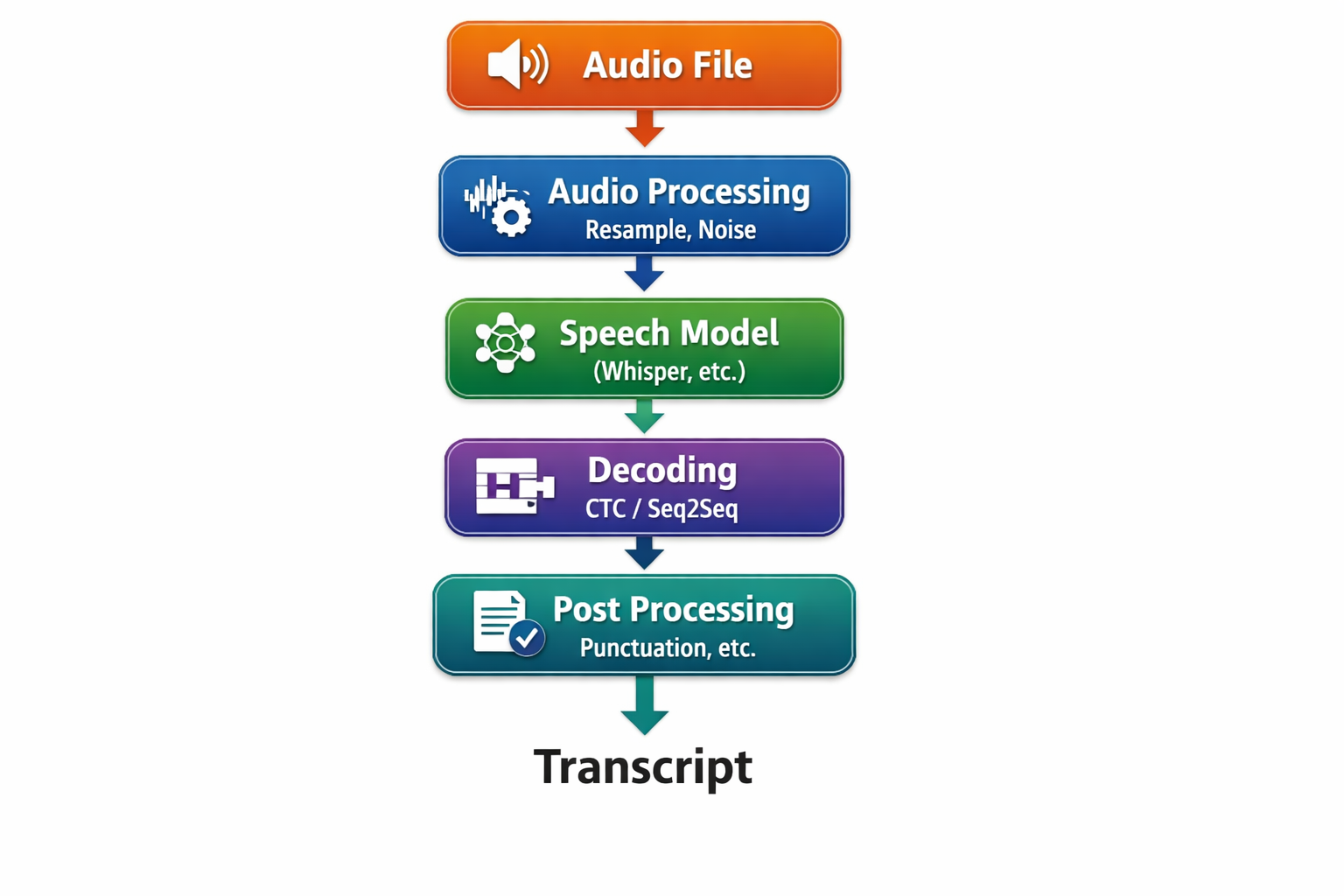
A production STT solution is a pipeline of several components:

Components of Modern STT Systems

1. Audio Capture and Pre-processing

Most speech-to-text models expect audio input in 16 kHz mono format, which means the audio must usually be standardized before it can be processed effectively. This preprocessing step ensures that the model receives consistent input and can perform recognition accurately across different recordings.

Several preprocessing tasks are commonly applied to prepare audio for transcription. These include sample rate normalization, which converts audio to the expected sampling rate, and channel mixing, where stereo recordings are converted into mono audio. Additional steps often include noise reduction to minimize background interference, voice activity detection (VAD) to identify segments containing speech, and audio segmentation to divide recordings into manageable pieces.

For longer recordings, audio files are typically split into smaller chunks of around 10–30 seconds before being sent to the model. Processing smaller segments improves GPU utilization, reduces inference latency, and lowers memory usage, making large-scale transcription pipelines more efficient and scalable.

2. Acoustic and Language Modeling

Modern speech-to-text (STT) systems are typically built using transformer-based neural networks trained on extremely large speech datasets. These models learn to map raw audio signals into written language by analyzing both the structure of sound and the structure of language itself.

During training, STT models learn two key aspects simultaneously. The first is acoustic patterns, which involves understanding how spoken phonemes correspond to patterns in sound waves. The second is language patterns, where the model learns which words are likely to appear together, helping it produce more natural and accurate transcriptions.

Different model architectures approach this task in different ways. Sequence-to-sequence models, such as Whisper, directly convert audio input into text output in a single neural pipeline. CTC-based models, including Wav2Vec2 and HuBERT, use a connectionist temporal classification strategy that aligns audio frames with text tokens. In production environments, hybrid architectures like NVIDIA NeMo’s Conformer combine multiple techniques to balance transcription accuracy, performance, and scalability.

3. Decoding Strategies

Speech recognition models do not directly output words. Instead, the neural network produces probability distributions over tokens (characters, sub-words, or words). A decoding strategy is then used to convert these probabilities into readable text by selecting the most likely sequence of tokens.

One common method is CTC (Connectionist Temporal Classification) decoding, used by models such as Wav2Vec2. In this approach, the model predicts probabilities for tokens across time steps, and decoding algorithms convert them into final text. Common strategies include greedy decoding, which selects the most probable token at each step, and beam search, which evaluates multiple possible sequences to find the best overall transcription. The advantages of CTC decoding include low latency and a simpler model architecture, making it suitable for real-time or resource-efficient systems.

Another approach is sequence-to-sequence generation, used by models like Whisper. These models generate text tokens sequentially using an encoder–decoder architecture that captures broader language context. This method typically provides greater robustness, stronger language modeling, and better multilingual support. However, the trade-off is higher computational cost, since the generation process requires more processing compared to CTC-based decoding.

4. Post-Processing

After the speech recognition model produces text, the output often requires post-processing to improve readability and usability. Raw transcripts generated by STT systems may lack punctuation, proper capitalization, or formatting because the model primarily focuses on recognizing spoken words rather than producing perfectly formatted written language.

Typical post-processing steps include punctuation restoration, capitalization, number normalization, profanity masking, and domain-specific vocabulary injection. These steps help convert raw transcripts into text that is easier to read and more suitable for business applications such as meeting transcripts, customer support logs, or voice analytics systems.

For example, a raw transcription produced by a model might look like:
“we shipped 500 units on february 5”

After normalization and formatting, the final output would appear as:
“We shipped 500 units on February 5.”

Production Infrastructure Requirements

In production environments, speech-to-text (STT) systems need more than a strong model—they require solid infrastructure to run reliably at scale. One of the core infrastructure needs is GPU scheduling and capacity management, especially when multiple transcription jobs compete for limited GPU resources. Teams typically rely on queued workloads, autoscaling, and smart routing to ensure the right jobs land on the right hardware.

To keep costs predictable and throughput high, production systems also use batch inference, where multiple audio segments are processed together to improve GPU utilization and reduce per-request overhead.

Many products also require streaming transcription, where partial results are returned in near real time (e.g., call centers, live meetings, voice assistants). This needs additional infrastructure resources, e.g., persistent connections (WebSockets/gRPC), low-latency chunking, buffering, and mechanisms to handle reconnections without losing context.

Additionally, STT deployments also require strong monitoring. This includes tracking transcription latency, error rates, queue depth, GPU utilization, and drift in accuracy over time.

Finally, STT infrastructure must address security, privacy, and data retention. Audio and transcripts can contain sensitive customer data, so encryption in transit and at rest, access control, audit logging, and retention policies are critical.

Popular Open Source Speech-to-Text Models

Several high-quality open-source STT models are available through Hugging Face and related ecosystems.

1. Whisper

Whisper (openai/whisper-large-v3) is one of the most widely used open-source speech recognition models. It’s designed for automatic speech recognition (ASR) and speech translation, and it’s known for being robust in real-world audio—especially when recordings include background noise, varied accents, or multiple languages.

Because it was trained on a very large and diverse multilingual dataset, Whisper tends to generalize well across different domains and recording conditions. This makes it a strong default starting point for many STT applications, particularly when you want solid accuracy out of the box without heavy tuning

Whisper’s strengths include strong multilingual accuracy, resilience to background noise, and good handling of different accents, with multilingual and translation capabilities built into the model family. The main trade-offs are that it can be relatively compute-heavy, long audio typically needs chunking/segmentation to run efficiently, and it may be slower than some CTC-based models in low-latency setups

  + Home Page: OpenAI Whisper

  + GitHub: Github Page: Whisper

  + Hugging Face: HuggingFace Whisper

2. Distil-Whisper

Distil-Whisper (distil-whisper/distil-large-v3) is a compressed version of the Whisper model created using knowledge distillation. The goal of this approach is to preserve much of Whisper’s transcription accuracy while significantly reducing model size and computational requirements. By training a smaller model to mimic the outputs of the larger Whisper model, Distil-Whisper provides a more efficient alternative for many real-world deployments.

Because it is lighter and optimized for performance, Distil-Whisper is particularly useful in environments where latency, GPU availability, or infrastructure costs are important considerations. It maintains compatibility with many Whisper-based pipelines, meaning existing workflows built around Whisper can often adopt Distil-Whisper with minimal modification.

The strengths of Distil-Whisper include faster inference speeds, a smaller memory footprint, and compatibility with Whisper tooling and pipelines. However, there are some trade-offs: the distilled model may show slightly lower transcription accuracy, and performance can vary depending on the language and acoustic conditions.

For teams building scalable speech-to-text systems, Distil-Whisper is often preferred when cost efficiency and response time matter more than achieving the absolute highest accuracy.

  + HuggingFace Home Page: Hugging Face Distil-Whisper overview

  + GitHub: Distil-Whisper project

3. Wav2Vec2

Wav2Vec2 (facebook/wav2vec2-base-960h) introduced a powerful self-supervised learning approach for speech recognition. Instead of relying entirely on labeled datasets, the model learns meaningful speech representations from large amounts of unlabeled audio. After this pretraining phase, the model can be fine-tuned for automatic speech recognition (ASR) tasks using smaller labeled datasets. This approach significantly reduced the amount of annotated data required to build high-quality speech recognition systems.

Because Wav2Vec2 uses CTC (Connectionist Temporal Classification) decoding, it tends to be efficient and relatively lightweight compared with some sequence-to-sequence models. It also benefits from a strong ecosystem within the research and developer community, with many fine-tuned variants available for different languages, accents, and domain-specific datasets.

The strengths of Wav2Vec2 include efficient decoding with low latency, broad ecosystem support, and a wide range of pretrained and fine-tuned models available through open-source repositories. However, it has some limitations. Compared with models like Whisper, Wav2Vec2 can be less robust to background noise and complex acoustic environments, and punctuation or formatting usually needs to be added through post-processing steps.

Despite these trade-offs, Wav2Vec2 remains a strong option when organizations want to fine-tune speech recognition models for domain-specific datasets, such as call centers, medical dictation, or specialized vocabulary.

  + Home Page: Wav2Vec Home Page

  + HuggingFace Home Page: Hugging Face Wave2Vec

  + GitHub: Wave2Vec GitHub

4. HuBERT

HuBERT (facebook/hubert-large-ls960-ft) is a self-supervised speech representation model developed by Meta AI. HuBERT stands for Hidden Unit BERT, and it builds on ideas similar to Wav2Vec2 but introduces a different training strategy. Instead of directly predicting raw audio features, HuBERT learns to predict clustered hidden units derived from speech signals, allowing the model to capture deeper and more structured representations of speech.

Through this approach, HuBERT learns rich acoustic representations from large amounts of unlabeled audio data, which can then be fine-tuned for downstream tasks such as automatic speech recognition (ASR). This design makes it particularly valuable for research environments and for organizations that want to train models on specialized speech datasets.

HuBERT’s strengths include strong speech representation learning, competitive ASR performance after fine-tuning, and flexibility for research experimentation and domain adaptation. However, the model typically requires additional downstream processing for full transcription pipelines, and achieving the best performance often depends on fine-tuning the model with domain-specific data.

As a result, HuBERT is often chosen by teams focused on research, experimentation, or building custom ASR models tailored to specific industries or datasets.

  + Home Page: HuBERT Home Page

  + HuggingFace Home Page: Hugging Face HuBERT

  + GitHub: HuBERT GitHub
Simple Python Example

Let's create a simple Python application that uses Whisper model. We will use HuggingFace Transformers to access these models. Please ensure you have installed following software on your machine.

pip install transformers torch torchaudio librosa

Note: Most models expect 16 kHz mono audio

""" Whisper STT Example (Hugging Face Transformers) What this script does: 1) Detects whether a GPU is available (CUDA) and selects the correct device. 2) Creates an Automatic Speech Recognition (ASR) pipeline using Whisper Large v3. 3) Transcribes an audio file and returns the recognized text. Notes: - chunk_length_s=30 splits long audio into ~30 second chunks for stable inference. - batch_size=8 processes multiple chunks per forward pass (better GPU throughput). """ import torch from transformers import pipeline # Use GPU (device=0) if available, otherwise run on CPU (device=-1) device = 0 if torch.cuda.is_available() else -1 # Build an ASR pipeline with Whisper asr = pipeline( task="automatic-speech-recognition", model="openai/whisper-large-v3", device=device, ) # Run transcription on an audio file result = asr( "path/to/audio.wav", chunk_length_s=30, # chunk long audio to avoid memory spikes and improve stability batch_size=8, # higher batch size can speed up inference on GPU ) # Print only the final transcript text print(result["text"])

Code Description

1. Checks whether CUDA GPU is available and selects GPU (device=0) or CPU (device=-1).

2. Loads a Hugging Face ASR pipeline using the model openai/whisper-large-v3.

3. Reads the audio file at path/to/audio.wav.

4. Splits long audio into 30-second chunks and transcribes them (batching chunks for speed).

5. Prints the final recognized transcript from result["text"].

How to run it

1. Create the Virtual Environment: python3 -m venv .venv source .venv/bin/activate

2. Install dependencies: pip install -U torch transformers accelerate If you want GPU support, install the CUDA-enabled PyTorch build that matches your CUDA version (from PyTorch’s official install selector).

1. Create the Virtual Environment: python3 -m venv .venv source .venv/bin/activate

3. Save the code into a file: nano whisper_asr.py Paste the Python code and save.

4. Update the audio path: "path/to/audio.wav" with something real, e.g.: "sample.wav"

5. Run it: python whisper_asr.py

Key considerations

Security and privacy
Speech data can contain highly sensitive information, including customer conversations, internal meetings, financial details, or personal identifiers. Because of that, companies need to think carefully about how audio is stored, transmitted, processed, and who is allowed to access it.

In other words, it is not enough to simply transcribe audio accurately. The system also needs to protect the data before, during, and after transcription.

Another important decision is whether to use cloud-based inference or on-premises deployment. Cloud inference can be faster to launch and easier to scale, but some organizations are not comfortable sending sensitive audio outside their own environment. In regulated industries such as healthcare, finance, or government, on-prem STT deployment is often preferred because it gives the organization more direct control over data handling, compliance, and audit requirements.

Quality Management
Building a speech-to-text system isn’t something you do once and forget about. Even after deployment, the quality of the transcriptions needs to be monitored continuously.

A good quality management process usually starts with representative test datasets. These datasets should reflect the kinds of audio the system will actually encounter in production—different speakers, accents, background noise levels, and speaking styles.

Another common practice is tracking Word Error Rate (WER) over time. WER is one of the most widely used metrics in speech recognition and helps teams measure how often the system misrecognizes words. Monitoring this metric regularly helps identify when transcription quality starts to drift or degrade.

In addition, many organizations track domain-specific errors. For example, a system used in healthcare, finance, or technology may struggle with specialized vocabulary.

Latency and Cost Optimization
Running large speech models can be expensive, especially when processing high volumes of audio. Because of this, many organizations invest time in optimizing both latency and operational costs without sacrificing too much accuracy.

One common approach is batching audio inference. Instead of processing each audio request individually, multiple audio segments are processed together. This allows better utilization of GPUs or CPUs and can significantly improve throughput.

Another technique is model quantization, which reduces the precision of model weights (for example, from 32-bit to 8-bit). While this slightly reduces numerical precision, it often leads to faster inference speeds and lower memory usage, making it useful for large-scale deployments.

GPU acceleration also plays a major role in improving performance. Speech recognition models are computationally heavy, and GPUs can process audio data much faster than CPUs. Many production systems rely on GPU-backed inference services to keep response times low.

For applications that require near real-time responses, streaming inference is another key optimization. Instead of waiting for an entire audio file to finish before transcribing, the system processes audio in small chunks and returns partial results continuously.

Compliance and Licensing
When working with open-source speech-to-text models, it’s easy to assume that “open” automatically means free to use in any way. In reality, that’s not always the case. Many models are publicly available for research and development, but their licenses may include restrictions that affect how they can be used in commercial products.

Before deploying any model in a production environment, it’s important to carefully review its license terms. Teams should check the type of license, whether it allows commercial use, and if there are any redistribution rules that apply when integrating the model into a product or service.

This becomes even more important when working with multilingual or multitask models, which are often released primarily for research purposes. These models can be technically impressive and widely available online, but their licensing terms may restrict how they can be used in commercial applications.

Lineage and Auditability: Proving What Changed, When, and Why

Lineage is traceability across the full release chain:

  + Data versions and sources

  + Feature definitions and transformations

  + Code commits and dependencies

  + Model version and parameters

  + Tests, evaluations, and approval evidence

  + Deployment events and configuration

  + Monitoring signals and incident timelines

Why lineage matters beyond compliance
Audit is the obvious win—but lineage also enables:

  + Post-incident reviews that lead to prevention, not a guesswork

  + Faster root-cause analysis because changes are tied to versioned artifacts

  + Financial governance by attributing costs and outcomes to specific releases

  + Reduced manual documentation because the system generates the evidence trail automatically

When you don’t have lineage, you pay for it later—in time, confusion, and risk.

Conclusion

Open-source speech-to-text models have progressed remarkably in recent years. What once required deep research expertise, custom infrastructure, and highly specialized teams can now be implemented much more easily with modern tools and frameworks such as Hugging Face. This has made speech technology far more accessible to startups, SMEs, and enterprise teams alike.

That said, choosing a model is only one part of the journey. In practice, the real challenge is building a complete speech processing pipeline that works well under real-world conditions. Organizations need to think carefully about how to balance accuracy, latency, scalability, operational cost, and security rather than focusing only on benchmark performance.

When modern STT models are combined with strong engineering practices, thoughtful infrastructure design, and ongoing quality management, they can deliver significant business value. From transcribing meetings and support calls to powering analytics, search, and multilingual workflows, speech data can become a highly useful operational asset when handled correctly.

This is where FAMRO LLC can help. Based in the UAE, FAMRO LLC brings strong experience in AI/ML, Python development, cloud infrastructure, DevOps, and enterprise IT delivery. Our teams have been working hands-on with AI and machine learning systems since 2018, helping organizations move from early experimentation to reliable production deployment. In the context of open-source speech-to-text (STT), we help businesses turn speech technology from a promising idea into a practical, scalable, and secure solution.

We support organizations across the full STT journey, starting with use-case discovery and architecture planning. This includes identifying where speech recognition can create the most value, such as call transcription, meeting notes, customer support analytics, multilingual transcription, compliance recording, or voice-driven workflows. From there, we help design the right solution based on your business goals, audio volume, privacy requirements, and infrastructure budget.

Our support also includes model selection and deployment strategy. We help evaluate open-source STT models such as Whisper, Distil-Whisper, Wav2Vec2, HuBERT, and other production-ready options based on factors like accuracy, speed, multilingual capability, hardware requirements, and licensing suitability. Whether you need a lightweight deployment for cost efficiency or a higher-accuracy pipeline for enterprise workloads, we help choose the right fit.

To help organizations get started, we offer a free initial consultation focused on your STT use case, current infrastructure, and deployment goals. The objective is simple: help you understand what is realistic, what is scalable, and what makes the most sense for your business without unnecessary complexity or generic advice.

If your organization is exploring open-source speech-to-text solutions and wants practical help with architecture, deployment, optimization, or enterprise readiness, FAMRO LLC can help you move forward with confidence.
🌐 Learn more: Visit Our Homepage
💬 WhatsApp: +971-505-208-240

Our solutions for your business growth

Our services enable clients to grow their business by providing customized technical solutions that improve infrastructure, streamline software development, and enhance project management.

Our technical consultancy and project management services ensure successful project outcomes by reviewing project requirements, gathering business requirements, designing solutions, and managing project plans with resource augmentation for business analyst and project management roles.

Read More
2
Infrastructure / DevOps
3
Project Management
4
Technical Consulting