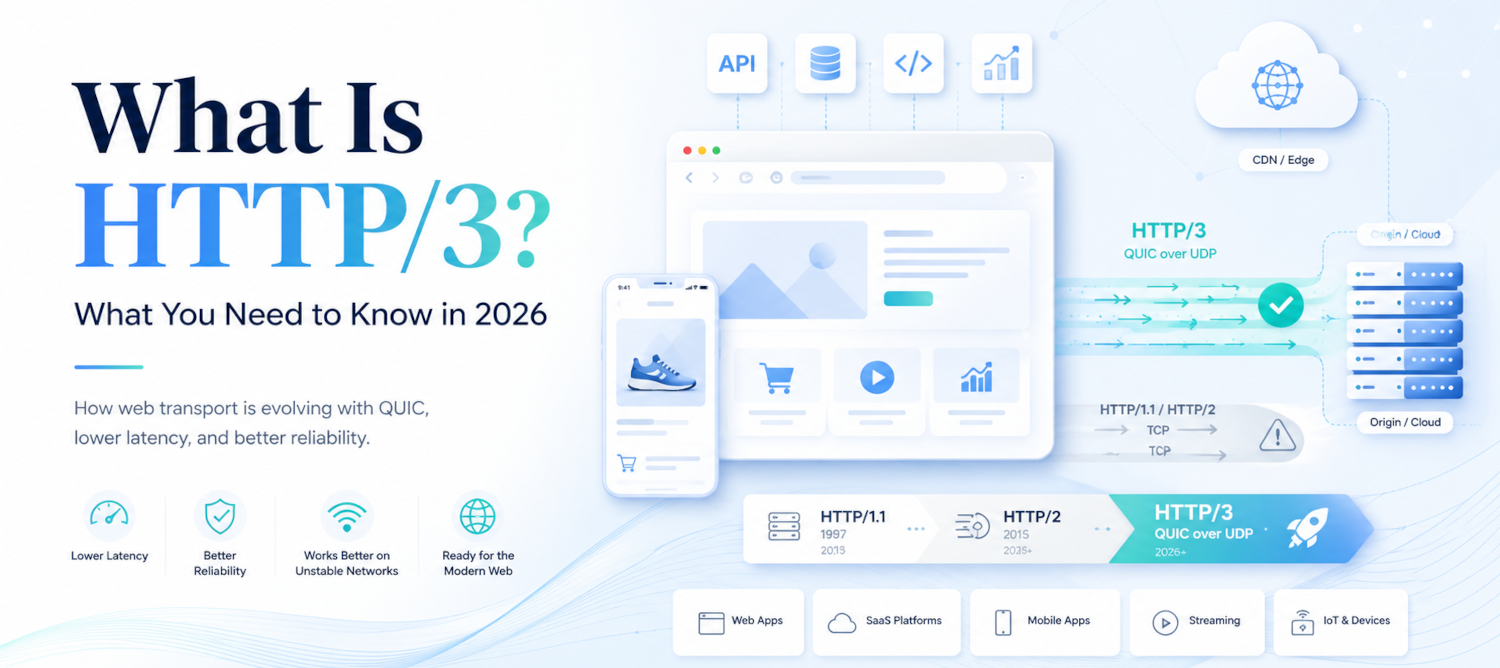
What Is HTTP/3? What You Need to Know in 2026
What Is HTTP?
For most users, the web feels simple: open a browser, click a link, load a page, submit a form, call an API, stream a video, or use a SaaS application. Behind that experience is a protocol stack that has been evolving for decades. One of the most important parts of that stack is HTTP, the protocol that allows clients and servers to exchange information across the web.
In 2026, HTTP/3 is no longer an experimental idea reserved for large technology companies. It is supported by major browsers, widely available through CDNs, and increasingly relevant for SMEs that depend on fast websites, APIs, mobile applications, ecommerce platforms, and cloud services. However, HTTP/3 is not a magic performance switch. It is an important improvement in how web traffic is transported, especially over unreliable networks, but it still requires thoughtful adoption, testing, and operational readiness.
This article explains what HTTP/3 is, how it evolved, what makes it different, and what SMEs and technical teams should consider before enabling it in production.
HTTP stands for Hypertext Transfer Protocol. It is the core application-layer protocol used by the web to request and deliver resources. When a browser loads a webpage, it uses HTTP to request HTML, CSS, JavaScript, images, fonts, videos, API responses, and other assets from one or more servers.
HTTP is not limited to websites. Modern applications use HTTP everywhere: REST APIs, GraphQL endpoints, mobile app backends, SaaS platforms, payment integrations, webhooks, authentication services, monitoring endpoints, and cloud-native microservices. MDN describes HTTP as the foundation of data exchange on the Web and a client-server protocol where requests are initiated by the recipient, usually a browser.
In practical terms, HTTP defines how a client asks for something and how a server responds. A browser may send a request such as “GET this page,” “POST this form,” or “fetch this API resource.” The server replies with a status code, headers, and a response body. Headers may describe content type, cache behavior, compression, cookies, authentication, security policies, and more.
For SMEs, this matters because HTTP directly affects user experience and application reliability. Slow page loads, delayed API responses, failed mobile requests, and inconsistent performance are often not just application-code problems. They can also be affected by transport behavior, network latency, packet loss, TLS handshakes, CDN configuration, and server support for newer HTTP versions.