Our Blog

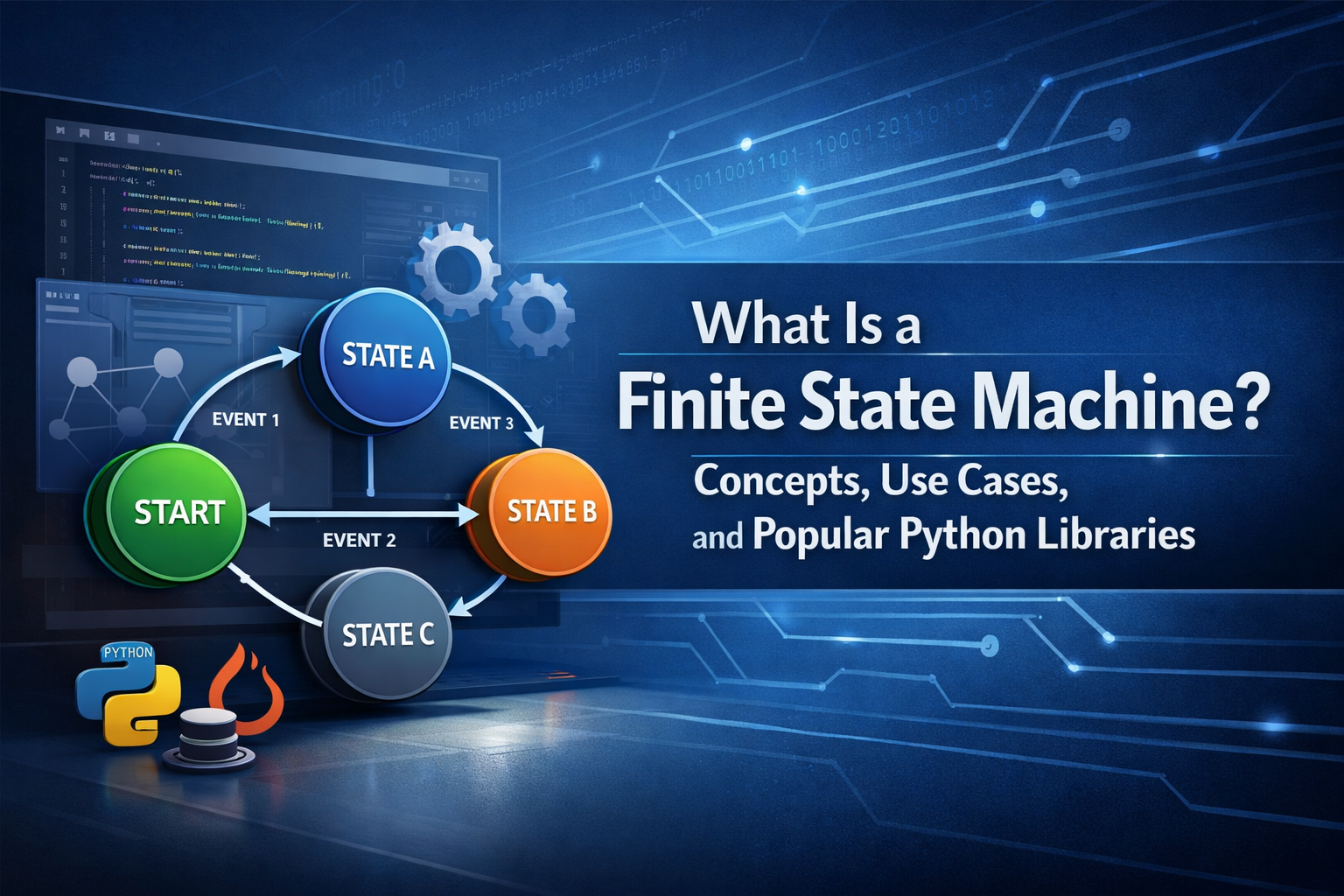
What Is a Finite State Machine? Concepts, Use Cases, and Popular Python Libraries

What Is a Finite State Machine? Concepts, Use Cases, and Popular Python Libraries

As software systems grow, one of the first things that becomes difficult to manage is behavior. A small workflow may start with a handful of if/else checks, a few boolean flags, and some “temporary” exceptions. Over time, that logic spreads across services, handlers, UI actions, and background jobs. The result is code that works, but is hard to explain, test, and safely extend.

That is exactly where a finite state machine, or FSM, becomes useful.

An FSM gives you a structured way to model behavior as a limited number of states and a defined set of transitions between those states. Instead of asking, “What combination of flags are active right now?” you ask, “What state is this system in, and what events are valid from here?” That shift sounds simple, but for SMEs building business applications, internal tools, SaaS workflows, device integrations, or approval systems, it can dramatically improve clarity and reduce errors.

What Is a Finite State Machine

A finite state machine is a model that represents a system using a finite set of states, along with transitions that move the system from one state to another. Those transitions are usually triggered by events. In practice, FSMs are valuable when a system’s behavior depends not only on the current input, but also on its current state. That is how major Python FSM libraries describe them: in terms of states, transitions, and event-driven behavior.

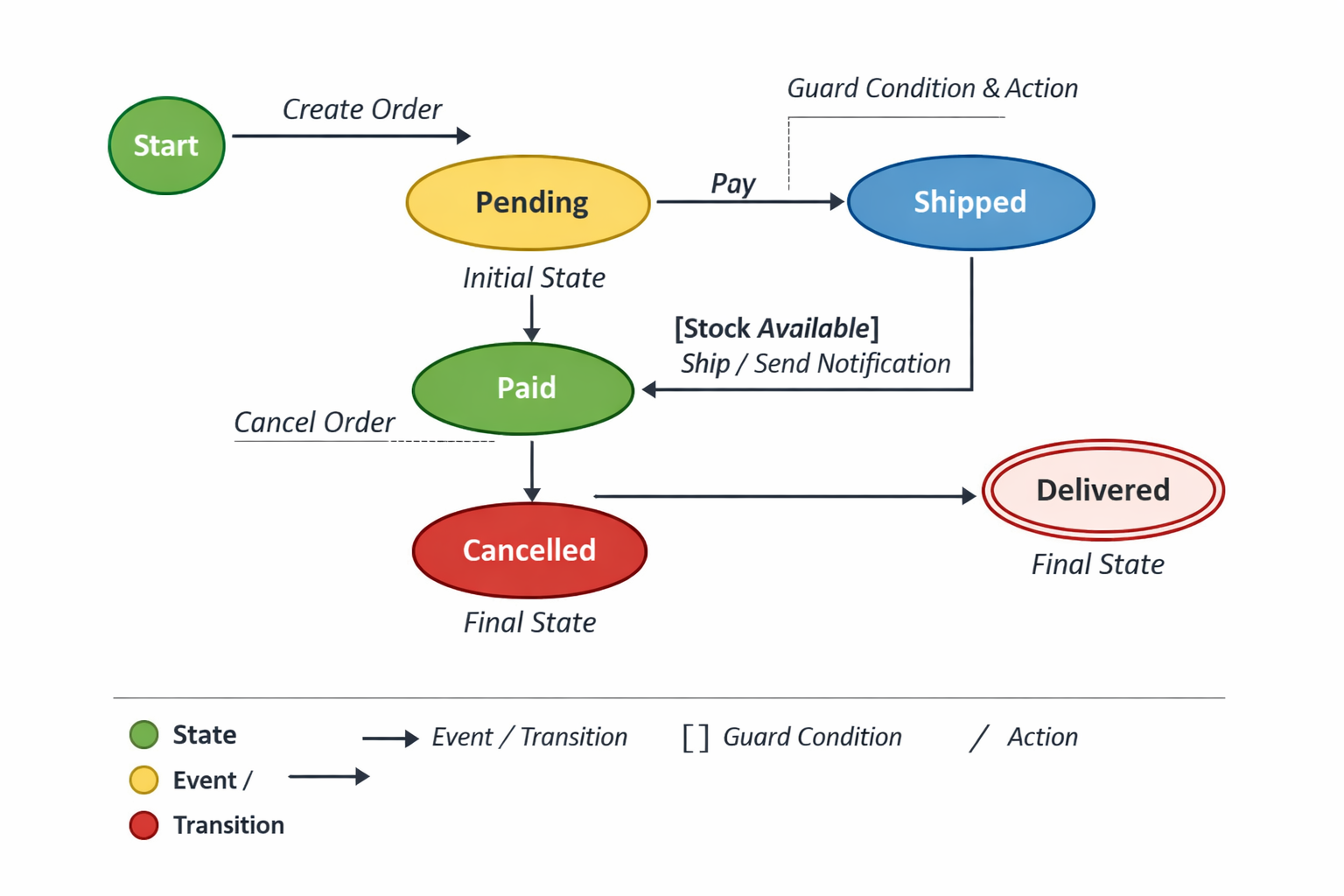
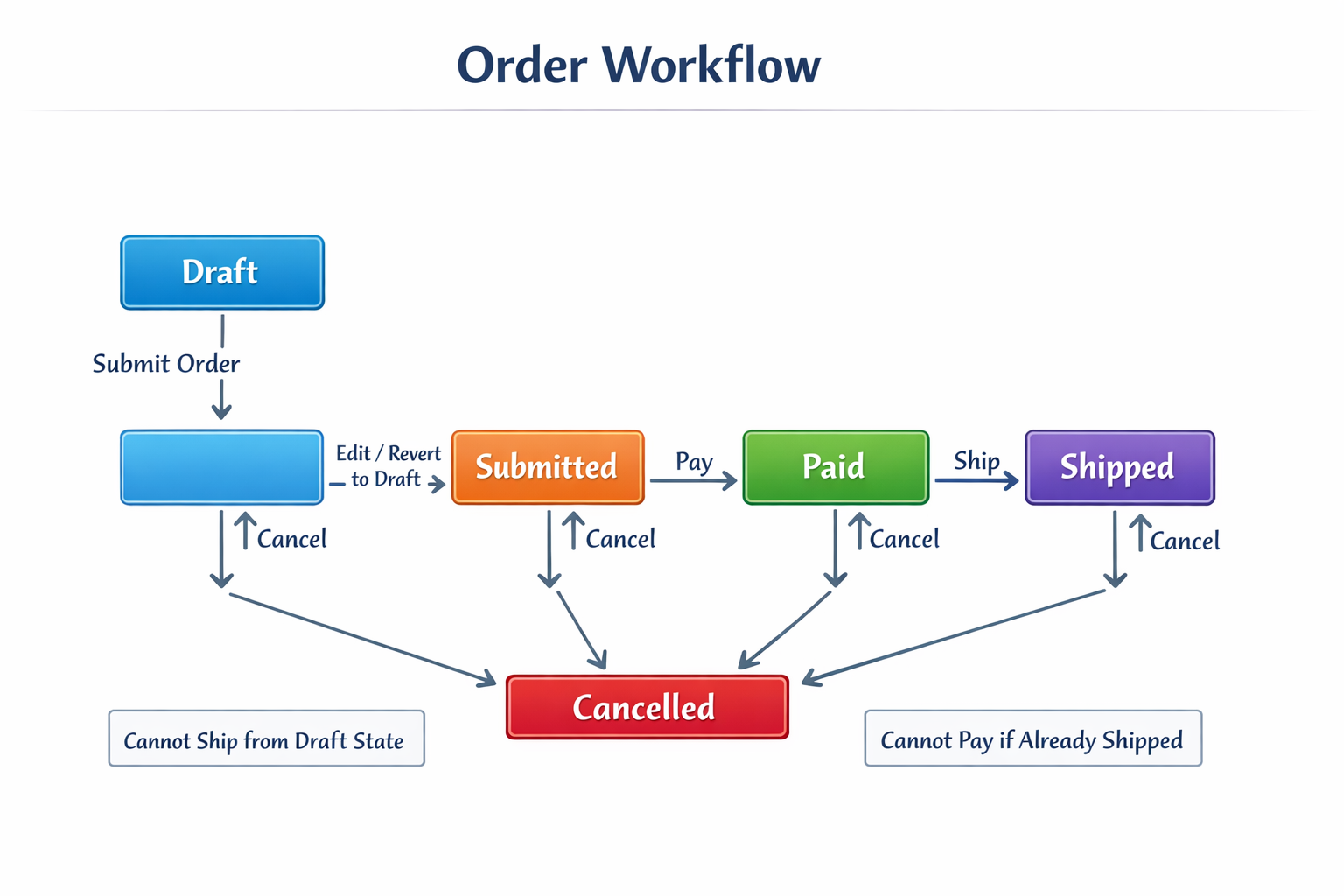
Think of a simple order workflow. An order can be in draft, submitted, paid, shipped, or cancelled. If the order is already shipped, a “pay” event should not be valid. If it is draft, a “ship” event should not be allowed yet. The meaning of the same event depends on the current state.

Simple Order Workflow

That is the practical core of an FSM: it makes the rules of behavior explicit.

This approach is especially helpful in systems where sequence matters. A user onboarding process, a ticket lifecycle, a subscription change flow, a manufacturing stage, or an IoT device controller all have one thing in common: they are not just processing isolated inputs. They are moving through a lifecycle.

Without an FSM, developers often end up encoding that lifecycle indirectly in conditions scattered across the codebase. With an FSM, the lifecycle becomes a first-class model.

Why Finite State Machines Are Needed

Most teams do not start with a state machine. They start with straightforward business logic. That is reasonable. The trouble begins when workflows grow.

A simple process might begin with one status field and a couple of checks. Then the business adds edge cases. Then exceptions. Then approval bypasses for admins. Then retry logic. Then async processing. At that point, the logic is often expressed through nested conditionals, feature flags, repeated validation, and “do not allow this if that already happened” checks spread across multiple modules.

The problem is not just code style. It is operational risk.

When workflow logic is scattered, it becomes harder to answer basic questions such as:

  + What states are possible?

  + Which transitions are valid?

  + What events should be ignored or rejected?

  + What actions should happen during a state change?

  + Can the system enter an impossible or inconsistent condition?

FSMs solve this by centralizing behavior into a model that developers and stakeholders can reason about. For SMEs, that matters because engineering teams are often balancing speed with limited maintenance capacity. Clear workflow models reduce onboarding time, simplify testing, and lower the cost of future changes. When the logic is visible, it is easier to review and much harder to accidentally break.

What Problems They Solve

Finite State Machines (FSMs) solve following software projects:

Controlling valid transitions
In many business systems, not every action is valid at every moment. An invoice cannot be marked paid after it has been voided. A support ticket should not move from closed back to waiting-on-customer without a defined reopening flow. FSMs enforce these rules directly. Libraries such as python-statemachine support conditions, also called guards, which determine whether a transition may occur, and actions that run when a transition succeeds.

Preventing impossible states
Systems often fail not because developers forgot a feature, but because the code allows combinations that should never exist. FSMs reduce this risk by making state transitions explicit rather than implied.

Structuring workflows
When a process has a sequence, an FSM provides a clean way to express it. Typical examples include order processing, approval chains, onboarding flows, background job orchestration, protocol handling, parsers, device control, and multi-step UI flows. A state machine does not eliminate complexity, but it puts that complexity in one place.

Making event-driven systems predictable
Event-driven code is powerful, but it can become difficult to reason about when the same event behaves differently under different circumstances. FSMs make those circumstances visible.

For business leaders and technical managers, the value is straightforward: fewer logic errors, safer changes, clearer workflows, and more predictable behavior in production.

4. Key Concepts in Finite State Machines

To use FSMs effectively, readers should understand a few core concepts.

FSM States

A state is the current condition of the system. For example, an order might be in pending, paid, or shipped.

An event is something that happens and may trigger a transition. Examples include pay, ship, cancel, or retry.

A transition is the rule that moves the system from one state to another when a particular event occurs.

A final or terminal state is a state where the workflow is complete or no further transitions are expected.

A guard or condition is a boolean rule attached to a transition. It decides whether the transition is allowed. The python-statemachine docs describe a guard as a predicate checked when an event arrives, and note that side effects belong in actions, not conditions.

An action is a side effect that occurs during a transition, such as sending an email, updating a database record, logging an audit event, or publishing to a queue. The python-statemachine docs frame actions as the mechanism that ensures the right code runs at the right time during state changes.

At a basic level, many teams start with a flat FSM, where every state exists on one level. That is often enough for straightforward workflows.

As systems become more sophisticated, some libraries support statecharts, which extend simple FSMs with richer modeling features such as compound states, parallel regions, and history. The current python-statemachine docs explicitly support flat machines as well as full statecharts with compound states, parallel regions, and history, and the same API can work in synchronous or asynchronous Python code.

Use Cases for Finite State Machines

Finite state machines are especially useful in business and software scenarios where a process must move through a clearly defined sequence of steps. Here are three practical use cases:

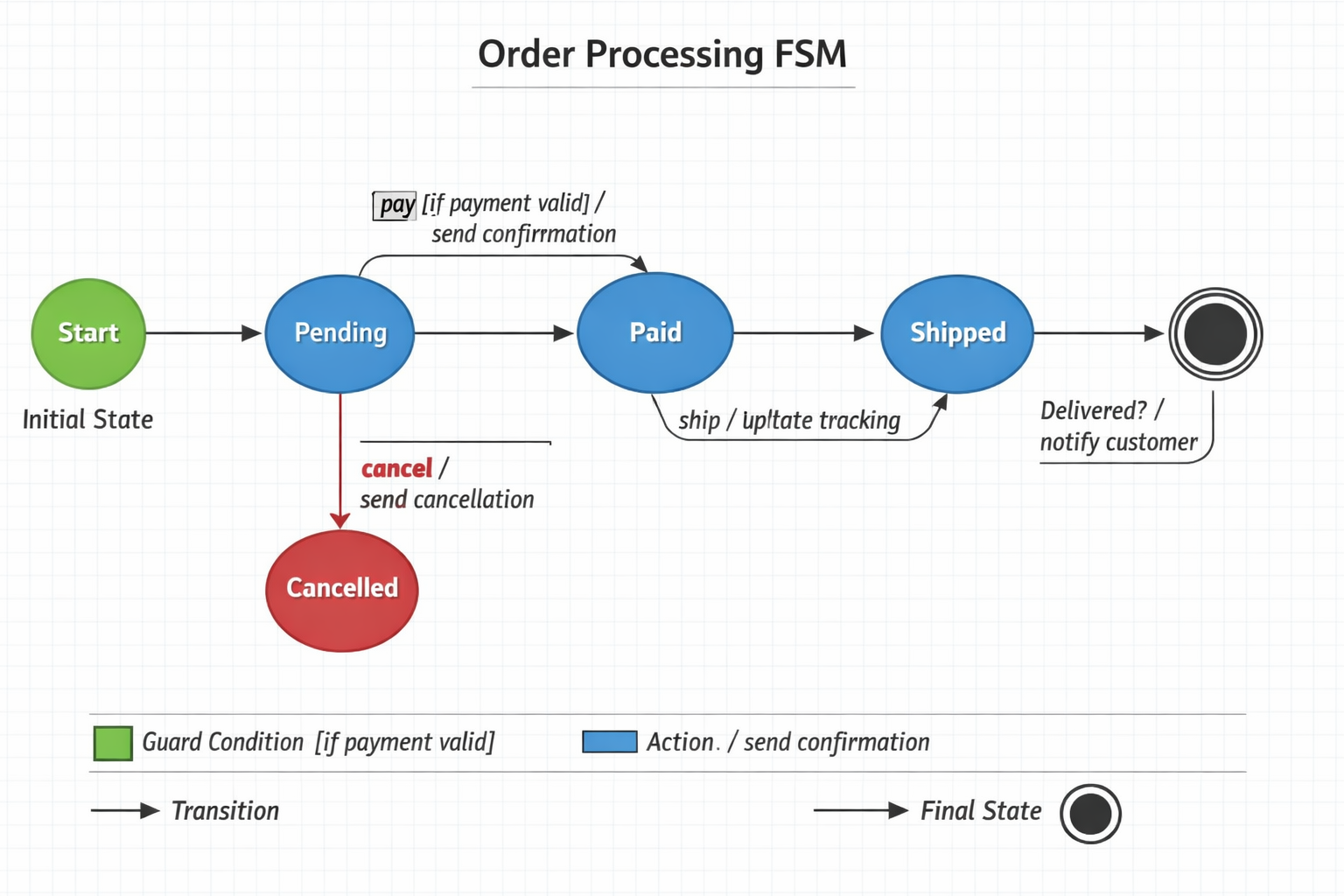
1. Order and Payment Workflows
FSMs are commonly used in e-commerce and ERP systems to manage order states such as draft, submitted, paid, shipped, and cancelled. They ensure that only valid transitions are allowed, such as preventing an unpaid order from being shipped or a cancelled order from being refunded incorrectly.

FSM for Order and Payment workflows

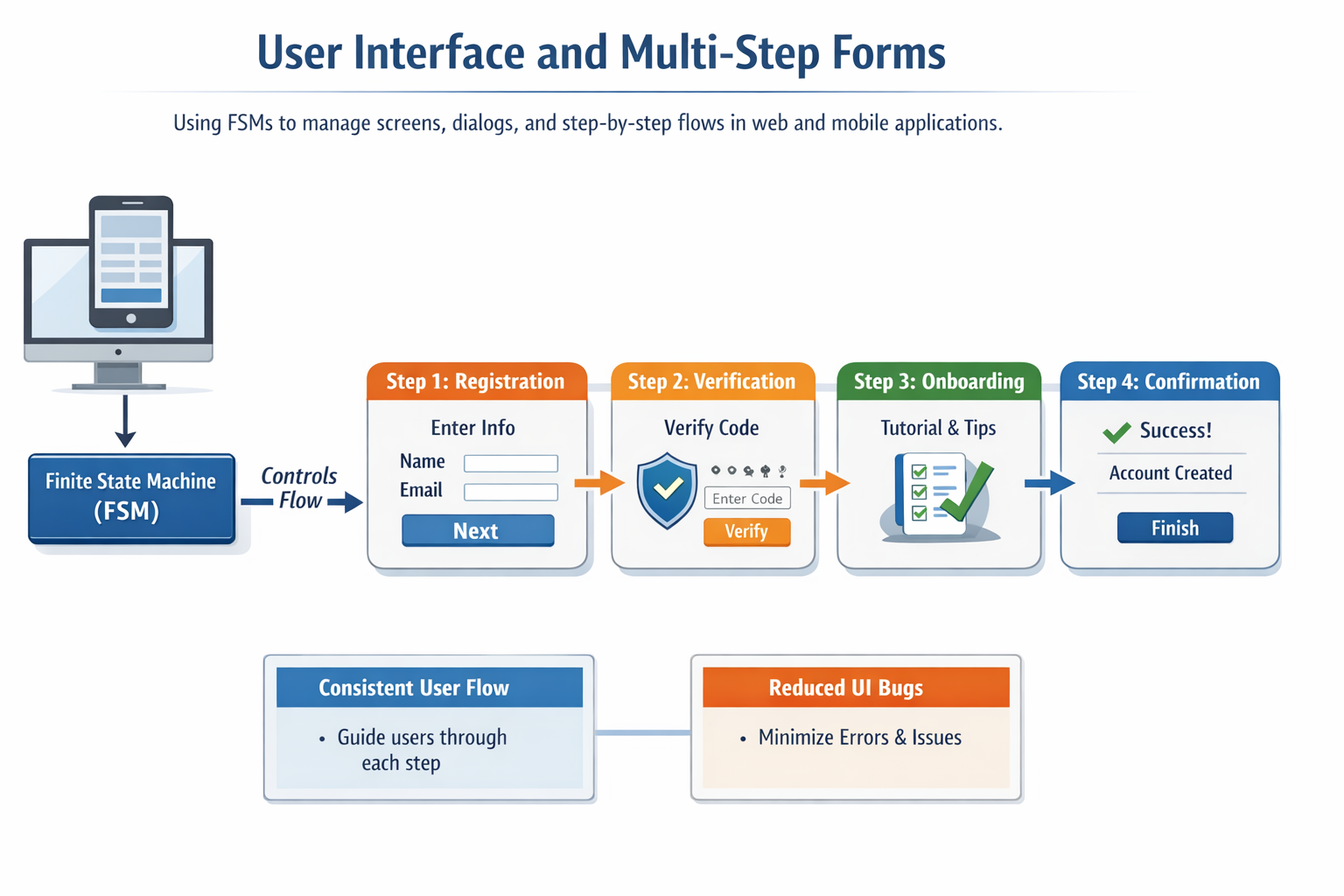
2. User Interface and Multi-Step Forms
In web and mobile applications, FSMs help manage screens, dialogs, and step-by-step flows such as registration, onboarding, or checkout. This makes it easier to control what users can do at each stage and reduces bugs caused by inconsistent UI behavior.

FSM for User interface and multi-step forms

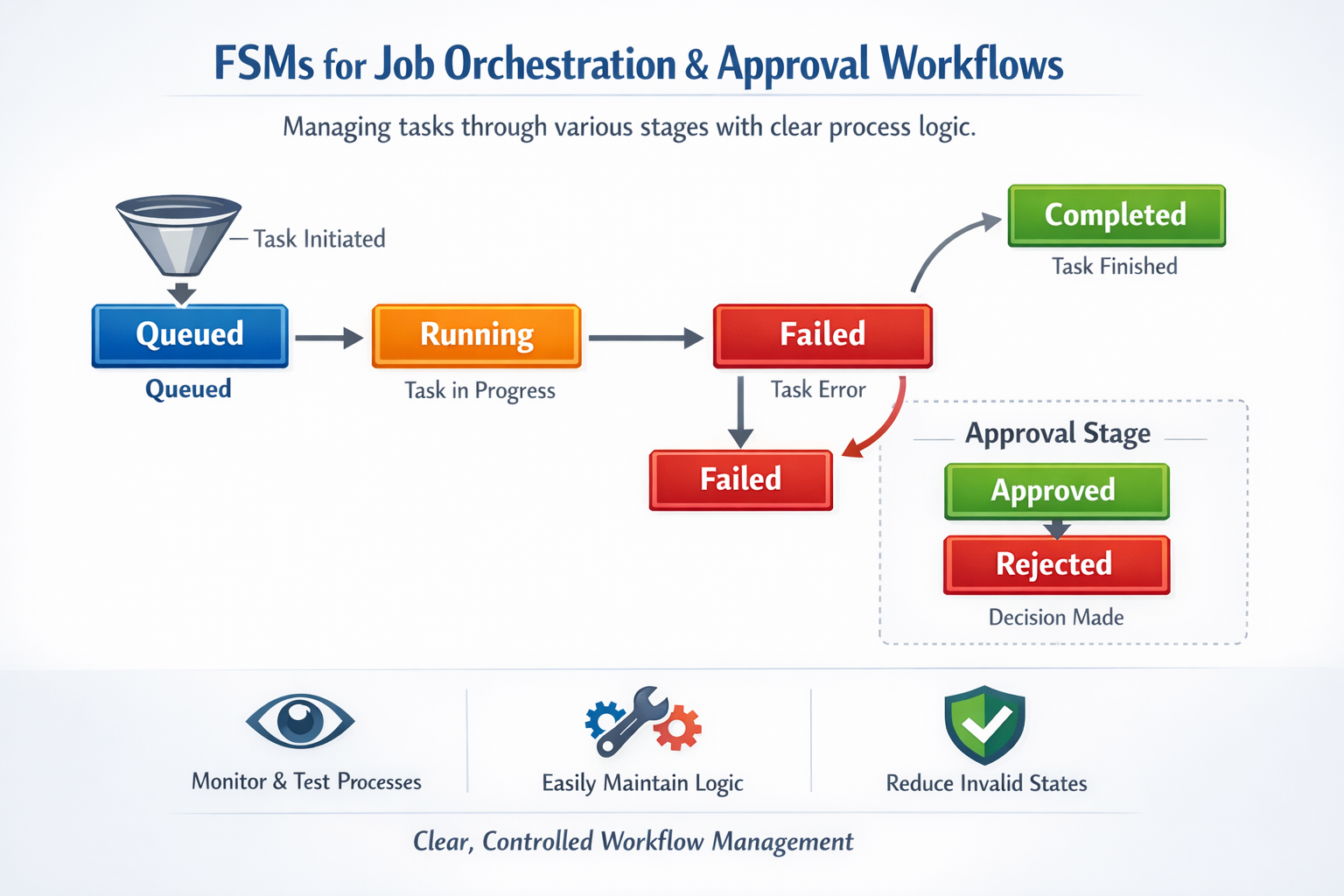
3. Background Jobs and Approval Processes
FSMs are a strong fit for job orchestration and approval-based workflows, where tasks move through stages like queued, running, completed, failed, or approved/rejected. They make process logic easier to monitor, test, and maintain while reducing the risk of invalid process states.

FSM for Background jobs and approval processes

Python Example: Modeling an Order Workflow

Here is a simple Python example using transitions (download it from: Pypi: transitions), which describes itself as a lightweight, object-oriented state machine implementation with many extensions

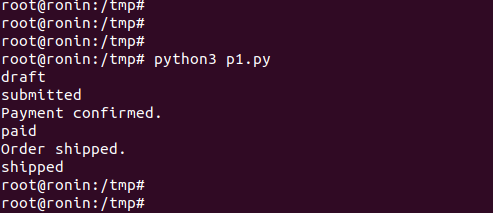
from transitions import Machine class Order: def __init__(self, is_paid=False): self.is_paid = is_paid def can_ship(self): return self.is_paid def on_enter_paid(self): print("Payment confirmed.") def on_enter_shipped(self): print("Order shipped.") def on_enter_cancelled(self): print("Order cancelled.") states = ["draft", "submitted", "paid", "shipped", "cancelled"] transitions = [ {"trigger": "submit", "source": "draft", "dest": "submitted"}, {"trigger": "pay", "source": "submitted", "dest": "paid"}, {"trigger": "ship", "source": "paid", "dest": "shipped", "conditions": "can_ship"}, {"trigger": "cancel", "source": ["draft", "submitted", "paid"], "dest": "cancelled"}, ] order = Order(is_paid=True) machine = Machine( model=order, states=states, transitions=transitions, initial="draft" ) print(order.state) # draft order.submit() print(order.state) # submitted order.pay() print(order.state) # paid order.ship() print(order.state) # shipped

Store above code as a p1.py. You can execute it using the following command: python3 p1.py Execution code for FSM

This small example already shows why FSMs are useful. The workflow is visible. Allowed transitions are explicit. Side effects are attached to state changes. And invalid transitions are naturally constrained by the model rather than hidden in scattered logic.

Popular Python Implementations and Libraries

Python has several strong options for FSMs, but they are not all solving the same problem.

transitions
transitions (download it: Pypi transitions) is a strong fit when you want a lightweight, general-purpose, object-oriented FSM library. Its own description emphasizes that it is lightweight and object-oriented, which makes it attractive for application workflows where you want to add stateful behavior to regular Python objects without a lot of ceremony.

Choose transitions when:

  + you want a pragmatic library for business workflows

  + you prefer attaching machine behavior directly to objects

  + you need something approachable for small to medium application logic

It is often a good entry point for teams adopting FSMs for the first time.

python-statemachine
python-statemachine (download it: Pypi python-statemachine) is a more declarative option and is especially appealing when you want a clean modeling style, explicit guards and actions, and support for more advanced statechart-style behavior. Its docs highlight flat state machines, full statecharts, compound states, parallel regions, history, and support for both sync and async code.

Choose python-statemachine when:

  + you want a more expressive, declarative API

  + your workflow may grow into nested or more advanced state logic

  + you need a path from simple FSMs to richer statecharts

  + you expect async callbacks or async event handling

For modern backend systems, this is often an excellent choice.

Automat
Automat (download it: Pypi Automat) describes itself as a concise, idiomatic Python library for finite-state automata, particularly deterministic finite-state transducers.

Choose Automat when:

  + you are working with event-driven systems

  + you want deterministic, concise automata definitions

  + you value a strong conceptual model for automaton behavior

Automat is less about general business workflow convenience and more about precise, event-driven automata design.

automata-lib
automata-lib (download it: Pypi automata-lib) is a different category. Its documentation presents it as a Python library for finite automata, pushdown automata, and Turing machines, suitable for researchers and instructors in theoretical computer science.

Choose automata-lib when:

  + you are studying formal automata

  + you need simulation of finite automata, PDA, or Turing machines

  + your use case is academic, instructional, or algorithmic rather than workflow-driven

For most SME application workflows, this is not the first library to reach for. It is better suited to theory-heavy use cases than to modeling order states, approval flows, or operational lifecycles.
Conclusion

Finite state machines are one of the most practical ways to model systems that move through well-defined stages. They help teams replace fragile, scattered workflow logic with clear states, valid transitions, and predictable event handling. That clarity improves correctness, makes maintenance easier, and reduces the risk of logic bugs in systems where sequence matters.

For SMEs, the business value is substantial. FSMs can make order flows safer, approval systems clearer, job orchestration more predictable, and device or UI behavior easier to test. They are not just a programming concept; they are a reliability tool.

The good news is that teams do not need to accept fragile workflow logic as a normal part of growth. By using finite state machines where they fit, businesses can introduce more structure into application behavior, reduce edge-case failures, improve testing, and create systems that are easier to scale with confidence.

A practical approach is usually the best one: identify the workflows where sequence and transition rules matter most, make state behavior explicit, and build software around clear, controlled logic rather than scattered conditional handling.

This is where FAMRO can help. Our software development team brings strong hands-on expertise in designing and delivering custom applications for startups, SMEs, and scale-ups that need dependable, scalable, and maintainable digital systems. We understand the real-world pressure businesses face when balancing speed of delivery, evolving requirements, technical quality, and long-term sustainability. From workflow-driven platforms to business process automation and modern cloud-based applications, we help organizations build software foundations that are structured for growth.

In addition, FAMRO’s CTO-as-a-Service offering gives businesses access to senior technology leadership without the cost of a full-time executive hire. Our technology leaders can help assess your current application architecture, identify areas where workflow logic is becoming difficult to manage, and recommend practical engineering approaches that improve reliability, clarity, and scalability across your software landscape.

If your organization is looking to build more predictable applications, modernize business workflows, or strengthen the quality of its software delivery, partnering with the right development and technology leadership team can make a meaningful difference. With the right approach, finite state machine thinking becomes more than an engineering pattern. It becomes part of a smarter software strategy that improves reliability, supports operational efficiency, and enables sustainable business growth.

To help organizations get started, we offer a free initial consultation focused on your current systems, workflow challenges, software delivery goals, and modernization priorities — with no obligation and no generic pitch.
🌐 Learn more: Visit Our Homepage
💬 WhatsApp: +971-505-208-240

Our solutions for your business growth

Our services enable clients to grow their business by providing customized technical solutions that improve infrastructure, streamline software development, and enhance project management.

Our technical consultancy and project management services ensure successful project outcomes by reviewing project requirements, gathering business requirements, designing solutions, and managing project plans with resource augmentation for business analyst and project management roles.

Read More
2
Infrastructure / DevOps
3
Project Management
4
Technical Consulting