What Is AWS Lightsail? Advantages, Limitations, and Whether It Fits Modern AI Apps and Agents
What Is AWS Lightsail?
Cloud adoption does not always need to begin with a sprawling architecture. Many startups and SMEs want to launch quickly, keep monthly costs understandable, and avoid hiring a full DevOps function before product-market fit is even clear. That is exactly where AWS Lightsail still earns attention.
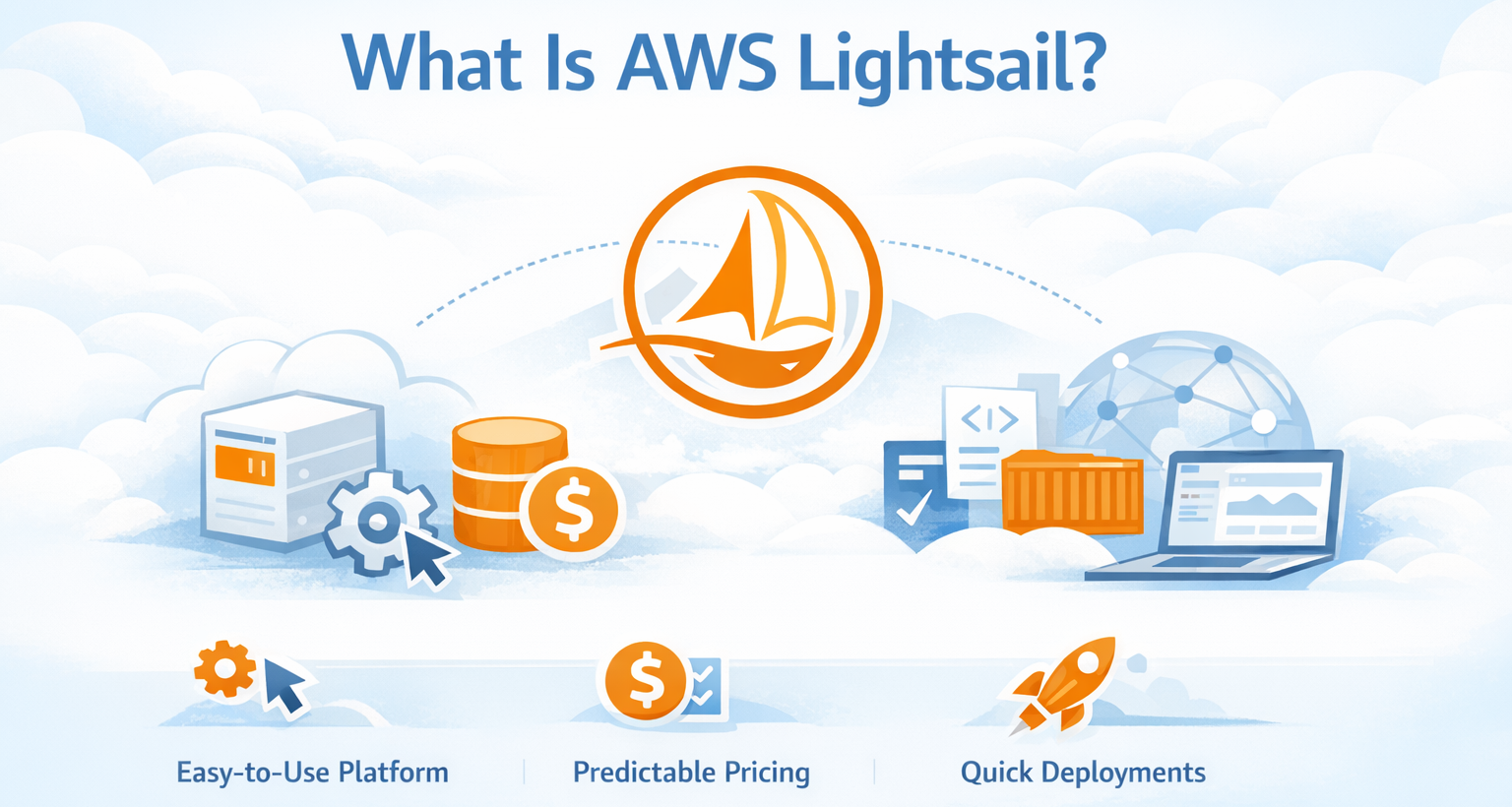
Amazon positions Lightsail as a simplified AWS service for building websites and applications with bundled, predictable pricing. It includes virtual servers, containers, managed databases, storage, load balancers, and networking features, all exposed through a much simpler experience than the broader AWS stack.
This matters now for a practical reason: many modern products, including AI-enabled apps and agents, are not training foundation models. They are orchestration layers, web apps, dashboards, workflow engines, retrieval services, and API backends. Those workloads often do not need Kubernetes, GPU fleets, or a full MLOps platform on day one.
That is the real AWS Lightsail conversation. It is not about whether Lightsail is “better” than full AWS. It is about whether simplicity is the right architectural decision for the current stage of the product. That framing also aligns with the outline you attached.
AWS Lightsail is a simplified cloud platform inside the AWS ecosystem. It is designed for teams that want to deploy quickly without dealing with the full complexity of EC2 networking, storage design, security controls, and service-by-service assembly. AWS describes it as an easy-to-use service for virtual private servers, containers, databases, storage, and related web application components.
In practical terms, think of Lightsail as a VPS-style cloud offering with AWS underneath it. You still get the benefit of operating inside the AWS environment, but the operational model is much more opinionated and much easier to grasp.
A simple way to explain it is this:
Lightsail is a simplified entry point into AWS for predictable, low-complexity deployments.
That is why it is attractive for founders, small engineering teams, internal business applications, and early-stage SaaS products.