Our Blog

The Top 5 Agentic Framework
The Top 5 Agentic Frameworks

The Top 5 Agentic Frameworks

In a demo, an “agent” feels like a minor miracle. You describe the outcome, it pulls context, calls tools, and completes the task end-to-end.

Then production happens.

Tokens expire halfway through a run. Audit asks, “What decision path led to that action?” A tool returns incomplete data and the agent marches on with false confidence. Retries balloon your cloud bill and still don’t succeed. And when something fails, nobody can explain which model call triggered which tool call—three steps earlier—before the workflow veered off course.

That’s the moment most pilots stall in the same awkward state: leadership sees strategic promise; engineering sees uncontrolled operational risk.

This is where agentic frameworks earn their keep. Not by making models smarter—but by making agent-based work operable: observable, governable, resumable, and economically defensible.

By the end, you’ll have a clear picture of what agentic frameworks do in practice, the enterprise problems they solve, and the five open-source frameworks that show up most consistently in real deployments in 2026—based on current adoption signals (GitHub stars as a directional proxy) and design fit.

Agentic AI Without the Chaos: Governance, State, and Scale

In production terms, an agent is not “a better chatbot.” It’s a system that combines:
A model: language + reasoning

Tools: APIs, databases, SaaS actions, internal services

A control loop that repeats: decide → act → observe → adjust

That loop is the difference between answering a question and moving work forward under uncertainty—handling branching paths, partial results, and “what happens next” based on real outcomes.

The 2026 shift is subtle but important: competitive advantage is moving away from prompt artistry and toward orchestration, state, and controls. Reliable agents aren’t defined by one perfect response; they’re defined by whether a multi-step workflow can run across systems over time—without turning into an un-debuggable, non-compliant liability.

Agentic Framework Work Flow

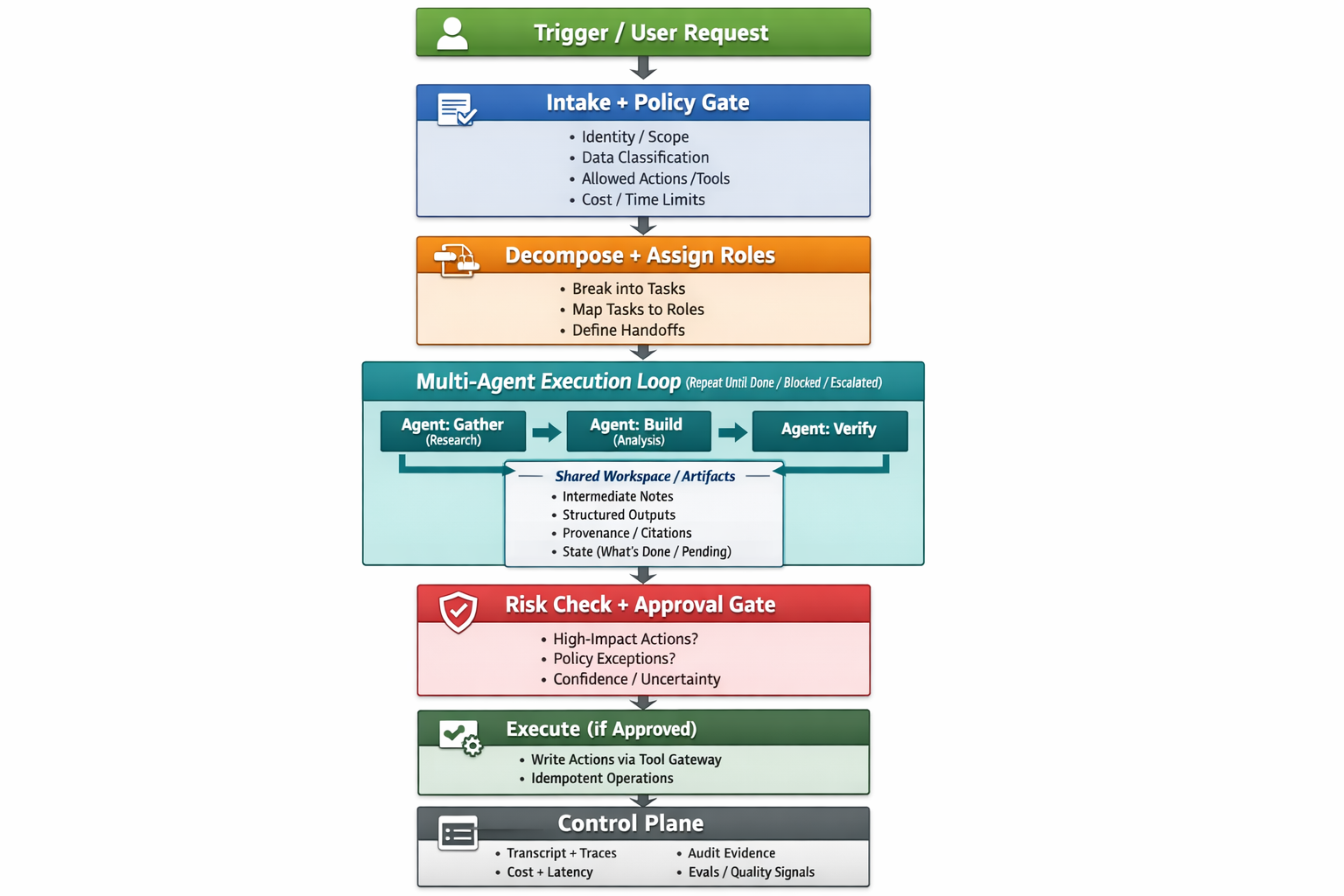
The following diagram shows a generalized, production-ready multi-agent workflow from request to execution.A Trigger/User Request enters an Intake + Policy Gate that enforces identity and scope, data classification, allowed tools/actions, and cost/time limits. The system then decomposes the request and assigns roles, breaking work into tasks and defining handoffs. Work proceeds through a Multi-Agent Execution Loop—agents Gather, Build, and Verify—collaborating through a shared workspace that stores intermediate notes, structured outputs, provenance/citations, and run state. Before any high-impact step, a Risk Check + Approval Gate evaluates policy exceptions and confidence/uncertainty. If approved, the system executes actions via a tool gateway using idempotent operations. A Control Plane captures transcripts, traces, cost/latency, audit evidence, and evaluation signals end-to-end.

Generalized Agentic Work Flow

The Top 5 Agentic Frameworks for 2026

1. LangChain LangChain remains the default starting point when teams need to connect models to “everything”—SaaS tools, internal APIs, vector stores, and data pipelines—without building the plumbing from scratch.LangChain remains the default starting point when teams need to connect models to “everything”—SaaS tools, internal APIs, vector stores, and data pipelines—without building the plumbing from scratch.

LangChain

Website: LangChain Website

Best fit for:

1. you have many tools and data sources to integrate quickly

2. you expect multiple teams to build multiple agent-enabled workflows

3. you value a common, widely understood set of abstractions

Caution::

1. breadth can become sprawl. The organizations that succeed with LangChain treat it like a platform: a small set of blessed patterns, an internal tool gateway, and pre-approved “golden path” templates for teams to reuse.

2. LangChain often becomes the integration layer, while a more explicit orchestrator handles long-running control.

2. AutoGen AutoGen is widely used for multi-agent patterns—agents collaborating with humans or each other—to break complex work into roles and handoffs.

Microsoft AutoGen

Website: Microsoft AutoGen Website

Best fit for:

1. workflows map naturally to specialist roles (research → analysis → reviewer)

2. you need structured collaboration across agents and humans

3. you want a framework with broad community mindshare for multi-agent designs

Caution::

1. Microsoft is actively steering new users toward Microsoft Agent Framework, with AutoGen maintained for bug fixes and critical security patches. That signals potential migration planning for long-lived programs.

3. LlamaIndex When the business value is anchored in enterprise knowledge—policies, contracts, product docs, SOPs—LlamaIndex is often the backbone for retrieval + reasoning workflows, with packaging designed around installable integrations.

LlamaIndex

Website: LlamaIndex Website

Best fit for:

1. your “agent” is only as good as the data it can retrieve and ground on

2. you need traceability to sources and strong retrieval pipelines

3. you’re building copilots where correctness and provenance matter more than autonomy

Caution::

1. the biggest failure mode is quiet wrongness: retrieval returns plausible but incorrect context, and the system responds confidently. Governance here means evaluation focused on grounding rates, retrieval precision/recall, and “unknown—needs review” behavior.

4. CrewAI CrewAI has become a popular way to model role-based work: a set of agents with defined responsibilities collaborating toward an outcome. It emphasizes being a standalone framework and highlights enterprise-oriented workflow concepts like “Flows.”.

LlamaIndex

Website: CrewAI Website

Best fit for:

1. you want fast prototyping of multi-step, role-based processes

2. you can enforce least privilege per role (tools and scopes per agent)

3. your work product is documentable (briefs, analyses, drafts) before execution

Caution::

1. Multi-agent systems can amplify both productivity and mistakes. Risk management comes from separation of duties (permissions per role), explicit approval gates for high-impact actions, and strong observability so you can reconstruct who/what decided what.

5. Semantic Kernel Semantic Kernel is positioned as a model-agnostic SDK for building and orchestrating agents, with an enterprise-friendly plugin ecosystem across Python, .NET, and Java.

Semantic Kernel

Website: Semantic Kernel Website

Best fit for:

1. you’re .NET-heavy or want SDK-first extensibility and governance-aligned patterns

2. you expect to standardize plugins/tools across teams

3. you need a consistent orchestration approach across languages

Caution::

1. Microsoft’s agent ecosystem is evolving quickly (Semantic Kernel, AutoGen, and now Agent Framework). Treat the orchestration SDK as a layer with clean interfaces so models/tool backends remain swappable over time.

Guide for selecting Agentic Framework

Instead of starting with “which framework is best,” start with what kind of failure you can’t afford.

Choose an integration-first framework: when speed-to-connectivity is the bottleneck.

  + Typical outcome: faster time-to-value, higher risk of pattern sprawl (mitigated with guardrails and golden paths).

Choose an orchestration-first framework: when reliability, resumability, and auditability dominate.

  + Typical outcome: slower initial build, lower operational risk at scale.

Choose a data-centric framework: when retrieval quality determines business value.

  + Typical outcome: ROI depends on data hygiene, evaluation, and governance, not model cleverness.

Choose a role-based multi-agent framework: when work maps to clear responsibilities and handoffs.

  + Typical outcome: high productivity with the right separation of duties; high blast radius without it.

Conclusion

The fastest way to get value from agentic systems (and MCP-style tool connectivity) is to treat them like production workflow software, not a clever demo. That means planning for versioning on day one—version your tool contracts, keep clients compatible, selectively lock the critical pieces, and watch the ecosystem closely so upgrades don’t turn into surprise outages or surprise bills.

If you want a simple path that actually survives real operations, follow the same flow we covered in the blog:

    + Start with one domain (Ops or Engineering) so ownership is clear and the blast radius is small.

    + Put an Intake + Policy Gate in front of everything (identity, scope, data rules, cost/time limits).

    + Expose 2–3 read-only tools first behind strong auth and audit logging (think: ticket lookup, KB search, CRM read).

    + Run the work through a role-based loop (gather → build → verify) with a shared workspace for notes, structured outputs, and citations.

    + Add a Risk Check + Approval Gate before anything high-impact.

    + Only then expand to bounded write actions, executed through a tool gateway with idempotency and guardrails.

    + Operate it like a real product with a control plane: traces, transcripts, eval signals, cost/latency, and audit evidence.

That’s the real value proposition here: replace fragile, one-off AI integrations with a standard, governable connectivity layer—so AI can operate safely inside your systems, not around them.

Where FAMRO LLC comes in
If you’re thinking, “This sounds right, but we don’t want to spend six months reinventing it,” that’s exactly where we help. FAMRO LLC (UAE-based) has been building and operating AI/ML + enterprise IT systems since 2018, supporting hundreds of projects—from early prototypes to production rollouts. We’ll help you turn the ideas in this blog into a working, governed capability your security team can sign off on and your ops team can actually run.

We assist organizations in:

    + readiness + architecture (pick the domain, define the rollout plan).

    + secure tool/MCP server build or hardening (read-first, bounded writes).

    + Implementing traceability and provenance for multi-step workflows—so that organizations can debug failures, prove evidence, and pass audits.

    + IAM, policy enforcement, and approvals.

    + observability and auditability (like production APIs).

    + governance model (tool onboarding, change control, ownership).

    + delivery acceleration from pilot → production.

To help you get started, we offer a free initial consultation focused on your current AI stack, target use cases, risk posture, and readiness to operationalize agents—no obligation, no generic pitch.
🌐 Learn more: Visit Our Homepage
💬 WhatsApp: +971-505-208-240

Our solutions for your business growth

Our services enable clients to grow their business by providing customized technical solutions that improve infrastructure, streamline software development, and enhance project management.

Our technical consultancy and project management services ensure successful project outcomes by reviewing project requirements, gathering business requirements, designing solutions, and managing project plans with resource augmentation for business analyst and project management roles.

Read More
2
Infrastructure / DevOps
3
Project Management
4
Technical Consulting