Our Blog

Agentic AI to Real Systems: The 2026 Enterprise Playbook

Agentic AI to Real Systems: The 2026 Enterprise Playbook

In the last two years, most enterprises have run the same experiment: take a large language model, bolt on a few tools, add retrieval, and watch it do something “agent-like” in a demo. The results are usually impressive—and then reality arrives. Security asks how the model authenticates to downstream systems. Legal asks where answers came from. Finance asks why inference costs look like a new cloud bill. Operations asks how to debug a failure that spans ten model calls, three tools, and two data sources.

The good news is that “agentic AI” is no longer just a UX trick. A handful of practical shifts have moved agentic systems from bespoke prototypes into architectures you can standardize, govern, and scale. The takeaway for senior leaders is simple: the winners won’t be the teams with the cleverest prompts—they’ll be the teams who treat agents like enterprise software, with contracts, observability, controls, and predictable unit economics.

What follows is a pragmatic 2026 blueprint: the enabling shifts, the modern default stack, and the decision criteria for when agentic AI is the right investment—and when it’s an expensive distraction.

The Inflection Point: Three Changes That Turned Agents into Systems

1. A Common Connector Layer for Tools and Data Sources
Early agent prototypes were fragile because every “tool” connection was custom: a wrapper here, a schema mismatch there, a one-off auth pattern everywhere. Standardized tool connectivity is reducing this integration tax.

The Model Context Protocol (MCP) is explicitly designed as an open protocol to connect LLM applications to external tools and data sources in a consistent way, so teams don’t have to rebuild the same adapters for every model and backend.

Importantly for enterprises, MCP’s momentum isn’t just theoretical—industry reporting notes MCP’s growing role as a common “port” for tool integrations across major AI ecosystems and its move toward neutral governance.

Enterprise implication: standard connectors create standard controls: consistent logging, centralized allow/deny policies, and repeatable security reviews. That’s the difference between “a cool agent” and “a platform capability.”

2. Turning Agents Into Processes: State, Steps, and Guardrails
The second shift is organizational as much as technical: enterprises are replacing improvisational agent behavior with explicit orchestration patterns—state machines, graphs, retries, timeouts, and human approvals.

Frameworks such as Microsoft AutoGen popularized multi-agent conversations where different agents collaborate, optionally with human feedback in the loop.

At the same time, the ecosystem is nudging teams toward “more controlled agency,” where you model the workflow as a graph with well-defined states and handoffs (rather than letting an agent loop forever). LangGraph is positioned directly in that lane, emphasizing stateful, controllable flows and human-in-the-loop controls.

Microsoft has also started converging ideas across agent tooling—its Agent Framework is presented as a unified foundation for building and orchestrating agents and multi-agent workflows.

3. RAG 2.0: Hybrid, Graph, and Agentic Retrieval in Practice
Most enterprises adopted retrieval-augmented generation (RAG) to keep answers grounded in internal content. But “vector search over chunks” often fails in production for predictable reasons: acronyms, policy nuance, and multi-hop questions that require connecting facts across documents.

A production-default recipe is emerging: hybrid retrieval (lexical BM25 + vector embeddings) plus reranking to improve relevance and reduce “near but wrong” context. This pattern is becoming mainstream in platform docs and guidance for enterprise search and RAG.

For harder questions—where the system must connect entities, relationships, and “communities” of related content—GraphRAG is an increasingly common next step. Microsoft Research describes GraphRAG as a structured, hierarchical approach that extracts a knowledge graph from unstructured text and uses those structures to improve retrieval and reasoning.

Finally, retrieval itself is becoming “agentic”: instead of a single fetch, the system iterates—reformulating queries, consulting multiple sources, and validating evidence. LlamaIndex has framed this direction explicitly as “agentic retrieval,” treating retrieval as a tool the system uses repeatedly until it can justify an answer.

Enterprise implication: “RAG 2.0” is not one technique; it’s an operating posture. Retrieval becomes a subsystem with SLOs, tuning, evals, and traceability—because you can’t manage what you can’t measure.

Why observability and provenance became non-negotiable

When you move from one-shot Q&A to multi-step agents, the core reliability question changes:

    + Old question: “Did it hallucinate?”

    + New question: “Where in the chain did it go wrong—and how do we prevent that class of failure?”

This is why traceability and provenance are becoming first-class. Microsoft’s VeriTrail work targets hallucination detection and provenance tracing in multi-step AI workflows, emphasizing that it’s not enough to judge the final output—you need to track how faithful content moves through intermediate steps.

This aligns with a broader industry realization: hallucinations aren’t a single bug; they’re an emergent property of optimization and deployment choices. OpenAI’s research write-up on hallucinations highlights that plausible-but-false statements can arise in surprising ways and that evaluation incentives matter.

Enterprise implication: No trace means no accountability. If you can’t follow the steps an agent took, you can’t sign off on it—and you can’t use it for sensitive workflows involving customers, payments, or regulations.

Compliance and Governance as Core Capabilities

As governments and regulatory agencies accelerate the process of formalizing AI regulations, the need for compliance has become a major driving force for AI security investment. To meet this challenge, leading platforms are now incorporating governance and compliance functionality directly into the processes of security testing.

The platforms link vulnerability and test data to compliance standards such as the EU AI Act and the NIST AI Risk Management Framework, developing traceable paths of testing coverage, outcome, and remediation actions. This significantly reduces the time and effort required for preparing audit trails or for regulatory inquiries.

However, lifecycle governance is also an important factor. Security testing platforms are now tracking model lineage, data provenance, configuration, and deployment history. This end-to-end visibility is useful for accountability, incident response, and internal risk reporting.

For global companies, automated governance enables compliance to become a proactive process rather than a reactive one. It also enables C-level executives to maintain AI risk management at a portfolio level, rather than having to synthesize reports from various teams.

Multimodal is becoming the default interface, not a novelty

In 2026, “AI UI” increasingly means text plus images, audio, and video—because enterprise work is not purely textual. Field service has photos. Claims have scans. Manufacturing has video. Sales has recorded calls.

Google DeepMind publicly presents a growing model lineup that includes video, audio, and world-model/robotics directions. Meanwhile, major open(-ish) ecosystems are moving multimodal too: Reuters reported Meta’s Llama 4 as multimodal across text, audio, video, and images, alongside named variants (Scout and Maverick).

Enterprise implication: multimodal isn’t only “cool demos.” It changes your data governance surface area (Personally identifiable information-PII in images, sensitive audio), your security posture (new ingestion pipelines), and your value proposition (higher-fidelity workflows).

Inference Budgets as Policy: Controlling Speed, Spend, and Risk

A major capability shift from 2025 to 2026 is that progress is no longer only about bigger training runs. Many deployed systems now improve outcomes by spending more compute at inference time: tool use, search, verifier loops, self-consistency sampling, and hierarchical strategies.

Recent research frames this as “test-time scaling,” exploring methods to allocate inference-time compute via search strategies. In parallel, reinforcement learning with verifiable rewards (RLVR) has emerged as a driver for reasoning behavior, with recent work analyzing how RLVR can incentivize correct reasoning under more stringent evaluation.

But leadership should internalize the caution: “more thinking” is not a free lunch. Over-extended reasoning can degrade answer quality and increase failure loops, as industry reporting has highlighted in the context of “overthinking” behaviors in reasoning-focused models.


Enterprise implication: reasoning budgets become a product and cost lever. You will need policy: which workflows earn higher reasoning spend, which must be fast, and which require deterministic guardrails.

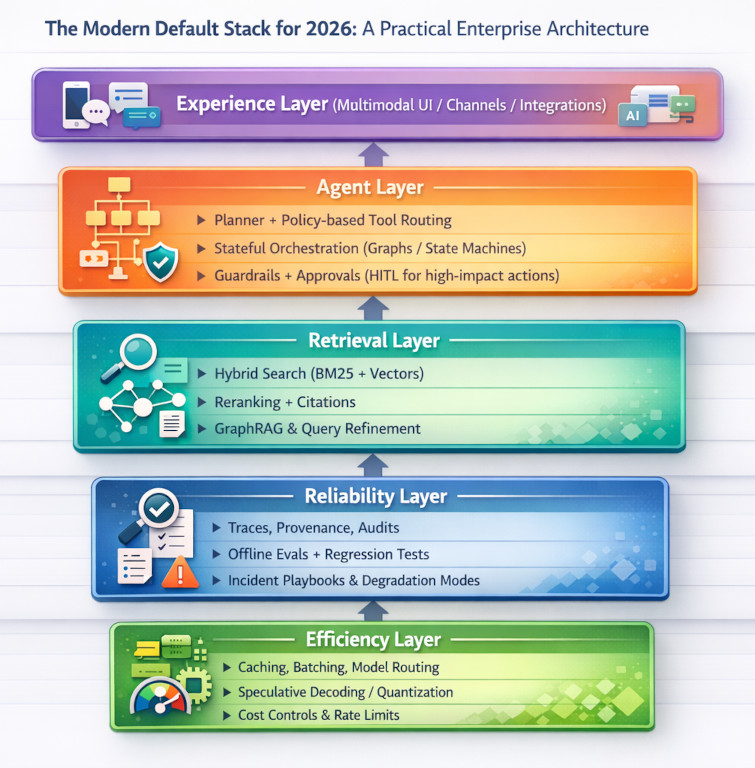
The Modern Default Stack For 2026

Here’s a mental model that maps directly to how enterprises build and operate dependable systems:

Compliance and Governance as Core Capabilities Where the industry is converging:

    + Agent Layer: AutoGen-style multi-agent patterns, or graph-based control with LangGraph; enterprise consolidation via platform kits like Microsoft Agent Framework.

    + Retrieval Layer: hybrid + reranking as baseline; GraphRAG when questions demand structure and multi-hop evidence; “agentic retrieval” when you need iterative retrieval strategies.

    + Reliability Layer: provenance tracing and hallucination localization in multi-step chains (VeriTrail-style thinking).

    + Efficiency Layer: inference optimization strategies, plus hardware diversification pressures visible even among frontier labs.

Decision Framework: Aligning Tools With Enterprise Reality

The choice of AI and application security tools should be aligned with the enterprise reality of maturity, risk, and speed of delivery. Organizations in the regulated industries having strict compliance needs may find full-suite platforms like Veracode or Synopsys more attractive. On the other hand, companies requiring rapid development sprints would be more likely to use developer-friendly tools that integrate directly into the CI/CD pipeline.

Automated testing platforms allow for quick coverage, but these platforms should be complemented with more in-depth analysis for high-risk applications. The truth is that most enterprises are hybrid and use a combination of multiple tools.

Conclusion

    + Standardized tool connectivity (MCP) reduces integration friction and enables repeatable governance at scale.

    + Multi-agent systems become enterprise-ready when orchestration is explicit: graphs, bounded retries, and human approvals.

    + “RAG 2.0” is hybrid retrieval + reranking by default; GraphRAG and agentic retrieval are the upgrade paths for complex, multi-hop questions.

    + Traceability is not optional in multi-step workflows; you need to localize failures, not just judge outputs.

    + Multimodal AI expands value—and your compliance surface area—so plan governance early.

    + Inference-time compute improves reasoning but can also introduce “overthinking” failure modes; reasoning budgets need policy.

    + Cost and latency are the long-term differentiators; speculative decoding and hardware diversification are now strategic levers.

As agentic AI begins to appear in actual products and internal processes—not just in demos—the challenge isn’t in getting a model to perform some clever task. The challenge is getting it to work like enterprise software: reliable, traceable, and cost-effective enough to run on a daily basis. Many organizations understand the benefit of agentic AI—reducing tedious work, accelerating decision-making, and relieving busy teams of tedious tasks—but delivering on this vision and actually deploying it in production is where the rubber meets the road. It is here that FAMRO LLC can help.

Based in the UAE, FAMRO LLC brings deep AI/ML and enterprise IT delivery expertise, with a proven track record of helping organizations move from experimentation to production-grade AI since 2018. We’ve supported hundreds of successful initiatives across industries by focusing on what matters in 2026: building agentic systems that behave like enterprise software—auditable, measurable, and secure—without slowing innovation.

We assist organizations in transitioning from agent demo environments to actual environments by:

    + Designing future-proof agent architectures (planner + tool routing + guardrails + stateful workflows) that are controllable and business-aligned.

    + Implementing RAG 2.0 (hybrid retrieval + reranking + citations) and GraphRAG when multi-hop reasoning and structure are needed.

    + Implementing traceability and provenance for multi-step workflows—so that organizations can debug failures, prove evidence, and pass audits.

    + Optimizing inference efficiency (latency, caching, batching, quantization/speculative techniques) to safeguard unit economics and SLOs.

    + Building governance and compliance into the operating model (access control, approval gates, logging, and eval pipelines) for scalable adoption.

To help you get started, we offer a free initial consultation focused on your current AI stack, target use cases, risk posture, and readiness to operationalize agents—no obligation, no generic pitch.
🌐 Learn more: Visit Our Homepage
💬 WhatsApp: +971-505-208-240

Our solutions for your business growth

Our services enable clients to grow their business by providing customized technical solutions that improve infrastructure, streamline software development, and enhance project management.

Our technical consultancy and project management services ensure successful project outcomes by reviewing project requirements, gathering business requirements, designing solutions, and managing project plans with resource augmentation for business analyst and project management roles.

Read More
2
Infrastructure / DevOps
3
Project Management
4
Technical Consulting