Our Blog

Speech-to-Speech on AWS: Building Lower-Latency Voice Agents for Modern Businesses

Speech-to-Speech on AWS: Building Lower-Latency Voice Agents for Modern Businesses

Introduction

Voice AI is entering a new architectural phase. For years, most enterprise voice assistants were built as a pipeline: capture audio, convert speech to text, send the transcript to an LLM or dialog engine, generate a text response, convert that response back to audio, and play it to the user.

That approach works, and it is still appropriate for many systems. But it also creates friction. Every component adds latency. Every boundary between services introduces orchestration complexity. Every handoff can lose useful speech signals such as pauses, tone, hesitation, interruption, urgency, or emotion. For simple IVR automation, that may be acceptable. For real-time AI agents expected to speak naturally with customers, employees, clinicians, field engineers, or travelers, it becomes a serious design limitation.

Modern users do not evaluate a voice agent only by whether it eventually gives the right answer. They judge whether it feels responsive, understands context, handles interruptions, and keeps the conversation moving without awkward pauses. A technically accurate answer delivered two seconds too late can still feel broken.

This is why speech-to-speech is becoming important for technical leaders designing the next generation of conversational AI. Instead of treating speech as a temporary format that must be converted into text before intelligence can happen, speech-to-speech architectures process spoken input and generate spoken output more directly. AWS has moved strongly in this direction with Amazon Nova Sonic and Amazon Nova 2 Sonic, which are positioned as speech-to-speech models for real-time conversational AI in Amazon Bedrock. AWS describes Nova Sonic as supporting real-time conversational interactions through bidirectional audio streaming, while Amazon Nova 2 Sonic is described as a speech-to-speech model for natural, real-time conversational AI.

For architects, CTOs, and senior engineering leaders, the key question is no longer simply, “Can we add voice to our application?” The better question is, “What architecture gives us a voice experience that is fast, natural, secure, observable, and production-ready?”

Build Better AWS Voice Experiences With Confidence

FAMRO helps SMEs, scaleups, and technical leaders design secure, scalable, and cost-aware AWS voice architectures using Amazon Polly, automation pipelines, cloud delivery, observability, and AI-ready infrastructure.

Book a Free AWS AI Strategy Review

This guide is for you if:

  • You are evaluating Amazon Polly or AWS TTS services for a product, platform, or customer workflow.
  • You need natural-sounding voice experiences for apps, portals, learning content, or customer support.
  • You want to combine TTS with Amazon Lex, Amazon Connect, Amazon Bedrock, or existing backend systems.
  • You need a scalable pipeline for batch audio generation, storage, approval, and global delivery.
  • You are concerned about TTS latency, governance, access control, monitoring, and cost predictability.
  • You want to modernize audio content workflows without manually recording every update.
  • You need technical guidance on AWS-native architecture, DevOps automation, and cloud operating models.

What Is Speech-to-Speech?

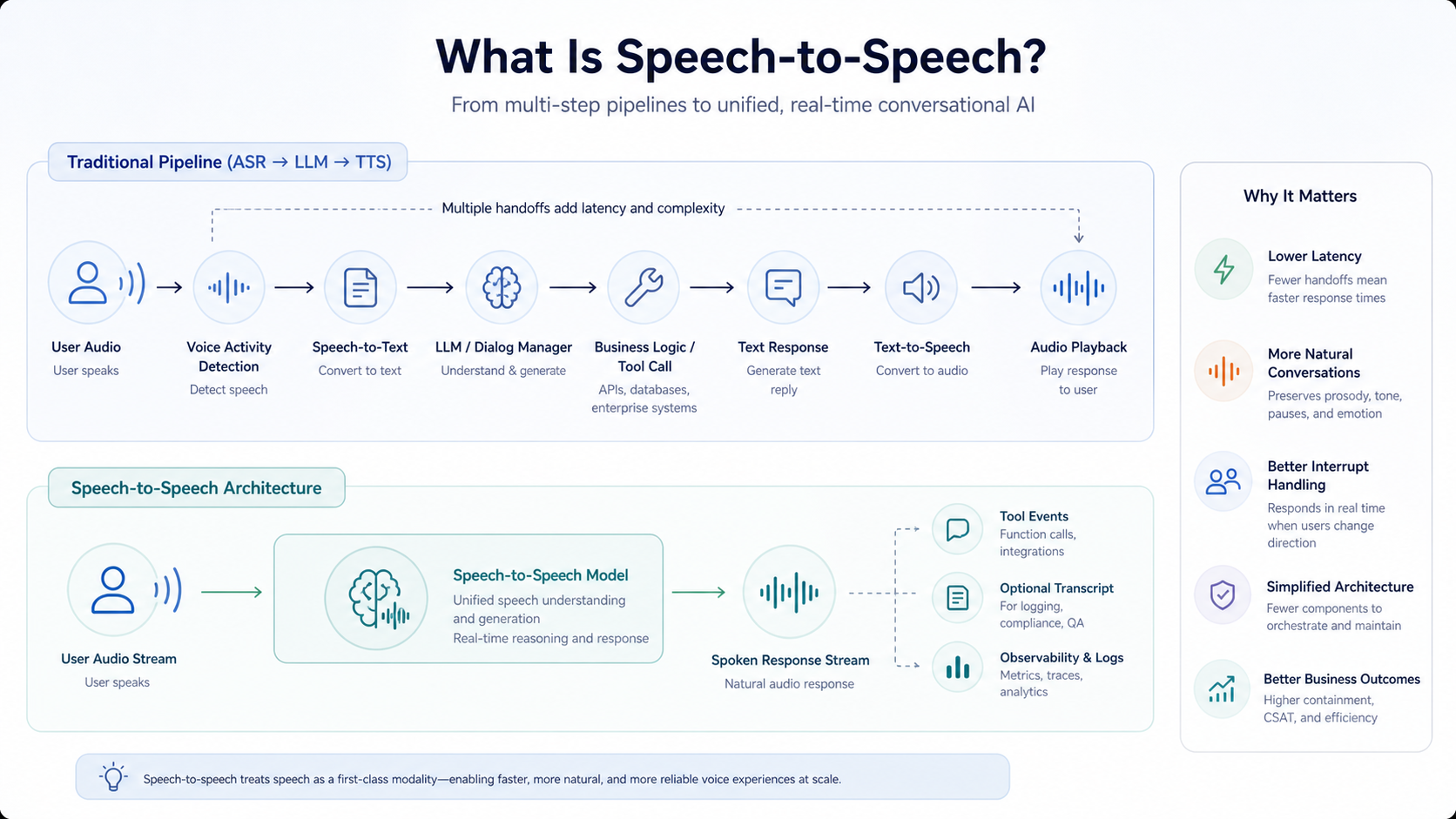
Speech-to-speech is an AI architecture where spoken input is processed and spoken output is generated directly, usually through a unified model or a tightly integrated model stack. In practical terms, the user speaks, the system understands the spoken signal, reasons over the request, and responds in speech without relying on a loosely stitched chain of separate automatic speech recognition, language model, and text-to-speech components.

What is speech-to-speech AI Archtecture

This does not mean text disappears completely. Many speech-to-speech systems can still produce transcripts, intermediate events, tool calls, structured outputs, or logs. The architectural shift is that speech is no longer just a wrapper around a text-only system. The model can use speech as a first-class modality.

That matters because human conversation is not only words. People pause, interrupt, self-correct, trail off, speak with uncertainty, emphasize certain phrases, and change direction mid-sentence. Traditional ASR → LLM → TTS pipelines often flatten these signals into text. Once that happens, downstream systems may lose important context.

A classic pipeline typically looks like this:

User audio → voice activity detection → speech-to-text → LLM or dialog manager → business logic/tool call → text response → text-to-speech → audio playback

A speech-to-speech pattern is closer to this:

User audio stream → speech-to-speech model → spoken response stream, tool events, and optional transcript

AWS documentation describes Amazon Nova Sonic as using a unified speech understanding and generation architecture and supporting bidirectional streaming for low-latency multi-turn conversations. AWS also describes Nova 2 Sonic as unifying speech understanding and generation into a single model for real-time conversational AI.

The result is not just a technical simplification. It can change the user experience. A voice agent can begin responding sooner, maintain a more natural rhythm, and handle interruptions more gracefully. For high-volume or high-value interactions, that difference can directly affect containment rates, customer satisfaction, operational cost, and adoption.

Frequently Asked Questions About Speech-to-Speech on AWS

What is speech-to-speech on AWS?

Speech-to-speech on AWS is an architecture pattern for building real-time voice agents that can listen, understand, reason, and respond with spoken output using AWS AI, compute, networking, and monitoring services.

Why is low latency important for voice agents?

Low latency makes voice agents feel more natural and responsive. Delays in speech recognition, AI reasoning, or audio generation can make conversations feel slow, robotic, or difficult for users to trust.

Which AWS services can support real-time voice AI systems?

Common AWS services for voice AI architectures include Amazon Bedrock, Amazon Nova Sonic, AWS Lambda, Amazon Connect, Amazon CloudWatch, IAM, API Gateway, and other cloud infrastructure components depending on the use case.

How can businesses reduce latency in AWS voice agent architectures?

Businesses can reduce latency by optimizing audio streaming, choosing the right AWS region, minimizing service hops, using efficient model orchestration, monitoring response times, and designing event-driven cloud workflows.

Are AWS voice agents suitable for contact centers?

Yes. AWS voice agents can support contact center automation, customer support triage, appointment scheduling, order status updates, and other conversational workflows when designed with proper security, monitoring, and fallback handling.

What should technical teams monitor in production voice AI systems?

Teams should monitor end-to-end latency, model response quality, audio errors, failed requests, user drop-off points, fallback rates, cost per interaction, and infrastructure health across the full voice agent pipeline.

Can FAMRO help design production-ready AWS voice agent systems?

Yes. FAMRO helps businesses design AWS-based AI, cloud, and automation systems with a focus on architecture, latency, scalability, reliability, cost control, and production readiness.

Key Use Cases for Speech-to-Speech

Speech-to-speech is most valuable where voice is not a novelty interface but the primary interaction channel. It is especially relevant when users need speed, hands-free access, natural turn-taking, or support during complex tasks.

In customer service, speech-to-speech agents can support billing questions, appointment scheduling, order status checks, troubleshooting, and account updates. The value is not simply automation. The value is reducing the conversational drag that makes many automated phone systems frustrating. A lower-latency agent that can respond naturally, clarify intent, and call backend systems can improve both containment and escalation quality.

Key use cases for speech-to-speech

Contact center automation is one of the most obvious enterprise use cases. Amazon Connect documentation now includes configuration guidance for using Amazon Nova Sonic as a speech-to-speech model for conversational AI bot locales, where customer speech is converted directly into natural, expressive speech responses while Amazon Connect continues to manage orchestration, intents, and flows. This matters because many organizations already have contact center flows, routing rules, queue logic, compliance requirements, and reporting practices built around platforms such as Amazon Connect. Speech-to-speech can enhance the experience without forcing every operational process to be redesigned from scratch.

Virtual assistants are another strong fit. Executives, sales teams, support engineers, and operations staff often need fast access to information while multitasking. A speech-to-speech assistant can retrieve CRM data, summarize tickets, check inventory, update tasks, or trigger workflows without forcing the user into a screen-first interaction.

Healthcare intake is a particularly compelling but sensitive use case. Patients often describe symptoms in incomplete or non-linear ways. A voice agent must listen carefully, ask clarifying questions, and route appropriately. Speech-to-speech can support intake, appointment preparation, medication reminders, and administrative workflows, provided the system is designed with strong privacy, auditability, clinical safety, and human escalation controls.

Field service support is another practical area. Technicians working on equipment may not be able to type while inspecting machinery, reading gauges, or following procedures. A real-time voice agent can guide them through diagnostics, search manuals, open service records, and capture updates hands-free.

Education and training also benefit from natural voice interaction. A tutoring assistant that responds quickly, detects uncertainty, and allows interruption can feel far more engaging than a text chatbot with audio bolted on. Travel support is similar: travelers often need fast help while moving through airports, hotels, vehicles, or unfamiliar environments.

Internal enterprise helpdesks may be one of the most commercially realistic near-term opportunities. Employees frequently ask repetitive questions about IT access, HR policies, procurement, benefits, device setup, password resets, or internal systems. A voice-first helpdesk can reduce ticket volume and give employees a more natural support channel, especially when integrated with identity, knowledge bases, and workflow systems.

Across all of these use cases, the architecture is justified when it improves experience, reduces operational friction, or enables workflows that are hard to deliver through text-first interfaces.

How AWS Services Align with Speech-to-Speech Architectures

1. AWS Turns Speech-to-Speech into a Full Architecture

AWS is well positioned for teams building production-grade voice applications because speech-to-speech is not only a model problem. It is an architecture problem.

The model matters, but so do streaming transport, tool execution, contact center integration, identity controls, observability, networking, cost management, and deployment governance.

2. Amazon Bedrock Provides the Core Model Layer

At the center of the architecture, Amazon Bedrock can provide access to Amazon Nova Sonic or Nova 2 Sonic.

Amazon Nova Sonic supports real-time conversational interactions through bidirectional audio streaming. Amazon Nova 2 Sonic is positioned as a speech-to-speech model for natural, real-time conversational AI, with unified speech understanding and generation.

For architects, Bedrock becomes the managed foundation model layer where the voice agent’s conversational intelligence is hosted.

3. User Channels Connect Through Real-Time Streaming

A typical AWS-based architecture might include a browser, mobile app, phone channel, kiosk, or embedded device as the audio endpoint.

For web and mobile experiences, WebRTC-based patterns are attractive because they are designed for real-time media. AWS has published guidance on building real-time voice streaming applications with Amazon Nova Sonic and WebRTC.

In some implementations, API Gateway, WebSocket patterns, or service-specific streaming APIs may also be used depending on client requirements and network constraints.

4. AWS Lambda Enables Business Actions and Tool Execution

For business actions, AWS Lambda can execute tools.

A voice agent is rarely useful if it can only talk. It needs to check order status, open a support ticket, retrieve account details, query a knowledge base, update a booking, or trigger an enterprise workflow.

Lambda is a natural fit for encapsulating these actions behind controlled, auditable interfaces.

5. Asynchronous Tool Handling Improves Conversation Flow

Nova 2 Sonic is especially relevant because AWS describes it as supporting asynchronous tool handling.

This allows tool calls to execute while maintaining conversation flow. Instead of freezing while waiting for a backend API, the agent can acknowledge the request, continue the interaction, handle follow-up questions, and return the tool result when it is available.

From a user experience perspective, this can make the voice agent feel more natural and responsive.

6. Amazon Connect Supports Contact Center Use Cases

For contact center use cases, Amazon Connect can provide telephony, routing, queues, recording policies, call flows, and operational contact center features.

AWS documentation describes configuring Amazon Nova Sonic as a speech-to-speech model in Amazon Connect for conversational AI bot locales.

This gives organizations a path to bring speech-to-speech into existing service operations without rebuilding every contact center capability from the ground up.

7. Amazon CloudWatch Provides Observability

For observability, Amazon CloudWatch can monitor logs, metrics, errors, invocation patterns, latency, and operational signals.

Voice systems require more than standard API monitoring. Teams should measure first-audio latency, interruption handling, tool-call duration, failed turns, escalation rates, session drops, fallback frequency, and customer sentiment signals where appropriate.

8. IAM, VPC, Encryption, and Policies Support Governance

For governance, AWS Identity and Access Management, VPC controls, encryption, logging, and organization-level policies are essential.

Enterprise voice agents may access customer records, operational systems, internal documents, or regulated data. The architecture must enforce least privilege, separate environments, protect secrets, and ensure that model access and tool execution are governed consistently.

9. Simplified AWS Reference Pattern

A simplified AWS reference pattern could look like this:

User channel → WebRTC or streaming connection → Amazon Bedrock with Nova Sonic/Nova 2 Sonic → Lambda tools and enterprise APIs → CloudWatch observability → IAM/VPC governance → Amazon Connect integration where telephony/contact center workflows are required
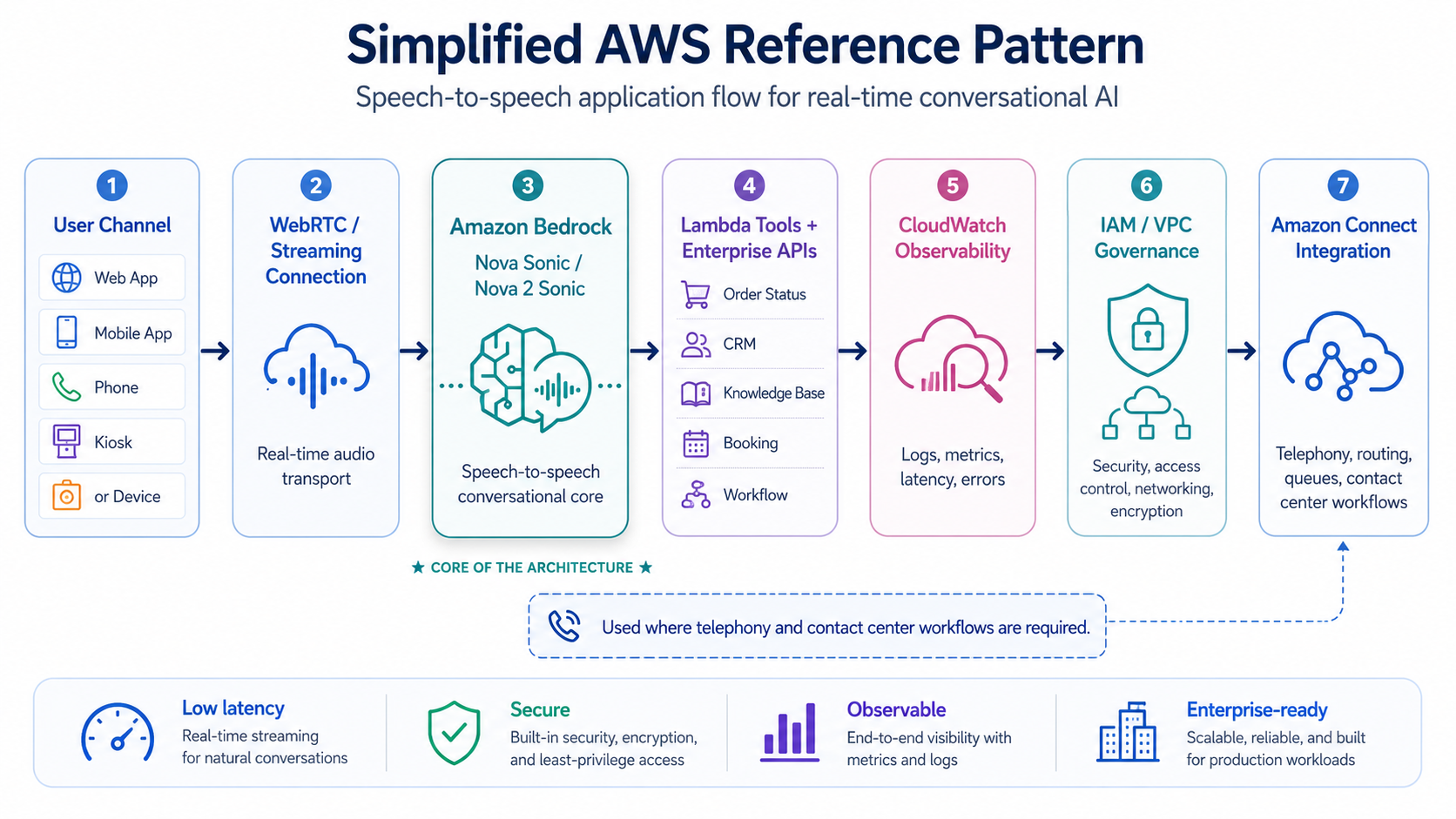
Simplified AWS Reference Pattern

10. Strong Architectures Treat the Model as the Conversational Core

The strongest AWS architectures will not treat the speech-to-speech model as a standalone demo.

They will treat it as the conversational core inside a secure, observable, integrated enterprise system.
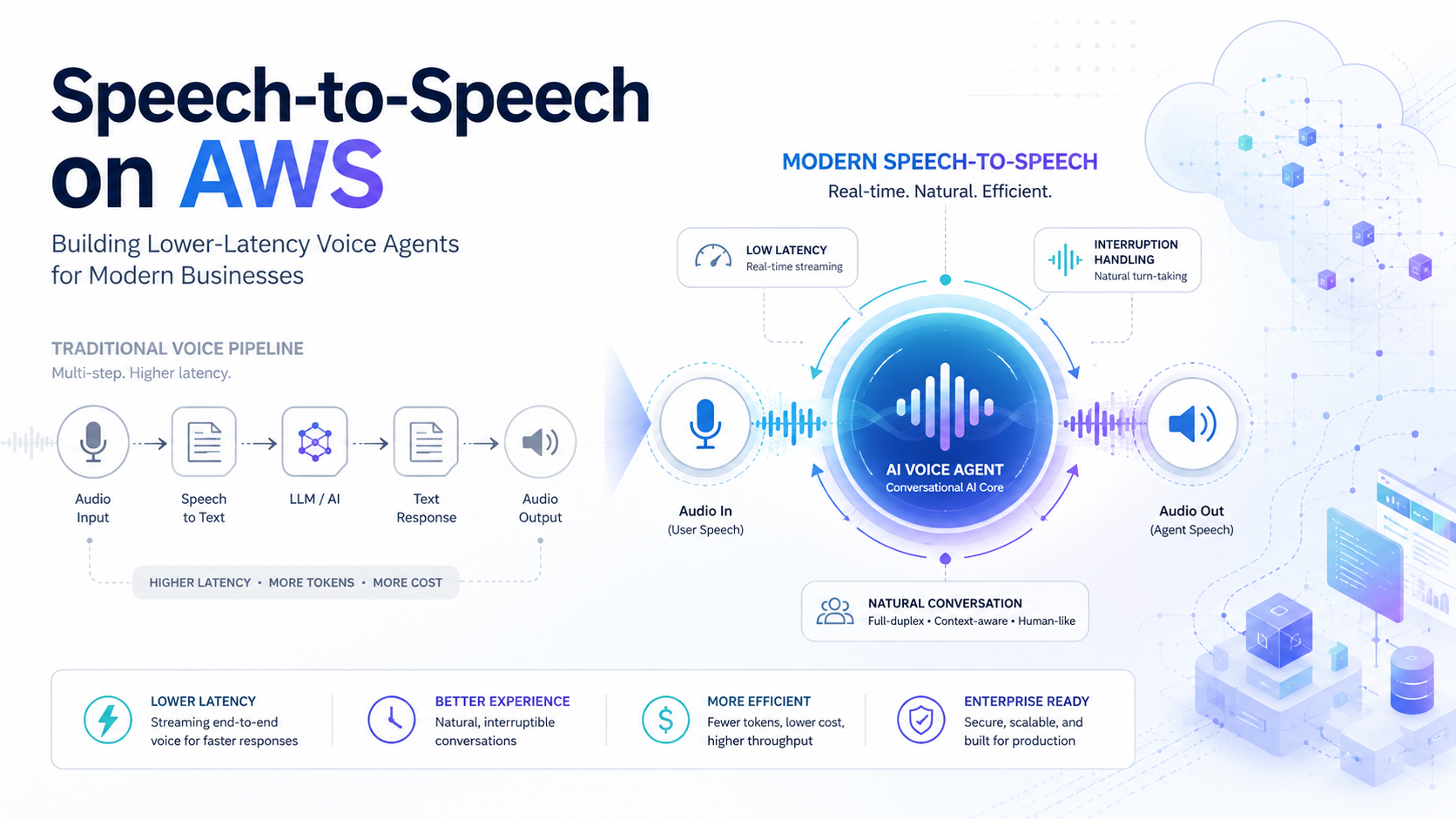
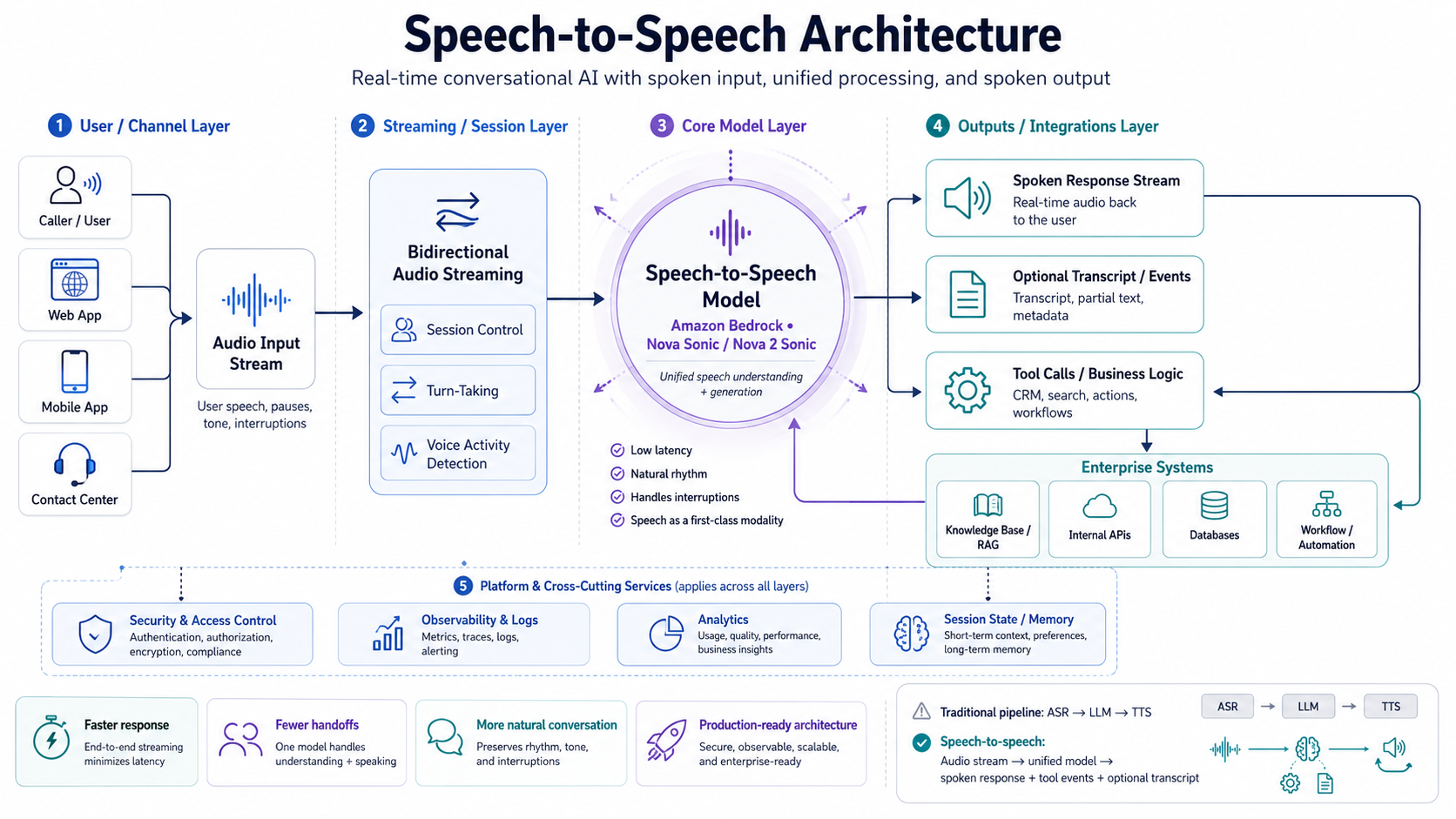
Pros and Cons Compared with Traditional Voice AI Solutions

Pros and Cons as compared with traditional Voice AI Solutions

How FAMRO helps

FAMRO supports SMEs and scaleups with cloud infrastructure design, AWS migration, DevOps automation, CI/CD, observability, cost optimization, and technical consulting. We help teams move from fragile infrastructure to scalable, reliable, and cost-aware cloud platforms.

Conclusion

Speech-to-speech represents an important architectural shift for real-time voice AI. It is not simply a replacement for transcription or text-to-speech. It changes how we design conversational systems by treating spoken interaction as the primary experience rather than an audio layer wrapped around a text chatbot.

For modern businesses, this shift matters. Customers expect fast, natural service. Employees expect internal tools that reduce friction instead of adding another interface. Field teams need hands-free guidance. Contact centers need automation that improves service quality without damaging trust. Healthcare, travel, education, and enterprise support teams need voice systems that can handle real human interaction, not just scripted commands.

AWS now provides a practical foundation for this shift through Amazon Bedrock, Amazon Nova Sonic, Nova 2 Sonic, Lambda, Amazon Connect, CloudWatch, IAM, and related cloud services. But successful implementation still requires architecture discipline. Teams must design for latency, interruption handling, tool execution, security, monitoring, compliance, cost, and lifecycle management from the beginning.

For SMEs and enterprises, the opportunity is to move beyond basic transcription workflows and build production-grade voice-agent architecture. That means designing systems that can listen, reason, act, respond, escalate, and improve over time.

Our team helps organizations design and implement AWS-based voice AI solutions that are secure, scalable, and commercially aligned. Whether you are modernizing a contact center, building a real-time virtual assistant, integrating voice agents with enterprise systems, or evaluating whether speech-to-speech is right for your use case, we can help you move from concept to production with confidence.

To help organizations get started, we offer a free initial consultation focused on your speech-to-speech and AWS voice-agent strategy—no obligation, no generic pitch.

If your organization is investing in real-time voice AI and wants confidence—not guesswork—now is the time to act.

🌐 Learn more: Visit Our Homepage

💬 WhatsApp: +971-505-208-240

Our solutions for your business growth

Our services enable clients to grow their business by providing customized technical solutions that improve infrastructure, streamline software development, and enhance project management.

Our technical consultancy and project management services ensure successful project outcomes by reviewing project requirements, gathering business requirements, designing solutions, and managing project plans with resource augmentation for business analyst and project management roles.

Read More
2
Infrastructure / DevOps
3
Project Management
4
Technical Consulting