Our Blog

Security Challenges in the Age of AI Bots and Agents

Security Challenges in the Age of AI Bots and Agents

Artificial intelligence has moved well beyond pilot projects and innovation labs. In many enterprises, bots already handle routine tasks, copilots assist employees with research and drafting, and emerging AI agents are starting to take action across business systems with limited human input. What once felt experimental is now becoming operational.

That shift matters because enterprise security is no longer only about protecting users, devices, applications, and data in the traditional sense. It is now also about managing software-driven actors that can read information, interpret requests, connect to internal tools, and trigger business actions at speed. For senior IT and security leaders, the challenge is not simply adding another technology category to the stack. It is understanding how AI changes the way work happens, how decisions are made, and how access is exercised across the enterprise.

The real concern is not that AI bots and agents are inherently unsafe. The concern is that they introduce a new operating model into environments that are often already complex, fragmented, and difficult to govern consistently. In that setting, even a useful AI capability can create risk if controls do not evolve with adoption.

Why This Topic Matters Now

This issue has become urgent because enterprise adoption is moving faster than most governance models were designed to support. Business units want productivity gains. Operations teams want automation. Customer-facing functions want quicker response times. Leadership wants measurable value from AI investments. All of that creates pressure to deploy bots and agents quickly.

But speed creates a familiar problem. New capabilities often reach the business before security teams have full visibility into how they work, what they connect to, what data they can touch, and what decisions they are allowed to make. In earlier waves of transformation, enterprises dealt with shadow IT, cloud sprawl, and SaaS proliferation. AI introduces a similar pattern, but with an important difference: these tools do not just store or display information. Increasingly, they can act on it.

That changes the risk profile in a meaningful way. A traditional application may expose data if configured poorly. An AI-enabled system may do that and also summarize the wrong information, send it to the wrong audience, trigger an unintended workflow, or make a recommendation that employees follow without questioning. The issue is not only access. It is action, scale, and trust.

This is why the topic matters now. Organizations are not preparing for a distant future. They are trying to secure a present reality in which AI is becoming part of daily operations, often before standards, ownership models, and control frameworks are fully mature.

What Bots, AI Agents, and Agentic Systems Are

The terminology around AI can create unnecessary confusion, so it helps to keep the definitions practical.

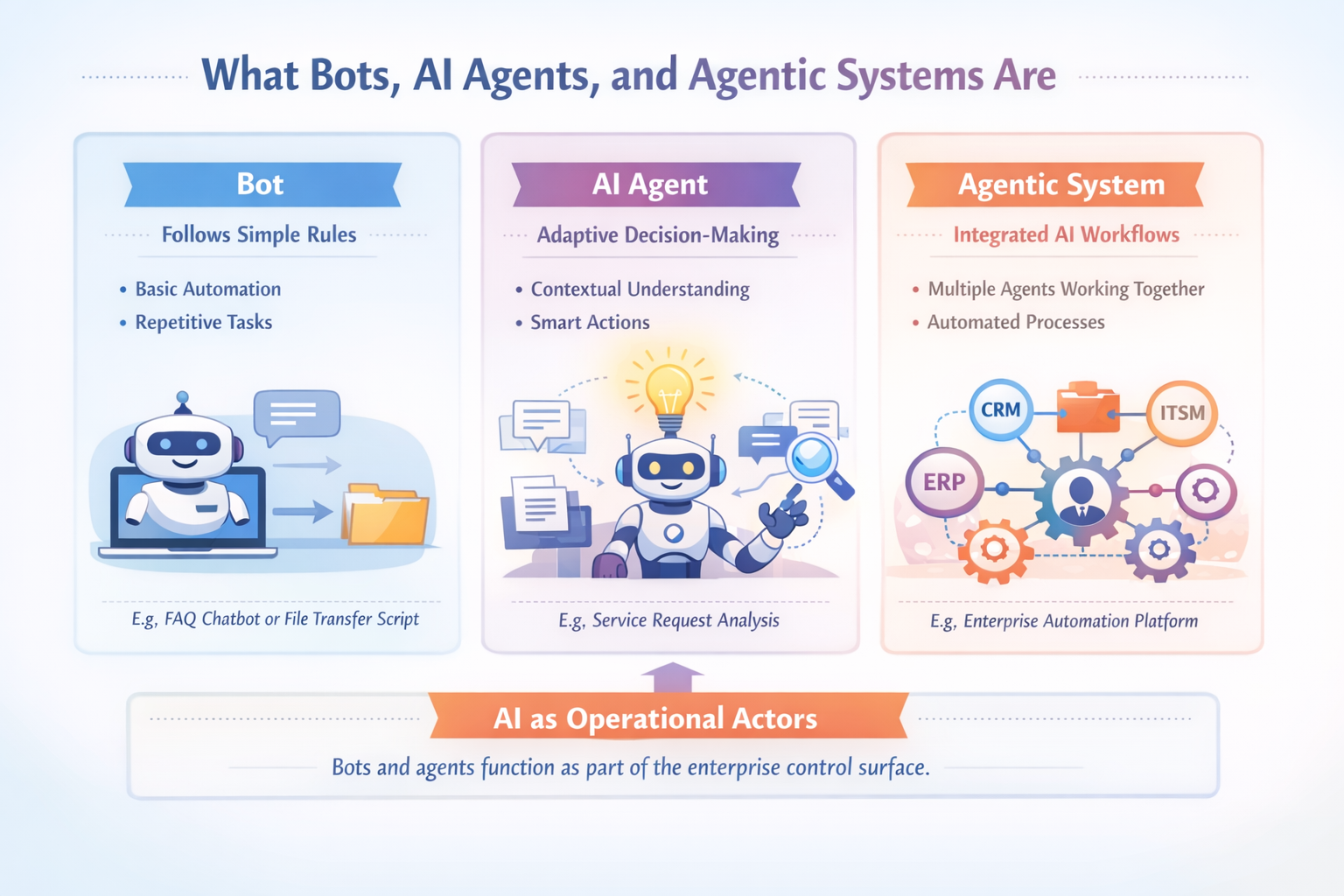
What Bots, AI Agents, and Agentic Systems Are

A bot is typically the simplest form of automation. It follows predefined rules to complete repetitive tasks. Think of a chatbot that answers common HR questions or a script that moves files from one system to another. Bots are useful, but they generally operate within a narrow set of instructions.

An AI agent goes further. Instead of only following fixed rules, it can interpret prompts, evaluate options, use available context, and decide on a next step within defined boundaries. For example, an AI agent might review a service request, check knowledge sources, query a ticketing platform, and recommend or initiate an action based on what it finds.

An agentic system is broader still. It refers to a setup where multiple AI-driven components, tools, and workflows work together toward a goal. In an enterprise setting, that could mean one agent gathering information, another validating policy conditions, and another triggering a task in a CRM, ERP, or ITSM platform. Human oversight may still exist, but the system is designed to carry out a sequence of decisions and actions with a degree of independence.

That distinction is important for security leaders. These are not just smarter interfaces layered onto existing software. They can influence workflows, move information between systems, and operate with credentials or permissions that give them meaningful reach. Once AI can access calendars, tickets, code repositories, knowledge bases, customer records, contracts, or financial systems, it becomes part of the enterprise control surface.

That is why AI bots and agents need to be treated as operational actors, not just productivity features.

Existing Enterprise Security Challenges

Before AI enters the picture, most large enterprises already manage a difficult security baseline.

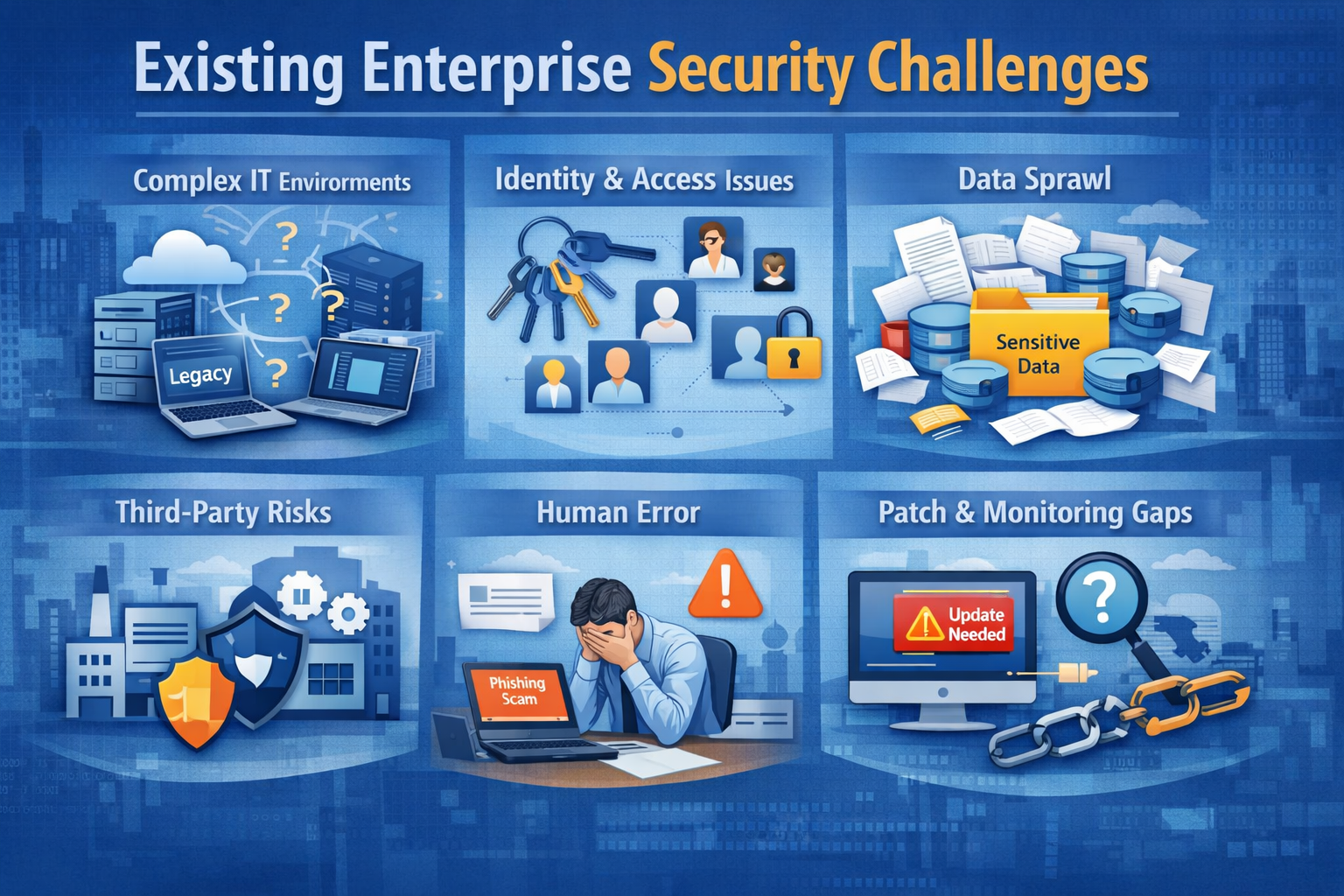
The first challenge is complexity. Enterprises run on a mix of legacy infrastructure, modern cloud services, SaaS platforms, partner integrations, remote endpoints, and specialized business applications. The larger the organization, the harder it becomes to maintain a clear, current map of who has access to what and how information flows across systems.

Existing Enterprise Security Challenges

The second challenge is inconsistent identity and access control. In many organizations, permissions accumulate over time. Users change roles, contractors come and go, and service accounts remain active longer than they should. Least-privilege access is a common goal, but it is not always consistently enforced.

The third challenge is data sprawl. Sensitive information exists in structured systems, collaboration platforms, emails, shared drives, data lakes, analytics tools, and third-party applications. It is often duplicated, poorly classified, or retained longer than necessary. Security teams may know the critical data sets, but not every place those data sets travel.

Supplier and third-party risk also remain major concerns. Vendors may integrate directly with core enterprise systems, process sensitive data, or provide services that are difficult to replace. That creates exposure beyond the direct control of internal security teams.

Human error continues to be another constant issue. Employees click, share, approve, upload, and configure things incorrectly. Most breaches do not happen because organizations lack security awareness entirely. They happen because people work quickly in complex environments and make understandable mistakes.

Then there is the operational reality of patching, visibility, and policy enforcement. Some systems are updated quickly, others are not. Monitoring may be strong in one environment and weak in another. Policy may be clear at the enterprise level but interpreted differently across business units. Security leaders are often trying to govern a business that is more decentralized than the policy model assumes.

This matters because AI does not arrive in a clean environment. It arrives in the middle of these existing weaknesses.

New Security Challenges Introduced by AI Bots and Agents

AI bots and agents introduce several risks that are distinct enough to deserve direct attention.

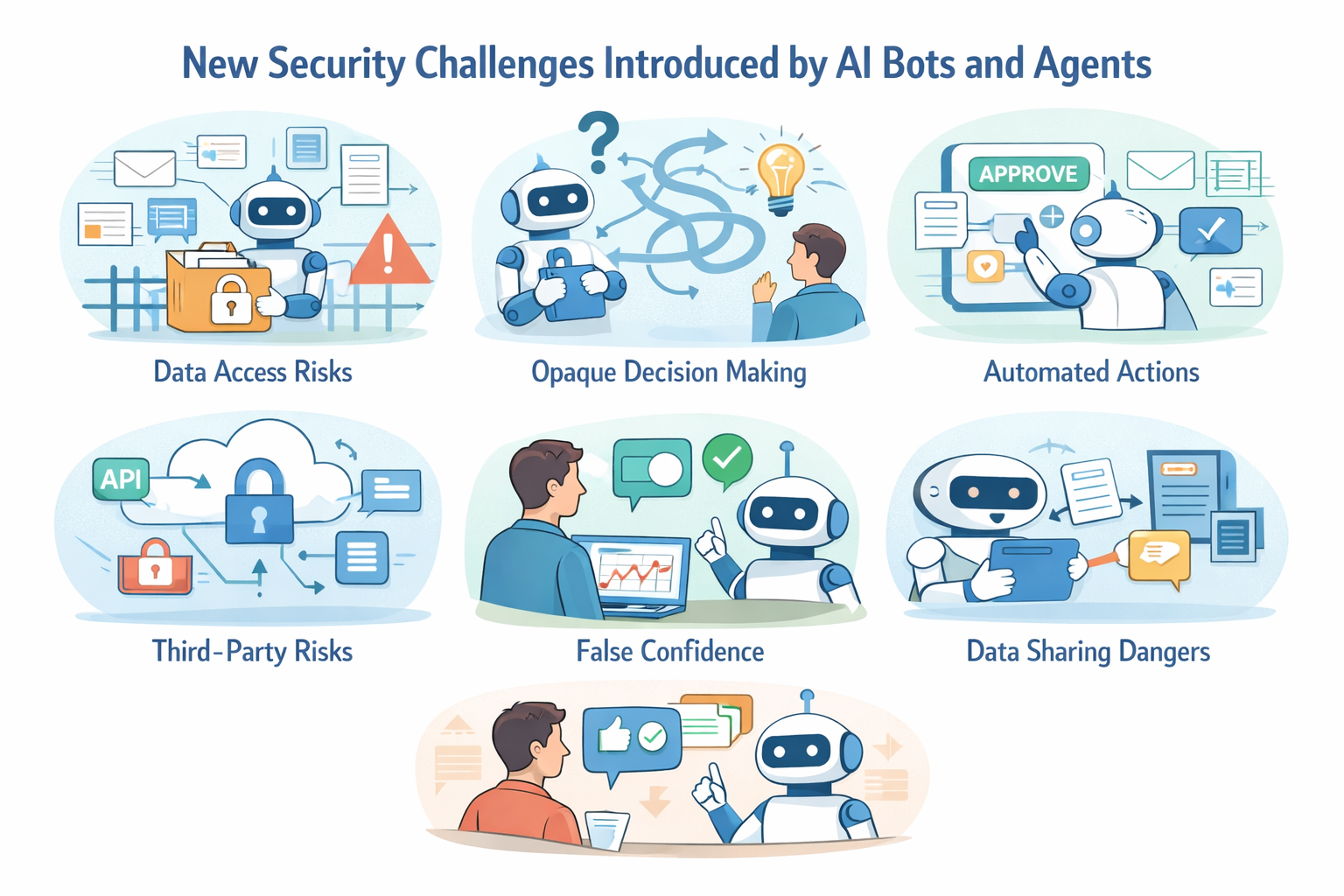
One of the biggest is uncontrolled access to internal data. For an AI tool to be useful, it often needs context. That context may come from documents, emails, knowledge repositories, tickets, customer records, or internal systems. If access boundaries are too broad, the tool may retrieve or expose data beyond its intended purpose. Even when the AI does not “leak” data externally, surfacing sensitive information to the wrong internal user is still a serious control failure.

New Security Challenges Introduced by AI Bots and Agents

Another challenge is unclear decision paths. Traditional automation usually follows explicit rules. AI agents can make choices based on prompts, context, and probabilistic outputs. That can make it harder to explain why a certain recommendation was made or why a workflow was triggered. In security and compliance terms, lack of explainability can quickly become a governance issue.

There is also the problem of weak oversight over automated actions. If an agent can open tickets, update records, send messages, approve requests, or initiate workflows, organizations need clarity around where human review is required and where it is not. Without that, small mistakes can scale quickly.

Third-party exposure is another major concern. Many AI capabilities rely on external platforms, APIs, plugins, or vendor-hosted services. That extends the enterprise attack surface and introduces questions about data handling, retention, model use, access logging, and security responsibilities. In some cases, business users may activate external AI services with little awareness of the enterprise implications.

A more subtle but equally important risk is unexpected information sharing. Employees may paste internal content into AI tools without understanding where that data goes, how long it is retained, or whether it becomes available beyond the original context. Even approved tools can create risk when usage patterns are not clearly governed.

Finally, AI systems can create false confidence. Because outputs are fluent and fast, users may assume they are accurate, approved, or safe. That trust can lead teams to act on incomplete or flawed recommendations without the level of review they would apply to a human-generated request.

How AI Agents Increase Existing Enterprise IT Risks

The most important point for enterprise leaders is that AI does not replace existing security issues. It amplifies them.

If identity management is already weak, AI agents can misuse excessive permissions faster than a human user ever could. A broadly privileged employee account is risky enough. A broadly privileged agent connected to multiple systems can magnify that risk through speed, frequency, and automation.

If monitoring is incomplete, AI-driven activity becomes harder to interpret. Traditional logs may show system access, but not always the business context behind an agent’s actions. Security teams may see that something happened without clearly understanding why it happened, what prompt initiated it, or whether the outcome matched policy.

If data governance is poor, AI expands the blast radius. A disorganized content environment with weak classification already creates exposure. Add an AI layer that can search, summarize, and move information, and the spread of sensitive data becomes much harder to contain.

If vendor governance is inconsistent, AI compounds supplier risk. Enterprises may depend on a growing network of model providers, orchestration tools, connectors, embedded AI features, and automation platforms. Each additional dependency can introduce new questions around security, resilience, compliance, and accountability.

If policy enforcement varies across departments, AI adoption will likely follow the same uneven pattern. One business unit may use approved tools with strong controls. Another may deploy AI-enabled processes with minimal review. That inconsistency creates gaps attackers can exploit and auditors will notice.

Even human error becomes more powerful in an AI environment. A poorly written prompt, an accidental approval, or an overly broad configuration can have much wider consequences when the system is designed to act at scale.

This is why AI should be seen as a force multiplier. It accelerates outcomes, but it also accelerates weaknesses.

Practical Ways Enterprises Can Reduce Risk

The good news is that enterprises do not need to pause AI adoption entirely to reduce risk. What they need is a more disciplined operating model.

The first priority is to tighten access. AI tools and agents should only have access to the data, systems, and actions required for a specific business purpose. This sounds simple, but it requires careful scoping of permissions, role design, and service account management. Broad default access should not be the starting point.

The second step is to define approval boundaries. Not every automated action should be treated the same. Some can be low risk and fully automated. Others should require human review, especially where customer impact, financial implications, or sensitive data are involved. Enterprises need clear rules for when an agent can recommend, when it can draft, and when it can act.

Third, organizations need formal policies for AI use. These should cover approved tools, restricted data types, acceptable use cases, prompt handling, third-party integrations, and escalation paths. Employees should not have to guess what is allowed.

Fourth, improve tracking and observability. Enterprises need better visibility into what AI tools access, what they generate, what actions they trigger, and how those actions are reviewed. Logging should go beyond technical events and support operational accountability.

Fifth, strengthen vendor review. Any AI platform or embedded AI feature that touches enterprise workflows should be assessed with the same seriousness applied to other critical technology providers. Security, privacy, retention, access control, incident response, and contractual clarity all matter.

Sixth, invest in employee guidance. Most AI risk in the enterprise will not begin with sophisticated attacks. It will begin with ordinary users trying to work faster. Clear training, realistic examples, and usable guardrails will reduce unsafe behavior far more effectively than broad warnings.

Finally, roll out AI in phases. High-value use cases should be prioritized, but security review needs to be built into deployment rather than added later. Controlled implementation helps teams learn where governance breaks down before the technology scales across the organization.

Recommended Tools for Enterprises

   1. Identity and access management tools
AI bots and agents become risky when they inherit broad or poorly controlled permissions. Platforms such as Okta, Ping Identity, SailPoint, and CyberArk help enforce single sign-on, role-based access, privileged access controls, and identity lifecycle management. The goal is to ensure AI systems only access the systems, files, and actions they truly need.

   2. Data security and data loss prevention tools
Since AI tools rely on enterprise data to deliver value, organizations need stronger controls over where sensitive data lives and how it is used. Solutions such as Microsoft Purview, Varonis, and similar platforms help classify information, apply protection policies, and reduce the risk of oversharing. Microsoft positions Purview’s Data Security Posture Management for AI as a way to secure data for AI apps and monitor AI use across copilots, agents, and generative AI applications.

   3. AI security posture management tools
As enterprises deploy AI across cloud environments and business platforms, they need visibility into configuration and runtime risk. Microsoft says Defender for Cloud offers AI security posture management to help secure generative AI apps and agents across multicloud and hybrid environments. Palo Alto Networks Prisma AIRS focuses on runtime protection against risks such as prompt injection, data leaks, tool misuse, and identity impersonation.

   4. Cloud and workload security tools
AI agents often connect to APIs, SaaS platforms, cloud storage, and internal applications. That makes cloud security platforms essential for finding exposed assets, risky configurations, and overly permissive identities before AI amplifies them. Microsoft positions Defender for Cloud as part of a broader cloud-native protection approach that extends posture management and workload security to AI workloads.

   5. Native AI platform governance controls
External security products matter, but built-in platform controls are equally important. For example, ChatGPT Enterprise and Edu provide administrative controls such as workspace analytics, role-based controls for apps and GPT access, and compliance logging. OpenAI documents that Enterprise and Edu workspaces can configure RBAC for apps, while app calls are logged through compliance logs.

   6. A layered control strategy
The strongest recommendation is not a single vendor but a layered approach. Enterprises should combine tools for identity, data protection, AI posture management, cloud visibility, and native platform governance. That gives leadership clearer answers to the questions that matter most: what the AI can access, what it can do, how it is monitored, and where risk needs approval or intervention.

Conclusion

AI bots and agents can deliver real business value, but that value only scales when governance, visibility, and control scale with it. For enterprise leaders, the priority is not to slow adoption. It is to introduce AI in a way that strengthens security discipline rather than exposing long-standing weaknesses at greater speed.

A practical path forward is to start with focused, lower-risk use cases and expand only when governance proves effective:

  - pick one domain such as operations, service management, or internal support

  - expose a small set of approved enterprise data sources and read-only actions behind strong identity controls and audit logging

  - define measurable outcomes such as faster triage, fewer manual handoffs, better response quality, or reduced context-gathering effort

  - expand to bounded write actions only after approval rules, observability, and accountability are working as intended

The value proposition is simple: use AI to improve speed and decision support without weakening oversight. That means treating bots and agents as operational actors, applying least-privilege access, strengthening observability, defining approval boundaries, and ensuring that vendor and platform controls meet enterprise expectations.

This is where FAMRO LLC can help. Based in the UAE, FAMRO LLC brings deep AI/ML and enterprise IT experience with a proven delivery track record. Our teams have worked hands-on with AI and machine learning systems since 2018, supporting organizations from early experimentation to production-scale deployment. We help enterprises move from AI ambition to controlled, enterprise-ready execution.

We support secure AI adoption end-to-end, including:

   1. AI readiness and risk assessment: identify high-value use cases, evaluate access exposure, and define realistic rollout priorities

   2. Secure architecture and implementation: design AI-enabled workflows with least-privilege access, bounded actions, and clear system ownership

   3. Identity, authorization, and approval design: apply enterprise IAM patterns, role-based access, and approval checkpoints for higher-impact actions

   4. Observability and operational controls: establish logging, monitoring, traceability, and review processes so AI activity is visible and accountable

   5. Governance and policy framework: define approved tools, data handling rules, third-party review standards, and operating models that support security and compliance expectations

   6. Delivery acceleration: help teams move from pilot to production with a phased, governed approach that supports innovation without losing control

To help organizations get started, we offer a free initial consultation focused on your AI environment, security posture, and enterprise adoption priorities.

If your organization is investing in AI bots and agents and wants confidence, accountability, and control built in from the start, now is the time to act.

🌐 Learn more: Visit Our Homepage

💬 WhatsApp: +971-505-208-240
Our solutions for your business growth

Our services enable clients to grow their business by providing customized technical solutions that improve infrastructure, streamline software development, and enhance project management.

Our technical consultancy and project management services ensure successful project outcomes by reviewing project requirements, gathering business requirements, designing solutions, and managing project plans with resource augmentation for business analyst and project management roles.

Read More
2
Infrastructure / DevOps
3
Project Management
4
Technical Consulting