Our Blog

REST API Development using RUST

REST API Development using RUST

Over the last decade, backend development has increasingly moved toward architectures that prioritize performance, reliability, and operational predictability. As organizations scale their services and integrate distributed systems, the cost of runtime inefficiencies and memory errors becomes significant.

Rust has emerged as one of the most discussed languages in this context. Originally developed for systems programming, Rust combines low-level performance with modern safety guarantees, enabling developers to write highly efficient applications without sacrificing maintainability.

Unlike traditional systems languages such as C or C++, Rust enforces memory safety through its ownership model, eliminating entire classes of runtime bugs such as null pointer dereferencing and data races. At the same time, it avoids the overhead of garbage collection common in many high-level languages.

For backend engineers, this balance is particularly compelling when building API services, data processing pipelines, and networked systems.

Key characteristics that drive Rust adoption in backend services include:

  - Memory safety without garbage collection

  - Predictable performance and low latency

  - Strong concurrency model

  - Modern dependency management via Cargo

  - Growing ecosystem of web frameworks

Zero Trust Architecture shifts the focus of cybersecurity from a network to an identity and context-based approach. Zero Trust does not remove trust; it removes implicit trust.

For small and medium enterprises (SMEs), Rust offers an opportunity to build high-performance backend services with long-term operational stability, reducing the risk of scaling bottlenecks that often emerge with rapid growth.
API Fundamentals and HTTP Standard Methods

Before discussing Rust frameworks, it is useful to briefly review how APIs function in modern backend systems.

An Application Programming Interface (API) acts as a communication layer between services, applications, or external clients. In most backend environments, APIs are implemented using the REST architectural style, which relies on HTTP as the transport protocol.

REST APIs expose resources through endpoints and use HTTP methods to define the action performed on those resources.

The most common HTTP operations include:

  GET
Purpose: Retrieve
Typical Use: Fetch records

  POST
Create data
Typical Use: Add a new resource

  PUT / PATCH
Purpose: Update data
Typical Use: Modify an existing record

  DELETE
Purpose: Remove data
Typical Use: Delete resource

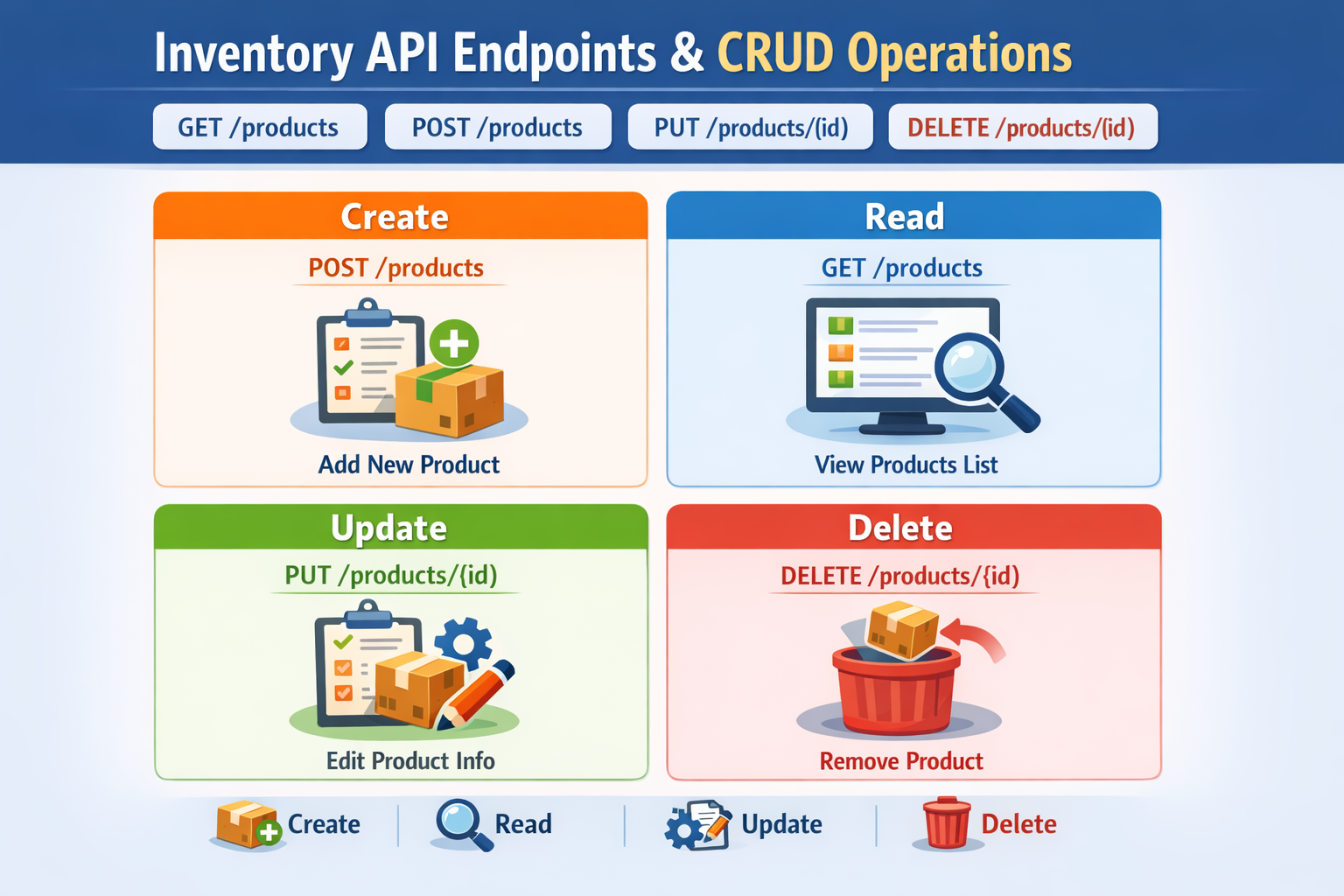
For example, an API managing products in an inventory system might expose endpoints such as:

GET /products

POST /products

PUT /products/{id}

DELETE /products/{id}

These operations correspond directly to CRUD actions:

  - Create

  - Read

  - Update

  - Delete

These operations correspond directly to CRUD actions

When designing APIs, developers also consider additional factors such as:

  - Authentication and authorization

  - Versioning strategy

  - Rate limiting

  - Error handling

  - Monitoring and observability

Rust frameworks support these concerns through middleware, typed request handling, and structured error management.

Advantages of Using Rust for API Development

From an architectural perspective, Rust provides several advantages that influence backend technology decisions.

Predictable Performance
Rust compiles directly to native machine code, enabling performance characteristics similar to C or C++. For API services processing high request volumes or performing computational work, this efficiency translates to lower infrastructure costs and improved response times.

Memory Safety
Rust’s ownership model prevents common memory issues at compile time. This eliminates entire classes of vulnerabilities such as:

  - Buffer overflows

  - Data races

  - Use-after-free errors

For backend services handling sensitive or mission-critical data, these guarantees significantly improve system reliability.

Concurrency Model
Modern backend systems rely heavily on asynchronous operations and concurrent workloads. Rust provides strong support for async/await programming, enabling high concurrency with minimal runtime overhead.

Libraries such as Tokio provide the asynchronous runtime used by many Rust web frameworks.

Dependency Management with Cargo
Rust projects rely on Cargo, a built-in package manager and build tool that simplifies dependency management.

Cargo provides:

  - Reproducible builds

  - Version locking

  - Automated testing support

  - Dependency auditing

For SMEs building maintainable services, this ecosystem helps reduce operational complexity over time.

Common Rust Frameworks for Building REST APIs

Rust’s web ecosystem has matured significantly, with several frameworks now commonly used to build backend APIs.

Rather than recommending a single solution, it is useful to understand how different frameworks approach API development.

Actix Web

Actix Web is known for its high performance and actor-based architecture. It uses asynchronous Rust and the Actix actor framework to process requests efficiently.

Characteristics include:

  + High throughput

  + Mature ecosystem

  + Strong production usage history

Axum

Axum is a modern web framework built on the Tower and Tokio ecosystem.

Key features include:

  + Type-safe request handling

  + Modular middleware

  + Integration with Tokio async runtime

  + Strong developer ergonomics

Rocket

Rocket emphasizes developer experience and compile-time guarantees.

Its design focuses on:

  + Simple routing syntax

  + Strong type safety

  + Automatic parameter validation

Working Example: CRUD API Using Axum and MongoDB

The following section demonstrates a simplified Rust API service using:

  + Axum framework

  + MongoDB database

  + Ubuntu 24.04 running on a GCP VM

Prerequisites
Before starting development, ensure the following components are available

  + GCP VM running Ubuntu 24.04

  + Rust toolchain installed

  + MongoDB database instance

  + Cargo package manager

  + Basic familiarity with terminal and Git

Step 1: Update Ubuntu Software
Login into SSH into GCP server. Update the Ubuntu software and libraries using the following code: sudo apt update sudo apt upgrade -y

Step 2: Install Rust Toolchain
Install Rust using rustup: curl https://sh.rustup.rs -sSf | sh source $HOME/.cargo/en Verify Installation: rustc --version cargo --version

Step 3: Install MongoDB
Install MongoDB on Ubuntu: sudo apt install mongodb -y sudo systemctl start mongodb sudo systemctl enable mongodb Verify service: sudo systemctl status mongodb

Step 4: Initialize Rust Project
Create a new Rust project using Cargo. cargo new rust-api cd rust-api Project structure: rust-api ├── Cargo.toml └── src └── main.rs

Step 5: Add Dependencies
Update Cargo.toml: [dependencies] axum = "0.7" tokio = { version = "1", features = ["full"] } serde = { version = "1", features = ["derive"] } serde_json = "1" mongodb = "2" tower = "0.4" These libraries provide:

  - Axum → web framework

  - Tokio → async runtime

  - Serde → serialization

  - MongoDB driver → database integration

Step 6: Define Data Model
Example product structure: use serde::{Serialize, Deserialize}; #[derive(Debug, Serialize, Deserialize)] struct Product { name: String, price: f64, } This structure represents a document stored inside MongoDB.

Step 7: Create API Routes
Example Axum routing configuration: use axum::{ routing::{get, post}, Router, }; fn app() -> Router { Router::new() .route("/products", get(get_products)) .route("/products", post(create_product)) } Routes map HTTP operations to functions that process requests.

Step 8: CRUD Handler Example
Example create handler: async fn create_product() -> &'static str { "Product created" } Example read handler: async fn get_products() -> &'static str { "List of products" } Production implementations would interact with MongoDB collections.

Step 9: Run the API
Start the server: cargo run The API will start on: http://localhost:3000

Step 10: Test the API
Test endpoints using curl.
Create product: curl -X POST http://localhost:3000/products Get products: curl http://localhost:3000/products For real environments, teams typically use tools such as:

  - Postman

  - Insomnia

  - automated integration tests

Conclusion

Building REST APIs with Rust is not only about adopting a fast and memory-safe programming language. It is about creating backend systems that are reliable, efficient, maintainable, and ready for real-world production demands.

For startups, SMEs, and growing digital businesses, API development is rarely an isolated task. A strong API must fit into a larger software ecosystem that includes application logic, cloud infrastructure, deployment pipelines, monitoring, scaling strategy, and operational support. The real value comes from building services that are not just functional in development, but dependable in production.

Rust offers a strong foundation for this kind of modern backend engineering. Its performance, safety model, and reliability make it a compelling choice for APIs that need to handle concurrency, reduce runtime failures, and support long-term scalability. But successful adoption also depends on how well the API is designed, deployed, integrated, and operated within the wider platform.

That is where FAMRO-LLC can help. We provide practical software engineering, cloud engineering, and DevOps services for organizations building modern digital products and platforms. Our team works across backend software development, cloud-native architecture, deployment automation, CI/CD implementation, containerized workloads, infrastructure design, and operational readiness. Whether a business is launching a new API-driven product, modernizing legacy services, or improving reliability across existing systems, we help turn technical goals into production-ready solutions.

Beyond software delivery, FAMRO-LLC supports organizations with hands-on cloud and DevOps expertise that helps ensure applications are deployed the right way from the start. From designing scalable cloud environments to implementing secure release pipelines, observability, infrastructure automation, and resilient service operations, we help businesses reduce engineering friction while improving delivery speed and system stability.

For companies that need both execution and strategic direction, our CTO-as-a-Service offering provides senior-level technology leadership without the cost of a full-time executive hire. We help evaluate architecture decisions, review software and infrastructure maturity, align engineering practices with business goals, and define practical roadmaps for growth.

If your organization is exploring modern API development, planning cloud-native software delivery, or looking to strengthen backend engineering and DevOps practices, FAMRO-LLC can be a strong technology partner. With the right combination of software engineering discipline, cloud architecture, and DevOps execution, Rust APIs can become part of a larger platform strategy built for performance, resilience, and growth.

To help organizations get started, we offer a free initial consultation focused on your current software architecture, cloud environment, delivery process, and operational priorities.
🌐 Learn more: Visit Our Homepage
💬 WhatsApp: +971-505-208-240

Our solutions for your business growth

Our services enable clients to grow their business by providing customized technical solutions that improve infrastructure, streamline software development, and enhance project management.

Our technical consultancy and project management services ensure successful project outcomes by reviewing project requirements, gathering business requirements, designing solutions, and managing project plans with resource augmentation for business analyst and project management roles.

Read More
2
Infrastructure / DevOps
3
Project Management
4
Technical Consulting