Our Blog

Release Engineering for ML

Release Engineering for ML

Machine learning (ML) is no longer “just an analytics project.” In many enterprises it now drives pricing, fraud detection, customer experience, forecasting, staffing, and risk decisions. That means ML changes are business changes—and business changes need disciplined release engineering.

Traditional software release practices don’t automatically translate to ML because the “thing” you’re releasing isn’t only code. It’s a moving combination of:

  Data (and its drift)

  Features

  Training code

  Model artifacts

  Serving configuration

  Runtime environments

  Monitoring and thresholds

When any of these shift without clear control, ML failures become expensive: production incidents, customer impact, regulatory exposure, and lots of rework. The fastest path to predictability is to treat ML like a product with a system of record and a repeatable promotion path. That’s exactly what registry-driven release engineering delivers.

1. Why ML Release Engineering Matters to CIOs and Finance

ML changes happen often, are difficult to audit, and are expensive when they fail. Unlike most traditional applications, ML can fail silently. When it fails, it tends to fail in ways that impact results directly: approvals decline, false positives skyrocket, revenue projections miss, customer journeys halt.

From a CIO and Finance lens, the issues typically show up as:

  + Unplanned operating cost: war rooms, escalations, vendor overtime, and internal context switching

  + Rework and duplication: retraining “just to fix it,” rerunning experiments, rebuilding pipelines after a missed dependency

  + Low predictability: delivery dates slip because deployments are manual, environment-specific, and fragile

  + Audit and compliance burden: “prove what was in production last month” becomes a multi-week scramble

  + Revenue and customer impact:outages or degraded decisions translate to lost conversions, churn, or operational disruption

What disciplined releases do financially:
A release-engineering mindset for ML is essentially a cost-control and predictability program:

  + Lower incident costs: through standardization and fast rollback paths

  + Avoid rework: by making model versions reproducible and deployable across environments

  + Improve spend predictability: by reducing “unknown unknowns” in production and enabling consistent release cadence

  + Make outcomes measurable: by tying changes to versioned artifacts and observable production impact

This is not process for process’ sake. It’s a way to convert ML from “science projects with risk” into operational products with governed change.

Model Registry as the System of Record for What’s in Production”

A model registry is the enterprise catalog of model versions and the artifacts required to operate them. In mature organizations, it becomes the authoritative answer to:

“Which model is running in production, how was it built, and what evidence supported its release?”

What a registry represents in an enterprise setting
A registry should hold (or reference) the items that define a deployable model version:

  + Model binary/artifact (e.g., serialized model)

  + Metadata: version, owner, purpose, business domain

  + Training context: code commit, training dataset reference, feature definitions

  + Evaluation results: metrics, fairness checks (where required), performance thresholds

  + Operational configuration: serving parameters, feature flags, resource profiles

  + Approval state: candidate/approved/deployed, who approved, when, why

Scope boundaries: registry vs feature store vs pipelines
A lot of ML programs blur responsibilities. Clarity matters:

  + Model registry: “What is this model version, what evidence backs it, and what is its release state?”

  + Feature store: “What features exist, how are they computed, and how are they served consistently between training and inference?”

  + Training pipelines: “How do we build and test models repeatedly?”

  + Deployment/orchestration: “How do we release models to environments safely and consistently?”

The registry isn’t trying to replace these systems. It’s the control plane for production promotion. Registry-centric operations remove ambiguity, reduce tribal knowledge, and create a single place to anchor governance.

Registry-Driven Deployment Flow: From Candidate to Production

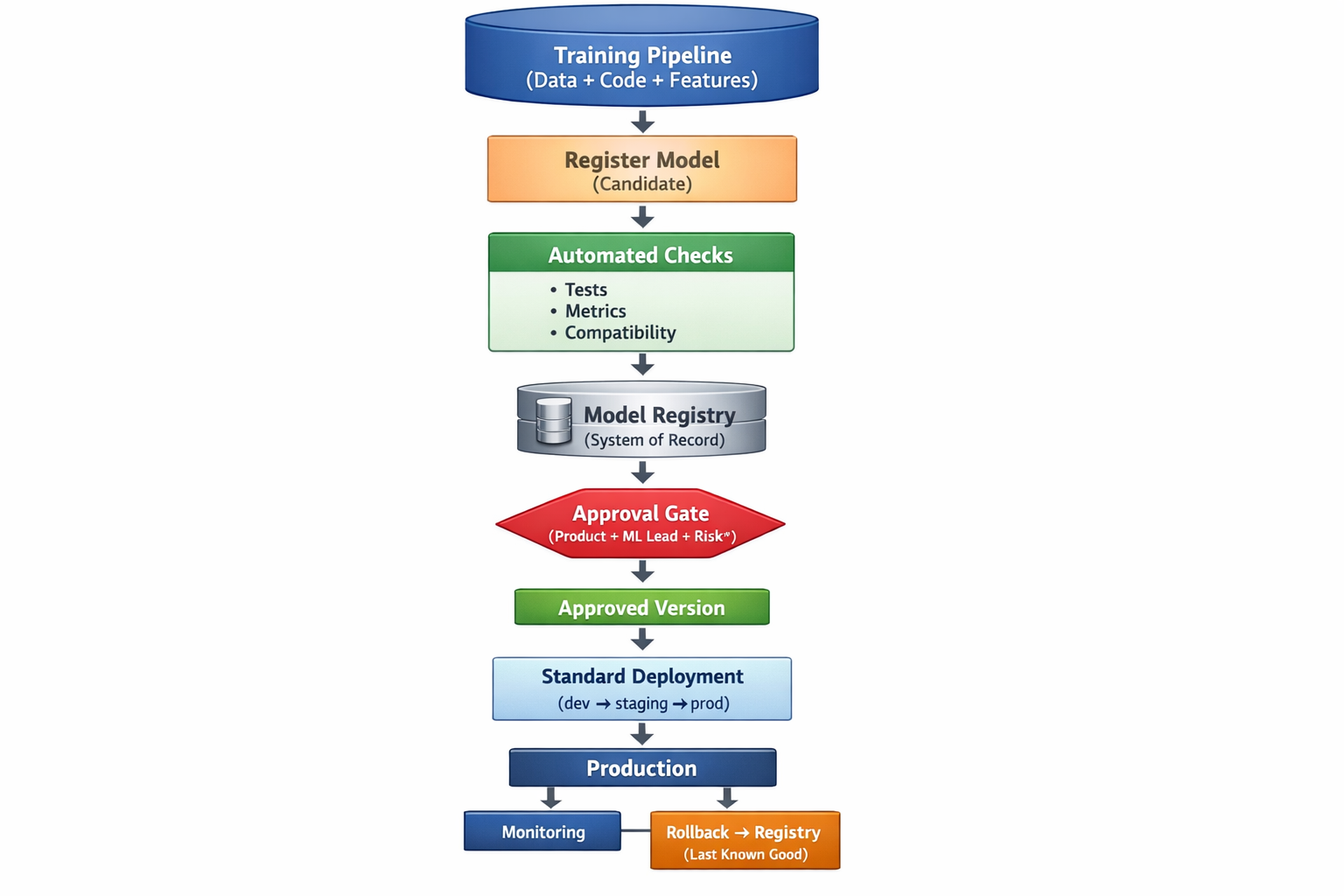
The release path should be simple enough to repeat, strict enough to trust. A practical registry-driven flow looks like this:

Release Engineering for ML

1. Candidate:
A model version is registered as a candidate when it passes baseline checks:

  + Unit/integration tests for serving code

  + Validation on holdout data

  + Compatibility checks (schema, feature expectations, contract tests)

  + Minimum performance thresholds

2. Approved:
A candidate becomes approved when required evidence is attached and the right stakeholders sign off.

3. Deployed:
Only approved versions can be deployed. Deployment should be standardized:

  + Packaging: consistent runtime containerization or model package format

  + Environment targeting: dev → staging → prod, with parity and immutable versions

  + Configuration: externalized configs, no “one-off” manual edits

  + Repeatability: same promotion mechanism every time, regardless of team

This approach turns deployments into a controlled promotion of a known registry entity—rather than a human-driven copy/paste exercise.

The business benefit is straightforward: fewer surprises, faster releases, and less variability in delivery and cost.

Reducing Risk Without Slowing the Business

Governance fails when it’s heavy, inconsistent, or disconnected from outcomes. The goal is pragmatic control: enough rigor to reduce risk, not enough friction to stop delivery.

A lightweight approval model that works in enterprises

Who signs off

  + Model owner / Product owner: confirms business intent, expected impact, and acceptance criteria

  + ML lead / Engineering lead: confirms technical readiness, test coverage, operational fit

  + Risk/Compliance (as required): only for regulated domains or high-impact models

  + Finance involvement: usually not per-release approval, but as a consumer of cost and predictability reporting (unless the model materially affects financial reporting, pricing, or regulated decisions)

What evidence should be required (minimum viable governance)

Keep it short, consistent, and mostly automated:

  + Registry entry with versioned artifacts

  + Evaluation report (key metrics + comparison to current production baseline)

  + Data/feature compatibility checks

  + Operational readiness checklist (monitoring, alert thresholds, rollback plan)

  + Change note: what changed and why (one paragraph, not a novel)

Why CIOs and Finance like this

  + Fewer production surprises: approvals are tied to evidence, not opinions

  + Clear accountability: every release has an owner and an approval trail

  + Stable operating costs: fewer emergency fixes, less firefighting, more predictable delivery

Rollbacks and Safe Change: Designing for Failure as a Cost Lever

In production, “failure” isn’t optional—you’re just deciding whether it’s expensive.

Rollback strategy is one of the highest ROI capabilities you can build because it directly reduces.

  + Downtime duration

  + Customer impact

  + Engineering time in incident response

  + Escalations and reputational damage

Operational rollback strategies that work

  + Revert to a prior registered version: “last known good” promoted back to deployed state

  + Controlled traffic shifts: canary releases, gradual rollout, automated rollback on metric regression

  + Known-good baselines: keep a stable version pinned and tested as a fallback

  + Shadow deployments: validate inference behavior without influencing decisions (where feasible)

Translate it to business impact
Faster recovery means:

  + Lower incident cost

  + Fewer SLA penalties

  + Less lost revenue from degraded decisions

  + Reduced operational churn and overtime

If Finance wants a simple way to justify release engineering investment: measure incident minutes avoided.

Lineage and Auditability: Proving What Changed, When, and Why

Lineage is traceability across the full release chain:

  + Data versions and sources

  + Feature definitions and transformations

  + Code commits and dependencies

  + Model version and parameters

  + Tests, evaluations, and approval evidence

  + Deployment events and configuration

  + Monitoring signals and incident timelines

Why lineage matters beyond compliance
Audit is the obvious win—but lineage also enables:

  + Post-incident reviews that lead to prevention, not a guesswork

  + Faster root-cause analysis because changes are tied to versioned artifacts

  + Financial governance by attributing costs and outcomes to specific releases

  + Reduced manual documentation because the system generates the evidence trail automatically

When you don’t have lineage, you pay for it later—in time, confusion, and risk.

Conclusion

You don’t need a perfect MLOps platform to get value. Start with three moves that create immediate control and reduce incident risk:

  1. Make the model registry the gate for production promotion. If it’s not in the registry with the required metadata, it doesn’t ship.

  2. Define minimum approval evidence. One standard evaluation summary, compatibility checks, and an owner sign-off.

  3. Publish a rollback playbook and practice it. Revert to prior registered versions, define “known-good,” and rehearse traffic shifts.

What to measure over time

  Release lead time: candidate → deployed

  Rollback frequency: and what triggered it

  Incident duration: MTTR for ML-related issues

  Operational overhead: hours spent per release, per incident

  Change failure rate: deployments that cause user-visible impact

If you can make releases repeatable, approvals lightweight, and rollbacks fast, you convert ML from a variable cost center into a predictable operational capability. That’s the language both CIOs and Finance understand—and it’s where release engineering pays for itself.

If your ML program is already influencing revenue, risk, or customer experience, then every “small model tweak” is a business change—whether it’s treated that way or not. The fastest way to reduce surprise costs is to stop shipping ML like an experiment and start releasing it like a product: registry-gated promotion, lightweight approvals, and a tested rollback path.

FAMRO-LLC Services helps enterprises implement this pragmatically—without boiling the ocean. We typically start with a focused, high-impact step:

  Make your model registry the single gate to production (system of record for “what’s running”)

  Put a rollback playbook in place (revert-to-known-good, controlled traffic shifts)

From there, we help you prove the value in business terms by tracking: release lead time, incident duration (MTTR), rollback frequency, and operational overhead per release—the metrics that translate directly into predictable spend and fewer production surprises.

If you’re ready to make ML releases auditable, repeatable, and cost-stable, FAMRO-LLC Services can assess your current ML delivery flow, identify the highest-risk gaps, and stand up a registry-driven release path that your CIO can govern and Finance can trust.
🌐 Learn more: Visit Our Homepage
💬 WhatsApp: +971-505-208-240

Our solutions for your business growth

Our services enable clients to grow their business by providing customized technical solutions that improve infrastructure, streamline software development, and enhance project management.

Our technical consultancy and project management services ensure successful project outcomes by reviewing project requirements, gathering business requirements, designing solutions, and managing project plans with resource augmentation for business analyst and project management roles.

Read More
2
Infrastructure / DevOps
3
Project Management
4
Technical Consulting