Our Blog

How to Evaluate AI-Generated Code Using Rubrics

How to Evaluate AI-Generated Code Using Rubrics

AI can generate working code in seconds. That speed is useful, but it also creates a new review problem for engineering teams. Too often, AI-generated code gets approved because it appears polished, passes a happy-path test, or produces the expected output in a quick demo.

That is not enough.

The real risk with AI-generated code is not that it fails loudly. It is that it often looks correct long before it is actually safe, reliable, or maintainable.

For SMEs and scale-ups, this matters even more. Smaller engineering teams usually have less room for hidden technical debt, fragile code paths, or security mistakes introduced under delivery pressure. If AI is now part of your development workflow, your review process needs to become more structured as well.

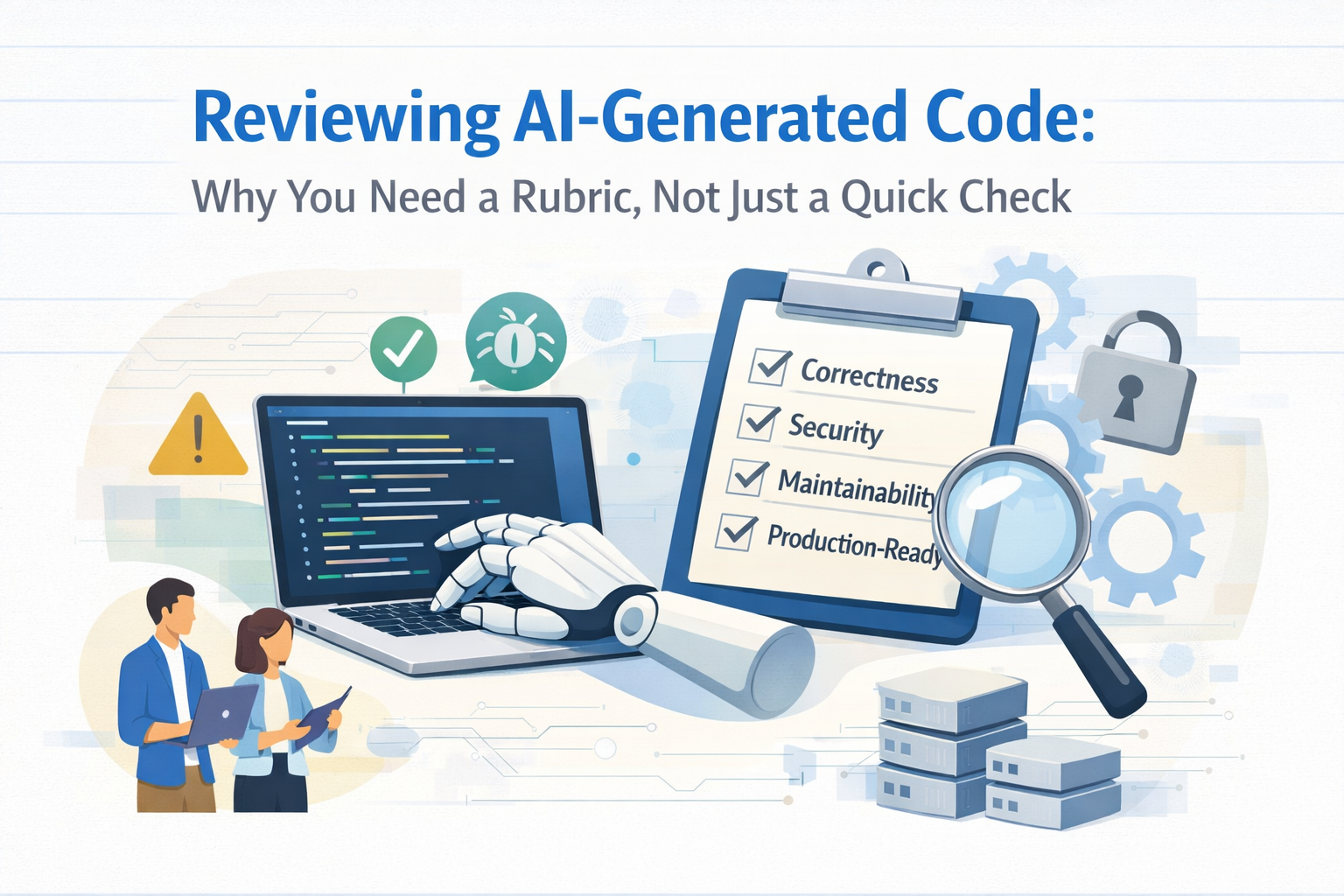
That is where rubric-based evaluation helps. A rubric gives teams a repeatable way to judge whether AI-generated code is merely functional or genuinely ready for use. It replaces casual review with a more disciplined standard built around correctness, security, maintainability, and production-readiness.

What is a rubric in software engineering?

In software engineering, a rubric is a structured scoring guide used to evaluate quality against defined criteria. Instead of relying on vague feedback such as “looks fine” or “seems okay,” reviewers assess code against a consistent set of standards.

In plain terms, a rubric is a checklist plus a scoring system for quality.

For example, rather than reviewing AI-generated code with a general impression, a team might score it across areas like:

  - correctness

  - edge-case handling

  - security

  - readability

  - maintainability

  - testability

  - production readiness

This creates two immediate benefits. First, it improves consistency across reviewers. Second, it makes approval decisions easier to justify, especially when teams are under pressure to move quickly.

Why AI-generated code needs structured evaluation

AI-generated code often passes superficial review because it is good at producing something that looks complete. It may use familiar frameworks, readable naming, clean formatting, and apparently sensible structure. That presentation layer creates false confidence.

The problem is that quality in production software is rarely about appearance.

A code snippet can look professional while still containing serious weaknesses:

  - logic that only works on ideal inputs

  - missing validation for malformed or unexpected data

  - insecure defaults

  - inadequate authorization checks

  - brittle assumptions about request shape or environment

  - poor error handling

  - low observability

  - code that is hard to extend or support later

This is especially common with LLM-generated output because models optimize for plausible completion, not deep ownership. They can generate a convincing answer without fully reasoning through operational realities.

That is why “it runs” and “it is production-ready” are two very different judgments.

Common problems in AI-generated code

Engineering teams reviewing AI-assisted output tend to see the same patterns repeatedly.

1. Correct on the happy path, weak on edge cases

The code works for the example in the prompt, but breaks when given missing fields, invalid formats, empty values, oversized inputs, or unexpected states.

2. Poor input validation

AI-generated code often assumes that input is clean. In real systems, it rarely is. Weak validation leads to runtime errors, bad data, and security issues.

3. Missing authentication or authorization checks

A generated endpoint may perform the business action correctly while ignoring who is allowed to perform it.

4. Unsafe database or file handling

This can show up as unsafe query construction, insecure file operations, weak path handling, or assumptions that external input is trustworthy.

5. Brittle assumptions about data shape

Generated code may assume a field always exists, that a value is always numeric, or that an external service always returns the expected schema.

6. Incomplete error handling

Many examples return success responses cleanly but provide poor failure behavior. They may crash, leak internal messages, or return inconsistent responses under error conditions.

7. Unnecessary complexity

AI sometimes introduces extra abstractions, helper layers, or patterns that add little value. The result technically works, but is harder to maintain.

8. Weak package or framework choices

The code may rely on outdated, unnecessary, or poorly justified dependencies.

9. Low testability

Tight coupling, hidden side effects, and unclear boundaries make the code difficult to verify.

10. Hard-to-own code

This is one of the biggest business risks. Even if the code works today, the team may not want to support it six months from now.

Example rubric for evaluating AI-generated code

A practical rubric should be simple enough for teams to use regularly, but strong enough to catch the real risks. A 1-to-5 scoring model works well because it is easy to apply in pull requests and team reviews.

Here is a useful starting rubric.

Correctness — Does the code solve the required task accurately? — 1–5

Instruction adherence — Did it follow the prompt and business requirement properly? — 1–5

Edge-case handling — Does it handle invalid, missing, or unusual inputs safely? — 1–5

Security — Are obvious vulnerabilities, unsafe defaults, or risky patterns avoided? — 1–5

Readability — Is the code understandable for a human reviewer? — 1–5

Maintainability — Can the team realistically modify and support it later? — 1–5

Performance — Is the approach reasonable for expected usage and scale? — 1–5

Testability — Can the code be validated easily with unit or integration tests? — 1–5

Production readiness — Does it include proper validation, logging, error handling, and configuration discipline? — 1–5

A sample score might look like this:

Correctness — 4/5

Edge-case handling — 2/5

Security — 3/5

Maintainability — 4/5

Production readiness — 2/5

That tells a much clearer story than “the code seems fine.”

Worked example: evaluating AI-generated Python code

Let us take a simple prompt:

   Prompt: Write a Python Flask endpoint that accepts two numbers and returns their sum as JSON.

A typical AI-generated answer might look like this:

from flask import Flask, request, jsonify
app = Flask(__name__)
@app.route('/sum', methods=['POST'])
def sum_numbers():
    data = request.get_json()
    a = data['a']
    b = data['b']
    return jsonify({"result": a + b})
if __name__ == '__main__':
    app.run(debug=True)

At first glance, this looks fine. It is short, readable, and works for a basic request like:

{
  "a": 5,
  "b": 7
}

The response will correctly return:

{
  "result": 12
}

A casual review might approve this quickly. A rubric-based review would not.

Quick review

The code is functionally correct for the happy path, but it misses several practical concerns:

  - no validation that JSON exists

  - no check that a and b are present

  - no type validation

  - no error handling for malformed requests

  - no handling for string inputs or null values

  - debug mode enabled

  - no structured logging

  - no clear production configuration pattern

Rubric-based scoring

  - Correctness — 4/5 — Works for expected numeric inputs

  - Instruction adherence — 5/5 — It does what the prompt requested

  - Edge-case handling — 1/5 — Missing validation and failure handling

  - Security — 2/5 — Debug mode should not be used in production

  - Readability — 5/5 — Easy to read

  - Maintainability — 3/5 — Simple, but lacks defensive structure

  - Performance — 5/5 — Fine for this use case

  - Testability — 3/5 — Testable, but not designed with error scenarios in mind

  - Production readiness — 1/5 — Missing validation, logging, and safe configuration

What the code missed

This is the key lesson. The code works, but it is not production-ready. That gap is exactly what a rubric exposes.

Now compare it to an improved version:

from flask import Flask, request, jsonify
import logging
import os
app = Flask(__name__)
logging.basicConfig(level=logging.INFO)
logger = logging.getLogger(__name__)
@app.route('/sum', methods=['POST'])
def sum_numbers():
    data = request.get_json(silent=True)
    if not data:
        return jsonify({"error": "Invalid or missing JSON body"}), 400
    if 'a' not in data or 'b' not in data:
        return jsonify({"error": "Fields 'a' and 'b' are required"}), 400
    try:
        a = float(data['a'])
        b = float(data['b'])
    except (TypeError, ValueError):
        return jsonify({"error": "'a' and 'b' must be numeric"}), 400
    result = a + b
    logger.info("Sum calculated successfully")
    return jsonify({"result": result}), 200
if __name__ == '__main__':
    debug_mode = os.getenv("FLASK_DEBUG", "false").lower() == "true"
    app.run(debug=debug_mode)

This version is still simple, but it is much stronger operationally. It validates input, handles malformed requests, avoids hardcoded debug assumptions, and includes basic logging.

That is the difference between code generation and engineering judgment.
What rubric-based review reveals that casual review misses

Casual review tends to focus on whether code runs. Rubric-based review focuses on whether code deserves to be trusted.

That shift reveals issues that quick checks often miss:

  - hidden assumptions about data shape

  - failure behavior under invalid input

  - lack of monitoring or logging

  - unsafe development defaults in production contexts

  - maintainability problems that become expensive later

  - missing controls that matter under real user traffic

This is why teams can get into trouble with AI-generated output. It passes a demo, enters the codebase, and only later creates bugs, support overhead, or security exposure.

Rubrics force deeper review before those problems become operational costs.

How teams can use rubrics in real workflows

To be useful, a rubric cannot stay theoretical. It needs to fit into day-to-day engineering workflow.

A practical implementation often looks like this:

  - Pull request review

Add a lightweight rubric section to PR templates when AI-generated code is involved. Reviewers assign simple scores or mark risk areas explicitly.

  - Merge thresholds

Set minimum approval standards. For example, production-bound code may require no score below 3 in security, maintainability, and production readiness.

  - Different standards for different contexts

Not all code needs the same threshold. A temporary internal prototype does not need the same rigor as a customer-facing billing service.

  - Combine rubric review with automation

Rubrics are not a replacement for tooling. They work best when combined with:

  - linting

  - unit and integration tests

  - dependency scanning

  - static analysis

  - secrets detection

  - security review where appropriate

  - Build shared review language

Rubrics help scale decision-making across teams. Instead of debating code quality in vague terms, reviewers can speak in a common framework.

For SMEs and scale-ups, this is valuable because it reduces inconsistency as teams grow. It also helps less experienced reviewers evaluate AI-assisted code with more confidence.

Rubrics for different levels of software maturity

One of the most practical ways to apply rubrics is to adjust them based on business criticality.

   Prototype stage

At this stage, the focus is usually on:

   speed

   basic functional correctness

   understandable code

Security and resilience still matter, but the threshold may be lower if the system is isolated and non-critical.

   Internal tool stage

Now the bar should rise. Teams should add stronger expectations around:

   error handling

   maintainability

   basic security controls

   testability

Internal tools often become more important than originally planned. Review standards should reflect that risk.

   Production stage

For customer-facing or revenue-critical systems, the rubric should require stronger scores in:

   security

   observability

   resilience

   test coverage

   configuration discipline

   performance suitability

   ownership readiness

This matters for scale-ups in particular. The cost of weak review rises sharply once software affects customers, compliance obligations, or operational uptime.

What rubric-based evaluation does not replace

Rubrics are useful, but they are not magic.

They do not replace engineering judgment. A senior reviewer still needs to understand architecture, trade-offs, and context.

They do not replace tests. Code that scores well still needs automated verification.

They do not replace architecture review. A clean code snippet can still be the wrong design choice.

They do not replace security validation. Sensitive workflows need deeper security analysis than a general rubric alone can provide.

What rubrics do provide is consistency. They reduce vague approvals, improve accountability, and lower the chance that convincing-looking code slips through without proper scrutiny.

Practical takeaway for startups and SMEs

AI coding tools can absolutely accelerate delivery. Used well, they help teams move faster, draft boilerplate, explore approaches, and reduce repetitive work.

But speed without structure creates hidden technical debt.

For SMEs and scale-ups, that debt can be expensive. Small teams often do not have the spare capacity to continuously rework fragile code, trace avoidable failures, or clean up rushed implementations after release.

Rubric-based evaluation creates a practical governance layer. It helps teams review AI-generated code in a way that is repeatable, measurable, and aligned with business risk.

That matters especially when the software is:

  - customer-facing

  - compliance-sensitive

  - integrated with core operations

  - revenue-critical

  - expected to scale beyond its first version

In those environments, the real question is not whether AI generated the code quickly. The real question is whether your team can trust, support, and evolve it.

Conclusion

AI-generated code should not be judged by whether it appears impressive, but by whether it meets the standards required for real-world use.

That is the value of rubrics.

They help engineering teams move from casual approval to structured evaluation. They expose risks that demos miss. They create shared quality standards. And they give businesses a more reliable way to benefit from AI-assisted development without quietly accumulating operational risk.

Used properly, a rubric does not slow teams down. It helps them move fast without lowering the standard of what enters production.

At FAMRO, we help businesses move beyond fast code generation toward production-ready software engineering. That includes architecture review, AI code quality assessment, backend hardening, cloud deployment, DevOps, and the engineering discipline needed to turn promising AI-generated output into reliable systems.

To help teams get started, we offer a free initial consultation focused on your current specific use case.
🌐 Learn more: Visit Our Homepage
💬 WhatsApp: +971-505-208-240

Our solutions for your business growth

Our services enable clients to grow their business by providing customized technical solutions that improve infrastructure, streamline software development, and enhance project management.

Our technical consultancy and project management services ensure successful project outcomes by reviewing project requirements, gathering business requirements, designing solutions, and managing project plans with resource augmentation for business analyst and project management roles.

Read More
2
Infrastructure / DevOps
3
Project Management
4
Technical Consulting