Our Blog

How AWS Speech-to-Text Services Power Meeting Transcripts, Call Analytics, and Real-Time Captions

How AWS Speech-to-Text Services Power Meeting Transcripts, Call Analytics, and Real-Time Captions

Brief Introduction to AWS Speech-to-Text Services

Voice is one of the richest sources of business information, but for many organizations, it remains underused. Meetings happen, customer calls are completed, training sessions are recorded, podcasts are published, interviews are conducted, and support conversations take place every day. Yet much of that spoken information is difficult to search, analyze, share, or reuse unless it is converted into text.

That is where speech-to-text becomes valuable.

Speech-to-text is the process of converting spoken audio into written text. In practical business terms, it turns conversations into searchable, reviewable, and reusable records. Instead of manually listening to a one-hour meeting to find one decision, teams can search the transcript. Instead of relying only on call summaries entered by agents, managers can review actual customer language. Instead of making live sessions inaccessible to some users, businesses can provide real-time captions.

For founders, CTOs, technical senior managers, and business owners, speech-to-text is no longer just a productivity feature. It is becoming part of how modern organizations document knowledge, improve customer experience, automate workflows, support compliance, and build AI-enabled products.

AWS provides a strong set of services for building these workflows, with Amazon Transcribe at the center of its speech-to-text capabilities.

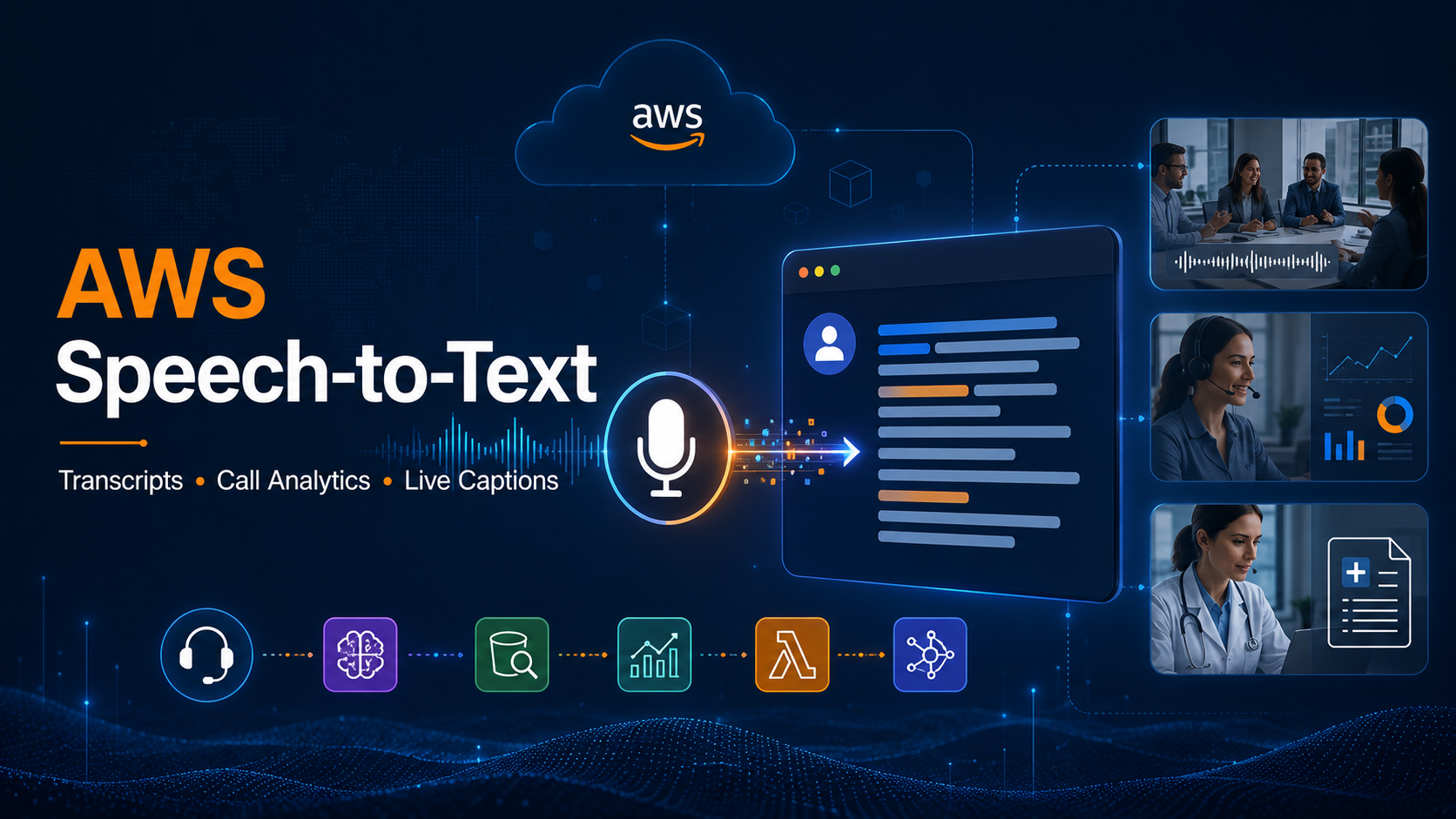
AWS offers several services that support speech-to-text, conversation analysis, medical transcription, real-time captions, and downstream AI workflows. The core service is Amazon Transcribe, a fully managed automatic speech recognition service that allows developers to add speech-to-text capabilities to applications for both recorded and streaming speech. AWS positions Amazon Transcribe for use cases such as automation, accessibility, discoverability, and unlocking insights from audio and video content.

Amazon Transcribe can be used for general transcription requirements such as meetings, media files, interviews, webinars, training videos, and internal business recordings. It also includes features that help improve transcript usability, such as customization and content filtering to support customer privacy.

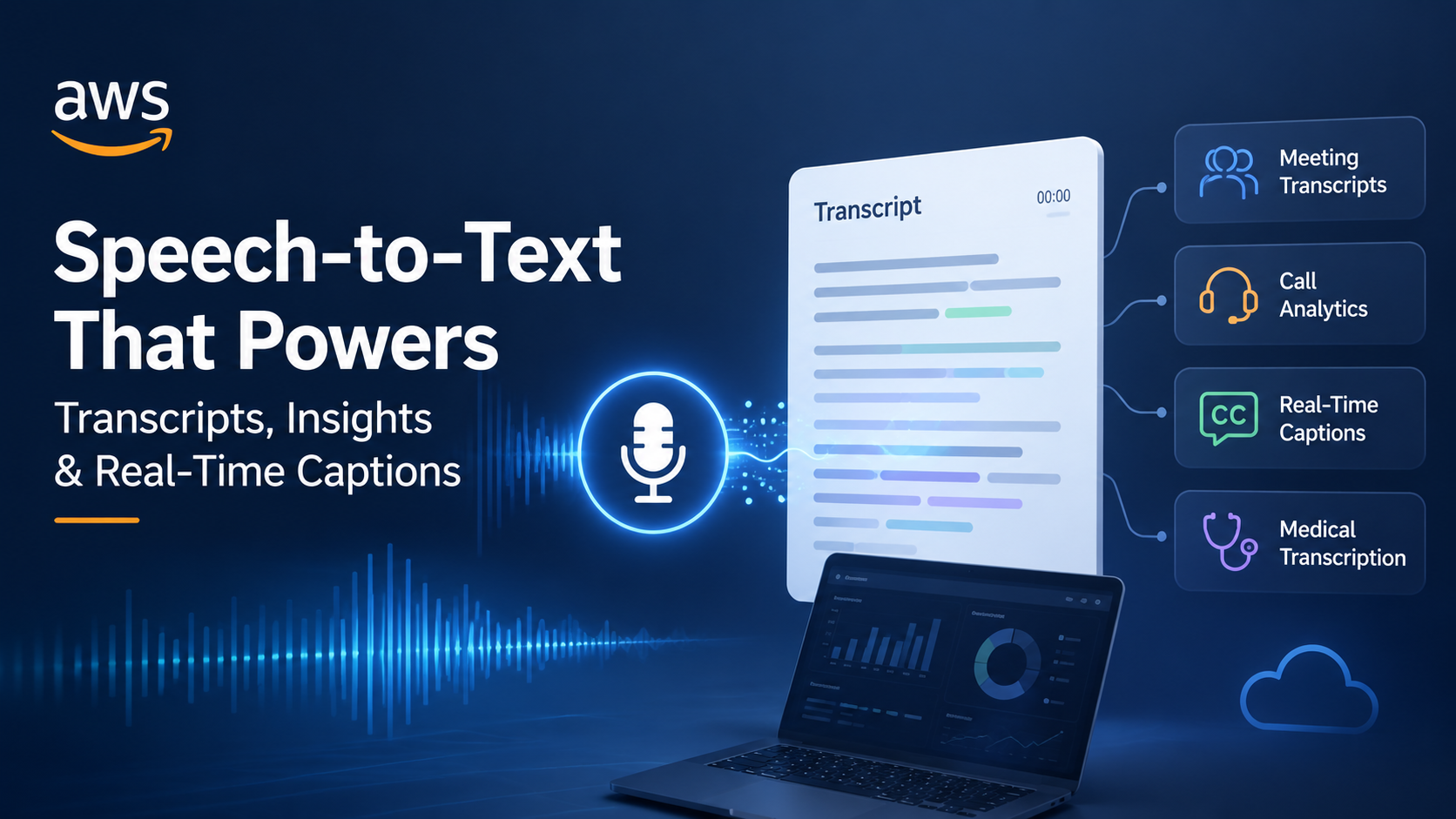
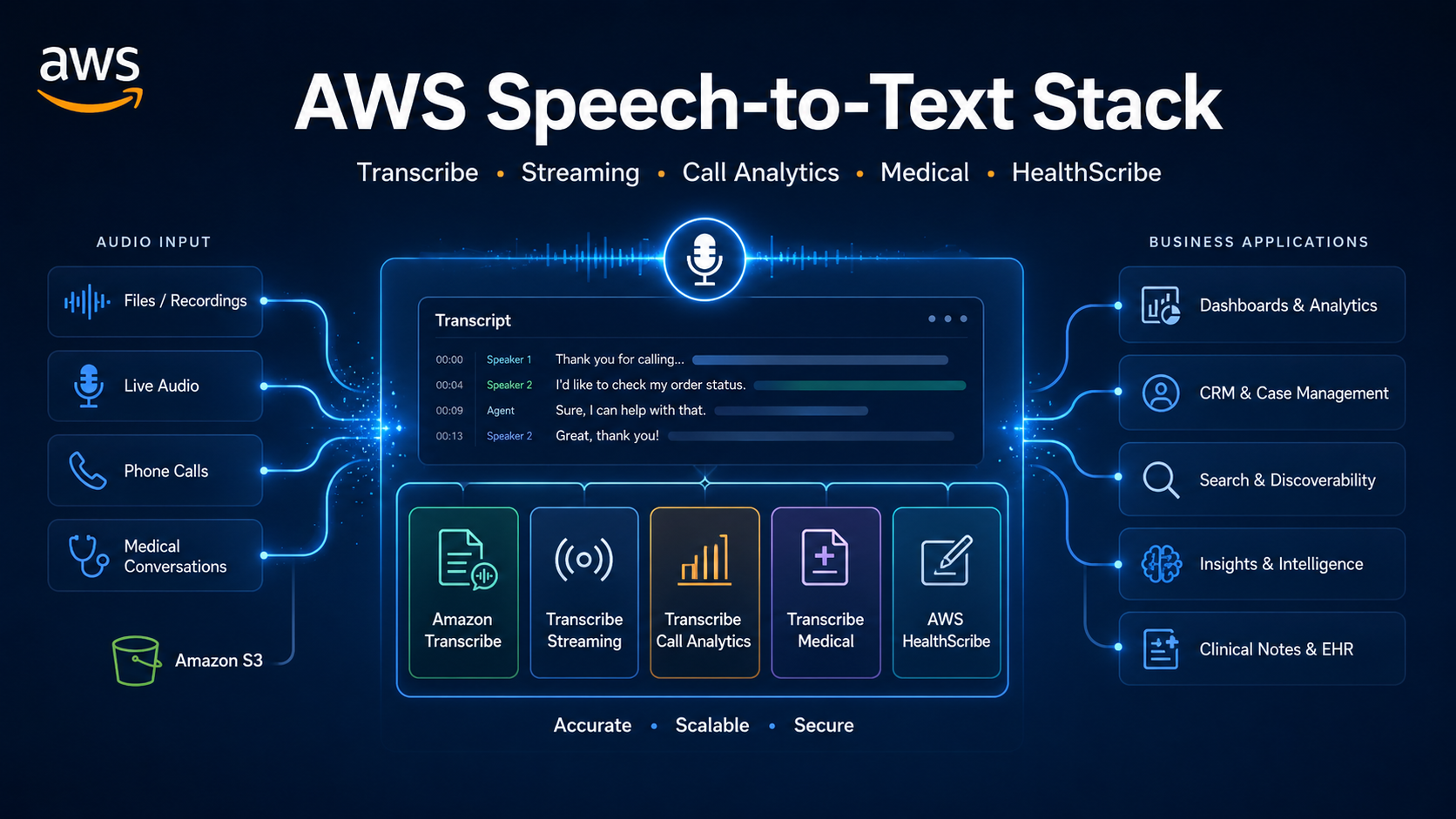
For more specialized needs, AWS provides related capabilities such as Amazon Transcribe Call Analytics for customer service and sales conversations, Amazon Transcribe Medical for healthcare-related speech-to-text, and AWS HealthScribe for clinical applications that need patient-clinician conversation transcription and draft clinical note generation.

The result is not a single transcription tool, but a broader AWS ecosystem that can support simple transcript generation today and expand into analytics, compliance workflows, multilingual search, healthcare documentation, and generative AI applications over time.
Build Secure AWS Speech-to-Text Workflows

FAMRO helps SMEs, scaleups, and technical teams design AWS-powered speech-to-text systems for meeting transcripts, call analytics, live captions, healthcare workflows, multilingual content, and AI-enabled business applications.

Book a Free AWS Cost & Capacity Review

This guide is for you if:

  • You want to turn meetings, calls, webinars, or interviews into searchable business records.
  • You are evaluating Amazon Transcribe for a SaaS, support, healthcare, or internal knowledge product.
  • Your contact center needs better visibility into sentiment, call drivers, objections, and escalation patterns.
  • You want to add real-time captions or live transcription to a web, mobile, or collaboration workflow.
  • You need a secure architecture for transcripts, redaction, access control, retention, and audit workflows.
  • You are exploring how speech-to-text can connect with Amazon Bedrock, OpenSearch, Translate, or Comprehend.
  • You need technical guidance before scaling transcription across teams, products, or customer-facing workflows.

Why Businesses Need Speech-to-Text

Businesses are adopting speech-to-text because voice data is becoming too important to leave unmanaged. In startups, SMEs, and scale-ups, teams move fast. Important decisions may happen in video calls, customer discovery interviews, sales demos, onboarding sessions, product reviews, and support escalations. Without transcription, much of that information depends on manual notes, memory, or fragmented CRM updates.

Why Businesses Need Speech-to-Text

Speech-to-text helps reduce this operational blind spot.

The first benefit is less manual note-taking. Teams can focus on the conversation instead of trying to capture every detail. Meeting transcripts can preserve decisions, action items, technical discussions, objections, and follow-up points. For leadership teams, this improves accountability and reduces the risk of losing important context.

The second benefit is better customer visibility. Customer calls contain direct feedback about pricing, product gaps, onboarding issues, competitor comparisons, support pain points, and purchase intent. When these calls are transcribed, businesses can analyze patterns across conversations instead of relying only on anecdotal feedback.

The third benefit is searchable knowledge. Transcripts turn audio and video into a searchable asset. A training library, support call archive, webinar collection, podcast series, or internal meeting repository becomes easier to retrieve and reuse. This is especially valuable for growing companies where knowledge is often spread across teams, tools, and time zones.

The fourth benefit is support for compliance workflows. Many businesses need records of customer interactions, advisory conversations, support cases, or operational decisions. Speech-to-text does not replace legal, security, or compliance controls, but it can support structured documentation, review, redaction, and audit workflows.

Finally, speech-to-text creates a foundation for AI-driven automation. Once speech becomes text, it can be summarized, classified, translated, searched, analyzed for sentiment, connected to knowledge bases, or used to trigger workflows. This is where AWS becomes particularly useful because transcripts can be integrated with services such as Amazon Comprehend, Amazon Translate, Amazon Bedrock, and Amazon OpenSearch.

Frequently Asked Questions About AWS Speech-to-Text Services

What are AWS speech-to-text services used for?

AWS speech-to-text services help businesses convert recorded or live audio into text for meeting transcripts, customer call analysis, real-time captions, searchable knowledge bases, healthcare documentation, and AI-driven workflows.

Which AWS service is best for general transcription?

Amazon Transcribe is the core AWS service for general transcription. It can process recorded audio and streaming speech for use cases such as meetings, interviews, webinars, training videos, and application-level speech recognition.

Can AWS support real-time captions?

Yes. Amazon Transcribe Streaming can be used to build real-time transcription and live captioning workflows for webinars, meetings, support tools, accessibility features, and voice-enabled applications.

How does Amazon Transcribe Call Analytics help contact centers?

Amazon Transcribe Call Analytics helps contact centers analyze customer and agent conversations by generating transcripts and extracting insights such as sentiment, call drivers, interruptions, talk speed, and call categories.

Is AWS suitable for medical transcription workflows?

AWS provides Amazon Transcribe Medical and AWS HealthScribe for healthcare-related transcription and clinical documentation workflows. These solutions should be implemented with strong privacy, security, review, and compliance controls.

Can transcripts be used with generative AI?

Yes. Once audio is converted into text, transcripts can be summarized, searched, classified, translated, analyzed, and connected to services such as Amazon Bedrock, Amazon Comprehend, Amazon Translate, and Amazon OpenSearch.

What should businesses consider before implementing speech-to-text?

Businesses should plan for audio storage, access controls, redaction, encryption, language support, transcript accuracy, retention policies, search requirements, and downstream AI or analytics use cases before scaling transcription workflows.

Key Use Cases Businesses Are Looking For

Businesses are looking for speech-to-text solutions that turn voice content into useful business records, customer insight, accessibility features, healthcare documentation, privacy-aware workflows, and multilingual knowledge assets.

Key Use cases business are looking for

1. Meeting and Call Transcription

One of the most common use cases is meeting and call transcription. Businesses want transcripts for Zoom calls, Microsoft Teams meetings, interviews, podcasts, internal discussions, sales calls, training sessions, and webinars.

For founders and senior managers, this solves a familiar problem: important conversations happen faster than teams can document them. A transcript gives everyone a reliable record of what was discussed, what was agreed, and what needs to happen next.

In technical organizations, meeting transcripts are also useful for architecture reviews, sprint planning, incident reviews, vendor discussions, and product roadmap sessions. Instead of relying on scattered notes, teams can build a searchable record of technical decisions and operational context.

For marketing and content teams, transcripts can turn podcasts, webinars, and interviews into blogs, social posts, FAQs, documentation, and training material. This increases the return on every recorded conversation.

2. Contact Center Analytics

Contact centers are another high-value area for speech-to-text. Every customer call contains signals about satisfaction, frustration, product issues, agent performance, and business risk. However, without transcription and analysis, most companies can only review a small sample of calls manually.

Amazon Transcribe Call Analytics is designed for customer service and sales call analysis. It can generate call transcripts and extract conversation insights such as customer and agent sentiment, call drivers, interruptions, non-talk time, talk speed, and call categorization. AWS also describes capabilities for detecting and redacting sensitive information in real time or after a call.

This is valuable for companies that want to improve customer experience, support quality assurance, and make call reviews more scalable. Instead of depending only on random call sampling, managers can identify recurring issues, escalation triggers, negative sentiment patterns, or specific phrases that indicate churn risk.

For sales teams, call analytics can help identify objections, competitor mentions, pricing concerns, and follow-up commitments. For support teams, it can highlight unresolved issues, policy gaps, product confusion, and agent coaching opportunities.

3. Real-Time Transcription and Live Captions

Real-time transcription is important when businesses need text while the conversation is happening, not after the recording has been processed. This includes live captions, live support notes, coaching tools, voice-driven product features, and accessibility workflows.

Amazon Transcribe supports streaming transcription, allowing applications to send audio streams and receive transcription output as speech occurs. AWS documentation covers streaming transcription workflows for real-time use cases.

For businesses, this can support live event captions, webinar accessibility, internal meeting captions, and real-time agent assist experiences. In product environments, real-time transcription can also power voice interfaces, live command recognition, or note-taking features inside SaaS platforms.

For CTOs and product leaders, the key point is that real-time speech-to-text can become part of the user experience itself. It is not only a back-office process. It can be embedded into applications, dashboards, collaboration tools, and support systems.

4. Medical Transcription

Healthcare-related speech-to-text has its own requirements. Clinical conversations contain specialized terminology, patient context, dictated notes, diagnoses, medications, and treatment plans. Generic transcription may not be enough for these workflows.

Amazon Transcribe Medical is built for medical speech-to-text use cases. AWS describes it as an automatic speech recognition service for medical-related speech, including physician-dictated notes, drug safety monitoring, telemedicine appointments, and physician-patient conversations. It supports both real-time streaming and batch transcription of uploaded files.

AWS also offers AWS HealthScribe, which combines speech recognition and generative AI to transcribe patient-clinician conversations and generate easy-to-review clinical notes. AWS describes HealthScribe as a HIPAA-eligible capability designed to help healthcare software vendors build clinical applications that reduce documentation burden and improve the consultation experience.

For healthcare technology companies, clinics, telemedicine platforms, and clinical software vendors, these services can help reduce manual documentation effort and improve the structure of clinical records. However, implementation must be handled carefully, with strong attention to privacy, security, regulatory requirements, review workflows, and human validation.

5. Compliance, Privacy, and Redaction

For many organizations, transcription creates both value and responsibility. Once a conversation is converted into text, it becomes easier to search and analyze, but it also needs to be protected.

Businesses may need to manage personally identifiable information, payment data, health information, contractual discussions, HR conversations, or regulated customer interactions. This makes security architecture, retention policies, encryption, access control, and redaction important parts of any speech-to-text solution.

Amazon Transcribe includes features that help produce readable transcripts, improve accuracy with customization, and filter content to support customer privacy. Amazon Transcribe Call Analytics also includes functionality for detecting and redacting sensitive information in call audio and text workflows.

For senior management, the lesson is simple: transcription should not be implemented as a standalone convenience tool. It should be designed as part of a broader data governance model. Who can access transcripts? How long are they stored? Which fields are redacted? Are transcripts encrypted? Are they indexed for search? Are they used for AI analysis? These decisions should be made before scaling the workflow across the business.

6. Multilingual Transcription

Many companies now operate across regions, languages, accents, and distributed teams. Customer support may happen in multiple markets. Training content may need to serve global teams. Media companies may publish content for international audiences. SaaS products may serve users who speak different languages.

AWS documentation lists language-specific support across Amazon Transcribe features, including batch transcription, streaming transcription, medical transcription, and call analytics workflows.

For businesses, multilingual transcription can support searchable archives, regional customer analytics, multilingual training libraries, and international content operations. When combined with services such as Amazon Translate, transcripts can also become part of a broader localization and global support strategy.

The practical value is significant: instead of treating multilingual voice content as isolated recordings, companies can convert it into text, translate it, index it, summarize it, and make it available to teams across the organization.

Key AWS Technologies That Fit

AWS speech-to-text workflows can start simple and become more advanced as the business need grows. The right architecture depends on the use case, but the following services are commonly relevant.

Amazon Transcribe

Amazon Transcribe is the main AWS service for general speech-to-text. It is suitable for recorded audio, video files, meetings, interviews, podcasts, training sessions, and application-level transcription. It can support both batch and streaming scenarios, making it a strong starting point for most business transcription requirements.

A typical workflow may involve storing audio in Amazon S3, processing it with Amazon Transcribe, saving the transcript output, and then making that transcript available through a portal, dashboard, CRM, search interface, or analytics pipeline.

Amazon Transcribe Streaming

Amazon Transcribe Streaming supports real-time use cases where the transcript is needed during the live conversation. This is useful for live captions, live meeting notes, support tools, coaching applications, accessibility features, and voice-enabled products.

For product teams, streaming transcription can be embedded directly into web or mobile applications. For operations teams, it can provide live visibility into conversations as they happen.

Amazon Transcribe Call Analytics

Amazon Transcribe Call Analytics is designed for contact center, customer service, and sales conversation analysis. It goes beyond basic transcription by extracting conversation insights such as sentiment, call drivers, interruptions, talk speed, and call categories.

This makes it relevant for customer experience teams, support leaders, sales operations, and quality assurance programs. It can help organizations move from manual call reviews to more scalable conversation intelligence.

Amazon Transcribe Medical

Amazon Transcribe Medical supports medical speech-to-text workflows, including dictated notes, telemedicine appointments, medical conversations, and healthcare application features. AWS describes it as available through both real-time streaming and batch transcription.

This service is most relevant for healthcare platforms, clinical software providers, telehealth systems, and medical documentation workflows that require domain-specific speech recognition.

AWS HealthScribe

AWS HealthScribe is built for clinical documentation applications. It combines speech recognition and generative AI to transcribe patient-clinician conversations and generate clinical notes for review.

This is especially relevant for healthcare software vendors that want to reduce documentation burden inside clinical workflows. It can help accelerate product development because teams do not need to assemble every component of speech recognition, medical term extraction, speaker role identification, and note generation separately.

Downstream AI, Search, and Analytics Services

The transcript is often only the first step. Once the speech is converted into text, businesses can connect it to other AWS services.

Amazon Translate can translate transcripts for multilingual teams and customers. Amazon Comprehend can help classify text, extract entities, and identify patterns. Amazon Bedrock can support generative AI workflows such as summarization, question answering, topic extraction, and knowledge assistant features. Amazon OpenSearch can index transcripts so teams can search across meetings, calls, support records, training libraries, and media archives.

This is where speech-to-text becomes a business intelligence layer. The value is not just having text. The value is being able to search, understand, summarize, and act on the information contained in conversations.

How FAMRO helps

FAMRO supports SMEs and scaleups with cloud infrastructure design, AWS migration, DevOps automation, CI/CD, observability, cost optimization, and technical consulting. We help teams move from fragile infrastructure to scalable, reliable, and cost-aware cloud platforms.

Conclusion

Speech-to-text is no longer only about transcription. For founders, SMEs, startups, and scale-ups, it can support better documentation, faster customer insight, searchable knowledge, accessibility, compliance workflows, and product automation.

AWS provides a practical and scalable set of services for this journey. A business can begin with simple meeting or media transcription using Amazon Transcribe, then expand into real-time captions, call analytics, medical transcription, multilingual workflows, AI summarization, and searchable knowledge systems. For companies building SaaS platforms, customer service tools, healthcare applications, internal knowledge systems, or AI-powered products, speech-to-text can become a foundational capability.

The important step is designing it correctly. Audio pipelines, storage, access controls, redaction, transcript quality, language support, integration points, and downstream AI use cases all need thoughtful planning. A basic transcription feature can be built quickly, but a reliable business-grade speech-to-text platform requires strong architecture and implementation discipline.

Our team helps organizations design and implement AWS-powered speech-to-text solutions for meeting transcripts, call analytics, real-time captions, healthcare workflows, multilingual content, and AI-enabled business applications. We help connect Amazon Transcribe, Transcribe Call Analytics, Transcribe Medical, AWS HealthScribe, Amazon Bedrock, OpenSearch, and related AWS services into secure, scalable workflows that fit real operational needs.

To help organizations get started, we offer a free initial consultation focused on your AWS speech-to-text implementation—no obligation, no generic pitch.

If your organization is investing in meeting transcription, call analytics, real-time captions, or AI-powered voice workflows and wants confidence—not guesswork—now is the time to act.

🌐 Learn more: Visit Our Homepage

💬 WhatsApp: +971-505-208-240

Our solutions for your business growth

Our services enable clients to grow their business by providing customized technical solutions that improve infrastructure, streamline software development, and enhance project management.

Our technical consultancy and project management services ensure successful project outcomes by reviewing project requirements, gathering business requirements, designing solutions, and managing project plans with resource augmentation for business analyst and project management roles.

Read More
2
Infrastructure / DevOps
3
Project Management
4
Technical Consulting