Our Blog

From RDBMS to Vector Search: Rethinking Enterprise Data Architecture for AI

From RDBMS to Vector Search: Rethinking Enterprise Data Architecture for AI

Artificial intelligence projects are no longer just experimental pilots in the enterprise world; they're quickly becoming mission-critical systems that impact customer experience, operational efficiency, and business strategy.

In the last three to four years, there has been one underlying technology that has become a critical component in supporting artificial intelligence-powered systems: the vector database.

As organizations look to revamp their underlying data infrastructure to power large language models, recommendation engines, intelligent search, and anomaly detection systems, traditional databases are no longer enough. Vector databases have stepped in to bridge this underlying infrastructure gap. In this blog, we'll take a closer look at what a vector database is, how they differ from traditional relational databases, and how organizations can strategically leverage them.

1. What Is a Vector Database?

A vector database is a specific kind of data management system. Its purpose is to store, index, and query vector embeddings that have been generated by machine learning algorithms.

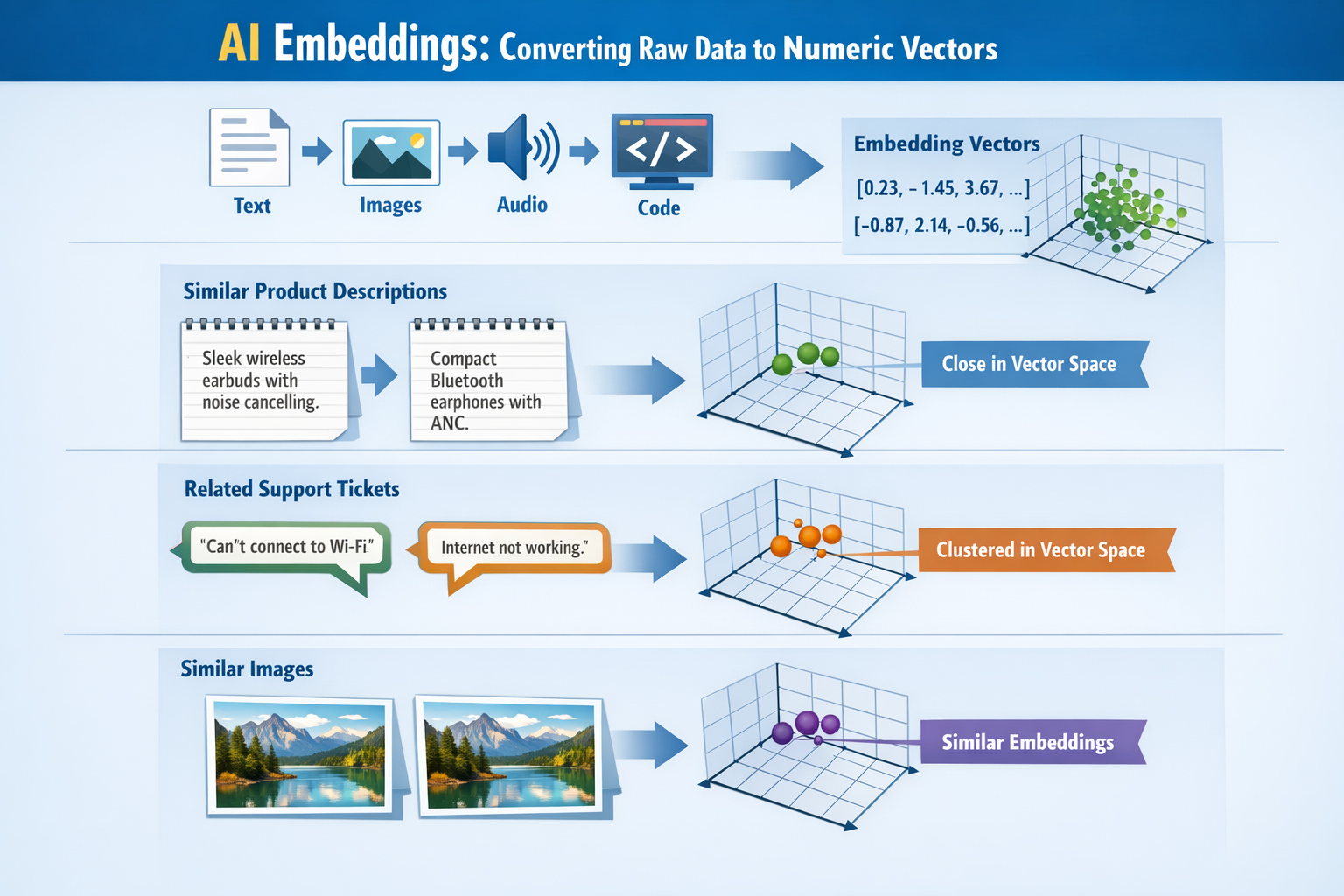
In today’s AI world, we have many types of AI models. These include NLP models, computer vision models, and multimodal AI models. These models take in raw data, which can include text, images, audio, documents, code, etc. The models then convert the raw data into a numerical representation, which is called a vector embedding. The vector embedding is essentially a set of numbers. These numbers represent the semantic meaning of the original data.

What are vectors or AI Embeddings

For example:
  - Two product descriptions with similar meanings will have vector embeddings that are close to each other.

  - Two images with similar visual patterns will have vector embeddings that are similar.

Rather than asking exact-match questions, which we can solve with SQL, we can ask vector databases questions like:

  - What documents are most similar to my query?

  - What products are most similar to the product in my query?

  - What transactions are most similar to the transaction in my query?

2. How Embeddings are generated

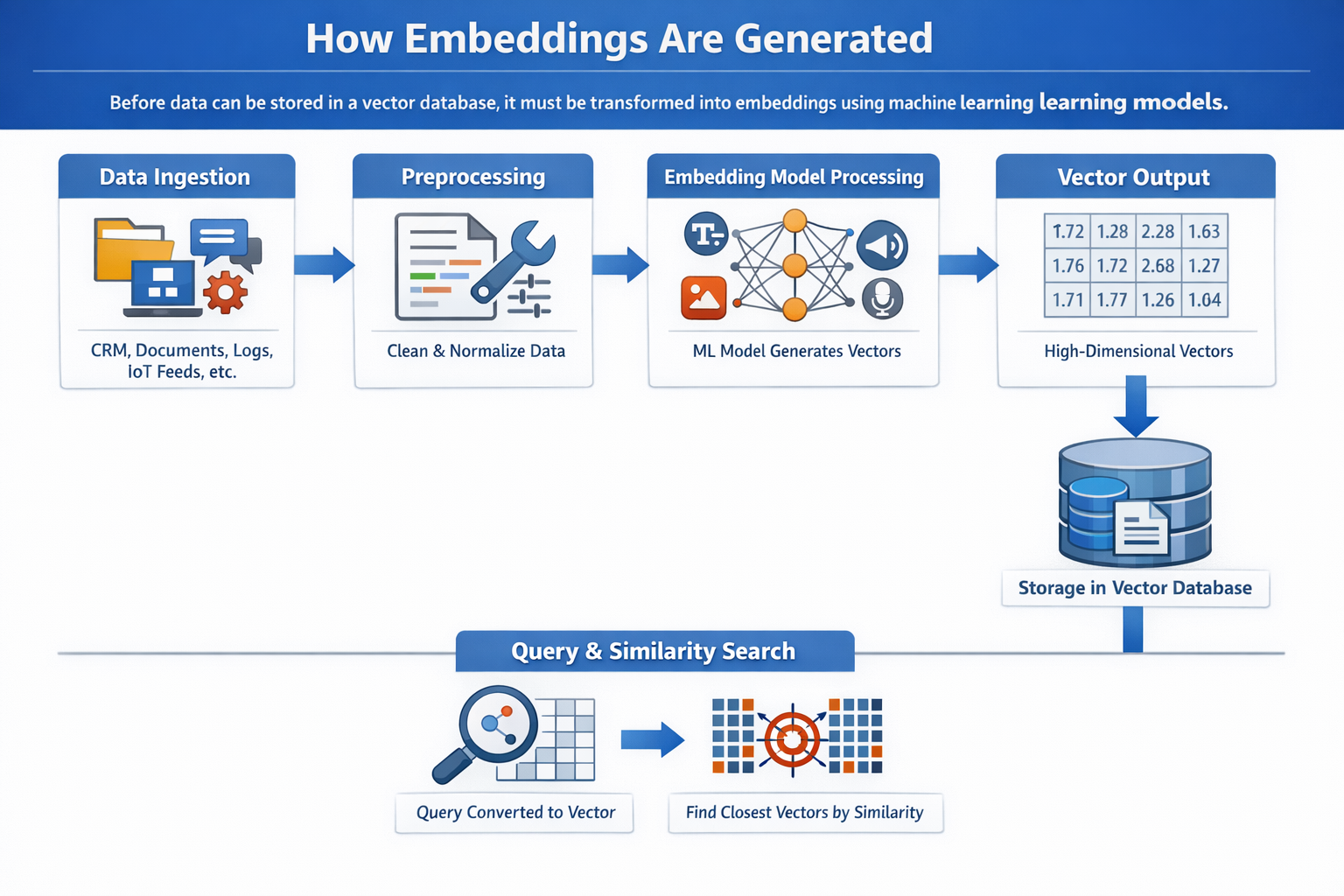
In order for the data to be inserted into a vector database, it needs to undergo a transformation in the form of embeddings with the help of machine learning models. Here’s a brief overview of how that’s done in the context of an enterprise environment:

How to create Vector Embeddings

Data Ingestion:
The raw form of the data in the enterprise environment is ingested from sources such as CRM, document storage, ERP systems, customer chat logs, IoT devices, or content management systems.

Preprocessing:
The ingested data undergoes preprocessing, which includes cleaning, normalization, segmentation of long documents, etc. The preprocessed data is then ready to be fed into the model.

Embedding Model Processing:
The preprocessed data is then fed into a machine learning model, which then transforms the ingested unit of data into a fixed-size numerical vector.

Text models transform sentences or paragraphs of text into semantic vectors.

Vision models transform images into feature vectors.

Multimodal models transform images, text, etc., in a way that also captures the relationships between them.

Vector Output (High-Dimensional Representation):
Each piece of content becomes a vector, often containing hundreds or thousands of dimensions (e.g., 768, 1024, or 1536 numerical values).

Storage in a Vector Database:
These vectors, along with relevant metadata (document ID, category, timestamp, user attributes), are stored in the vector database and indexed for similarity search.

Once stored, new queries are also converted into embeddings using the same model. The database then calculates which stored vectors are closest to the query vector based on similarity metrics such as cosine similarity or Euclidean distance.

3. Why This Matters in Enterprise Context

The embedding generation process is very important. The quality of your embeddings directly impacts search relevance, accuracy of recommendations, contextual understanding of the AI assistant, precision of fraud detection, and effectiveness of personalization. If your embeddings are of poor quality or not aligned with business data, no matter what infrastructure you throw at the problem, you will not achieve meaningful results.

In short, the vector database does not create intelligence; it simply allows efficient retrieval. The intelligence actually comes from the model used to create the embeddings. The vector database simply allows efficient retrieval of these high-dimensional vectors; however, the contextual understanding of these vectors comes from how they were generated in the first place.

This implies that, for the IT leaders in the enterprise space, the adoption of a vector database is not an exercise in database selection; rather, it is an exercise in model selection, validation against domain-specific data, and performance benchmarking and monitoring. Quality embedding should not be treated as a black box.

By understanding the construction of embeddings, the deployment of vector databases is not an exercise in AI experimentation; rather, it is an exercise in the strategic deployment of embeddings and vector databases, which form the backbone of AI-driven enterprise systems.

Enterprise Definition for Vector Search: In enterprise terms, a vector database is:
A system that enables AI-driven applications to retrieve contextually relevant information based on similarity rather than strict relational rules.

This shift from exact matching to semantic matching is transformative.

Typical Enterprise Use Cases

1. Semantic Search: Typical uses included: Internal knowledge bases, legal document repositories, technical documentation search, customer support ticket search

2. Recommendation Systems: Typical uses included: E-commerce product recommendations, content personalization, cross-sell and upsell engines

3. Personalization Engines: Typical uses included: Behavioral similarity modeling, dynamic content adaptation, customer segmentation at scale

4. Anomaly Detection: Typical uses included: Fraud detection, operational irregularity detection and network intrusion monitoring

5. AI Driven Knowledge Retrieval: Typical uses included: Retrieval-Augmented Generation (RAG), enterprise copilots, intelligent assistants

Vector databases are particularly critical in Retrieval-Augmented Generation architectures, where a large language model requires contextual enterprise data in real time.

3. How Vector Databases Differ from Traditional RDBMS

Enterprise IT departments are no stranger to relational database management systems (RDBMS). In fact, database management systems such as Oracle, Microsoft SQL Server, and PostgreSQL have long been the foundation of most applications.

Vector databases, however, have a very different role to play. While traditional database management systems have their foundation in structured row-column data with rigid schemas, normalized data, and relationships, vector databases have their foundation in storing high-dimensional numeric vectors, often with hundreds or thousands of dimensions. In addition to these vectors, they also have the ability to store metadata, allowing businesses to associate meaning with their data. In fact, unlike traditional database management systems, they have flexible schemas.

Traditional RDBMS systems are great at ACID compliance and deterministic operations. They are designed to handle exact-match operations, joins, and aggregations, where the result is guaranteed to be exact and repeatable. This makes them perfect for financial applications, order processing, inventory control, and so on.

On the other hand, vector databases are designed with similarity-based retrieval in mind. They are not designed to perform exact-match operations; rather, they are designed to perform operations such as searches using mathematical distances such as cosine similarity, Euclidean distance, and dot product similarity. Most vector databases employ Approximate Nearest Neighbors (ANN) algorithms to provide fast performance, although the results are only guaranteed to be approximate and not exact. This is a completely different query paradigm from traditional relational databases.

Workload Optimization:
RDBMS are optimized for:

  - Financial transactions

  - ERP Systems

  - Order management

  - Structured reporting

Vector databases are optimized for:

  - AI search systems

  - Recommendation engines

  - Context retrieval for LLMs

  - Pattern similarity detection

Architectural Implications for Enterprise IT

Enterprises should not treat vector databases as replacements for relational systems. Instead, they are complementary components in a modern data architecture.
Key implications include:

  - Additional infrastructure layer in AI pipelines

  - Embedding generation pipelines (via ML models)

  - New observability requirements

  - Specialized performance tuning

  - GPU/CPU balancing considerations

IT leaders must view vector databases as part of a broader AI platform strategy—not as isolated tools.

3. Vector Databases Advantages

When implemented correctly, vector databases deliver measurable business impact.

3.1 Improved Relevance in Search and Retrieval
Traditional keyword search often fails in enterprise environments due to:

  - Synonym mismatches

  - Domain-specific terminology

  - Multilingual content

  - Contextual nuance

Vector databases enable semantic understanding. This dramatically improves:

  - Knowledge discovery

  - Customer support efficiency

  - Research and compliance workflows

The result: faster access to the right information.

3.2 AI and Machine Learning Applications Support
Vector databases are ideal for:

  - LLM augmentation

  - Personalization at real-time

  - Context-aware automation

They eliminate the barriers between ML models and production data systems, ensuring better reliability in AI applications.

3.3 Large Embedding Datasets scalability
Enterprise AI systems generate massive volumes of embeddings:

  - Millions of product records

  - Billions of interaction events

  - Petabytes of document archives

Modern vector databases are designed to handle high-dimensional data at scale using distributed architectures and approximate indexing.

3.4 Fast Similarity Queries
AI-powered applications must deliver results in milliseconds. Vector databases leverage:

  - Memory-optimized indexing

  - ANN search techniques

  - Parallel processing

This ensures that recommendation engines and copilots operate without perceptible delay.

3.5 Support for Modern Data Modalities
Unlike traditional databases, vector databases seamlessly support:

  - Text embeddings

  - Image embeddings

  - Audio embeddings

This positions enterprises to build:

  - Visual search systems

  - Voice-enabled AI tools

  - Multimodal assistants

3.6 Business Impact Framing
From a strategic perspective, vector databases enable:

  - Faster decision cycles

  - Improved digital experiences

  - Higher operational efficiency

  - Enhanced knowledge utilization

  - Competitive differentiation in AI maturity

They are not just a technical upgrade—they are an enabler of intelligent enterprise transformation.

4. Popular Vector Databases for Enterprise Usage

Several platforms have emerged as leaders in the enterprise vector database space. Below is a neutral overview of widely adopted solutions.

1. Pinecone

It is a fully managed cloud vector database, designed for use in production AI applications, with high-performance similarity search, hybrid filtering, automated scaling, and simplification of operations, particularly for LLM applications and recommendation systems.

Website: Pinecone
The key strengths include:

  - Ease of operations

  - Autoscaling

  - Managed infrastructure

  - Enterprise-level SLAs

It is best suited for organizations that require cloud-managed solution with low management complexity.

2. Milvus

It is a Distributed open-source vector database optimized for large-scale embeddings with GPU acceleration, multiple ANN indexes, cloud-native deployments, and billion-vector workloads across enterprise AI and computer vision systems.

Website: Milvus
The key strengths include:

  - Flexible deployment

  - Kubernetes-native

  - Strong community adoption

  - Suitable for self-managed environments

It is best suited for organizations that prefer full control and open-source alignment.

3. Weaviate

It is also an Open-source vector database providing hybrid keyword-vector search, GraphQL APIs, modular ML integrations, and flexible deployment across cloud, Kubernetes, or on-prem environments for semantic search and RAG pipelines.

Website: Weaviate
The key strengths include:

  - Metadata filtering

  - GraphQL API

  - Hybrid keyword + vector search

It is best suited for applications that require both semantic similarity and structured constraints..

4. Qdrant

It is a Rust-based vector database emphasizing precise filtering, payload storage, and fast similarity search, designed for production semantic retrieval with both managed cloud and self-hosted deployment options.

Website: Qdrant
The key strengths include:

  - Efficient filtering

  - Large payload support

  - High performance

It is best suited for latency-sensitive AI systems with filtering requirements.

5. MongoDB with Vector Search

It is a Document-oriented database with native vector search, allowing enterprises to add semantic retrieval directly into existing JSON workflows, simplifying AI adoption without introducing separate vector infrastructure

Website: MongoDB
The key strengths include:

  - Unified data model

  - Reduced architectural sprawl

  - Familiar ecosystem

It is best suited for organizations already using MongoDB. They extend existing capabilities by using Vector Search for MongoDB.

6. Key Things to Keep in Mind While Considering a Vector Database

When you in the market for selecting a Vector Database, please keep following things in mind.

  - Cloud vs. Self-Managed

  - Data Residency

  - Security

  - Compliance (SOC2, ISO, HIPAA, etc.)

  - Integration with ML Pipelines

  - Cost of Ownership

  - Vendor maturity

The selection of a Vector Database should not be done with short-term considerations in mind. It should match with the overall governance and long-term strategy for AI.

7. Common Issues and Challenges

Despite their power, there are no shortages of complexities with Vector Databases.

  - Data Quality and Embedding Accuracy

  - Indexing and Performance Tuning Complexity

  - Infrastructure Cost at Scale

  - Integration with Existing Data Stacks

  - Governance, Security, and Compliance

  - Vendor Maturity and Ecosystem Risk

Conclusion

Vector databases are not meant to replace relational databases. They are meant to be an enabling layer within AI-driven enterprise architectures. The organizations that are able to leverage vector databases effectively have certain common attributes:

  - Defining business objectives

  - Defining AI-based use cases

  - Aligning governance

  - Planning infrastructure scalability

  - Collaborative efforts from cross-functional teams

The best approach is to follow a phased approach to leveraging vector databases:

  - Find a high-impact AI-based use case

  - Perform a proof of concept

  - Measure precision and performance of retrieval

  - Ensure governance alignment

  - Scale with architectural rigor

Vector databases are an enabler for "Retrieval-Augmented Generation," semantic search, recommendation engines, and AI copilots. As AI becomes an integral part of business operations, vector search is no longer an optional innovation but a business requirement.

At FAMRO-LLC Services, we assist organizations in evaluating, architecting, and operationalizing vector database solutions as part of their larger enterprise AI strategies. We ensure that the benefits of vector database adoption outweigh the costs of complexity.

If your organization is embarking on an enterprise AI modernization strategy, then the time is now to consider whether your data architecture is poised for similarity-driven intelligence. FAMRO-LLC can help you in making that transition. We offer Free initial consultation. Please reach via Email / Phone / Whatsapp.


🌐 Learn more: Visit Our Homepage
💬 WhatsApp: +971-505-208-240

Our solutions for your business growth

Our services enable clients to grow their business by providing customized technical solutions that improve infrastructure, streamline software development, and enhance project management.

Our technical consultancy and project management services ensure successful project outcomes by reviewing project requirements, gathering business requirements, designing solutions, and managing project plans with resource augmentation for business analyst and project management roles.

Read More
2
Infrastructure / DevOps
3
Project Management
4
Technical Consulting