1. Vibe Coding Security Risks and Vulnerabilities
Security is one of the most important concerns when deploying AI-generated software.
Generated code can include familiar application vulnerabilities, including missing authorization checks, unsafe database queries, exposed credentials, insecure dependency choices, and insufficient input validation.
Consider a multi-tenant SaaS application. An AI coding tool generates an endpoint that retrieves customer records using a record ID: GET /api/customers/123.
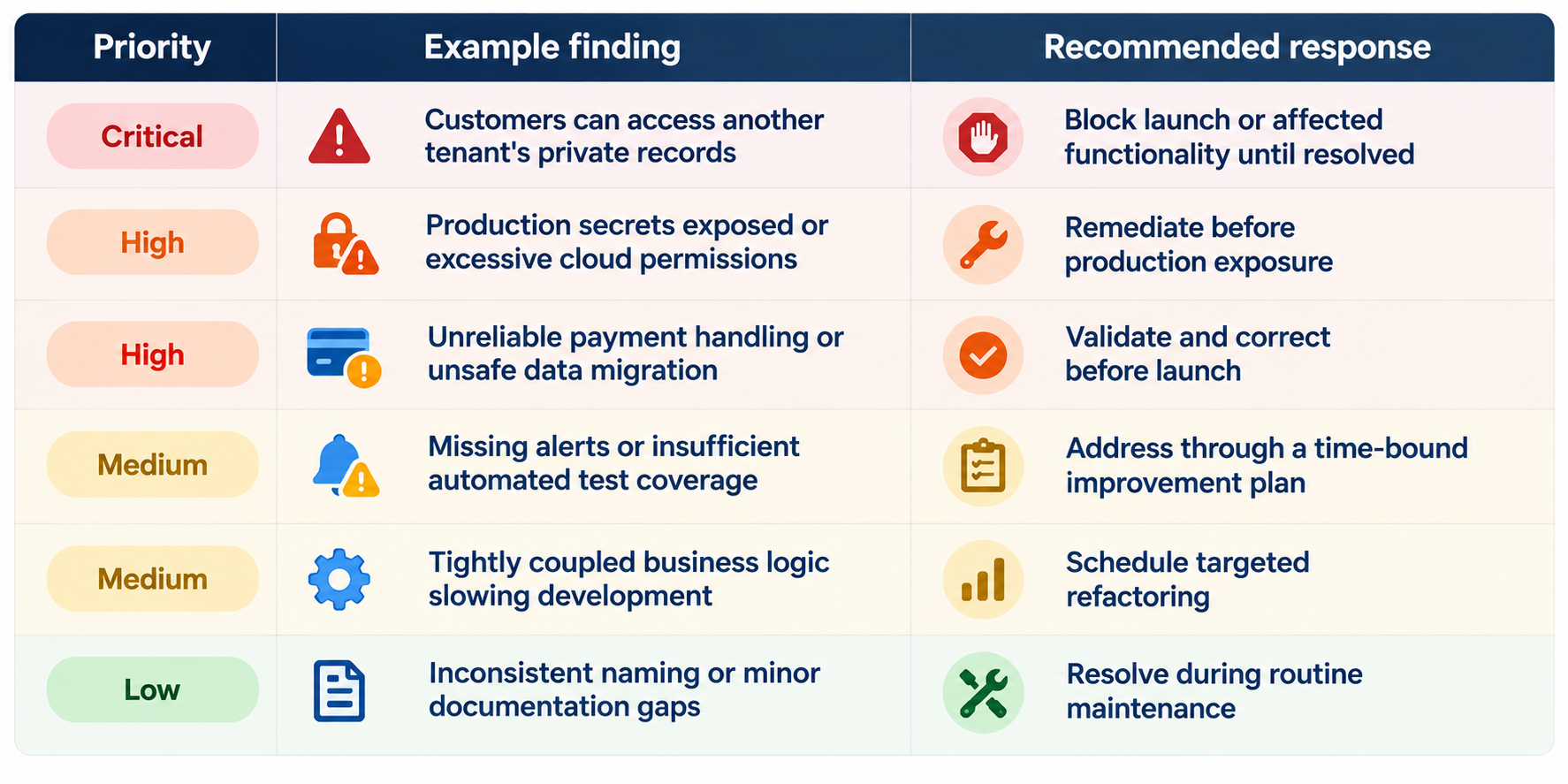
The endpoint works correctly for the account used during development. But if the implementation does not verify that the authenticated user is authorized to access customer 123, another customer might retrieve information they should never see.
The application passes basic functional testing while failing a critical security requirement.
Other areas requiring particular attention include:
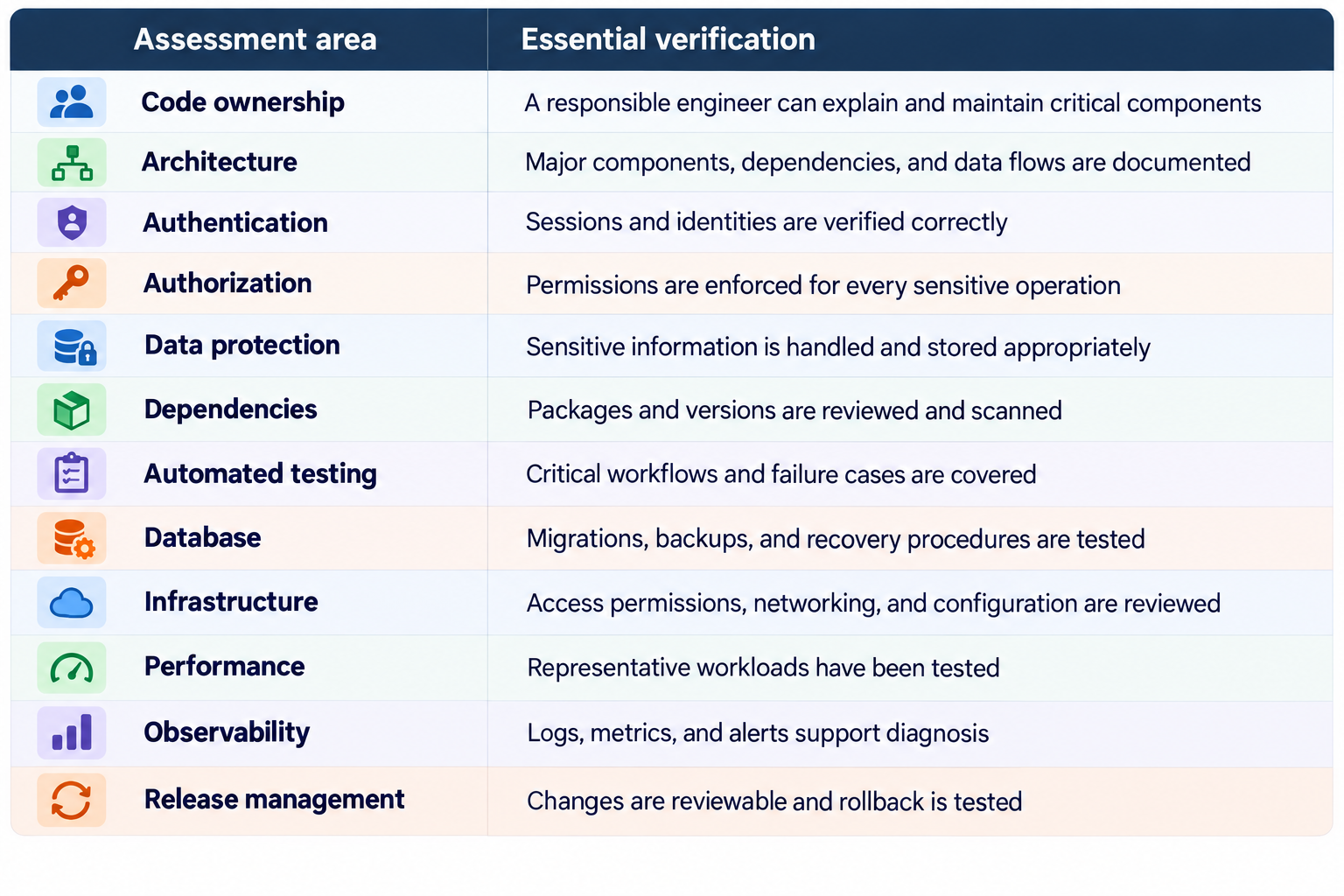
- Authentication and authorization: Are permissions enforced on the server, rather than only in the interface?
- Secrets management: Are credentials excluded from repositories, logs, frontend bundles, and AI prompts?
- Input handling: Are user-controlled inputs validated and safely processed?
- Dependencies: Are libraries necessary, maintained, and checked for known vulnerabilities?
- Data separation: Can one tenant access another tenant's information?
- AI integrations: If the application uses an LLM at runtime, are prompt injection, tool permissions, and sensitive-data exposure addressed?
Traditional application security guidance remains relevant even when AI generates the code. Where an application itself integrates LLMs, additional AI-specific threats must also be considered.
The OWASP Secure Coding with AI Cheat Sheet offers practical guidance on controls for AI-assisted development.
Best practice: Require human security review and automated security checks before generated code handles customer data, authentication, or payments.
2. Hidden Technical Debt in AI-Generated Code
Technical debt refers to implementation decisions that make future changes more difficult or expensive.
Vibe coding can accelerate the accumulation of technical debt when software grows through repeated prompts without a consistent architecture.
Imagine a startup building an order-management application. The initial version contains a straightforward checkout workflow. Later, the team asks the AI tool to add discount codes, regional taxes, recurring orders, and customer-specific pricing.
Each change may work individually. But across multiple iterations, the implementation might accumulate duplicated pricing calculations, inconsistent data validation, hardcoded business rules, and tightly coupled modules.
Eventually, changing the checkout workflow requires modifications across several files, and engineers cannot easily predict which functionality might break.
This is an example of vibe coding technical debt.
Typical warning signs include:
- Duplicate business logic across endpoints or services.
- Large functions with several unrelated responsibilities.
- Database queries scattered throughout application code.
- Limited automated tests for important business rules.
- Unnecessary dependencies introduced during iterative changes.
- Configuration values embedded in source code.
- Modules that cannot be changed without unexpected side effects.
Not all generated code has these problems, and manually written code can suffer from the same issues. The underlying risk is rapid implementation without sufficient architectural review.
Best practice: Define module boundaries, data models, coding standards, and ownership before a prototype becomes a long-lived product.
3. Cloud Infrastructure and Deployment Risks
An AI coding agent can generate deployment configuration quickly. That might include a Dockerfile, reverse proxy, database connection, CI/CD workflow, environment variables, and cloud provisioning scripts.
This is useful for experimentation. It does not guarantee a secure or reliable deployment.
For instance, an AI-generated cloud configuration might grant unnecessarily broad permissions to an application service account. The application deploys successfully, but it has greater access than required.
Other potential infrastructure problems include unbounded resource consumption, incorrect network exposure, insufficient database backup policies, missing cost alerts, and configurations that differ across environments.
One particularly important concern is operational knowledge. When the generated deployment fails, can someone on the engineering team explain its components and recover the service without relying entirely on another AI-generated suggestion?
Best practice: Review infrastructure permissions, networking, backups, resource limits, deployment reproducibility, and rollback procedures before production use.
4. Weak Testing and False Confidence
AI coding tools are often effective at producing functional demonstrations. However, a successful demonstration does not establish that an application behaves correctly under exceptional conditions.
A subscription-management application may appear reliable when a customer signs up and completes a payment. But what happens when:
- A payment provider sends the same webhook twice?
- Two requests update the same customer record concurrently?
- An external API times out after a transaction has partially completed?
- A database connection becomes unavailable?
- A user submits malformed input?
- A deployment interrupts a running request?
A prototype may never encounter these cases during development. Generated tests can also provide false reassurance when they merely confirm the implementation's existing assumptions.
For example, an AI tool might produce tests that validate a function's current output without verifying whether the underlying business calculation is correct.
Best practice: Define important expected behaviors independently of generated code. Test failure cases, authorization boundaries, concurrency, and recovery—not only successful user journeys.
5. Maintainability and Engineering Ownership
A startup can build a product quickly and still struggle to maintain it. This happens when no one understands the complete implementation, knows why key architectural decisions were made, or feels confident modifying critical components.
Vibe coding does not eliminate the need for documentation and engineering ownership.
A sustainable application still benefits from:
- Architecture diagrams and meaningful module boundaries.
- Explicit database schemas and migration procedures.
- Documented dependencies and configuration.
- A named owner for critical services.
- Code review and change history.
- Runbooks for deployments, incidents, and recovery.
AI tools can help generate documentation, but that documentation must be reviewed against the actual system.
Best practice: Treat code comprehension and operational ownership as requirements, not optional activities performed after launch.
6. Production Reliability and Operational Visibility
An application may run correctly in development but fail under real user traffic. Potential problems include slow database queries, memory leaks, uncontrolled background tasks, connection exhaustion, and resource contention.
Without monitoring, the team may not discover these problems until customers report failures.
Consider a generated Flask application connected to PostgreSQL through Nginx. It performs well during a demonstration. After launch, increased concurrent requests cause database connections to accumulate, request latency rises, and the server begins returning errors.
The immediate problem is performance. The broader problem is inadequate capacity testing and operational visibility.
At minimum, production teams should know:
- Whether the application is available and responding correctly.
- How request latency and error rates change over time.
- Whether CPU, memory, disk, or network resources are under pressure.
- How application and database performance relate to infrastructure health.
- Whether failed deployments can be rolled back safely.
Best practice: Establish health checks, meaningful logging, monitoring, alerts, and recovery procedures before customers depend on the application.