7 Signs Your Infrastructure Can’t Keep Up With Growth Anymore
For SMEs and scale-ups, growth is a good problem to have, but it often exposes weaknesses in infrastructure that were easy to overlook at an earlier stage. Systems that worked for a small team, a modest customer base, or a limited product offering can quickly become a barrier when demand increases, applications become more business-critical, and operational complexity starts to rise.
This is where cloud infrastructure becomes part of the growth conversation. Rather than treating infrastructure as a fixed asset that needs periodic replacement, cloud platforms allow businesses to build an environment that can adapt more easily as needs change. AWS is often considered by growing companies because it offers the flexibility to scale resources, improve resilience, strengthen security, and support faster delivery without the same level of upfront capital investment associated with traditional infrastructure.
Below are seven common signs that your current infrastructure may be struggling to support growth and why that matters.
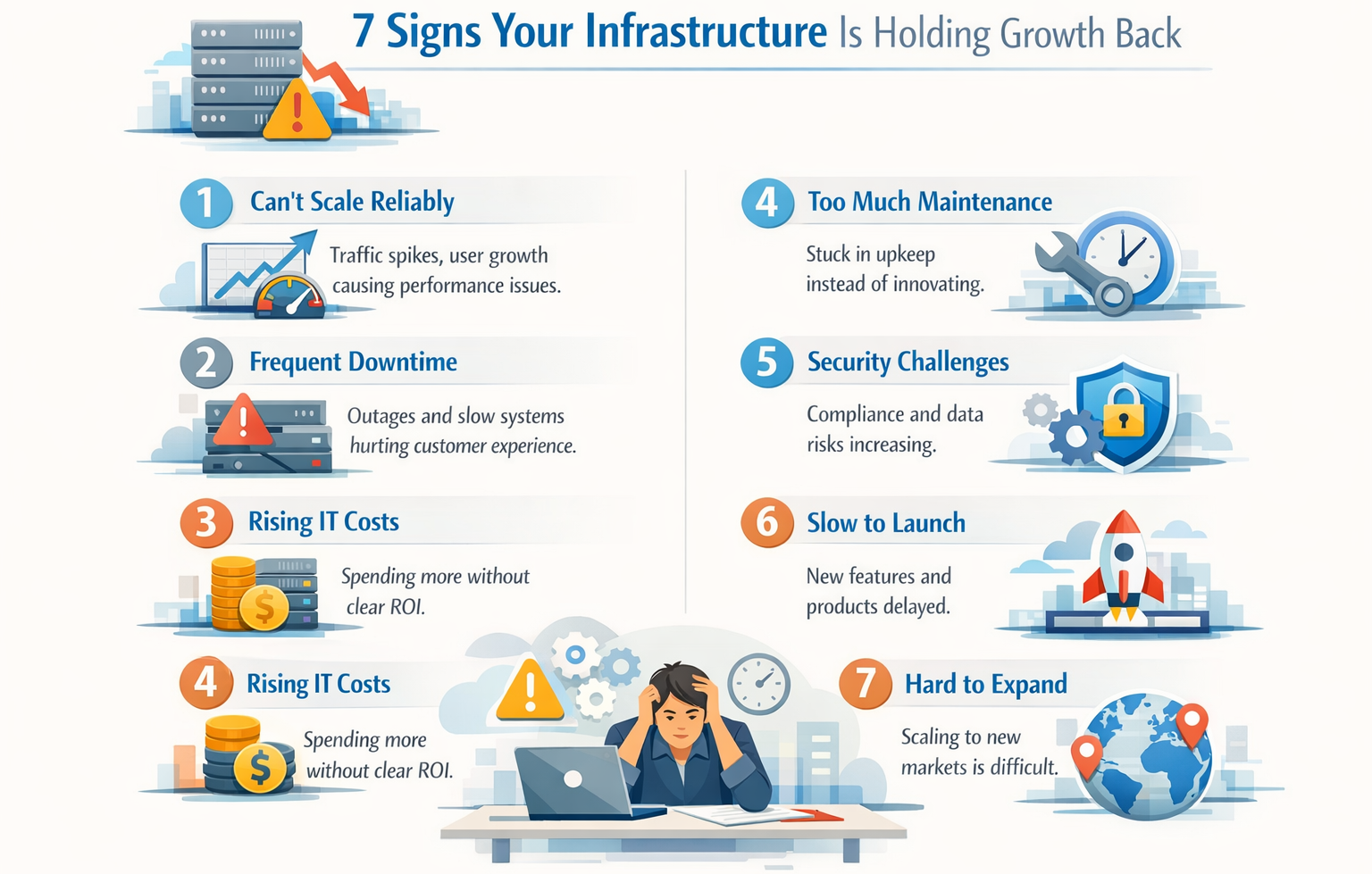
1. Your infrastructure cannot scale reliably with demand
Traffic spikes, user growth, and product launches are starting to create performance issues.
2. Downtime or performance problems are affecting customer experience
Slow systems and outages are beginning to damage trust and disrupt operations.
3. IT costs are rising, but value is hard to measure
Spending continues to grow without clear visibility into efficiency or return.
4. Your team spends too much time on maintenance instead of innovation
Internal resources are tied up managing infrastructure rather than building business value.
5. Security and compliance requirements are getting harder to manage
Growth is increasing the pressure on governance, access control, and data protection.
6. Launching new products or features takes too long
Infrastructure limitations are slowing development, testing, and deployment.
7. Your current setup makes expansion more difficult
New markets, distributed teams, and broader workloads are becoming harder to support.