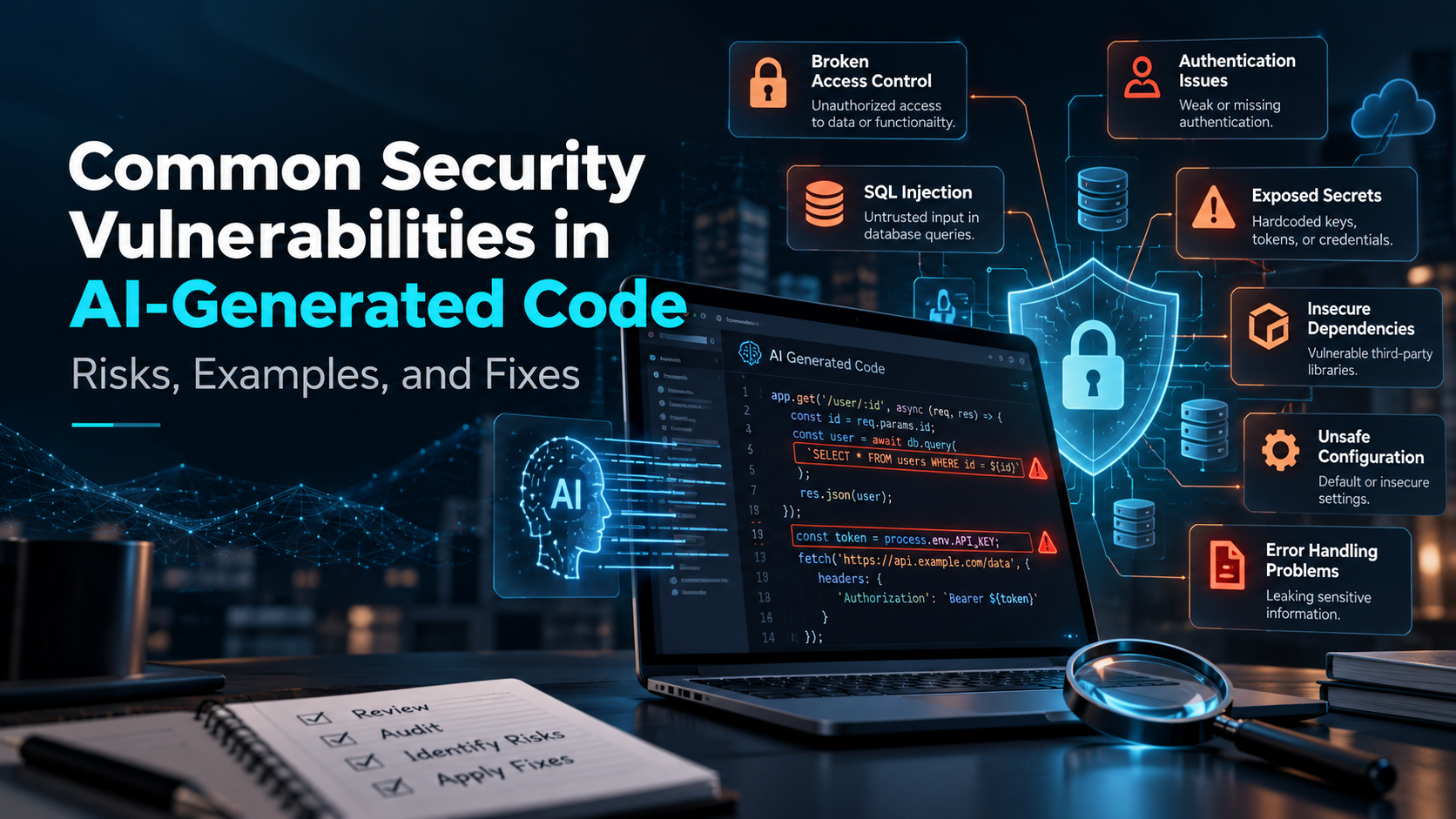
Common Security Vulnerabilities in AI-Generated Code: Risks, Examples, and Fixes

AI-generated code may work correctly while still exposing customer records, credentials, dependencies, APIs, or cloud infrastructure. This guide explains seven security vulnerability categories, shows a practical cross-tenant authorization example, compares scanning and manual review, and provides a CTO-ready checklist for deciding what to fix before production.

Introduction

AI-generated code vulnerabilities can include broken access controls, authentication failures, SQL injection, exposed credentials, insecure dependencies, unsafe configurations, and inadequate error handling. These problems can remain invisible during a successful product demonstration and emerge only when an application handles real users, sensitive information, or unexpected requests.

For startups and scale-ups, the central concern is not whether artificial intelligence can generate functional software. It can. The concern is whether the resulting application enforces the security boundaries required for production.

A working login page does not prove that sessions are properly validated. A customer dashboard does not establish that tenants cannot access one another's records. Successful deployment does not mean credentials, dependencies, and cloud permissions have been reviewed.

This guide examines seven categories of security vulnerabilities worth checking in AI-generated applications, explains practical verification techniques, and provides an audit checklist for engineering leaders.

Why Does AI-Generated Code Introduce Security Risks?

AI coding assistants can implement features, generate tests, suggest dependencies, and modify existing applications. However, the quality of their output depends partly on the requirements, repository context, available tools, and verification process.

Consider a developer asking an assistant to build an invoice management API. The generated application may successfully create, retrieve, and update invoices.

But did the requirements specify that invoices belong to individual customers? Did they define which employees can approve payments? Did they require authorization checks for background jobs and exports?

If not, the generated implementation may satisfy its functional requirements while omitting essential security controls.

Three failure mechanisms deserve particular attention.

Incomplete security specifications. Requests describe what users should accomplish but omit what unauthorized users must be prevented from doing.

Unverified implementation patterns. Generated code may include inappropriate dependencies, insecure defaults, or implementation shortcuts that work during development.

Security regressions during iteration. Subsequent AI-assisted changes can bypass previously implemented controls, remove validation, or modify sensitive behavior without adequate review.

These risks are not exclusive to AI-generated software. Human developers can introduce the same weaknesses. The important distinction is that AI-assisted workflows can produce and modify substantial amounts of code without corresponding improvements in review capacity.

The OWASP Top 10:2025 provides a useful starting point for assessing web application security. OWASP also maintains specific guidance for secure coding with AI.

Seven Security Vulnerability Categories to Investigate

The following categories are practical review priorities, not a statistical ranking of defects in AI-generated code.

1. Broken Access Control and Cross-Tenant Data Exposure

Relevant OWASP category: A01:2025 — Broken Access Control

Broken access control occurs when an authenticated user can access or change resources beyond their permissions.

Imagine an AI-generated SaaS application exposing this endpoint: GET /api/invoices/202.

The application may correctly verify that the requester is logged in but fail to verify that invoice 202 belongs to their organization. Changing the invoice ID could expose another customer's financial records.

This is an example of broken object-level authorization, a risk covered by the OWASP API Security Top 10.

Business impact: Unauthorized access to customer information, data modification, and potential contractual or regulatory consequences.

Recommended controls: Enforce authorization at the server and data-access layers. Verify tenant ownership and resource permissions for every sensitive read, update, deletion, and export. Never rely on hiding interface controls as a substitute.

How to verify: Create two synthetic customer accounts, populate separate records, and test whether either account can access the other's resources through direct API requests.

2. Weak Authentication and Session Management

Relevant OWASP category: A07:2025 — Authentication Failures

Authentication establishes user identity. Authorization determines what that identity can access.

An AI-generated application might implement a convincing login interface while mishandling session expiration, password recovery, token validation, or administrative access.

For example, an API may accept an expired authentication token because expiration is checked by the frontend but not validated by the backend.

Other warning signs include hardcoded development passwords, improperly protected administrative endpoints, and insecure session cookies.

Business impact: Account takeover, unauthorized administrative actions, and exposure of customer data.

Recommended controls: Use established authentication libraries, validate credentials and token claims server-side, protect session cookies appropriately, and require stronger authentication for sensitive operations.

How to verify: Test missing, expired, invalid, and revoked credentials. Confirm that protected endpoints reject unauthorized requests even when called independently of the frontend.

3. SQL Injection and Unsafe Input Handling

Relevant OWASP category: A05:2025 — Injection

Injection vulnerabilities arise when untrusted input is interpreted as an executable instruction.

A generated backend might construct a database query by directly inserting user-supplied text into SQL. For example, a search endpoint could concatenate a search term into its query rather than binding it as a parameter.

The application may perform correctly for ordinary inputs but behave unsafely when the input contains unexpected SQL syntax. Similar risks can affect operating-system commands, templates, and other interpreters.

Business impact: Unauthorized data access, data modification, service disruption, or broader system compromise depending on the affected component.

Recommended controls: Use parameterized database queries, enforce appropriate input constraints, avoid shell command construction from untrusted strings, and apply context-appropriate output encoding.

Input validation is useful, but it is not a replacement for parameterization.

How to verify: Review database query construction, inspect dangerous interpreter boundaries, and run controlled negative tests in an authorized test environment.

4. Exposed Secrets and Sensitive Configuration

Hardcoded credentials are particularly dangerous when generated code moves from temporary experimentation into a shared repository or production deployment.

Examples include API keys embedded in frontend bundles, database passwords committed to source control, and credentials inadvertently written to application logs.

A related AI-assisted development risk appears when confidential repository content is sent to tools or services without appropriate organizational controls.

Business impact: Unauthorized access to cloud resources, data exposure, service misuse, and incident-response costs.

Recommended controls: Use approved secret-management mechanisms, enforce least-privilege access, scan repositories and build artifacts, and prevent sensitive values from appearing in logs.

If a real credential is exposed, removing the string from the latest commit is not enough. Revoke or rotate the credential and assess the exposure.

How to verify: Inspect source history, CI/CD settings, deployed configurations, logging pipelines, and browser-delivered assets for sensitive values.

5. Vulnerable Dependencies and Software Supply-Chain Risks

Relevant OWASP category: A03:2025 — Software Supply Chain Failures

AI coding tools may recommend packages that are outdated, unnecessary, unsupported, or incorrectly named.

An application might install an unfamiliar dependency simply because the generated code references it.

In AI-assisted development, hallucinated package names create an additional concern: a developer or agent might attempt to install a package that was never part of the intended software ecosystem.

Even legitimate packages may contain known vulnerabilities.

Business impact: Malicious code execution, dependency compromise, service outages, or exposure through vulnerable third-party components.

Recommended controls: Review dependency provenance, maintain lockfiles, verify package identities, scan for known vulnerabilities, and limit permissions available to installation and build processes.

How to verify: Generate an inventory of direct and transitive dependencies, check security advisories, identify unsupported components, and examine unexplained dependency additions.

A vulnerability scanner finding must still be evaluated for actual exploitability and exposure.

6. Insecure API, Cloud, and Deployment Configuration

Relevant OWASP category: A02:2025 — Security Misconfiguration

AI-assisted development frequently extends beyond application code into Dockerfiles, infrastructure definitions, CI/CD workflows, and cloud configuration.

The resulting deployment may work while exposing unnecessary services or assigning excessively broad permissions.

Examples include public storage buckets containing sensitive data, administrative services accessible from the internet, overly permissive cloud roles, and production systems using development settings.

An important risk is that an AI coding agent may request broad permissions to resolve deployment failures rather than identifying the minimum necessary access.

Business impact: Unauthorized infrastructure access, data exposure, expensive resource misuse, and expanded attack surfaces.

Recommended controls: Apply least privilege, separate environments, restrict public exposure, review infrastructure as code, and require approval for sensitive deployment changes.

How to verify: Compare deployed settings against documented security requirements. Inspect IAM policies, network exposure, storage access, debug settings, and CI/CD permissions.

If the application is also moving between hosting environments, consider a scoped cloud migration and modernization assessment to review infrastructure design, access management, and deployment readiness alongside the migration plan.

7. Unsafe Error Handling, Logging, and Missing Security Tests

Relevant OWASP categories: A09:2025 — Security Logging and Alerting Failures; A10:2025 — Mishandling of Exceptional Conditions

An application can pass ordinary functional tests while behaving dangerously during failures.

Consider a database exception that returns internal connection information to an API consumer. Or an authorization failure that is neither logged nor monitored.

Missing negative-path tests create another problem: changes that weaken security may pass through CI because only successful user workflows are tested.

Business impact: Information leakage, delayed incident detection, unauthorized operations, and difficult recovery.

Recommended controls: Return safe error messages, preserve useful diagnostic context internally, protect sensitive logs, and establish monitoring for significant security events.

How to verify: Test malformed requests, dependency failures, unauthorized actions, expired credentials, and partial workflow failures. Confirm that expected controls remain effective and security events produce actionable evidence.
Technical Example: A Multi-Tenant Authorization Vulnerability

A small Python example demonstrates why a functional API is not necessarily a secure one.

Illustrative scenario: A SaaS application stores invoices belonging to two customers, Alpha and Beta.

The following example uses in-memory synthetic data to isolate the authorization problem. It is not a production API implementation.

INVOICES = {
    101: {"tenant_id": "alpha", "total": 120},
    202: {"tenant_id": "beta", "total": 300},
}

def lookup_insecure(invoice_id, principal):
    return INVOICES.get(invoice_id)

def lookup_secure(invoice_id, principal):
    invoice = INVOICES.get(invoice_id)

    if (
        invoice is None
        or invoice["tenant_id"] != principal["tenant_id"]
    ):
        return None

    return invoice

The insecure function ignores the requesting user's tenant. Any caller with access to the function can retrieve an invoice by its identifier. The secure version checks that the invoice belongs to the authenticated principal's tenant.

The essential negative test is:

alpha = {"tenant_id": "alpha"}
beta = {"tenant_id": "beta"}

assert lookup_insecure(202, alpha) is not None
assert lookup_secure(202, alpha) is None
assert lookup_secure(202, beta)["total"] == 300

These assertions were executed successfully against the illustrative functions.

In a real application, the principal must come from a validated authentication context—not from an untrusted request parameter. Database queries should enforce the appropriate ownership restrictions, and API responses should use suitable authorization and not-found behavior.

The broader lesson is simple: security verification needs tests for what a user must not be allowed to do.

What About AI Coding Agents Themselves?

Insecure application code is only one part of the problem.

Autonomous coding agents may access repositories, execute commands, install packages, modify build pipelines, and interact with external tools. That introduces additional trust boundaries.

A malicious instruction embedded in repository documentation, an issue description, or an external tool response may attempt to influence an agent's actions. Excessive filesystem or cloud permissions can increase the consequences of an unsafe action.

These are development-workflow security risks rather than ordinary vulnerabilities in the finished application.

OWASP's Secure Coding with AI guidance addresses dependency hallucination, prompt injection within development workflows, tool permissions, agent sandboxing, and sensitive-context exposure.

A practical policy is to restrict agent permissions, review high-risk actions, protect credentials, and require human approval for changes affecting access controls, deployment configuration, or production systems.

For startups already using AI-assisted development, this policy should become part of the engineering workflow rather than an optional final check.

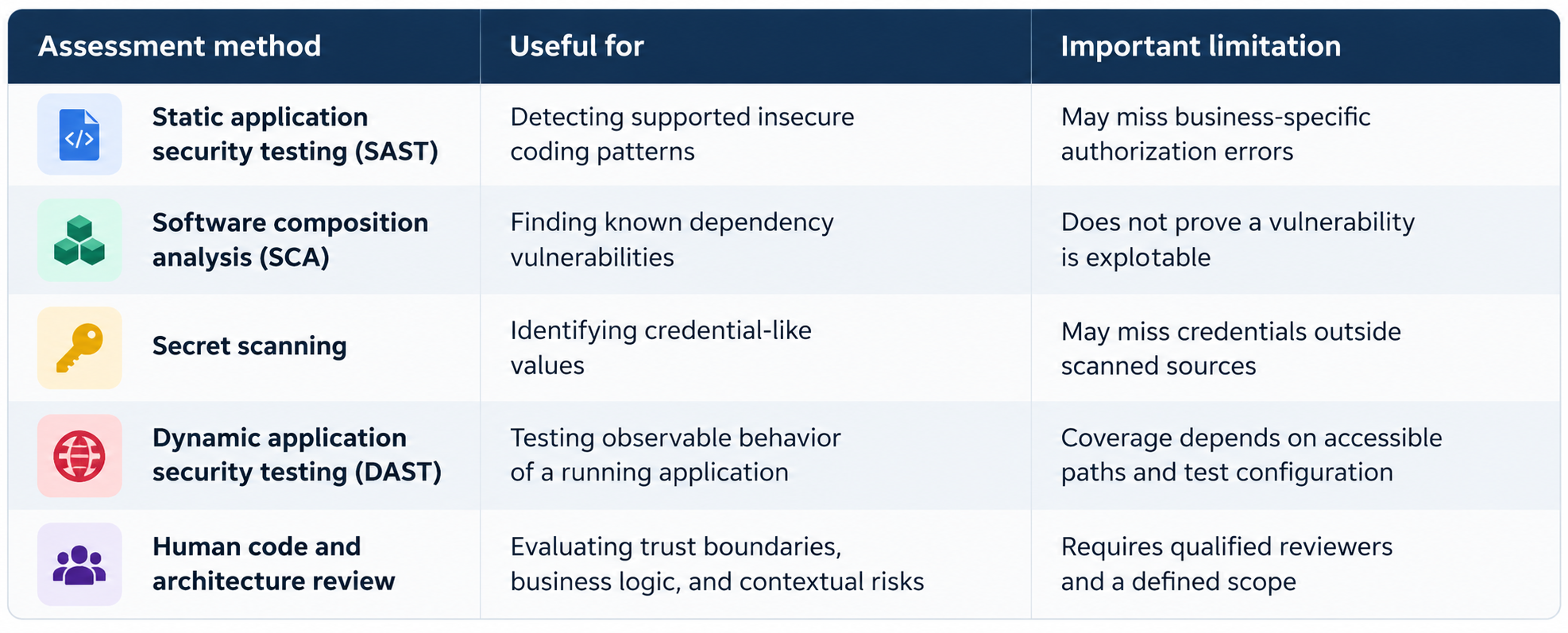
Can Automated Security Scanners Identify These Vulnerabilities?

Security scanners are valuable, but no single category of tool provides complete application security assurance.

Can Automated Security Scanners Identify These Vulnerabilities

For a small SaaS product, automated scanning might detect an unsafe query or a vulnerable dependency while overlooking a tenant-isolation defect in a valid API workflow.

A useful security process combines automated checks with threat modeling, targeted tests, engineering review, and remediation verification. The appropriate depth depends on the application's exposure, the sensitivity of its data, and the consequences of compromise.

If your application handles customer data or is approaching launch, an independent AI code security review can help identify important gaps that routine functional testing may not reveal.

AI-Generated Code Security Audit Checklist

The following is a proposed FAMRO engineering release checklist, intended as a starting point rather than a certification standard.

  • Sensitive endpoints require valid authentication.
  • Every resource access enforces appropriate user, role, and tenant permissions.
  • Untrusted inputs are handled safely at database, command, and template boundaries.
  • No active credentials are exposed in source code, browser assets, or logs.
  • Dependencies have been reviewed for provenance and known security issues.
  • Cloud and deployment permissions follow least-privilege principles.
  • Administrative and financial operations have dedicated authorization tests.
  • Failure responses avoid exposing confidential internal details.
  • Important security events are logged and monitored.
  • Critical and high-risk findings have documented remediation decisions.
  • Automated tests cover unauthorized, malformed, and failure scenarios.
  • A named engineer has reviewed the release and its rollback procedure.

For each check, record the responsible engineer, verification method, test evidence, result, and outstanding action.

The OWASP Application Security Verification Standard provides a more comprehensive basis for defining application-specific verification requirements.

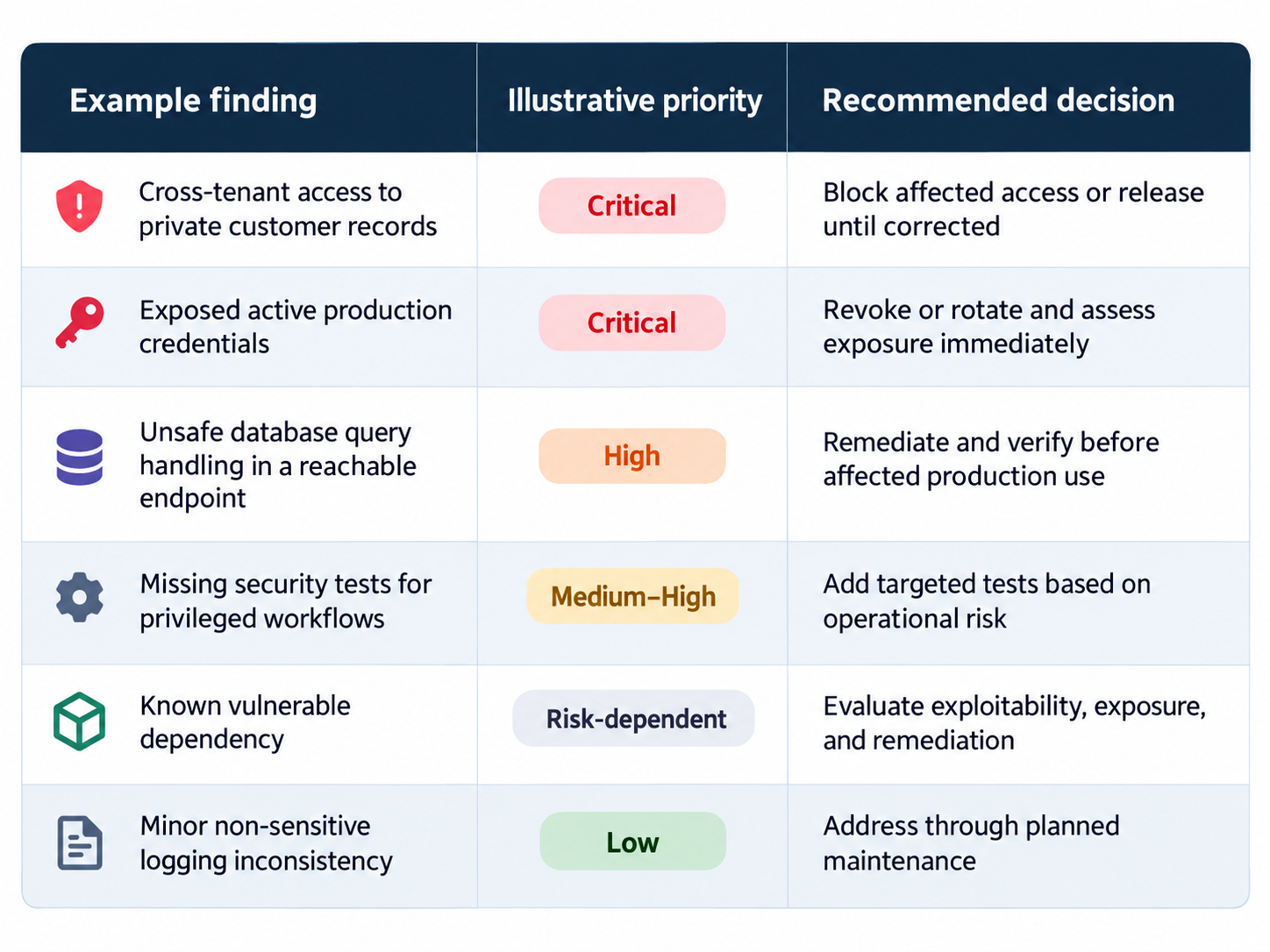
How Should CTOs Prioritize Vulnerabilities?

Not every finding has the same business impact.

A missing authorization check on a public customer-data endpoint may require immediate action. A minor logging inconsistency in a non-sensitive internal component may be appropriate for routine maintenance.

The correct priority depends on exposure, exploitability, affected information, potential business impact, and available compensating controls.

Illustrative Risk Prioritization Matrix

Illustrative Risk Prioritization Matrix

These priorities are examples, not severity classifications for actual customer systems.

A security review should document the evidence behind each finding and explain the proposed remediation. For resource-constrained teams, a prioritized backlog is often more useful than an undifferentiated list of warnings.

When Should Startups Request an Independent AI Code Audit?

Not every experiment needs an external audit.

A disposable prototype using synthetic data and no sensitive integrations may be adequately managed through internal engineering controls. The risk changes when an application moves into customer-facing or business-critical use.

An independent assessment becomes particularly relevant when a startup is preparing to launch a multi-tenant SaaS product, introducing payment workflows, handling sensitive information, inheriting a heavily AI-generated codebase, or integrating with production infrastructure.

It can also be valuable when an engineering team lacks confidence in its test coverage or cannot clearly explain the security assumptions behind generated components.

FAMRO's AI Code Audit and Vibe Coding Audit service offers scoped assessments covering application security, architecture, API and database design, dependencies, testing, and production readiness.

The objective is to identify and prioritize meaningful engineering risks, with supporting evidence and practical next steps.

A code audit does not guarantee that software is vulnerability-free or replace penetration testing when that is required.

For broader architectural and operational concerns, read Vibe Coding Built the Prototype. Who Will Put It Into Production?.

Key Takeaways for CTOs and Technology Strategy Leaders

AI-generated code needs risk-based verification rather than blanket acceptance or rejection. Before launching, engineering leadership should confirm that important trust boundaries are tested and that findings have clear owners.

  • Treat functional completion and security assurance as separate release criteria.
  • Test unauthorized and cross-tenant behavior, not only successful user workflows.
  • Review credentials, dependencies, deployment settings, and coding-agent permissions.
  • Combine automated security scanning with contextual architectural and code review.
  • Prioritize findings by exploitability, customer exposure, and business impact.
  • Record evidence, remediation ownership, and an accountable release decision.

Conclusion: Verify Security Before Customers Discover the Gaps

AI-assisted development can help startups build and experiment faster. That advantage should not be lost to unnecessary process, but neither should rapid implementation become permission to skip security verification.

The most useful questions are concrete.

Can one customer access another customer's data? Are credentials properly protected? Are database queries safe? Can a deployment agent modify production infrastructure without appropriate controls? Will the team detect unauthorized activity or dangerous failures?

A successful demo cannot answer those questions.

A disciplined audit process can provide evidence, identify weaknesses, and establish which improvements matter before an application becomes dependent on real users and business operations.

Built an application with AI and preparing to launch?

FAMRO can review your application's security-sensitive code, architecture, dependencies, API behavior, and deployment readiness, then provide prioritized findings and recommendations.

Request a Scoped AI Code Audit from FAMRO

🌐 Learn more: Visit Our Homepage

💬 WhatsApp: +971-505-208-240

Frequently Asked Questions

What are the biggest security risks in AI-generated code?

High-priority concerns include broken authorization, authentication failures, injection vulnerabilities, exposed credentials, insecure dependencies, unsafe deployment settings, and inadequate security testing. Which risk matters most depends on the application's design, exposure, and data.

Is AI-generated code less secure than human-written code?

There is no universal answer. Security depends on implementation requirements, tooling, developer practices, review quality, and testing. AI-generated code should be subjected to the same security controls as traditionally written code.

Can an AI code vulnerability scanner find every security issue?

No. Automated tools can identify many detectable patterns and known vulnerabilities, but application-specific authorization, business logic, and architectural risks often require contextual assessment and targeted testing.

How can a startup secure AI-generated code before production?

Define security requirements, identify trust boundaries, review sensitive code, scan dependencies and secrets, test unauthorized scenarios, verify deployment configurations, and require an accountable release decision.

Does an AI code audit replace penetration testing?

No. A code audit examines the implementation and related engineering controls within an agreed scope. Penetration testing evaluates security weaknesses through authorized testing techniques. Depending on the application, both may be appropriate.