Your AI-built application works. Is it secure, maintainable, and ready for real users?
We examine AI-generated code and the systems around it—from authentication and database design to architecture, testing, cloud configuration, and production readiness. Get clear findings, not a generic scanner report.
Start with a free conversation about your application. Audit scope and pricing are agreed separately.
Why Audit AI-Generated Code?
Fast development should not mean unmanaged risk.
Tools like Cursor, Claude, ChatGPT, Replit, Lovable, and Bolt can accelerate delivery. But a working demo does not prove that the code handles unauthorized access, failures, scale, or sensitive data safely.
What an independent review helps you validate
Authentication, authorization, and sensitive-data handling.
Architecture quality, code complexity, and maintenance bottlenecks.
Query patterns, database integrity, and API reliability.
Missing tests, unsafe dependencies, and weak deployment controls.
What to fix before inviting more users or customers.
Good Fit
Applications moving beyond the prototype stage
Founder-built MVPs, agency-delivered applications, internal tools, prototypes entering production, and existing systems with extensive AI-assisted code.
We tailor the assessment to your stack and business risks. The exact codebase, environments, tests, and infrastructure included are agreed before work starts.
01 / Security
Application security & secure code review
Review high-risk flows and common failure modes that can expose users, systems, or data.
Authentication and authorization
Input validation and injection risks
Secrets, dependencies, and access controls
02 / Architecture
Code quality & software architecture
Assess how safely and efficiently the application can evolve beyond its initial prototype.
Module boundaries and coupling
Maintainability and error handling
Asynchronous tasks and bottlenecks
03 / Data
Database design & API reliability
Find data-layer weaknesses that affect performance, consistency, and operational trust.
Schema, indexing, and query patterns
Validation and data integrity
API contracts and failure behavior
04 / Quality
Testing & dependency health
Assess how confidently the team can change code and detect regressions.
Unit and integration test coverage
Critical-path edge cases
Dependency and build checks
05 / Deployment
Production readiness & cloud review
Identify deployment and operational gaps that may not appear in local testing.
CI/CD and environment separation
Logging, monitoring, and recovery
Cloud configuration and cost risks
06 / AI Workflows
AI integration & inference efficiency
Where relevant, inspect the reliability, controls, and economics of AI-enabled features.
A defined process makes it easier to understand what was reviewed, why issues matter, and what happens next.
Step 01
Discovery & scope
Discuss the application, architecture, release plans, sensitive workflows, and highest-priority questions. Agree on boundaries and required access.
Step 02
Technical assessment
Review selected code paths and configurations, combining engineering inspection with appropriate automated checks and targeted testing.
Step 03
Findings & prioritization
Document evidence, business impact, severity, affected components, and recommended fixes.
Step 04
Readout & next steps
Walk through findings, answer technical questions, and discuss a realistic remediation sequence.
We arrange read-only repository access where practical and discuss secure handling of sensitive materials during scoping. A code audit is not a guarantee that an application is free of vulnerabilities, nor a substitute for a separately scoped penetration test.
Your Deliverables
Know the issues. Know what to do next.
The goal is an actionable engineering assessment you can share with your development team or technical stakeholders.
Deliverable 01
Audit findings report
A structured summary of reviewed areas, identified issues, supporting evidence, and limitations.
Deliverable 02
Prioritized remediation backlog
Recommendations ordered by risk and impact so your team can address the most consequential work first.
Deliverable 03
Engineering readout
A walkthrough of results, architectural tradeoffs, and next-step options for remediation and revalidation.
Implementation and remediation support are available as a separate engagement when needed.
Real-World Case Study · AI Video Analytics
When a working AI product needed production-grade engineering.
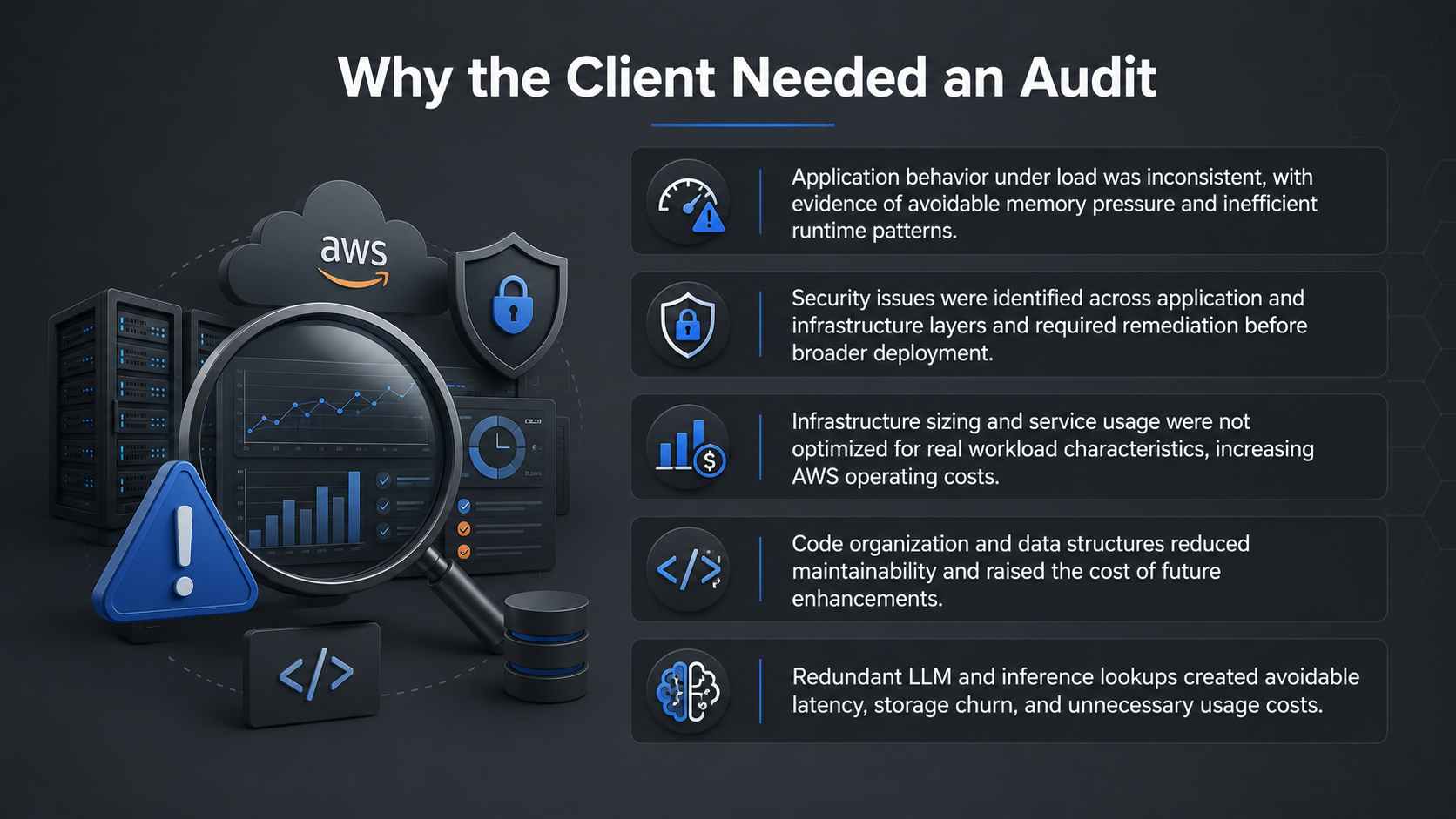
A public-safety-focused video analytics platform was built quickly with substantial AI coding assistance. FAMRO's assessment identified weaknesses in runtime efficiency, infrastructure fit, security posture, and maintainability—then helped shape a practical improvement plan.
Repeated component initialization: excess memory pressure and avoidable runtime overhead.
Redundant inference activity: unnecessary model calls, added latency, and usage costs.
Infrastructure and security concerns: workload placement, configuration, and access-control risks.
Clear remediation roadmap: practical steps toward more reliable, scalable operations.
You do not need to abandon AI-assisted development. You need appropriate engineering oversight for the risks your application actually carries.
Founders preparing an AI-built MVP for customers or investors
Non-technical teams seeking independent technical due diligence
Startups moving from prototype to production
Agencies looking for a third-party audit before handover
Engineering teams inheriting a fast-growing AI-assisted codebase
Frequently Asked Questions
Common questions about AI code audits
A vibe coding audit is an engineering review of software developed with substantial assistance from AI coding tools. It examines risks that a functioning demo may not reveal, including security, architecture, maintainability, databases, and deployment readiness.
Yes. The specific coding tool is less important than the application's codebase, dependencies, runtime environment, and business use. We agree on a practical review scope based on what can be accessed and tested.
Both. We can focus on a pre-launch assessment, a specific high-risk component, or an existing application that needs independent engineering review. Testing in production environments is scoped carefully.
Pricing depends on codebase size, technology stack, review depth, environments, and time-sensitive requirements. We first discuss your objectives and then propose the scope, deliverables, and price.
Yes. Remediation, architectural improvements, security hardening, and infrastructure changes can be discussed after the audit. They are not automatically included in the assessment.
No. A code and architecture audit can identify important security weaknesses, but it does not certify that a system is secure. Independent penetration testing or compliance verification may be appropriate depending on the application.
Start With Clarity
Understand your application's risks before they become expensive problems.
Tell us what you have built, what tools you used, and what concerns you have. We will discuss the right audit scope and next steps.
Initial conversation is free. No obligation.
Request an AI Code Audit
Tell us what you have built, which AI coding tools and technology stack you used,
and your main security, architecture, or production-readiness concerns.