Reliability
Unpredictable downtime
Manual releases, single points of failure, and unclear dependencies introduce avoidable risk during deployments and incidents.

Move your applications, databases, and infrastructure with a plan—not guesswork.
FAMRO helps startups, SaaS teams, and growing businesses migrate to the cloud, improve existing environments, and build secure, scalable, cost-aware foundations. We support moves from on-premises servers and legacy VPS hosting as well as cloud-to-cloud migrations across AWS, Microsoft Azure, Google Cloud, DigitalOcean, and Alibaba Cloud.
Application migrations · Database cutovers · Infrastructure modernization · CI/CD & observability
When It Is Time to Migrate
A cloud move can be a major improvement—or an expensive recreation of the same problems. Businesses often approach FAMRO when legacy servers, fragile deployments, mounting bills, unreliable performance, or unclear recovery procedures make everyday operations harder than they should be.
Reliability
Manual releases, single points of failure, and unclear dependencies introduce avoidable risk during deployments and incidents.
Cost
Oversized resources, unused services, or an unsuitable cloud provider can inflate spend without improving outcomes.
Technology
Old runtimes, tightly coupled components, and hard-to-move data create migration complexity that needs careful sequencing.
Operations
Without dependable monitoring, backups, runbooks, and ownership, even a successful cutover can leave teams exposed.
What We Do
There is no one-size-fits-all cloud architecture. We evaluate your applications, data, dependencies, security requirements, and operating budget before proposing a practical migration path.
01 / Assessment
Review dependencies, hosting constraints, traffic patterns, cost drivers, security gaps, recovery requirements, and migration risks. Receive a prioritized roadmap, target architecture, and cutover considerations.
02 / Infrastructure
Move workloads from physical servers, shared hosting, unmanaged VPS instances, or aging environments to a better-supported cloud foundation, with improved networking, access controls, backups, and deployments where appropriate.
03 / Portability
Transition workloads between AWS, Azure, Google Cloud, DigitalOcean, and Alibaba Cloud when pricing, geography, tooling, performance, or operational requirements justify the change. We assess lock-in, data transfer, compatibility, and rollback options first.
04 / Data
Plan PostgreSQL and MySQL upgrades and moves with attention to schema compatibility, replication or export methods, data integrity, application cutovers, backup validation, and acceptable downtime.
05 / Applications
Improve legacy applications incrementally through runtime upgrades, API and architecture improvements, Docker-based packaging, managed services, or Kubernetes where complexity and scale justify it. We do not recommend a wholesale rewrite by default.
06 / Operations
Establish repeatable CI/CD, infrastructure as code where appropriate, observability, access management, recovery procedures, performance checks, resource sizing, and cloud cost controls so the new environment remains manageable after go-live.
Platform-Independent Recommendations
Choosing a cloud is an architecture and business decision. We compare services, operating overhead, pricing models, integration needs, and regional availability against your application requirements—not a preferred vendor's sales pitch.
AWS
Migration and modernization for workloads using EC2, RDS, S3, container services, load balancing, networking, monitoring, and automated deployments.
Azure
Plan Azure-targeted application, infrastructure, and database moves with attention to identity, networking, service compatibility, and operational management.
GCP
Evaluate Google Cloud migration patterns for compute, managed data services, containers, networking, and application delivery.
DigitalOcean
For lean engineering teams, consider Droplets, managed databases, object storage, and Kubernetes where simpler operations and predictable architecture are priorities.
AliCloud
Assess Alibaba Cloud migrations where geographic reach, provider strategy, workload compatibility, or regional infrastructure requirements make it suitable.
Architecture
We help decide when a hybrid or multi-cloud design is worthwhile—and when it would add unnecessary complexity, cost, and operational overhead.
Our Migration Methodology
Migration strategy should reflect business-critical flows, technical dependencies, acceptable outage windows, and the team that will operate the resulting environment.
Step 01
Inventory applications, infrastructure, databases, integrations, usage patterns, and critical business flows. Identify dependencies, security concerns, and acceptable outage windows.
Step 02
Choose a justified strategy for each workload—rehost, replatform, refactor, retain, or retire. Define cloud services, cost assumptions, recovery expectations, and acceptance criteria.
Step 03
Build infrastructure, configure access and deployment paths, rehearse data movement, test performance and backups, create rollback procedures, and validate key integrations.
Step 04
Execute a staged or coordinated cutover based on risk and dependencies. Verify application behavior, data consistency, security controls, and monitoring before closing the migration window.
Step 05
Review real-world performance, resource sizing, cloud costs, alerting, budgets, and runbooks. Transfer operational knowledge so your team can manage the environment confidently.
Actual migration timelines and downtime depend on application architecture, data size, dependencies, and cutover constraints. We assess them before making commitments.
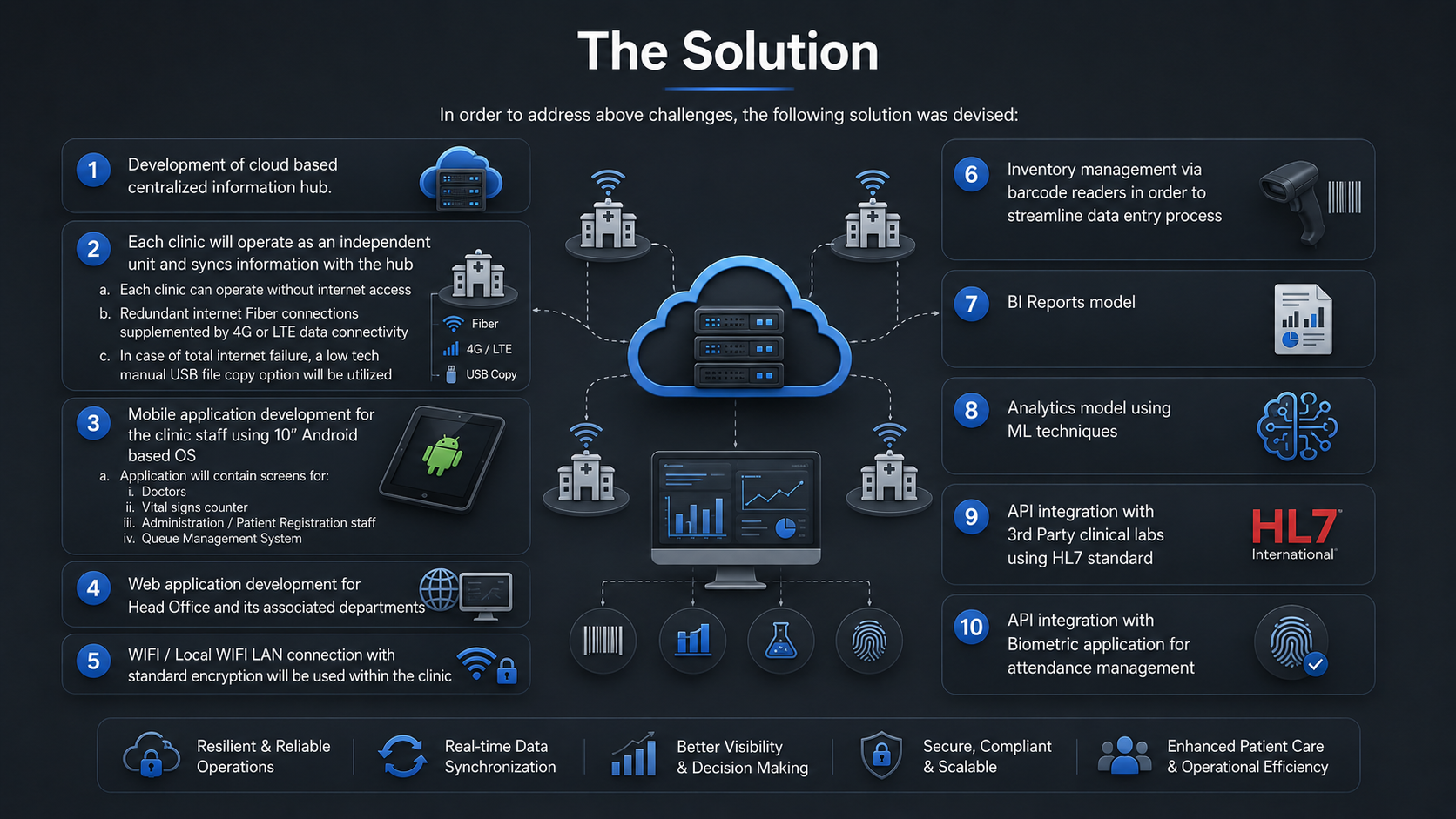
Selected Case Study · Healthcare Cloud Modernization
A multi-location nonprofit healthcare organization replaced fragmented paper workflows with connected digital services and reporting. The program used AWS infrastructure, PostgreSQL, Flask, React, and offline-capable clinic workflows to support centralized administration while accommodating unreliable connectivity.
These are reported results from this specific healthcare modernization engagement, not guaranteed outcomes of future cloud migration projects.
Who We Work With
Some teams need to leave an aging server behind. Others have already migrated but still face fragile deployments, spiraling infrastructure bills, slow databases, or limited observability. FAMRO can help through a focused migration, a targeted modernization phase, or ongoing technical guidance.
We focus on business continuity, clear engineering tradeoffs, maintainability, and solutions that fit the team expected to operate them.
That can mean choosing a managed service instead of Kubernetes, improving an existing database rather than replacing it, or postponing a migration until the risks are better understood.
Frequently Asked Questions