Our Blog

Amazon SQS vs SNS vs EventBridge: How to Choose the Right AWS Messaging Service

Amazon SQS vs SNS vs EventBridge: How to Choose the Right AWS Messaging Service

Introduction

Modern cloud architecture is increasingly distributed, asynchronous, and event-driven. As organizations move from monolithic applications to microservices, serverless workloads, SaaS integrations, and domain-oriented platforms, messaging becomes a core architectural decision—not a secondary implementation detail.

AWS provides several managed messaging and integration services, but three names often appear in the same conversation: Amazon Simple Queue Service (SQS), Amazon Simple Notification Service (SNS), and Amazon EventBridge. At first glance, they may seem interchangeable because all three help systems communicate without tight coupling. In practice, they solve different problems.

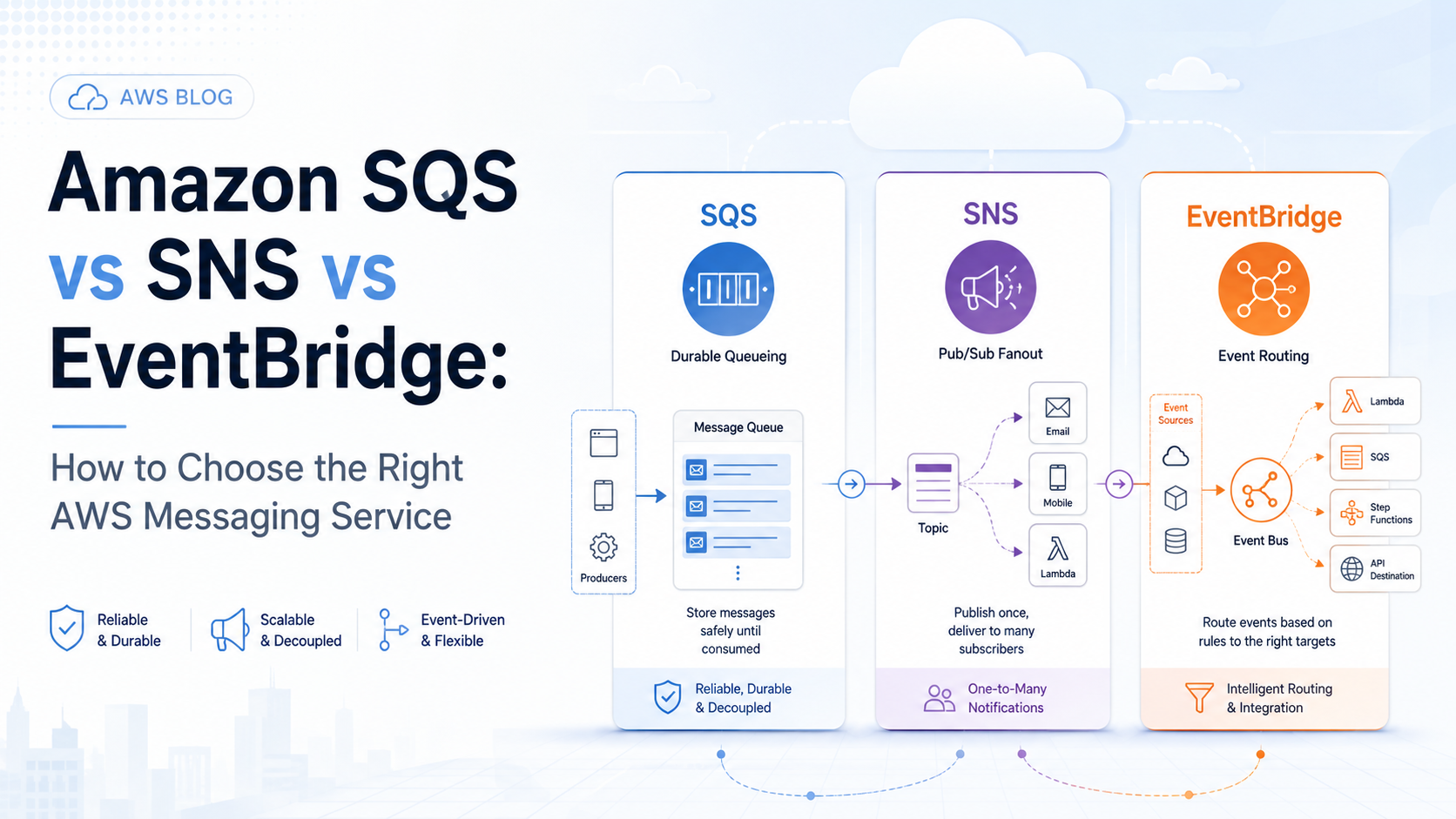
SQS is a queue. SNS is a pub/sub notification service. EventBridge is an event bus and routing layer.

For senior architects and technical leaders, the right question is not simply, “Which AWS messaging service should we use?” A better question is: What communication pattern does the workload require? Do you need durable workload buffering? Broad fanout? Cross-domain event routing? SaaS integration? Operational isolation? Governance across accounts and teams?

This article follows the structure and intent provided in the supplied outline, with a decision-led view for enterprise architecture and AWS migration planning.

As an AWS migration partner, we often see teams choose a messaging service too early—before clarifying reliability expectations, consumer ownership, retry behavior, and event governance. That usually leads to unnecessary complexity later. The goal here is to compare SQS, SNS, and EventBridge as complementary building blocks, not competing products.

Planning an AWS migration?

FAMRO helps SMEs and scaleups assess whether AWS can reduce infrastructure waste, improve capacity, strengthen resilience, and lower operational risk.

Book a Free AWS Cost & Capacity Review

This guide is for you if:

  • Your hosting costs are rising but performance is not improving.
  • Your application faces traffic spikes, slow response times, or 5xx errors.
  • Your backups, disaster recovery, or failover processes are manual or untested.
  • Your engineers spend too much time maintaining infrastructure instead of shipping features.
  • You are preparing for larger customers, security reviews, or compliance expectations.

Brief Overview of Amazon SQS, Amazon SNS, and Amazon EventBridge

Amazon SQS

Amazon SQS is a fully managed message queuing service used to decouple producers and consumers. AWS describes SQS as a managed queuing service that helps decouple and scale microservices, distributed systems, and serverless applications.

Architecturally, SQS is useful when one system produces work and another system processes that work asynchronously. The producer does not need to know whether the consumer is currently available. Messages remain in the queue until consumers poll and process them.

This makes SQS a strong fit for background jobs, workload buffering, retry handling, batch processing, and protecting downstream systems from traffic spikes.

Amazon SNS

Amazon SNS is a fully managed publish/subscribe messaging service. It is designed for scenarios where one message must be delivered to multiple subscribers. AWS documentation describes SNS fanout as a pattern where a message published to a topic is replicated and pushed to multiple endpoints, including SQS queues, HTTP endpoints, Lambda functions, and delivery streams.

SNS is best understood as a broadcast mechanism. A publisher sends a message to a topic, and SNS pushes that message to subscribed endpoints. When combined with SQS, each subscriber can receive its own durable copy for independent processing.

Amazon EventBridge

Amazon EventBridge is a serverless event bus used to route events from AWS services, custom applications, and third-party SaaS providers to downstream targets. AWS describes EventBridge event buses as routers that receive events and deliver them to zero or more targets, with optional event transformation.

EventBridge is most valuable when architecture requires routing based on event patterns, integration across domains, SaaS connectivity, multi-account event flows, or enterprise-level event governance.

It is not just about moving messages. It is about creating a controlled event fabric across producers and consumers.

When to Use Amazon SQS

Use Amazon SQS when the architecture needs a durable queue between producers and consumers.

A typical pattern is simple: a producer submits a task, and one or more workers process tasks from the queue. The queue absorbs load, smooths spikes, and allows consumers to scale independently. If a downstream service is temporarily slow, the queue buffers work rather than forcing upstream systems to fail immediately.

Common SQS use cases include:

⇒Background job processing

⇒Payment or invoice task queues

⇒Image, video, or document processing

⇒Retry and dead-letter handling

⇒Buffering traffic spikes

⇒Batch processing

⇒Decoupling microservices

⇒Protecting fragile downstream systems

For senior architects, the key considerations are not just whether SQS can move messages. The design questions are deeper.

Delivery semantics: Standard queues support at-least-once delivery and high throughput, which means consumers must be idempotent. FIFO queues add ordering and exactly-once processing support within defined constraints, but require careful design around message groups.

Visibility timeout: Once a consumer receives a message, it becomes temporarily invisible to other consumers. If processing does not complete before the visibility timeout expires, the message can be delivered again. This setting must align with realistic processing time.

Dead-letter queues: DLQs are essential for operational resilience. Poison messages should not block normal processing forever. They should be isolated, inspected, and handled through a defined remediation process.

Consumer scaling: SQS works well when consumers can scale horizontally. Lambda, containers, or worker fleets can process messages in parallel while the queue acts as a pressure buffer.

Idempotency: Because distributed systems can retry and redeliver messages, consumers must be designed to safely handle duplicate processing.

Pros and Cons of Amazon SQS

Pros

SQS provides strong decoupling with minimal operational overhead. Teams do not need to run brokers, manage clusters, patch middleware, or design complex queue infrastructure. It integrates naturally with IAM, Lambda, CloudWatch, Step Functions, ECS, and other AWS services.

It is especially strong when the goal is controlled asynchronous processing. A downstream service can process work at its own pace, while producers continue operating independently.

SQS also supports dead-letter queues, delayed messages, long polling, FIFO queues, and managed scaling. For many AWS-native workloads, it is the simplest reliable choice for queue-based processing.

Cons

SQS is not designed for broad event distribution by itself. If multiple independent consumers each need the same message, you usually need an additional pattern, such as SNS-to-SQS fanout.

It is also not the best fit for complex routing, event schema governance, SaaS event ingestion, or cross-domain event orchestration. SQS stores messages for processing; it does not provide a rich event routing model.

When to Use Amazon SNS

Use Amazon SNS when the primary requirement is pub/sub fanout.

SNS is appropriate when one event or notification must be distributed to multiple subscribers quickly. For example, when an order is confirmed, several downstream systems may need to react: customer notification, analytics, fraud monitoring, inventory, support tooling, and operational alerting.

Instead of the order service calling each downstream system directly, it publishes one message to an SNS topic. SNS then pushes the message to all subscribers.

Typical SNS use cases include:

⇒Order status notifications

⇒Alert distribution

⇒Fanout to multiple SQS queues

⇒Mobile push notifications

⇒SMS and email notifications

⇒HTTP endpoint delivery

⇒Lambda-triggered processing

SNS is especially effective when paired with SQS. AWS documentation highlights SNS and SQS together as a fanout pattern where messages can be delivered immediately to subscribers and also persisted in SQS queues for later processing.

That combination is common in production systems because each subscriber gets its own queue, retry behavior, failure isolation, and processing cadence.

Pros and Cons of Amazon SNS

Pros

SNS is simple, fast, and effective for broadcast-style messaging. Publishers do not need to know which systems are subscribed. Subscribers can be added or removed without changing producer code.

It supports multiple endpoint types, including SQS, Lambda, HTTP/S, email, SMS, mobile push, and Firehose delivery streams. This makes it useful for both application integration and notification delivery.

SNS also works well as the front end of a reliable fanout architecture. By subscribing multiple SQS queues to a topic, each downstream system can receive its own durable copy of the message and process independently.

Cons

SNS alone is not a work queue. It pushes messages to subscribers, but it does not provide the same consumer-controlled queue processing model as SQS. For durable and isolated downstream processing, SNS is often combined with SQS.

SNS is also less suitable than EventBridge for complex event routing, filtering across many domains, SaaS integration, and enterprise-level event governance. It is excellent for fanout, but not always sufficient as an organization-wide event backbone.

When to Use Amazon EventBridge

Use Amazon EventBridge when the architecture requires event routing, filtering, transformation, SaaS integration, or enterprise-scale event-driven design.

EventBridge is particularly useful when events are not merely technical messages but business-significant domain events: OrderCreated, PaymentAuthorized, InventoryReserved, ShipmentDispatched, CustomerUpdated, or SubscriptionCancelled.

Instead of building point-to-point integrations between services, teams publish events to an event bus. Rules match event patterns and route relevant events to targets. AWS documentation states that EventBridge event patterns allow rules to select which events are sent to specific targets.

This supports cleaner separation between producers and consumers. Producers publish meaningful events. Consumers subscribe to events they care about.

Common EventBridge scenarios include:

⇒Domain event routing across business capabilities

⇒Multi-account AWS architectures

⇒SaaS-to-AWS integration

⇒Decoupled enterprise platforms

⇒Event-driven workflows

⇒Integration between serverless services

⇒Cross-team event governance

⇒Routing events to different targets based on content

EventBridge Pipes is also relevant when architects need point-to-point integration with filtering and enrichment. AWS describes Pipes as a way to choose a source, optionally filter, optionally enrich, and deliver to a target.

This is useful when you do not need a full event bus pattern but still want managed filtering and transformation between a source and target.

Pros and Cons of Amazon EventBridge

Pros

EventBridge provides a higher-level event routing model than SQS or SNS. It supports filtering, routing, transformation, SaaS integration, AWS service events, and multi-target delivery.

It can reduce custom integration code because routing logic moves into managed event rules instead of being hardcoded inside services. This is valuable in enterprise environments where domains, accounts, platforms, and SaaS tools need to interact without direct dependencies.

EventBridge is also well suited for governance. Architects can define event buses by domain, account, environment, or organizational boundary. This helps teams scale event-driven architecture without turning every service into a custom integration hub.

Cons

EventBridge can be more abstract than SQS or SNS. Teams need good event design discipline, naming standards, schema thinking, ownership models, and observability practices.

It may also be unnecessary for simple workloads. If the requirement is just “put this task in a queue and process it later,” SQS is usually simpler. If the requirement is “broadcast this notification to several subscribers,” SNS may be enough.

EventBridge is powerful, but using it without event governance can create a distributed system that is hard to understand.

Practical 2026 Use Case: Modernizing an Order Processing Platform

Consider an enterprise modernizing an order management system during an AWS migration. The legacy platform may have direct integrations between order capture, payment, inventory, fulfillment, invoicing, customer notification, support systems, and reporting. Over time, these integrations become brittle. A delay in one downstream system can affect the whole order flow. New business capabilities are hard to add because every change touches multiple systems.

A modern AWS-native architecture may use SQS, SNS, and EventBridge together.

SQS buffers operational tasks. Payment capture, invoice generation, fulfillment requests, and inventory synchronization can each use dedicated queues. This allows every downstream system to process work at its own pace. If fulfillment slows down, payment does not necessarily stop. If invoice generation fails, messages can move to a dead-letter queue for investigation.

SNS broadcasts time-sensitive notifications. Events such as “order confirmed” or “payment failed” can be published to SNS topics and distributed to customer messaging, internal support tools, operational alerting, and downstream SQS queues.

EventBridge routes business events across domains. Events such as OrderCreated, PaymentAuthorized, InventoryReserved, and ShipmentDispatched can move across AWS accounts, bounded contexts, and SaaS systems using rules and event patterns.

In this model, the answer is not SQS vs SNS vs EventBridge. The better architecture uses each service intentionally:

⇒SQS for durable work processing

⇒SNS for fanout notification

⇒EventBridge for event routing and enterprise integration

That separation makes the platform easier to scale, govern, observe, and evolve.

Advantages of Amazon SQS Compared with Non-AWS Messaging Alternatives

SQS is attractive when the target architecture is already on AWS or actively migrating to AWS. Its biggest advantage is operational simplicity. There are no brokers to manage, clusters to patch, or storage layers to operate.

It also integrates natively with IAM, CloudWatch, Lambda, ECS, Step Functions, and other AWS services. For teams standardizing on AWS, this reduces platform complexity and accelerates delivery.

Compared with tools like Kafka or RabbitMQ, SQS is usually easier to operate for straightforward queue-based workloads. However, the comparison should be balanced. Kafka may be better for high-throughput event streaming, replayable logs, analytics pipelines, and advanced stream processing. RabbitMQ may be preferred where teams need specific broker semantics, routing exchanges, or existing operational maturity.

SQS is strongest when the priority is managed, durable, AWS-native asynchronous processing.

Advantages of Amazon SNS Compared with Non-AWS Pub/Sub Alternatives

SNS is valuable when teams need managed pub/sub fanout tightly integrated with AWS services. It works naturally with SQS and Lambda and supports multiple endpoint types, making it useful for both system integration and notification delivery.

For AWS-centric architectures, SNS reduces the need to run dedicated pub/sub infrastructure. It is particularly effective when combined with SQS queues, because each subscriber can process messages independently and reliably.

However, SNS is not a universal replacement for every messaging platform. Organizations with broader event streaming requirements, cross-cloud standardization goals, or existing Kafka ecosystems may prefer other platforms.

SNS is strongest when the problem is notification fanout, not complex event streaming.

Advantages of Amazon EventBridge Compared with Non-AWS Eventing Alternatives

EventBridge is especially useful for AWS-centered enterprise architectures because it provides managed event routing, filtering, SaaS integration, and service-to-service decoupling without requiring teams to operate custom event broker infrastructure.

It also aligns well with multi-account AWS strategies. Events can be routed between services, accounts, and domains while maintaining clearer ownership boundaries.

Compared with non-AWS eventing platforms, EventBridge reduces the amount of integration code teams need to write and maintain. It also provides native integration with many AWS services and supported SaaS providers.

That said, non-AWS platforms may be appropriate where organizations require cloud-neutral event mesh patterns, strict portability, existing Kafka investment, or advanced streaming semantics.

EventBridge is strongest when AWS-native event routing, integration, and governance matter more than broker portability.

Decision Framework: SQS vs SNS vs EventBridge

Senior architects should choose based on the communication pattern.

Use Amazon SQS when you need a durable queue and controlled asynchronous processing. It is the right choice when consumers pull work, process independently, and need buffering, retries, and failure isolation.

Use Amazon SNS when you need pub/sub fanout to multiple subscribers. It is the right choice when one publisher needs to broadcast a message to many endpoints.

Use Amazon EventBridge when you need event routing, filtering, SaaS integration, cross-domain communication, or enterprise-scale event-driven architecture.

Use them together when building resilient AWS-native platforms. Many mature architectures combine all three because queueing, fanout, and event routing are different concerns.

A practical rule is:

⇒SQS answers: “Who will process this work, and when?”

⇒SNS answers: “Who needs to be notified?”

⇒EventBridge answers: “Which events matter across the enterprise, and where should they go?”

How FAMRO helps

FAMRO supports SMEs and scaleups with cloud infrastructure design, AWS migration, DevOps automation, CI/CD, observability, cost optimization, and technical consulting. We help teams move from fragile infrastructure to scalable, reliable, and cost-aware cloud platforms.

Conclusion

Choosing between Amazon SQS, SNS, and EventBridge should start with the integration pattern—not the product name. These services overlap only at a surface level. Architecturally, they solve different problems.

SQS gives you durable queue-based decoupling. SNS gives you simple and scalable fanout. EventBridge gives you event routing, filtering, SaaS integration, and a stronger foundation for enterprise event-driven architecture.

For organizations evaluating AWS migration or modernization in 2026, these services can significantly reduce operational overhead compared with self-managed messaging infrastructure. But the decision still needs to be based on workload fit, reliability expectations, governance needs, cost model, consumer ownership, and long-term architecture strategy.

As an AWS migration partner, we help organizations assess existing integration patterns, modernize legacy messaging flows, and design AWS-native architectures using SQS, SNS, EventBridge, Lambda, Step Functions, containers, and related services. Whether you are decomposing a monolith, modernizing order processing, building a serverless platform, or creating a multi-account event-driven architecture, the right messaging design can directly improve resilience, scalability, and delivery speed.

To help organizations get started, we offer a free initial consultation focused on your AWS messaging and event-driven architecture strategy—no obligation, no generic pitch.

If your organization is investing in AWS migration, application modernization, or event-driven architecture and wants confidence—not guesswork—now is the time to act.

🌐 Learn more: Visit Our Homepage

💬 WhatsApp: +971-505-208-240

Our solutions for your business growth

Our services enable clients to grow their business by providing customized technical solutions that improve infrastructure, streamline software development, and enhance project management.

Our technical consultancy and project management services ensure successful project outcomes by reviewing project requirements, gathering business requirements, designing solutions, and managing project plans with resource augmentation for business analyst and project management roles.

Read More
2
Infrastructure / DevOps
3
Project Management
4
Technical Consulting