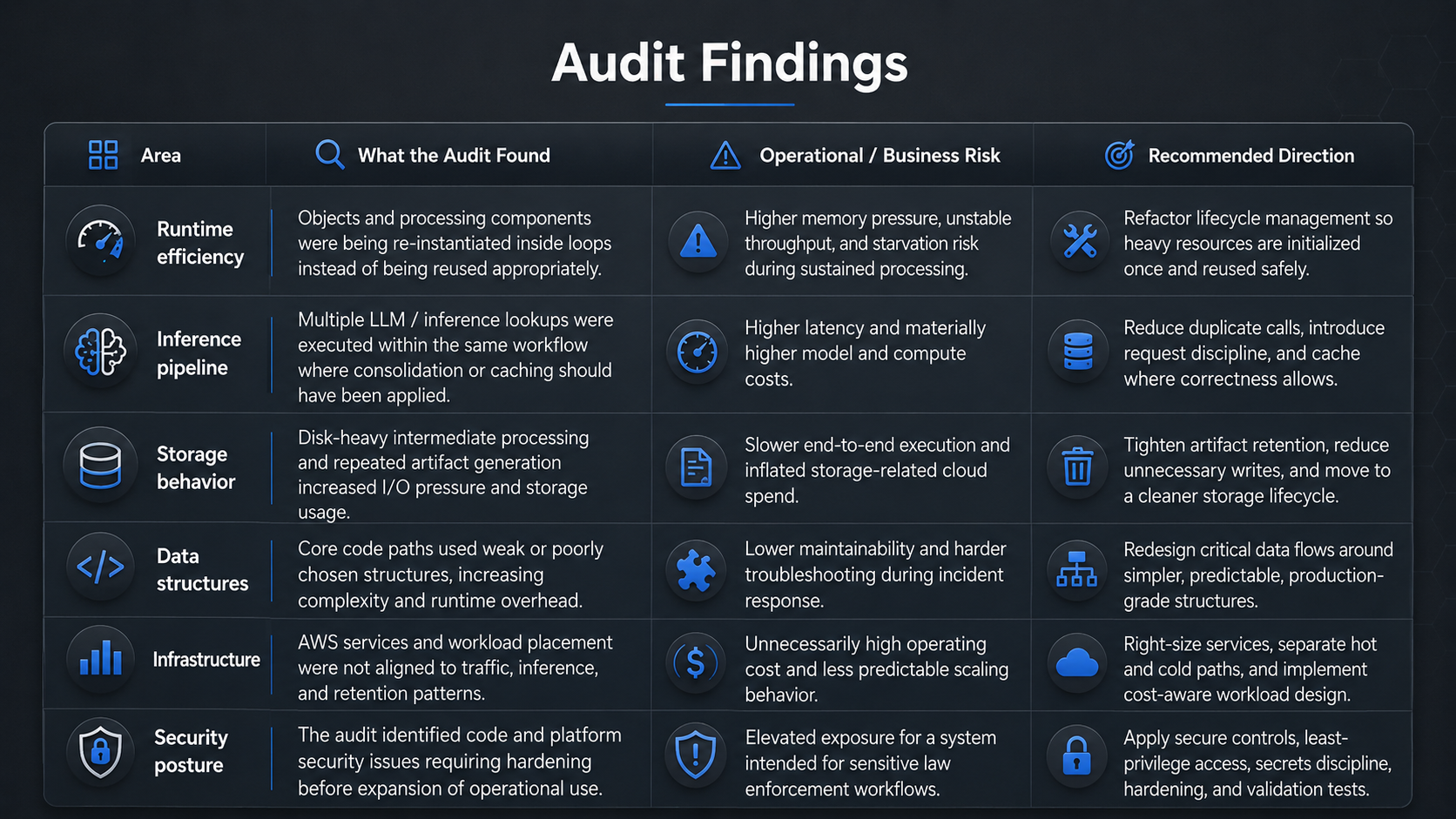
| Runtime efficiency |
Objects and processing components were being re-instantiated inside loops instead of being reused appropriately. |
Higher memory pressure, unstable throughput, and starvation risk during sustained processing. |
Refactor lifecycle management so heavy resources are initialized once and reused safely. |
| Inference pipeline |
Multiple LLM and inference lookups were executed within the same workflow where consolidation or caching should have been applied. |
Higher latency and materially higher model and compute costs. |
Reduce duplicate calls, introduce request discipline, and cache where correctness allows. |
| Storage behavior |
Disk-heavy intermediate processing and repeated artifact generation increased I/O pressure and storage usage. |
Slower end-to-end execution and inflated storage-related cloud spend. |
Tighten artifact retention, reduce unnecessary writes, and move to a cleaner storage lifecycle. |
| Data structures |
Core code paths used weak or poorly chosen structures, increasing complexity and runtime overhead. |
Lower maintainability and harder troubleshooting during incident response. |
Redesign critical data flows around simpler, predictable, production-grade structures. |
| Infrastructure |
AWS services and workload placement were not aligned to traffic, inference, and retention patterns. |
Unnecessarily high operating cost and less predictable scaling behavior. |
Right-size services, separate hot and cold paths, and implement cost-aware workload design. |
| Security posture |
The audit identified code and platform security issues requiring hardening before operational expansion. |
Elevated exposure for a system intended for sensitive law-enforcement workflows. |
Apply secure controls, least-privilege access, secrets discipline, hardening, and validation testing. |