FAMRO logo
  • Home
  • Overview
  • Problem
  • Solution
  • Outcomes
Contact Us
FAMRO logo
Home Overview Problem Solution Outcomes
Privacy Mission Contact
Scroll
00
Case Study
AIE
Case Study
AI Automation
AI Employee

AI Automation Using AI Employee

Turning distributed company knowledge into automated support, sales, and voice-based customer engagement.

This case study covers an AI-powered automation platform first built as an internal tool, then expanded into a white-label AI Employee solution used by more than 3,000 paying customers.

Read Case Study Discuss Your Automation

Overview

Building an AI automation layer that handles customer support, sales conversations, and knowledge retrieval at scale.

Startups and scaleups often accumulate valuable operational knowledge across documents, recordings, presentations, and internal files, but struggle to turn that information into fast, consistent customer engagement without growing headcount at the same pace.

Sector: Startups and Scaleups
Engagement: AI Automation Platform
Stack: FastAPI / React / AWS ECS
Outcome: 3,000+ Paying Customers

Case Summary

An AI-powered automation platform was developed to transform company knowledge into a practical support and sales resource. The bot was designed to handle customer-related queries through text and voice, ingest local company data across more than 40 supported file and content types, and make automated outbound sales calls based on company-defined sales funnels.

The platform was first built as an internal tool to reduce repetitive support and sales workload. After positive internal results, it was expanded into a white-label AI Employee solution for external customers.

The result was a commercially scalable automation product that improved operational efficiency while creating a broader client-facing AI service offering.
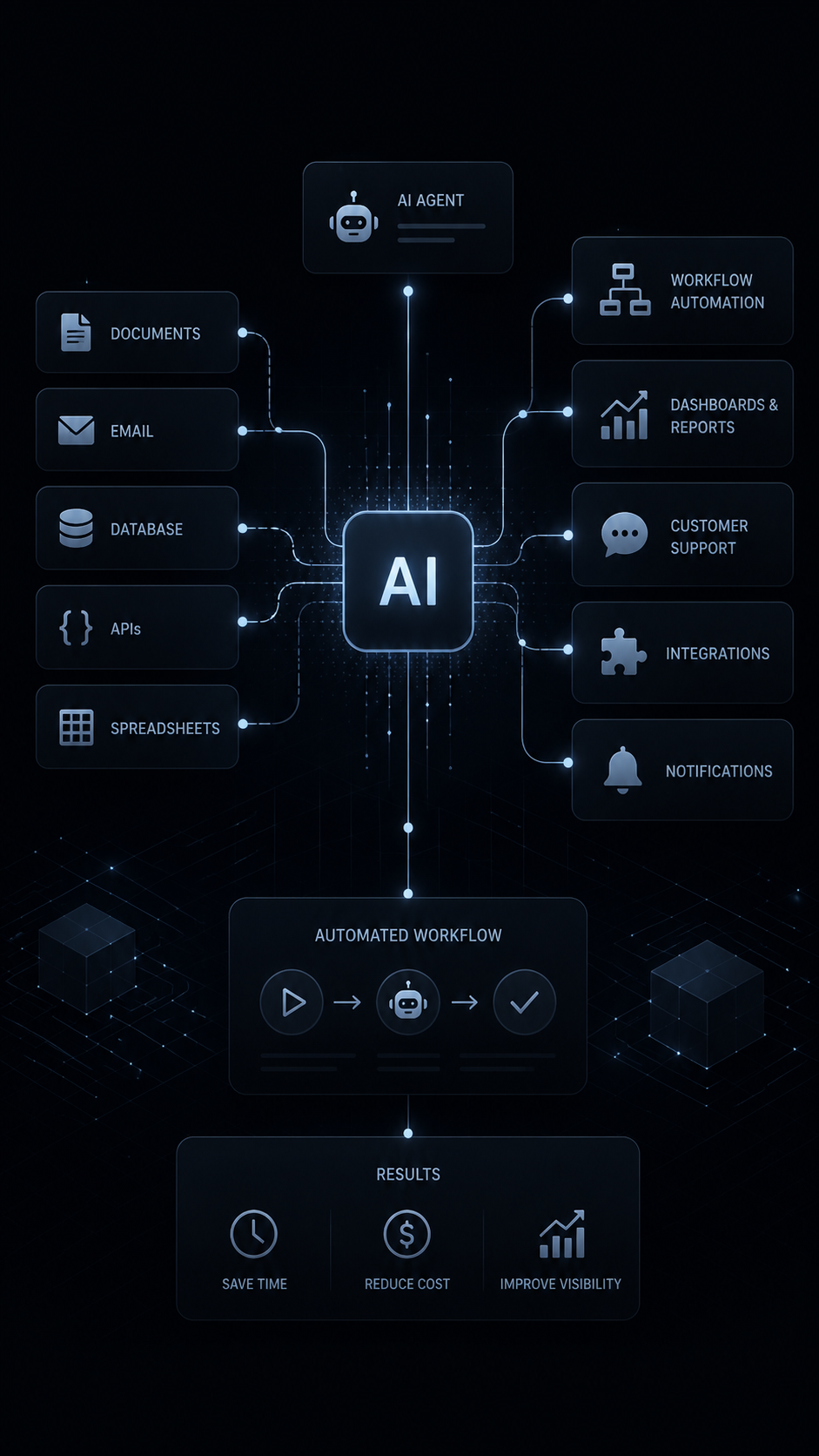
AI automation platform

Operational Context

The platform was built for organizations that need to respond to customers quickly, consistently, and at scale while controlling the cost of support and sales operations.

Many startups and scaleups hold critical information across documents, PDFs, spreadsheets, presentations, videos, emails, call recordings, and internal knowledge bases. In practice, that makes it difficult for support and sales teams to retrieve and apply the right information consistently during live customer interactions.

The AI Employee platform converted this distributed knowledge into a conversational capability accessible through text and voice, while also supporting workflow-driven support automation, call handling, and outbound sales engagement.

What The Platform Supported

  • Automated handling of customer support queries through text and voice.
  • Local data ingestion from more than 40 supported data and content types.
  • Vector-backed retrieval of relevant internal knowledge.
  • Automated outbound sales calls tied to company-defined funnels.
  • Automated handling and routing of incoming calls.
  • Speech-to-text and text-to-speech support for voice interactions.
  • Feedback-driven improvement after support and sales conversations.
  • White-label deployment for customer-branded AI Employee offerings.

Engagement Profile

Primary objective: Reduce repetitive customer support and sales workload through AI automation.

Modernization focus: Knowledge ingestion, conversational AI, telephony workflows, model routing, and white-label productization.

Commercial outcome: Internal automation tooling expanded into a market-ready AI Employee platform.

Problem

Fast-growing companies needed a way to scale customer engagement without matching every new request with new headcount.

Why AI-Based Automation Was Needed

Area Operational Constraint Business Impact Needed Capability
Support workload High volume of repeated questions across customer channels. Rising manual workload and slower support responsiveness. Automate routine text and voice support interactions.
Knowledge access Information spread across many file types and systems. Slow retrieval and inconsistent answers across staff. Ingest and retrieve company knowledge through conversational AI.
Sales follow-up Teams spent time on repetitive outreach and lead progression tasks. Missed follow-ups and limited sales capacity. Automate outbound calls and funnel-based follow-up workflows.
Operating cost Routine work depended heavily on direct human involvement. Cost scaled too closely with support and sales volume. Route repetitive, lower-risk work through automation.
Consistency Answers varied by channel, person, and timing. Unreliable customer experience and harder operational control. Deliver repeatable responses using centralized knowledge and workflows.
Scalability Growth in interactions outpaced team expansion. Support and sales operations became harder to scale efficiently. Introduce an automation layer that scales across channels and tenants.

What Teams Were Struggling With

  • High support workload caused by repetitive customer questions.
  • Slow response times when information was spread across multiple systems and file types.
  • Inconsistent answers across support staff, sales teams, and customer channels.
  • Limited capacity to follow up with leads at the right time.
  • High operating cost when routine customer tasks required direct human handling.
  • Underused internal knowledge because it could not be searched or applied efficiently.
  • Difficulty scaling support and sales activity without proportional headcount growth.

Solution

The platform combined AI support automation, vector-backed retrieval, telephony workflows, and cost-aware model routing.

Solution Overview

The system was developed as an AWS-deployed AI automation platform using Python FastAPI for backend services and React for the user interface. It ran on Amazon ECS to provide scalable support for API services, ingestion flows, automation jobs, and voice-enabled interactions.

The architecture used asynchronous processing to support concurrent customer interactions, ingestion workflows, call activity, and AI inference tasks. Where low-latency internal communication was needed, gRPC-based exchange could support efficient service-to-service calls.

The platform also optimized query handling by checking vector-backed knowledge stores before triggering unnecessary new inference requests, reducing repeated AI processing when reliable existing answers were available.

Core Solution Components

Area Solution Capability Business Value
Customer support automation Text and voice-based support handling for common customer queries. Reduces repetitive support workload and improves response availability.
Data ingestion Ingestion of more than 40 file and content types from local company data. Makes internal knowledge usable through conversational AI.
Knowledge retrieval Vector-backed retrieval and answer reuse for relevant or previously resolved queries. Improves answer consistency and lowers repeated processing.
Intelligent routing Routes routine or lower-complexity requests to lower-cost AI models. Controls operating cost while preserving stronger models for complex cases.
Automated sales calls Makes outbound calls according to company-defined sales funnels. Supports lead follow-up, qualification, and sales progression.
Incoming call handling Receives and processes incoming voice interactions. Extends automation beyond text-only support channels.
Speech capabilities Uses speech-to-text and text-to-speech services. Enables natural voice interaction with customers and prospects.
Feedback loop Captures feedback and conversation outcomes for future optimization. Improves workflows and responses over time.
White-label delivery Supports branded deployment for multiple client organizations. Converts internal tooling into a scalable commercial offering.

Why The Solution Matters

Operational efficiency. Routine support questions and retrieval-heavy interactions no longer required the same level of manual attention from support, account, and operations teams.

Better use of company data. Distributed business knowledge became accessible through one conversational interface instead of remaining trapped across disconnected file formats and systems.

Sales enablement. Automated outbound calls helped organizations apply sales funnels more consistently and maintain better follow-up discipline.

Cost-aware AI usage. Model routing let the platform reserve higher-cost AI processing for more complex scenarios.

Continuous improvement. Feedback capture created a path to improve responses, workflows, and sales conversations over time.

Roadmap

A five-phase operating model for rolling out AI Employee capabilities safely and commercially.

Phase 1: Build The Knowledge Foundation

  • Identify internal data sources, customer material, operational documents, and sales content.
  • Configure ingestion for supported file, audio, video, text, and structured-data formats.
  • Establish ownership, retention, access rules, and refresh processes.
  • Create a vector-backed knowledge layer for efficient retrieval and answer reuse.

Phase 2: Automate Support Workflows

  • Define common customer support scenarios and escalation conditions.
  • Configure text and voice interaction channels.
  • Implement speech-to-text and text-to-speech workflows for incoming and outgoing calls.
  • Set handoff rules for complex, sensitive, or unresolved requests.

Phase 3: Introduce Sales Automation

  • Map the company sales funnel into automation stages.
  • Define qualification questions, routing logic, follow-up rules, and call scripts.
  • Enable automated outreach for appropriate prospect and customer segments.
  • Capture outcomes from each call to improve future engagement.

Phase 4: Optimize AI Cost And Performance

  • Route routine and low-risk queries to lower-cost models.
  • Use vector storage and prior-answer reuse to reduce unnecessary inference calls.
  • Monitor response quality, resolution rates, call outcomes, latency, and operating costs.
  • Adjust routing, prompts, workflows, and escalation paths based on live performance data.

Phase 5: Expand Through White-Label Delivery

  • Package the platform for branded customer deployments.
  • Introduce tenant separation, organization-level configuration, and workflow customization.
  • Support client-specific data ingestion, sales funnels, support policies, and voice workflows.
  • Establish commercial onboarding and operational support processes for scale.

Outcomes

The platform reduced manual support work, improved sales execution, and scaled into a white-label AI product.

The supplied case-study content describes both technical delivery gains and commercial expansion after the platform proved effective as an internal automation tool.

Technical Achievements

  • Built an AI bot capable of handling customer support queries through both text and voice interactions.
  • Enabled local knowledge ingestion across more than 40 data and content types.
  • Introduced vector-backed retrieval and answer reuse to improve response efficiency and reduce repeated AI processing.
  • Implemented intelligent model routing so routine tasks could use lower-cost models where appropriate.
  • Deployed the solution on AWS using ECS, Python FastAPI, and React-based application components.
  • Added automated inbound and outbound call capabilities using telephony, speech-to-text, and text-to-speech workflows.
  • Applied asynchronous processing patterns to support multiple customer interactions, call workflows, and background automation tasks.

Business And Operational Achievements

  • Delivered a significant decrease in support requests requiring manual handling.
  • Reported a 3 percent increase in sales through automated sales-call workflows aligned with company-defined funnels.
  • Created a feedback loop that improved support quality, sales conversations, and automated workflows after each interaction.
  • Converted an internal operational tool into a market-ready white-label AI Employee solution.
  • Expanded the platform to support more than 3,000 paying customers.
  • Created a scalable foundation for organizations seeking to automate support, knowledge access, sales outreach, and customer engagement without proportional growth in operational headcount.
  • Positioned the product as a practical AI automation layer for startups and scaleups operationalizing their digital knowledge.

Need AI Automation?

If your team is carrying repetitive support, follow-up, or knowledge-retrieval work, AI automation should reduce load without degrading customer experience.

Reach out if you want FAMRO to help design AI support workflows, knowledge-ingestion pipelines, voice automation, sales follow-up systems, and scalable AI Employee capabilities.

Book a Free Review Contact Us
FAMRO-LLC — 2026
Mission Statement & Values Privacy Contact Us

Book a free review

Tell us what you are evaluating. We will review your current setup and help identify technical risks, cloud issues, automation gaps, and practical next steps.