Your First 90 Days of AI Automation: A Practical Roadmap

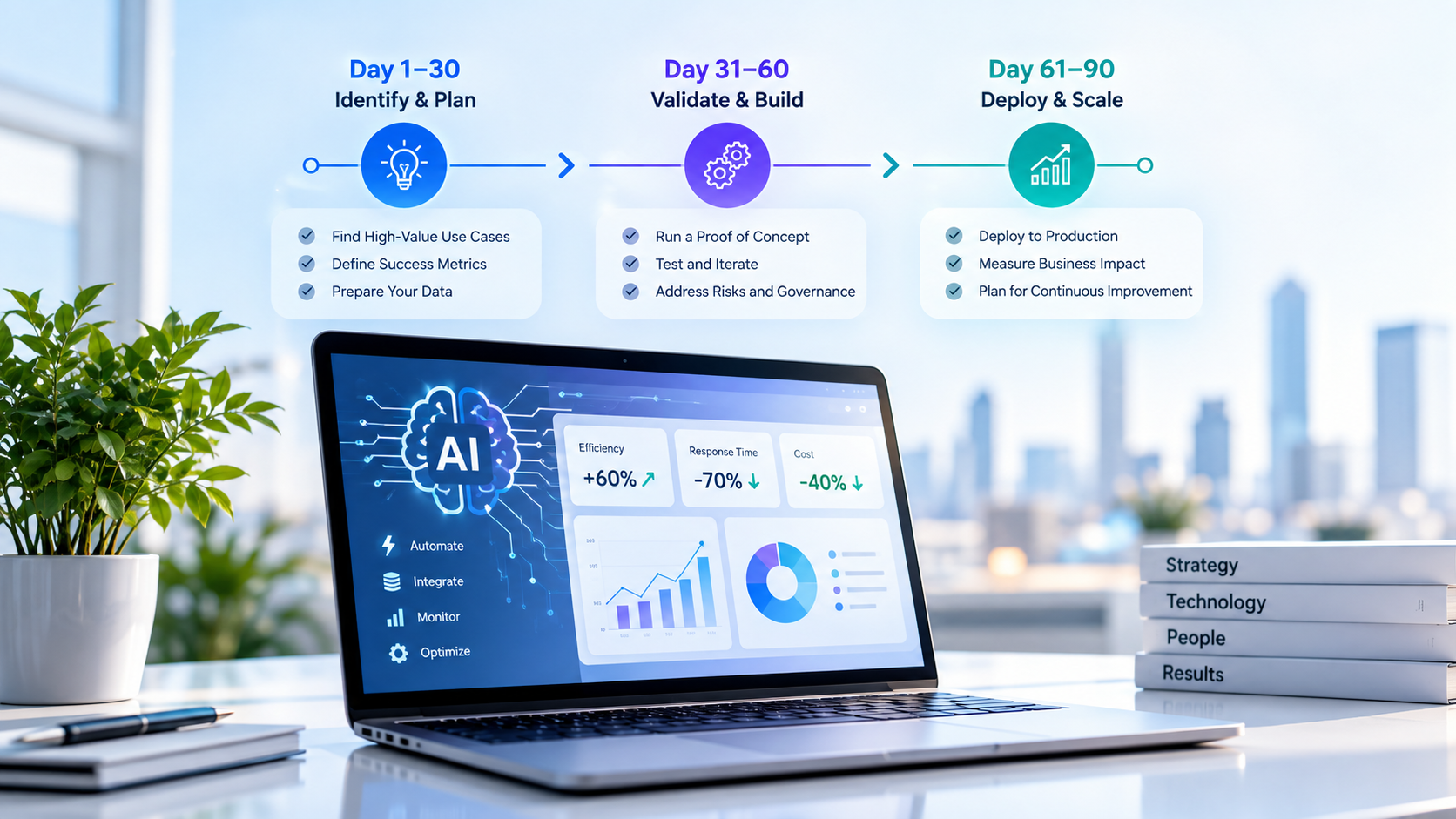
AI automation creates the most value when organizations move beyond experimentation and focus on specific workflows with measurable outcomes. This practical 90-day AI automation roadmap helps CTOs, founders, architects, and technical leaders structure their first initiative—from selecting the right opportunity and validating assumptions to production readiness, deployment, governance, and continuous improvement.

AI automation rarely fails because an organization cannot access the technology. More often, the difficulty lies in selecting the right workflow, connecting AI to real systems and data, managing risk, gaining user acceptance, and proving that the resulting automation creates measurable business value.

That distinction matters for enterprise leaders. In IBM's 2025 CEO study, surveyed CEOs reported that only 25% of AI initiatives had delivered their expected ROI, while just 16% had scaled enterprise-wide. The challenge, therefore, is not simply starting AI projects. It is establishing an execution model that can move a valuable use case from opportunity to controlled production deployment.

For a CTO or Head of Digital Transformation, the first 90 days should create exactly that model.

The objective is not to automate everything in one quarter. It is to prove that your organization can automate one meaningful workflow responsibly—and learn how to repeat the process.
Days 1–15: Identify and Rank Candidate Workflows

The first mistake many organizations make is beginning with the AI technology rather than the business process.

Instead of asking, “Where can we use an AI agent?” start with, “Where does repetitive knowledge work, decision friction, or manual coordination create measurable operational cost?”

Candidate workflows might include service-ticket triage, document classification, invoice processing, internal knowledge retrieval, sales research, compliance review support, customer-request routing, or extracting information from unstructured documents.

The important step is prioritization.

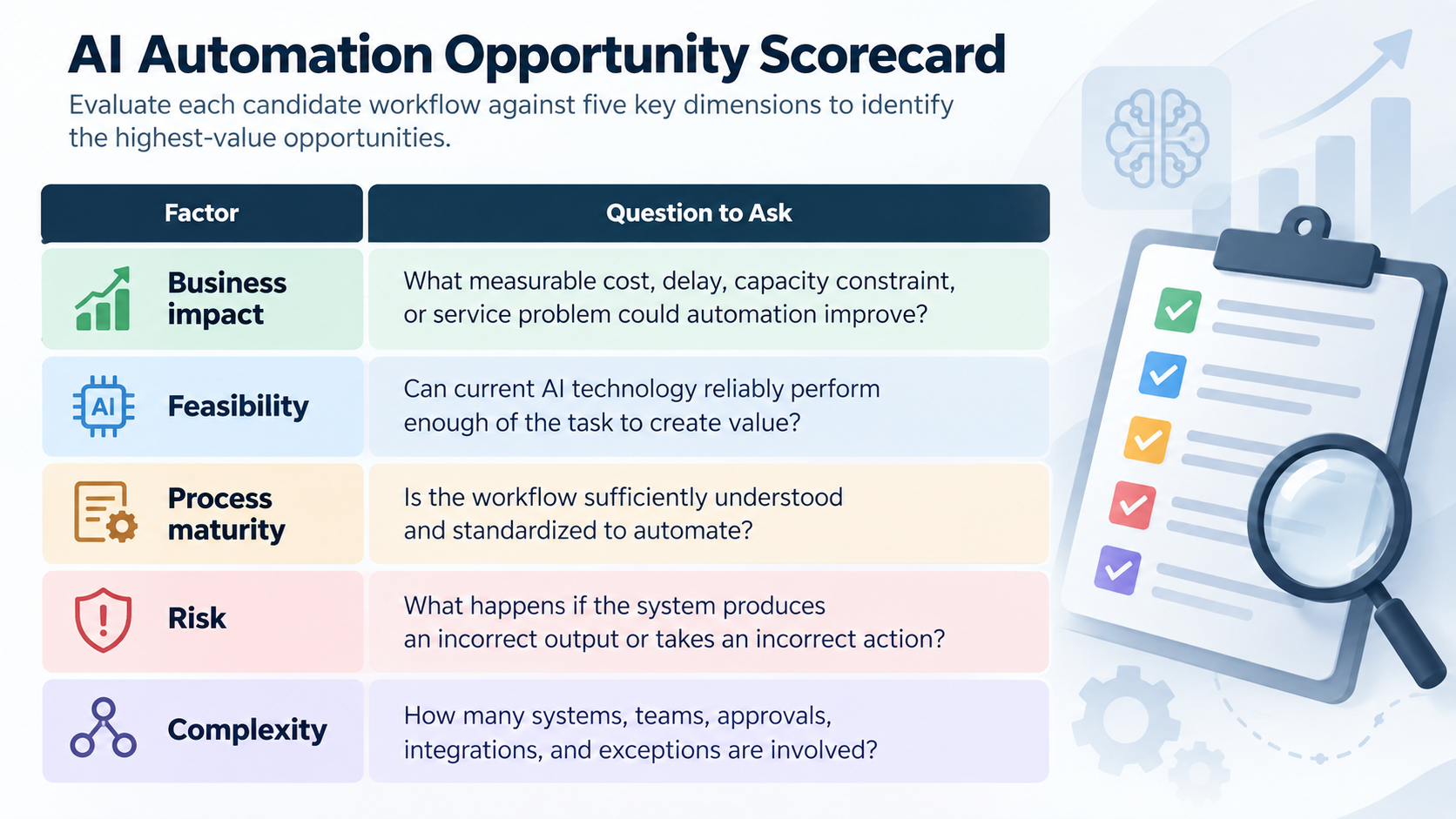
Build an AI Automation Opportunity Scorecard

Evaluate each candidate workflow against five dimensions:

Identify and Rank Candidate Workflows

A high-volume workflow is not automatically a good first candidate. A process involving six legacy systems, poorly defined ownership, sensitive data, and significant regulatory consequences may create substantial theoretical value but be unsuitable for a 90-day deployment.

Aim to leave this phase with one primary workflow and one backup candidate, not a portfolio of ten experiments.

McKinsey's 2025 AI research reinforces the importance of workflow design: among the organizational attributes it examined, workflow redesign showed the strongest relationship with reported EBIT impact from generative AI.

Days 15–30: Evaluate Data, Systems, Risks, and Integrations

Once a workflow has been selected, resist the temptation to immediately start building.

The next 15 days should answer a harder question: Can this automation operate inside the actual enterprise environment?

Start by mapping the process end to end. Identify where information originates, which systems own it, how decisions are currently made, which applications must be updated, and where humans need to remain involved.

The assessment should cover:

  • Data: availability, quality, sensitivity, ownership, retention, and access.
  • Systems: APIs, legacy applications, databases, SaaS platforms, identity systems, and integration constraints.
  • Security: authentication, authorization, secrets, data exposure, and least-privilege access.
  • Compliance: regulatory requirements, retention obligations, auditability, and applicable internal policies.
  • Ownership: the business owner, technical owner, risk owner, and operational support team.
  • Dependencies: vendors, APIs, infrastructure, approvals, and downstream processes that could delay deployment.

This is particularly important when AI systems can take actions rather than merely generate information. OWASP identifies excessive agency as a risk when AI applications are given unnecessary functionality, permissions, or autonomy.

A customer-service AI that recommends a refund is fundamentally different from an agent authorized to execute the refund directly.

By day 30, document the architecture, system boundaries, data flows, human checkpoints, major risks, and technical dependencies.

Days 30–45: Build a Focused Proof of Concept

Now build—but deliberately keep the proof of concept narrow.

The purpose of a POC is not to demonstrate every future capability. It is to answer a specific question:

Can AI improve this workflow enough to justify progressing toward production?

Suppose an enterprise receives thousands of supplier documents each month. A useful POC might extract ten required fields from two document types and send uncertain cases to a human reviewer.

It should not attempt to support every supplier, every document type, multilingual processing, automated ERP posting, exception resolution, analytics, and global deployment at once.

Define Success Before Testing

Agree on measurable criteria before evaluating the POC. Depending on the workflow, these could include:

  • extraction or classification accuracy;
  • task completion rate;
  • percentage of cases requiring human intervention;
  • processing time per transaction;
  • latency and cost per task;
  • reduction in manual steps;
  • quality compared with the existing process.

Define failure conditions as well.

A system achieving 95% accuracy may sound impressive, but the remaining 5% matters. Are failures obvious and recoverable, or can they silently create incorrect customer records, payments, compliance decisions, or operational actions?

A strong POC proves usefulness within explicit boundaries. It does not disguise unresolved risk behind an impressive demonstration.

Days 45–60: Test With Real Users and Realistic Data

A controlled demo tells you whether the technology can work. User testing tells you whether it works inside the business.

Bring representative employees into the process: the people who perform the workflow, supervise it, receive its outputs, and handle exceptions.

Use realistic data and realistic operating conditions wherever security and compliance requirements allow.

Testing should examine six areas: workflow fit, output quality, exceptions, user experience, human oversight, and downstream impact.

For example, an AI service desk assistant might categorize tickets correctly during a demonstration. In production-like testing, however, employees may discover that it struggles with ambiguous requests, fails to recognize urgent business context, or routes unusual incidents into the wrong queue.

These findings are valuable.

The goal is not to prove the AI was right. It is to discover where the combined human + AI + process system fails before those failures reach production.

Record false positives, false negatives, overrides, escalations, user corrections, and unusual cases. These become inputs to the next stage.

Days 60–75: Harden Security, Reliability, and Operations

At day 60, the question changes.

You are no longer asking, “Can this work?”

You are asking, “Can we operate this responsibly?”

NIST's AI Risk Management Framework organizes AI risk activities around four functions—Govern, Map, Measure, and Manage—and emphasizes that risk management should continue throughout the AI lifecycle rather than occur as a one-time approval exercise.

Translate that principle into production controls.

Define who can use the automation and what data it can access. Restrict service accounts and agent permissions to the minimum required. Protect credentials and sensitive information. Establish logs for important prompts, actions, approvals, and system events where appropriate.

Then design for failure.

What happens when a model endpoint becomes unavailable? What happens when an integration times out? What happens when confidence is low, a document is malformed, or an agent attempts an action outside its permitted scope?

Enterprise AI automation needs explicit escalation paths. High-risk or ambiguous cases should be routed to an authorized person rather than forcing the AI to make a decision.

Monitoring must also extend beyond infrastructure availability. Depending on the use case, teams may need visibility into output quality, exception rates, human overrides, model or prompt changes, latency, cost, integration failures, and unusual access patterns.

Finally, assign operational ownership. Someone must be accountable for what happens on day 91.

Days 75–90: Deploy, Monitor, and Measure Business Outcomes

Deployment should be controlled rather than organization-wide by default.

Start with a defined business unit, transaction category, customer segment, geography, or user group. Keep rollback procedures and human escalation available while collecting production evidence.

Most importantly, connect technical metrics to business outcomes.

An AI automation can have excellent model performance while producing little economic value.

For example, a support automation initiative might track technical indicators such as classification accuracy, response latency, and escalation rate. Leadership should connect these to outcomes such as:

  • average handling time;
  • time to resolution;
  • service-level performance;
  • operational effort per ticket;
  • backlog reduction;
  • customer satisfaction;
  • capacity released for higher-value work.

Establish a baseline from the pre-automation process whenever possible. Without one, leadership may know that the system is functioning but struggle to demonstrate whether the investment improved the business.

By day 90, the executive review should be able to answer four questions: What changed? What measurable value was created? What risks remain? What should happen next?

The answer may be to expand the automation. It may be to modify the workflow, improve the architecture, retain additional human oversight, or stop the initiative. All are useful outcomes when supported by evidence.

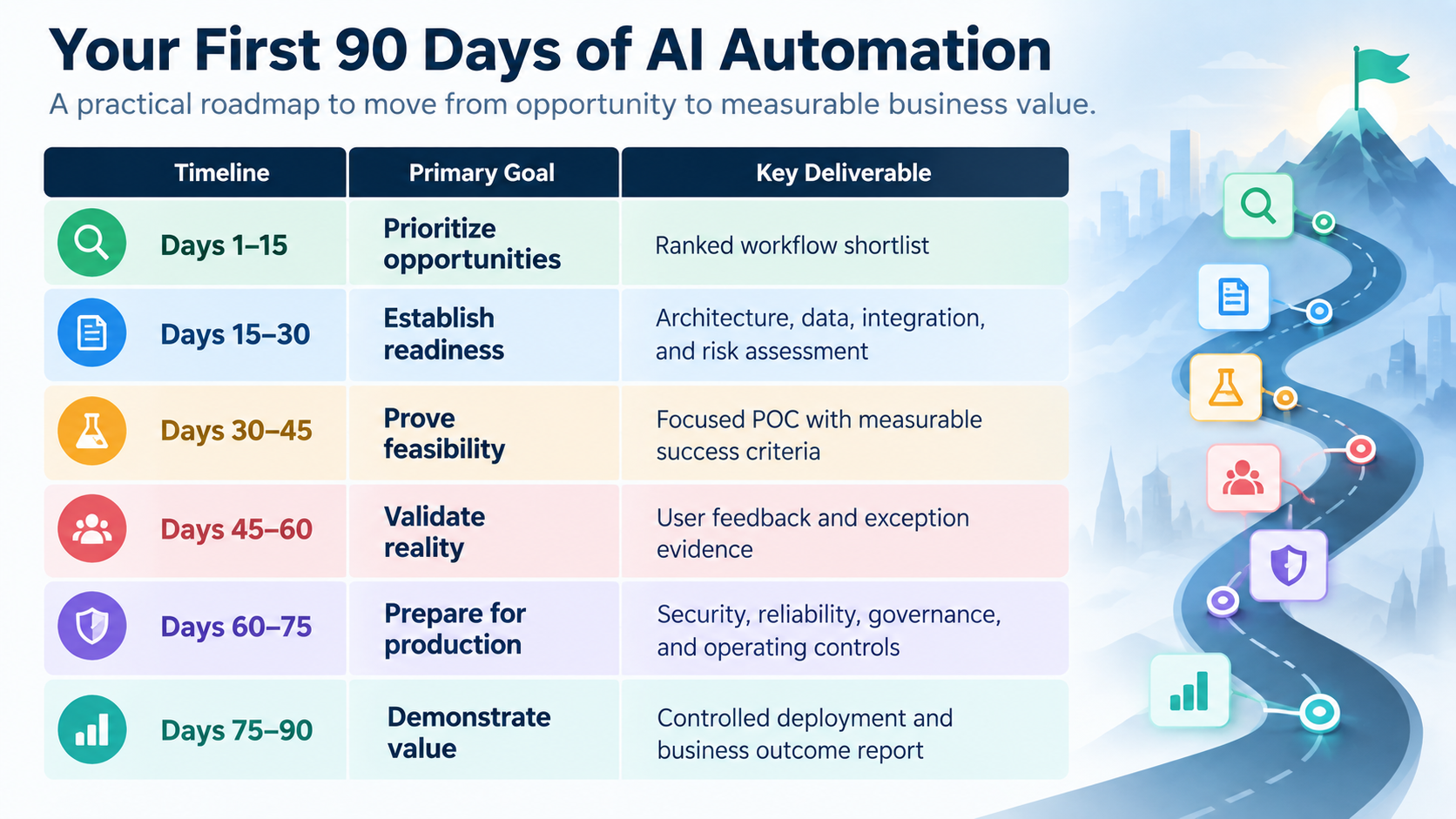
A 90-Day AI Automation Roadmap at a Glance

A 90-Day AI Automation Roadmap at a Glance

Conclusion

The most valuable outcome of the first 90 days is not a single AI deployment. It is a repeatable enterprise capability for moving from opportunity → assessment → proof → validation → operational readiness → measurable deployment.

That capability becomes increasingly important as organizations move from isolated generative AI experiments toward AI embedded in operational workflows.

The first deployment teaches leadership which data is actually usable, where integration bottlenecks exist, how employees interact with AI, what governance controls are practical, how exceptions should be handled, and which metrics demonstrate genuine business value. The next automation initiative should begin with that knowledge rather than starting again from zero.

For enterprise leaders attending the conference, this is an opportunity to move the AI conversation from possibility to implementation. Connect with FAMRO at the conference to discuss your first—or next—90-day AI automation roadmap, including use-case selection, solution architecture, enterprise integration, AI engineering, security, and production deployment.

We offer a free initial consultation focused on your AI automation priorities—no obligation, no generic pitch. If your organization is investing in AI automation and wants a controlled path from opportunity to measurable business outcomes, now is the time to turn that strategy into an execution plan.

🌐 Learn more: Visit Our Homepage

💬 WhatsApp: +971-505-208-240

Frequently Asked Questions

What should a company accomplish in its first 90 days of AI automation?

The first 90 days should focus on identifying a valuable workflow, defining measurable outcomes, validating the AI solution, preparing it for production, and establishing a process for monitoring results.

How should we choose our first AI automation use case?

Prioritize repetitive, high-volume workflows with clear inputs, measurable outcomes, manageable risk, and enough business value to justify implementation and ongoing operational costs.

Should we start with an AI proof of concept or build for production immediately?

A focused proof of concept can validate feasibility and business value before larger investments. Production requirements such as security, monitoring, reliability, governance, and integration should still be considered early.

How do you measure the ROI of AI automation?

Measure outcomes such as time saved, processing cost, error reduction, throughput, response time, employee productivity, customer experience, and revenue impact against the cost of building and operating the solution.

What are the biggest risks when implementing AI automation?

Common risks include unreliable outputs, poor data quality, security and privacy issues, uncontrolled costs, weak integrations, insufficient monitoring, and automating workflows that still require human judgment.

When should humans remain involved in an AI workflow?

Human review is especially important for high-impact decisions, ambiguous cases, sensitive data, exceptions, regulatory requirements, and workflows where incorrect AI outputs could create significant business risk.

References