A company may increase transactions by 10% and still see its cloud bill rise 25%. That does not necessarily mean the provider increased prices or the application suddenly became dramatically more expensive.
Often, infrastructure and business activity have simply stopped moving together.
Idle and “Zombie” Resources
Cloud environments accumulate infrastructure surprisingly quickly.
A developer creates a VM for testing. A team launches a temporary database during a migration. A project creates load balancers, snapshots and persistent disks. Six months later, the project has changed—but some of those resources remain.
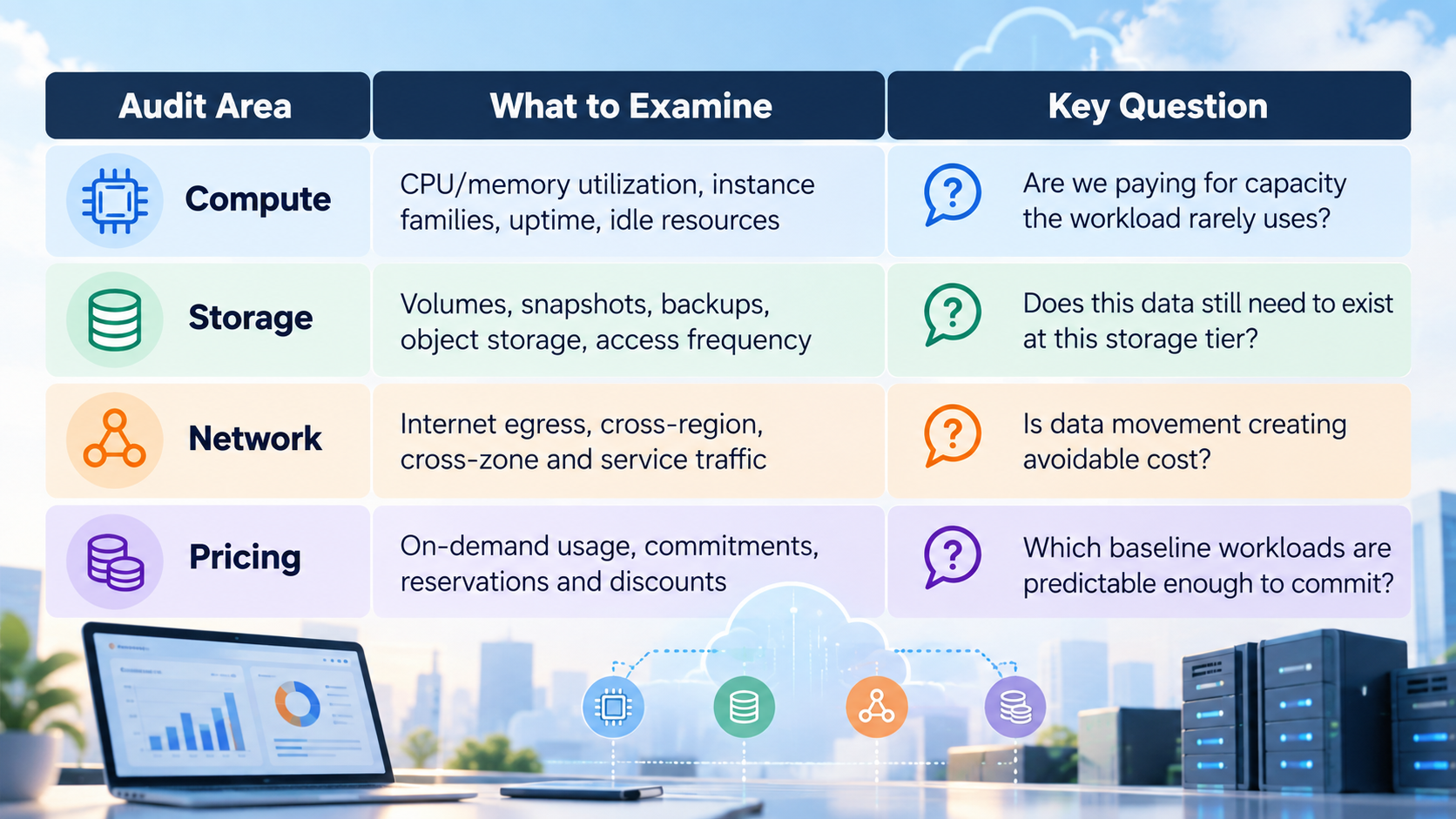
AWS explicitly recommends tracking project and resource lifecycles so organizations can identify resources that no longer have a useful purpose or owner. Its cost-management tooling similarly identifies idle resources, over-provisioned infrastructure and rightsizing opportunities.
Individually, these resources may look insignificant. Across dozens of teams and hundreds of cloud accounts or projects, they become material.
Oversized Compute
The cloud also exposes a habit inherited from traditional infrastructure: provisioning for the worst case.
If an application occasionally needs 16 vCPUs but normally needs four, running a 16-vCPU instance continuously means paying for headroom most of the month.
Google Cloud’s architecture guidance recommends matching resources to actual workload requirements and using autoscaling for dynamic demand rather than maintaining unnecessary fixed capacity.
Forgotten Storage
Storage is another quiet accumulator.
Snapshots, backups, logs, old database exports, unattached disks and duplicated datasets can survive long after their operational value disappears. Lifecycle policies and automated movement into lower-cost storage tiers help prevent data retention from becoming permanent by default.
Data Transfer and Egress
Networking costs are particularly easy to underestimate because architecture diagrams show connections—not invoices.
Traffic between regions, availability zones, services, the public internet and external platforms can have different cost implications. AWS specifically recommends modeling data-transfer cost by source, destination and volume because these charges are frequently neglected during architecture design.
Example: The $38,000 Application That “Should” Cost $25,000
Consider an illustrative SaaS platform whose engineering team expects infrastructure to cost approximately $25,000 per month.
A cost audit finds:
- $3,200 in development and staging compute running continuously
- $2,500 in oversized production instances
- $1,800 in old snapshots and unattached storage
- $3,500 in unexpected cross-zone, cross-region and internet data transfer
- $2,000 in miscellaneous resources without clear ownership
The application has not suddenly become 50% busier. The infrastructure around it has become 50% more expensive.
That is the visibility problem hidden inside “pay as you go.”