
meta name="description" content="Learn why AI pilots fail in production and how better data, integrations, evaluation, monitoring, governance, ownership, and cost controls improve AI readiness.">

Why AI Pilots Fail When They Reach Production

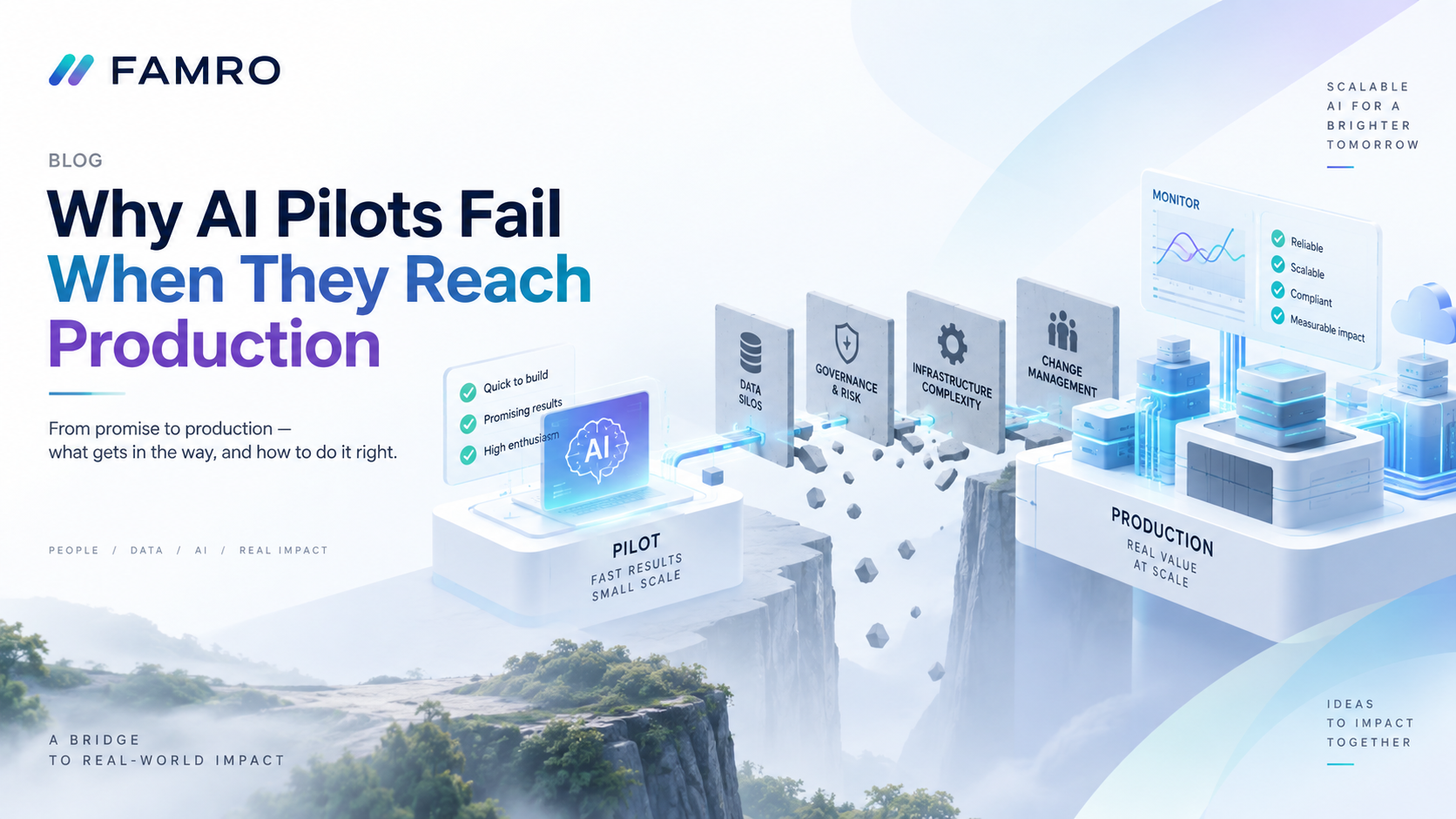
AI pilots often perform well in controlled environments but struggle when exposed to real-world data, workflows, integrations, users, costs, and operational risks. This guide explains the most common reasons AI pilots fail in production and shows how stronger data foundations, ownership, integrations, evaluation, observability, governance, escalation processes, and cost controls help organizations scale AI reliably.

An AI pilot can look impressive in a controlled environment. The data is curated, the use case is narrow, knowledgeable people are available to resolve problems, and usage remains predictable.

Production changes all of those conditions.

Real users provide unexpected inputs. Source systems change. APIs fail. Data arrives late. Security policies restrict access. Costs increase with usage. A model that performed well during a demonstration begins interacting with workflows, customers, compliance requirements, and operational dependencies that were largely invisible during the pilot.

That explains why moving AI from proof of concept to production remains difficult. Gartner reported in 2025 that only about 41% of generative AI prototypes reached production on average. More recently, Gartner found that only 22% of organizations had successfully scaled AI across multiple business units or adopted an AI-first approach.

Production readiness is therefore a systems-engineering and operating-model challenge—not simply a model-development challenge.
Unreliable Data Undermines Production Performance

A pilot often uses a stable dataset assembled specifically for testing. Production AI depends on continuously changing operational data.

Records may be incomplete. Schemas change. CRM fields are interpreted differently across teams. Documents become outdated. Data pipelines fail silently. Retrieval systems may surface conflicting versions of the same policy.

The model can remain unchanged while its outputs deteriorate because the environment around it has changed.

Production teams need dependable pipelines with validation, freshness checks, lineage, versioning, ownership, and alerting. They also need explicit answers to questions such as: Which system is authoritative? How quickly must information become available? Who owns a data-quality incident?

Data quality is not a preprocessing task completed before deployment. It is an ongoing production responsibility.

Unclear Ownership Creates Operational Gaps

AI systems frequently sit between organizational boundaries.

Data teams manage pipelines. ML or AI teams manage models. Platform teams manage infrastructure. Product teams manage user experience. Security teams define access controls. Business teams ultimately own the outcome.

When production performance declines, that distributed responsibility can become distributed ambiguity.

Every production AI capability should have clearly named owners for model quality, data quality, infrastructure, integrations, security decisions, incidents, approvals, cost management, and business performance.

This becomes particularly important when a model is updated or an external foundation-model provider changes behavior. Someone must have authority to decide whether to continue operating, roll back, restrict a capability, or escalate.

AI without operational ownership becomes technology that everybody influences but nobody truly operates.

Missing Integrations Keep AI Outside Real Workflows

A model that generates a useful answer is not necessarily a useful enterprise system.

Business value appears when AI connects reliably with the applications where work happens: CRM, ERP, document repositories, ticketing systems, identity platforms, analytics environments, internal APIs, approval workflows, and transactional systems.

A customer-service copilot that cannot access current customer history forces employees to copy information manually. A procurement assistant that cannot connect to vendor records cannot reliably support purchasing decisions. An AI agent that creates recommendations but cannot participate safely in approval workflows remains a demonstration rather than an operating capability.

Integration architecture should therefore be designed early. Teams need authenticated APIs, reliable event flows, service boundaries, permission controls, failure handling, and mechanisms to prevent AI-generated outputs from bypassing established business controls.

No Evaluation Framework Means Success Cannot Be Measured

A successful demo frequently produces subjective feedback: The answers look good.

Production requires a higher standard.

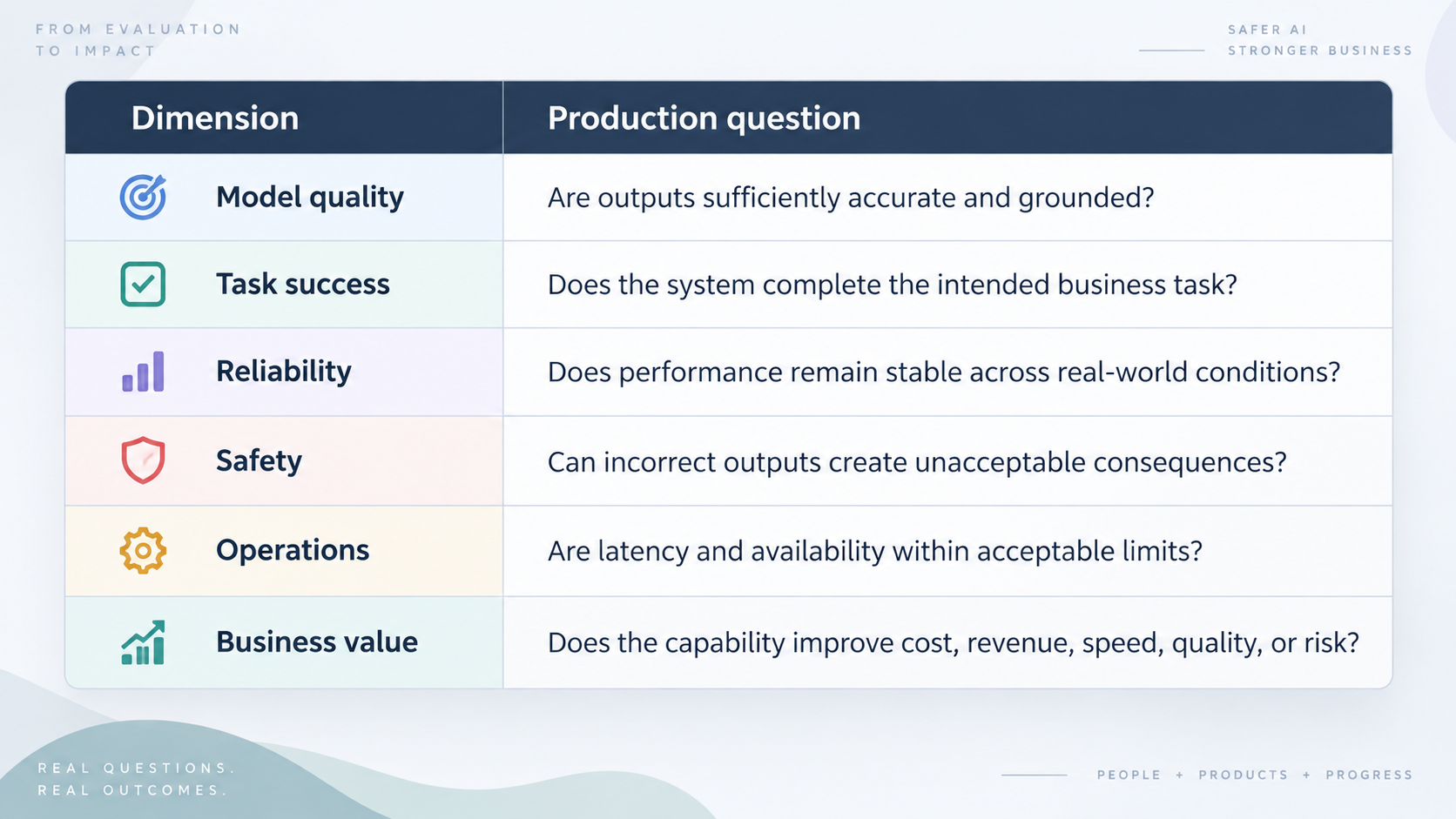
Teams need measurable acceptance criteria covering multiple dimensions:

No Evaluation Framework Means Success Cannot Be Measured

Evaluation should occur before release and continue after deployment. Test sets should represent realistic edge cases rather than only convenient examples.

NIST's AI Risk Management Framework specifically emphasizes incorporating trustworthiness into the design, development, deployment, use, and evaluation of AI systems.

Without repeatable evaluation, teams cannot distinguish genuine improvement from a convincing demonstration.

Inadequate Monitoring Hides Production Failures

Traditional monitoring tells teams whether a server is running.

That is necessary, but insufficient for AI.

Production teams must also observe model and application behavior: output quality, response latency, failed requests, retrieval quality, token consumption, input patterns, data drift, unusual outputs, user overrides, escalation rates, and changes in business outcomes.

Google describes production model monitoring as a core component of MLOps, including tracking performance and detecting degradation as data and environments change.

NIST has similarly emphasized that pre-deployment evaluations take place in controlled environments and that post-deployment monitoring is important for detecting unexpected outputs and consequences under real-world conditions.

Observability turns an AI application from a black box into an operable system.

Hallucination Risks Require System-Level Controls

Generative AI systems can produce responses that are fluent, confident, and incorrect.

That risk becomes materially different when an output influences a financial decision, customer communication, healthcare workflow, legal process, infrastructure change, or automated transaction.

The solution is not merely better prompting.

Architecture should reduce the consequences of incorrect generation through grounding against trusted information, deterministic validation where possible, constrained actions, permission boundaries, policy checks, and human approval for high-impact decisions.

For agentic systems, autonomy deserves particular scrutiny. OWASP identifies excessive agency as a risk when AI systems receive excessive functionality, permissions, or autonomy, particularly when unexpected or manipulated outputs can trigger downstream actions.

The higher the consequence of an error, the stronger the surrounding controls should become.

No Escalation Mechanism Leaves Failures Unresolved

Traditional applications often return a clear error.

AI applications can fail more subtly. They may lack sufficient information, produce conflicting answers, encounter a low-confidence retrieval result, or enter a situation outside the intended workflow.

Production architecture needs an explicit answer to: What happens when the AI should not continue?

A support assistant might transfer the conversation to an employee. A financial workflow might require human approval. An agent might stop rather than execute an irreversible operation. An internal knowledge assistant might disclose that the required information could not be verified.

Human intervention should be part of the design—not an emergency mechanism invented after the first serious incident.

Unpredictable Costs Make Scaling Difficult

Pilot economics are deceptive because usage is limited.

At production scale, organizations pay for model inference, embeddings, vector search, storage, data processing, observability, network traffic, integration infrastructure, orchestration, security controls, and engineering support.

Agentic architectures can amplify the effect because one user request may generate multiple model calls and tool interactions.

Cost therefore needs to become an observable production metric.

CTOs should understand cost per transaction, cost per user, cost per completed workflow, model utilization, caching effectiveness, and whether higher-cost models actually create proportionally higher business value.

That financial discipline matters increasingly as AI investment expands. Gartner's September 2026 research found that 11% of organizations surveyed were not even aware of what their function had spent on AI in 2025, while 85% of functional leaders expected AI spending to increase in 2026.

Scaling without unit economics turns adoption into an uncontrolled infrastructure expense.

Insufficient Governance Becomes a Production Constraint

Governance is sometimes introduced as a final approval step.

That approach usually creates friction.

Effective AI governance is embedded into the architecture and delivery process. It defines who can access models and data, what information can be processed, how changes are approved, which actions require human authorization, what must be logged, how incidents are investigated, and which use cases are prohibited.

Microsoft's current responsible-AI guidance similarly recommends making responsible-AI assessment a production release gate, with the depth of review determined by the risk of the system.

Good governance does not exist to prevent teams from using AI. It creates repeatable boundaries within which teams can move faster with confidence.

Production AI Requires an Operating System Around the Model

The model is only one component of production AI.

A dependable AI capability requires data pipelines, integration architecture, evaluation, observability, security controls, escalation procedures, cost management, governance, deployment processes, and clear ownership operating together.

This is the architectural difference between building an AI feature and running an AI service.

It also explains why changing models rarely solves fundamental production problems. A more capable foundation model cannot fix unreliable source data, missing APIs, undefined escalation processes, weak authorization, or unclear accountability.

The organizations that scale AI successfully will increasingly treat these capabilities as shared enterprise foundations rather than rebuilding them independently for every pilot.

Production AI Readiness: Quick Answers

Why do AI pilots perform better than production systems?

Pilots operate within narrower, cleaner, and more predictable conditions. Production introduces changing data, real integrations, unpredictable users, security constraints, operational failures, cost pressures, and edge cases.

Should enterprises eliminate hallucinations before deploying generative AI?

Not necessarily. For many generative systems, eliminating incorrect generation entirely is unrealistic. Organizations should instead measure the risk and design grounding, validation, permissions, escalation, and human review according to the consequences of an incorrect output.

What should CTOs evaluate before approving production AI?

Evaluate the complete system: business value, data readiness, integrations, accuracy, safety, reliability, monitoring, security, governance, ownership, escalation procedures, scalability, and unit economics.

Key Takeaways for CTOs and Technology Strategy Leaders

  • A successful AI pilot does not prove production readiness. Real-world deployment introduces changing data, integrations, security requirements, unpredictable usage, operational failures, and cost pressures.
  • Production AI should be treated as a complete system, not just a model. Data pipelines, infrastructure, integrations, permissions, monitoring, governance, and operational processes are equally important.
  • Define measurable production success criteria before scaling. Track output quality, latency, failure rates, user adoption, escalation rates, business outcomes, and cost per workflow.
  • Build AI observability into the architecture from the start. Teams need visibility into model behavior, retrieval quality, data drift, token consumption, errors, tool calls, and unusual system behavior.
  • Governance should match business risk. High-impact AI actions may require stronger permission controls, validation, auditability, policy enforcement, and human approval.
  • Assign clear operational ownership. CTOs and CAIOs should know who owns model quality, infrastructure, incidents, security, data quality, integrations, and escalation when production AI fails.
  • Evaluate economics at production scale. A technically impressive AI system can still fail if model usage, infrastructure, retrieval, and integration costs exceed the business value it creates.
  • Design for failure before launch. Production AI needs fallback behavior, escalation paths, safe failure modes, recovery procedures, and clear processes for handling incorrect or uncertain outputs.
  • Scale gradually instead of moving directly from pilot to enterprise-wide deployment. Controlled production stages make it easier to validate reliability, governance, cost, and operational readiness.

Conclusion

AI production readiness is ultimately multidisciplinary.

The challenge is not simply selecting a better model or writing a better prompt. Organizations need engineering disciplines and operating structures capable of keeping AI reliable as data changes, usage increases, integrations expand, models evolve, and business consequences become real.

For CTOs, Chief AI Officers, and transformation leaders, this changes the investment question. The objective should not be to accumulate more pilots. It should be to create an enterprise foundation that can repeatedly turn worthwhile AI experiments into secure, measurable, supportable production capabilities.

FAMRO helps organizations close that gap through AI architecture, enterprise integration, production hardening, observability, evaluation frameworks, and governance support. We help teams examine what exists around the model—not only the model itself—and design the technical and operational controls required for dependable adoption.

To help organizations get started, we offer a free initial consultation focused on AI production readiness—no obligation, no generic pitch.

If your organization has successful AI pilots but needs confidence that they can survive real-world workloads, integrations, governance requirements, and operational risk, now is the time to build the production foundation.

🌐 Learn more: Visit Our Homepage

💬 WhatsApp: +971-505-208-240

Frequently Asked Questions

Why do AI pilots fail when they reach production?

AI pilots often run with curated data, limited users, predictable workloads, and manual support. Production introduces changing data, integrations, security requirements, edge cases, operational failures, cost pressures, and governance requirements that the pilot may not have been designed to handle.

What is AI production readiness?

AI production readiness is the ability to operate an AI system reliably under real-world conditions. It includes dependable data pipelines, integrations, evaluation, monitoring, security, governance, ownership, escalation procedures, scalability, and measurable unit economics.

What should CTOs evaluate before moving an AI pilot into production?

CTOs should assess business value, data quality, integration readiness, model performance, security, evaluation criteria, observability, governance, operational ownership, escalation paths, scalability, and cost per user or completed workflow.

Why is monitoring important for production AI systems?

Traditional infrastructure monitoring cannot show whether AI outputs remain useful or trustworthy. Production AI monitoring should track output quality, latency, failures, retrieval performance, token usage, data drift, unusual behavior, user overrides, escalation rates, and business outcomes.

Can better prompting prevent AI failures in production?

Prompt improvements can help, but they cannot solve unreliable data, missing integrations, weak permissions, insufficient monitoring, unclear ownership, or inadequate governance. Production reliability requires system-level controls around the model.

How should enterprises manage hallucination risk in production AI?

Organizations should combine grounding against trusted information with validation, constrained actions, permission boundaries, policy checks, monitoring, and human approval for high-impact decisions.

How can organizations control AI costs as usage scales?

Teams should monitor cost per transaction, user, workflow, and business outcome while tracking model usage, caching, retrieval, infrastructure, and tool calls.

References

Meet FAMRO at AI Everything Abu Dhabi