AI programs frequently begin with a technology question:
“What can we do with this model?”
Production initiatives need a different question:
“Which business workflow should operate differently because this capability exists?”
That distinction sounds small, but it changes the project.
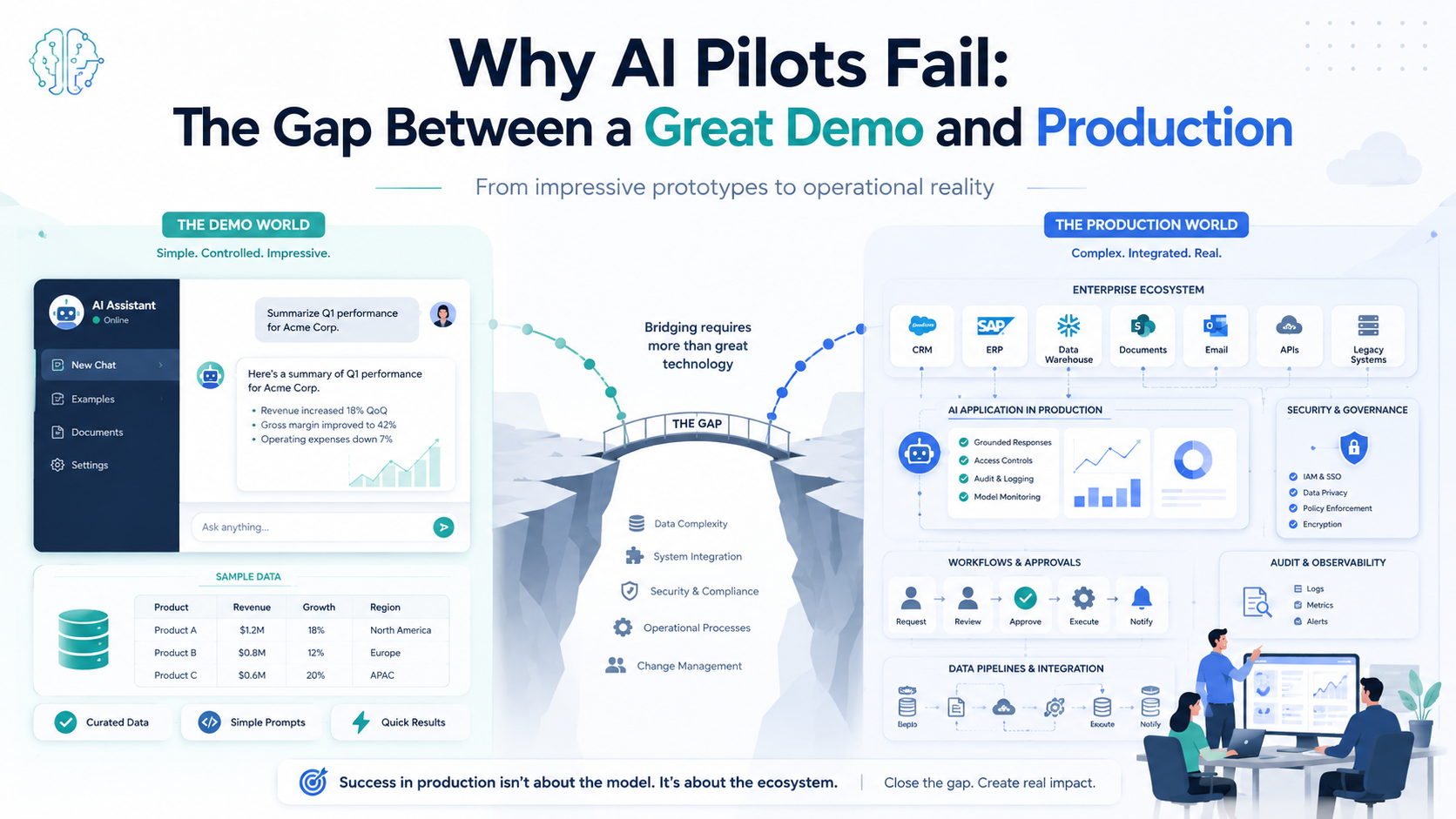
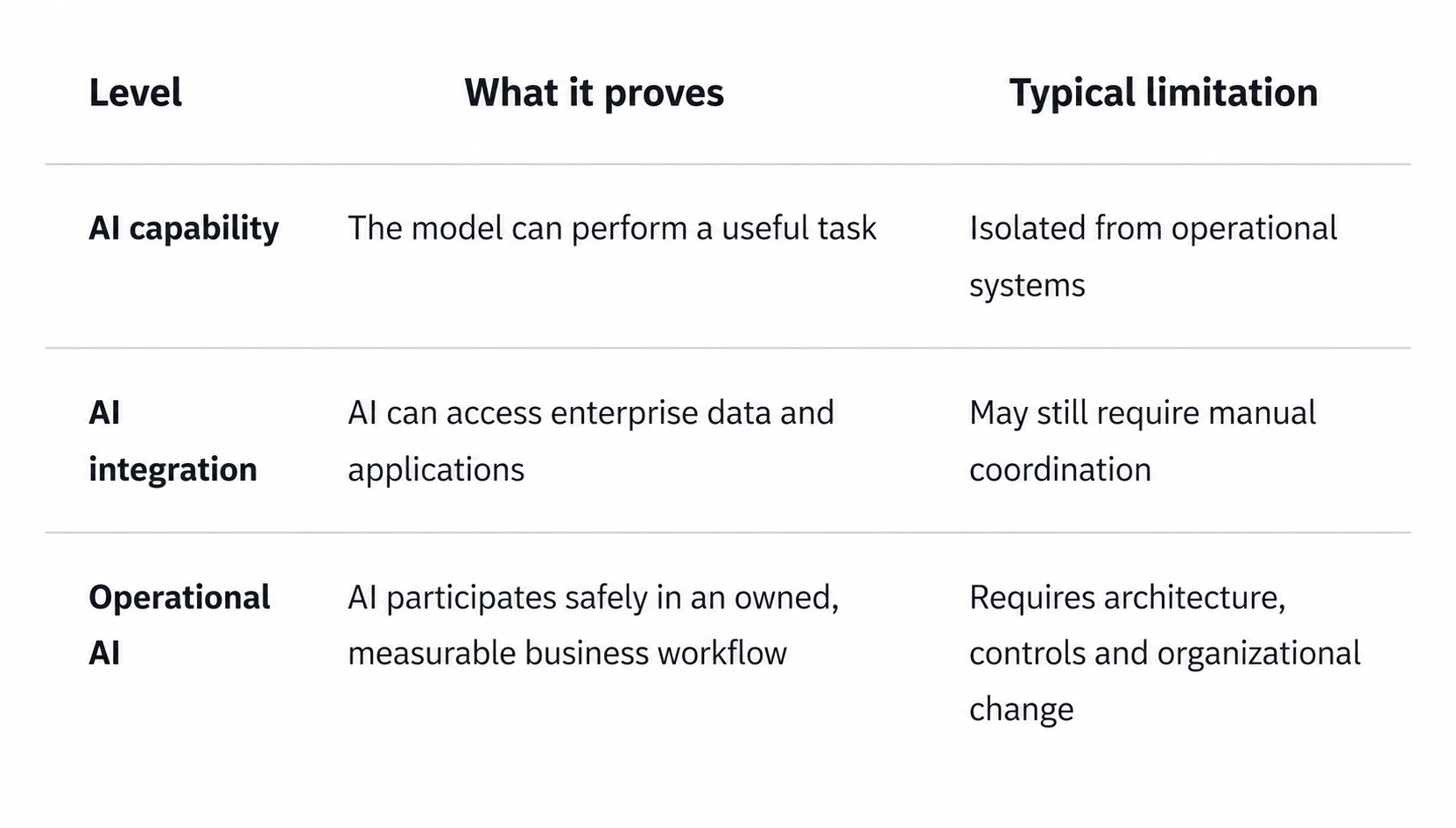
A technology-led pilot optimizes prompt quality, model selection, retrieval accuracy and demonstration speed. A production initiative must additionally address identity, APIs, process state, observability, exception handling, access control, human approval, data quality, service-level expectations and accountability.
Four barriers appear repeatedly:
1. Integration
Enterprise work rarely happens inside one application.
A procurement agent may need data from email, an ERP, contract storage, vendor master records and an approval system. A support assistant may depend on CRM history, product telemetry, entitlement data and knowledge bases.
If AI cannot reliably reach those systems—or act within them—it becomes another interface employees must manually feed.
That may increase productivity locally while adding complexity globally.
2. Model and Platform Rigidity
Pilot teams often optimize around the model or platform that gets them to a demo fastest.
That can create architectural lock-in.
Models change quickly. Pricing changes. Context limits evolve. New security requirements appear. A workload initially suited to one model may later require a smaller model, a specialist model, deterministic software, or several models orchestrated together.
Production architecture should therefore separate the business workflow from the model implementation wherever practical.
The model should be a replaceable component, not the operating model itself.
3. Governance
Governance is often treated as something that will be added after the pilot succeeds.
That is backwards.
Production AI needs clear policies covering:
- which data models may access
- which actions require human approval
- how outputs are evaluated
- how decisions are logged
- how sensitive information is protected
- how failures are detected and escalated
- and who can modify prompts, tools, permissions or agent behavior
NIST's Generative AI Profile frames AI risk management across the lifecycle through governance, mapping, measurement and management rather than treating risk as a final deployment checkpoint.
Security requirements are evolving just as quickly. OWASP's current 2026 guidance continues to identify critical risks specifically associated with LLM-powered applications, reinforcing why enterprise deployments require application-level controls rather than confidence in the model alone.
4. Ownership
This is often the least technical and most consequential barrier.
Who owns an AI system after the innovation team finishes the pilot?
IT may own infrastructure but not the finance process. Finance may own the process but not the integration platform. Security may define controls but not operational KPIs. Data teams may provide information without owning the decisions produced from it.
Without a named business owner and technical owner, pilots become permanent experiments.
Production systems require somebody who is accountable for outcomes.