
The real enterprise AI unlock is not better text generation. It is controlled access to business systems.

MCP addresses that gap by standardizing how AI applications discover capabilities, request context, invoke tools, and receive structured responses from external systems.

Why MCP Matters

AI assistants are getting better at reasoning and producing polished output, but enterprise value depends on what those systems can safely do with ticketing systems, source control, CI/CD, runbooks, CRMs, security tools, and institutional knowledge.

MCP, or Model Context Protocol, provides a standardized connectivity layer between AI applications and external systems. That means teams do not need to rebuild integration logic for every new assistant or workflow.

The real advantage is architectural discipline. MCP gives platform and security teams a known boundary where they can apply identity, approvals, observability, and guardrails consistently.

What MCP Standardizes

Tools
Capability discovery
Context
Predictable retrieval
Calls
Structured invocation
Results
Consistent responses
JSON-RPC style Client-server Governable Reusable

What MCP Standardizes and What It Does Not

MCP standardizes how an AI application can discover capabilities, request context, initiate actions through a predictable interface, and receive structured results from an external system.

At the protocol level, it is designed around client-server exchanges of context using JSON-RPC-style messaging, with transports suited to local development or remote shared services.

What MCP is not

  • It is not a decision about which model to use.
  • It is not an agent framework.
  • It is not a replacement for identity, compliance, or security governance.

MCP gives teams a repeatable integration contract. Governance still has to be designed and enforced around that contract.
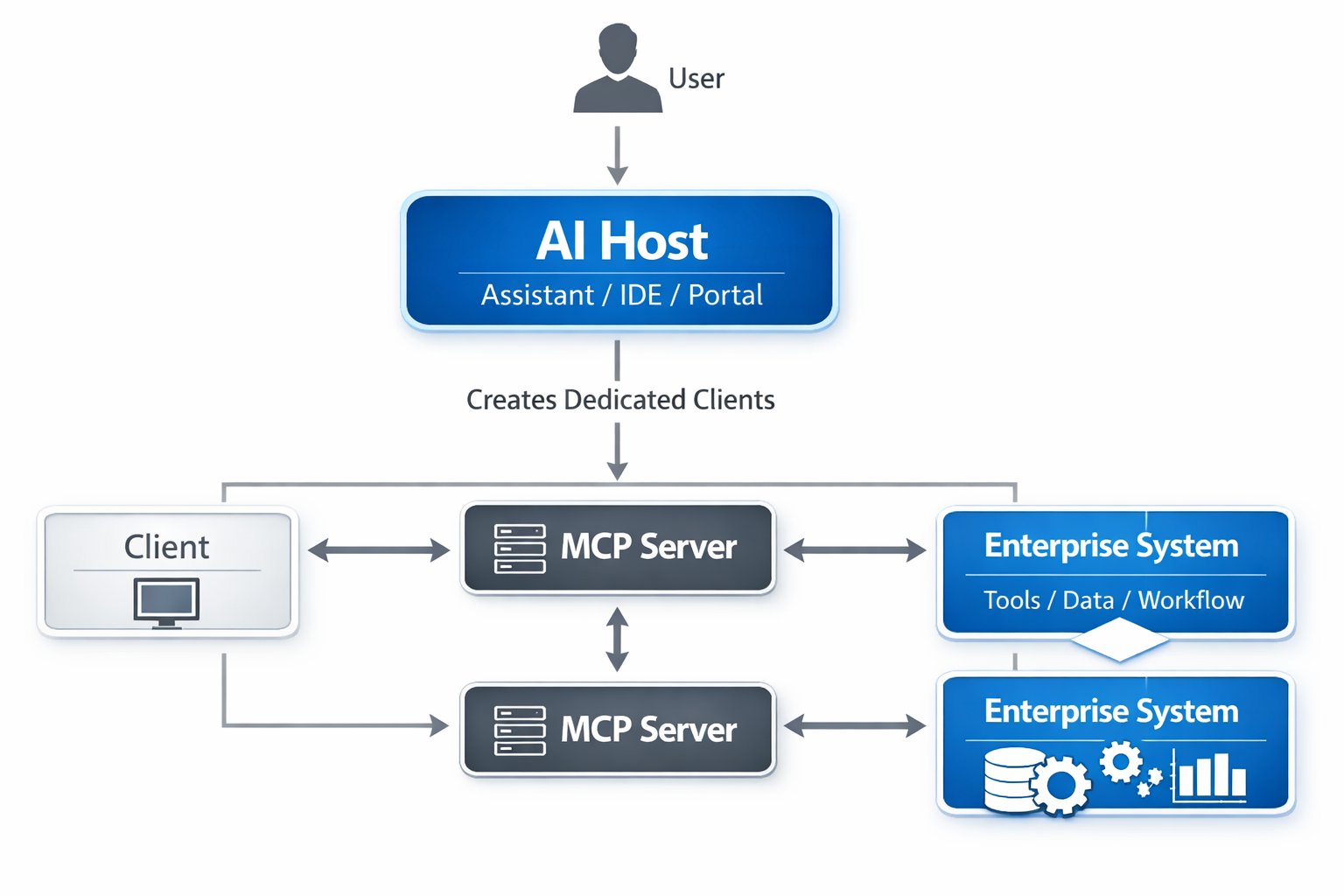
The MCP Mental Model: Host, Client, Server

MCP uses a straightforward structure that is easier to reason about than a pile of custom connectors.

  • Host: the AI application, such as a chat assistant, IDE assistant, or internal portal.
  • Client: the connection layer created by the host to communicate with a server.
  • Server: the system that exposes tools and context from underlying applications, APIs, or data stores.

A useful simplification is one client per server. That separation creates a clean operational seam for security controls, auditing, and reliability practices.

How MCP Communicates

MCP enforces a predictable messaging format so AI hosts can communicate with enterprise tools in a traceable manner.

  • Local development often uses simple transports such as `stdio`.
  • Shared enterprise deployments often use remote HTTP-based transports, including streaming when appropriate.
  • Structured calls such as `tools/list` and `tools/call` create a repeatable pattern for discovery, execution, and response handling.

The significance is not the message syntax by itself. The value is that a known interaction pattern makes policy enforcement, auditing, and operational monitoring much easier to standardize.

Need Help Turning MCP Into a Governed Enterprise Capability?

FAMRO helps teams design MCP rollout plans, harden server boundaries, apply least privilege, and move from experimentation to production without losing control.

Where MCP Fits in Enterprise Architecture

A practical way to position MCP is as a tool and context access layer for enterprise AI. It sits between AI experiences and the systems those experiences need to interact with to produce real outcomes.

In stronger deployments, MCP servers are best treated as thin, domain-oriented gateways rather than one monolithic connector. Organizations often align them to operational domains such as engineering, operations, security, and data.

This should feel familiar to platform teams. It serves a purpose similar to an API gateway or service mesh, except the surface area is optimized for AI tool invocation and context access.

Where MCP Creates Real Business Value

SRE and operations: Start with read-only access to logs, metrics, dashboards, and runbooks to shorten triage time. Add tightly bounded actions only after governance proves out.

Engineering productivity: Summarize pull request risk, link code changes to tickets, draft release notes, and reduce tool-switching overhead.

Security and compliance: Pull scan results, configuration state, and evidence through governed tools, then generate summaries backed by traceable sources and audit logs.

Data and analytics: Expose governed query templates and semantic metrics instead of allowing open-ended database access from ad hoc agents.

Customer support and success: Combine CRM context, ticket history, and telemetry to suggest next steps while keeping sensitive fields and high-impact actions behind policy.

What Makes MCP Production-Ready

Reference implementations are usually educational starting points, not hardened enterprise deployments. In production, MCP servers should be treated like production APIs.

  • Apply least privilege at the tool boundary.
  • Organize servers by domain and ownership.
  • Default to read-only access first.
  • Constrain tools to bounded actions instead of arbitrary execution.
  • Use identity-aware authorization tied to real users or services.
  • Capture audit logs with requesters, tool names, timestamps, outcomes, and correlation IDs.
  • Protect high-impact actions with approvals, policy checks, and stronger controls.

Common Control Gaps and Their Mitigations

Tool sprawl with no ownership: Without clear ownership, cost, security, and compliance accountability degrade quickly. Mitigation: align tools to domains and assign executive and technical owners.

Exposing powerful actions too early: Full capability too soon increases risk. Mitigation: use progressive enablement, beginning with read-only access and expanding only after governance proves out.

No observability: Unobservable services cannot be governed. Mitigation: require logging, tracing, metrics, and service-level expectations.

Assuming technology alone provides security: Protocol adoption is not the same thing as secure operations. Mitigation: anchor security in identity, access policy, data protection, and disciplined change management.

Ignoring protocol and transport evolution: Unplanned upgrades and compatibility shifts create instability. Mitigation: plan versioning for clients and servers and actively monitor ecosystem changes.

Conclusion

The pragmatic way to start with MCP is to choose one domain, expose two or three read-only tools behind strong identity and audit logging, define measurable business outcomes, and expand to bounded write actions only after governance is demonstrated.

MCP’s value proposition is simple: replace fragile one-off AI integrations with a standard, governable connectivity layer so AI can operate safely inside enterprise systems instead of around them.

FAMRO helps organizations make MCP practical through architecture design, secure server implementation, identity and policy integration, observability, and operating-model design so teams can move from pilot to production with confidence.

Frequently Asked Questions About MCP

MCP solves the repeated need to build custom integrations between AI applications and enterprise systems by standardizing how tools, context, and structured results are exposed and consumed.
No. MCP provides a protocol boundary. Identity, authorization, approvals, audit logging, and policy enforcement still need to be implemented around that boundary.
Start with one domain, expose a small set of read-only tools, require strong identity and full auditability, define measurable outcomes, and expand carefully once governance is proven.
Because they become a control surface for real enterprise systems. They need the same rigor around ownership, observability, access control, reliability, and change management as any other production interface.