A Portable Knowledge Layer for Enterprise AI

OKF v0.1 uses directories of Markdown files, YAML frontmatter, and ordinary links to describe datasets, metrics, APIs, runbooks, business definitions, and other concepts. It requires no proprietary runtime, SDK, or central registry.

What Is the Open Knowledge Format?

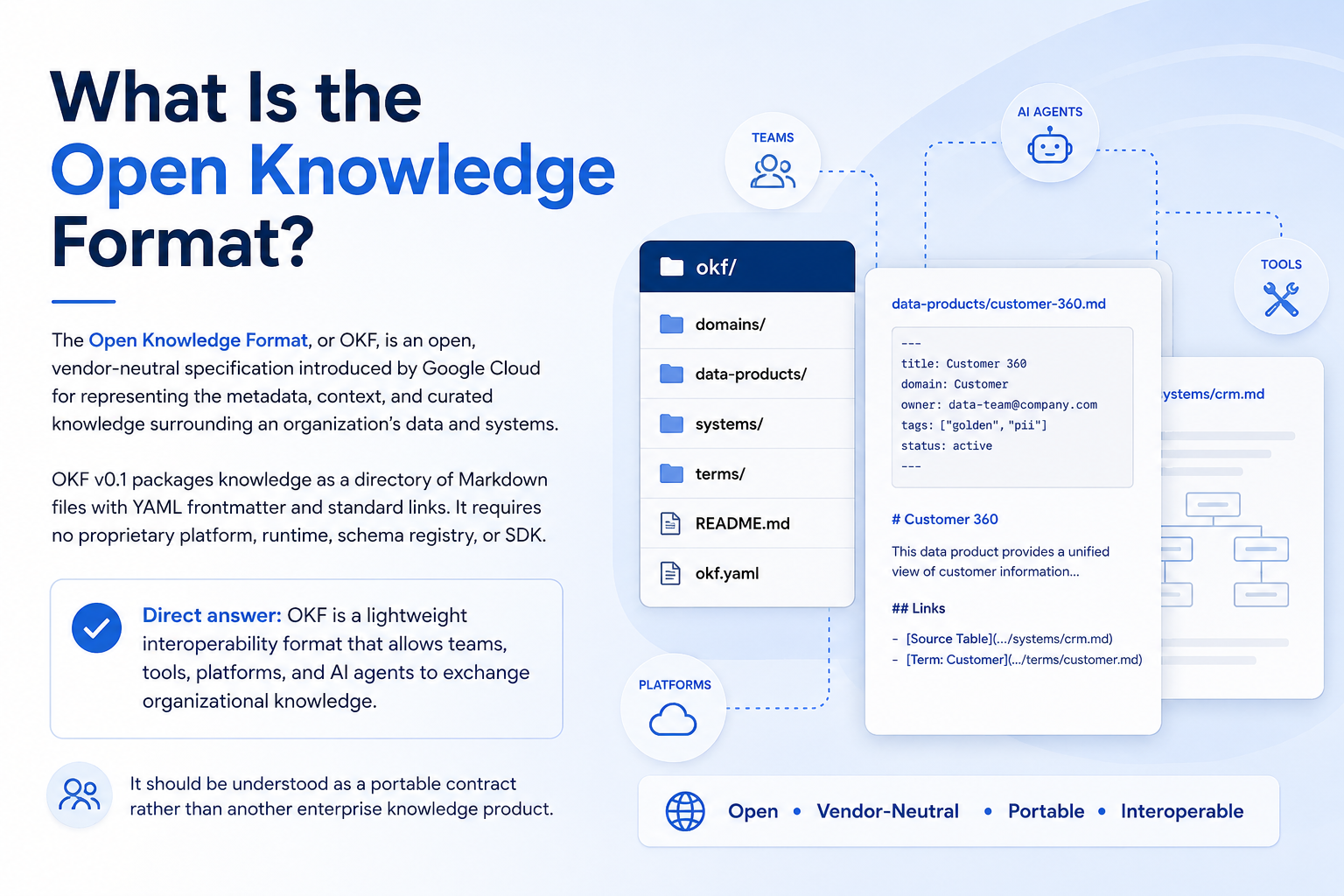
The Open Knowledge Format, or OKF, is an open, vendor-neutral specification introduced by Google Cloud for representing the metadata, context, and curated knowledge surrounding an organization’s data and systems.

OKF v0.1 packages knowledge as a directory of Markdown files with YAML frontmatter and standard links. It requires no proprietary platform, runtime, schema registry, or SDK.

It should be understood as a portable contract rather than another enterprise knowledge product.

The Idea Behind OKF: From LLM Wiki to Open Standard

OKF formalizes a pattern often described as an “LLM wiki.” Instead of asking an AI agent to repeatedly search fragmented source documents, teams give it a persistent, curated knowledge library.

The library can contain explanations, definitions, relationships, decisions, and procedures that improve as organizational understanding evolves. Models can assist with cross-references and routine updates while human teams curate and review the material.

Before OKF, teams were already building Markdown repositories, metadata-as-code projects, agent instruction files, Obsidian-style vaults, and catalog exports. Their structures were similar but not deliberately interoperable.

OKF adds a deliberately small interoperability layer. Knowledge created by one team, enrichment pipeline, platform, or model can be consumed by another without every integration beginning with a custom mapping project.

How Does OKF Work?

An OKF bundle is a directory tree. Each concept—such as a dataset, table, metric, API, business definition, playbook, or incident runbook—is represented by one Markdown file.

Element Purpose
YAML frontmatter Stores queryable metadata such as type, title, description, resource, tags, and timestamp.
Markdown body Contains schemas, explanations, procedures, examples, decisions, and contextual knowledge.
Markdown links Connect related concepts and create a traversable knowledge graph.
index.md Optionally provides hierarchical navigation and progressive disclosure.
log.md Optionally records chronological changes within a directory scope.

Under v0.1, the only mandatory metadata field for a normal concept is type. Organizations can add their own types and additional fields without requiring every consumer to understand them.

---
type: Business Metric
title: Weekly Active Users
description: Unique users completing a qualifying event within seven days.
tags: [product, engagement]
timestamp: 2026-07-14T00:00:00Z
---

# Definition
Weekly active users are calculated from qualifying events in the analytics event stream.

See the [event schema](/datasets/product-events.md) and [data-quality runbook](/runbooks/event-quality.md).

Why Might an Organization Need OKF?

Enterprise knowledge is rarely absent; it is fragmented across catalogs, wikis, shared drives, source code, notebooks, tickets, dashboards, and the experience of senior employees.

  • More consistent context for AI agents
  • Reduced duplication across agent and data initiatives
  • Knowledge that can be reviewed and version-controlled alongside code
  • Lower dependence on proprietary knowledge platforms
  • Easier exchange of metadata and domain context between systems
  • A clearer foundation for governing agent-accessible knowledge

The business value is strongest when multiple teams, models, data platforms, or agent frameworks depend on the same definitions.

What OKF Cannot Solve

OKF is a representation and exchange format, not a complete knowledge-management or AI platform.

  • Determine whether information is accurate or authoritative
  • Resolve conflicting business definitions
  • Establish ownership, approval, or governance processes
  • Apply access controls or protect sensitive information
  • Keep knowledge current without supporting workflows
  • Replace databases, catalogs, search systems, vector stores, or agent runtimes
  • Guarantee correct interpretation by an AI system

Production use still requires governance, provenance, security classification, validation, lifecycle management, monitoring, and accountable human oversight.

How Important Could OKF Become in the Coming Years?

OKF should currently be viewed as an early draft specification, not an established industry standard. Its long-term importance will depend on implementation by enterprises, platforms, agent frameworks, and open-source communities.

The strategic requirement is real: organizations deploying multiple agents will need portable, structured, governed context that is not locked to one model or vendor.

Organization type Potential value
Large enterprises Use OKF as an interchange layer between catalogs, architecture repositories, policy systems, documentation pipelines, search tools, copilots, and operational agents.
Scaleups Establish agent-ready technical and operational knowledge before fragmentation becomes difficult to reverse.
Platform teams Publish shared definitions once and allow multiple tools and agent frameworks to consume the same governed context.

A sensible adoption strategy is experimental rather than transformational: choose a bounded knowledge domain, define ownership, generate an OKF bundle, connect two different consumers, and measure whether portability reduces duplicated integration work.

The key signal will not be how many Markdown files are created, but whether teams and agents consistently retrieve the same trusted definitions.

Conclusion

Google’s Open Knowledge Format is a simple but potentially significant attempt to standardize how curated organizational knowledge is represented and exchanged for AI systems.

Its immediate value is not replacing existing knowledge infrastructure. Its value lies in creating a portable contract between the systems and teams that produce knowledge and the people, tools, and agents that consume it.

FAMRO helps enterprises and scaleups design AI-ready knowledge architectures, agent integration layers, data platforms, governance workflows, and custom software systems.

To help organizations get started, we offer a free initial consultation focused on agent-ready enterprise knowledge and Open Knowledge Format adoption—no obligation, no generic pitch.

🌐 Learn more: Visit Our Homepage
💬 WhatsApp: +971-505-208-240

Frequently Asked Questions

Is OKF a Google product?

OKF is an open specification introduced through Google Cloud. The associated repository states that its contents are not an official Google product.

Does OKF require Google Cloud?

No. OKF uses ordinary Markdown and YAML files and is designed to remain independent of any cloud, model, framework, or serving platform.

Is OKF a replacement for RAG or vector databases?

No. OKF packages knowledge. Search indexes, vector databases, and RAG pipelines can consume that knowledge but are separate architectural layers.

What is the minimum required metadata?

For a normal OKF v0.1 concept document, the YAML frontmatter must contain a non-empty type field.

Is OKF ready for enterprise-wide standardization?

It remains a draft v0.1 specification. Enterprises should begin with bounded pilots and assess governance, interoperability, and tooling before broader adoption.