The real value of an agentic framework is not making a model smarter. It is making agent-based work operable.

Once an agent has to survive token expiry, partial tool failures, audit questions, retries, and unclear provenance, the differentiator shifts from prompt quality to orchestration, state, observability, and control.

Why Frameworks Matter

In a demo, an agent feels like a minor miracle. It pulls context, calls tools, and completes the task. In production, those same workflows face expiring credentials, incomplete tool responses, runaway retries, and failure chains nobody can explain afterwards.

That is where agentic frameworks become useful. They provide structure for state, handoffs, tool boundaries, and operational visibility so systems can be resumed, audited, and governed.

The leadership problem is no longer “can the model do something impressive?” It is “can this workflow run as dependable software?”

What Production Agents Need

State
Resumable runs
Tools
Bounded actions
Trace
Decision visibility
Cost
Operational control
Governance Scale Auditability Reliability

Agentic AI Without the Chaos

In production terms, an agent is not a better chatbot. It is a system that combines a model, tools, and a control loop that repeatedly decides, acts, observes, and adjusts.

The 2026 shift is that competitive advantage is moving away from prompt artistry and toward orchestration, state management, and controls. Reliable agents are defined by whether a multi-step workflow can run across systems over time without becoming an un-debuggable or non-compliant liability.

Generalized Agentic Workflow

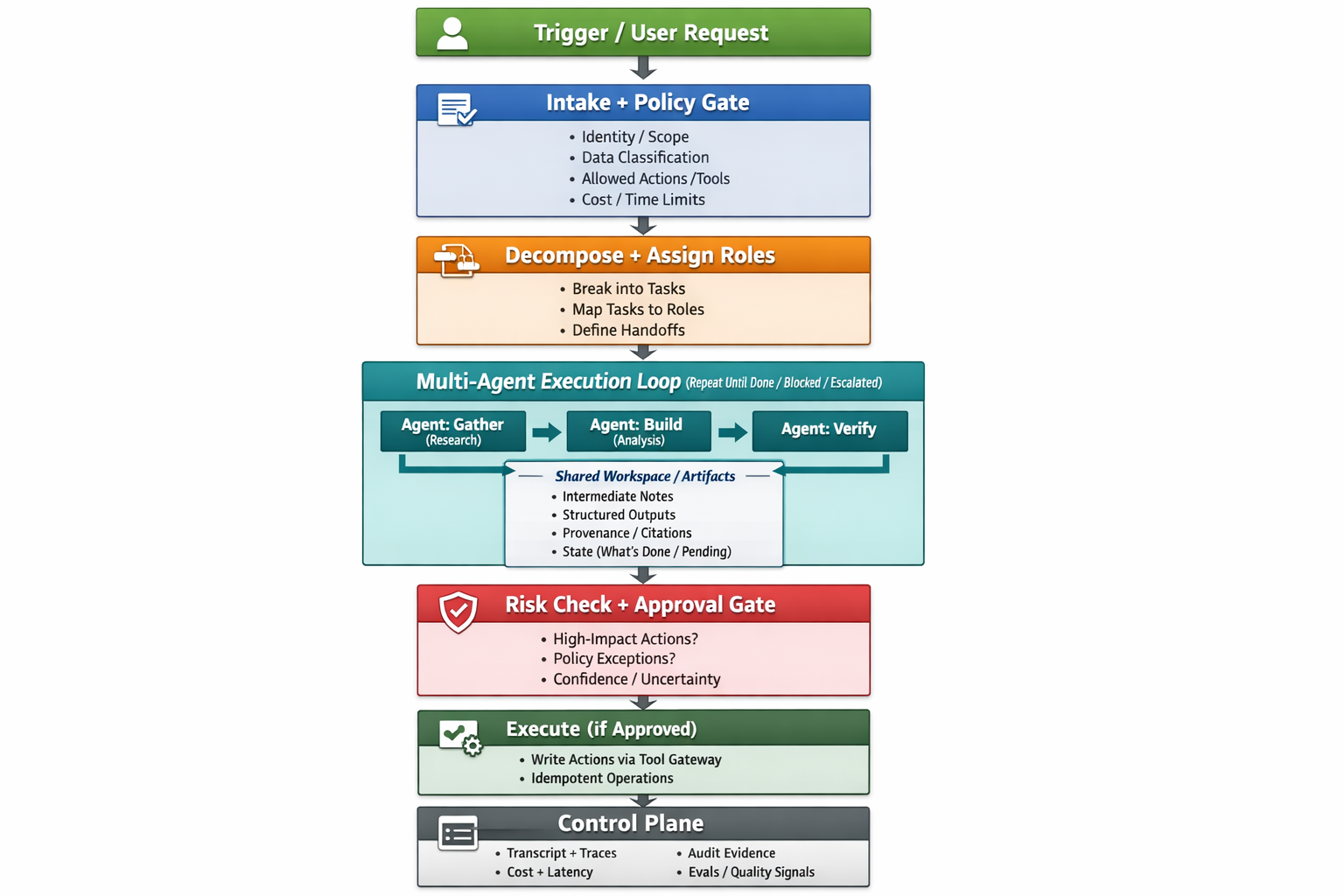
A production-ready multi-agent workflow starts with an intake and policy gate that enforces identity, data rules, allowed actions, and cost or time limits. It then decomposes the request, assigns roles, and routes work through a shared workspace where evidence, run state, and intermediate outputs can be preserved.

Before high-impact actions, a risk check and approval gate evaluates policy exceptions and uncertainty. A control plane then captures traces, transcripts, cost, latency, and audit evidence end-to-end.

The Top 5 Agentic Frameworks for 2026

1. LangChain

LangChain remains the default integration-first choice when teams need to connect models to SaaS tools, APIs, vector stores, and data pipelines quickly without building every connector from scratch.
Website: LangChain Website

Best fit for: fast connectivity across many tools, multi-team reuse, and broadly understood abstractions.

Caution: breadth can become platform sprawl unless teams enforce golden paths and clear integration boundaries.

2. AutoGen

AutoGen remains widely associated with multi-agent collaboration patterns where different agents or humans handle distinct roles and handoffs.

Website: Microsoft AutoGen Website

Best fit for: specialist role-based collaboration, structured human-in-the-loop workflows, and multi-agent designs.

Caution: long-lived programs should plan around Microsoft’s broader ecosystem evolution and possible migration paths.

3. LlamaIndex

LlamaIndex is strongest when enterprise value depends on knowledge retrieval, grounding, and provenance across internal documents and operational content.

Website: LlamaIndex Website

Best fit for: knowledge-heavy copilots, strong retrieval pipelines, and correctness-sensitive use cases.

Caution: the main risk is quiet wrongness when plausible retrieval produces confidently incorrect context.

4. CrewAI

CrewAI is popular for modeling role-based work where agents have clear responsibilities and collaborate toward a defined result.
Website: CrewAI Website

Best fit for: fast prototyping of role-based flows, documentable work products, and separation of duties.

Caution: multi-agent systems can amplify mistakes as easily as productivity unless roles, permissions, and approval gates are explicit.

5. Semantic Kernel

Semantic Kernel is a model-agnostic SDK with strong enterprise appeal for teams that want plugin-oriented extensibility across Python, .NET, and Java.

Website: Semantic Kernel Website

Best fit for: SDK-first enterprise development, cross-language consistency, and reusable plugin patterns.

Caution: Microsoft’s agent stack is evolving quickly, so orchestration layers should stay clean and swappable.

Need Help Choosing the Right Agentic Framework?

FAMRO helps teams choose the right integration, orchestration, and governance patterns before framework choices turn into long-term operational debt.

Guide for Selecting an Agentic Framework

Instead of asking which framework is best in the abstract, start with the failure mode you cannot afford.

Choose an integration-first framework when speed-to-connectivity is the bottleneck. Typical outcome: faster time-to-value with higher risk of pattern sprawl.

Choose an orchestration-first framework when resumability, reliability, and auditability dominate. Typical outcome: slower initial build with lower operational risk at scale.

Choose a data-centric framework when retrieval quality determines business value. Typical outcome: ROI depends on data hygiene, evaluation, and governance.

Choose a role-based multi-agent framework when work maps naturally to responsibilities and handoffs. Typical outcome: high productivity with the right separation of duties and higher blast radius without it.

Conclusion

The fastest path to value from agentic systems is to treat them like production workflow software, not a clever demo. That means versioning contracts, enforcing intake and policy gates, starting with read-only tools, and operating the result with traces, evaluation signals, audit evidence, and cost visibility.

FAMRO helps organizations turn those principles into governed capabilities through architecture planning, secure tool and MCP server design, traceability, IAM and approvals, observability, and delivery acceleration from pilot to production.

Frequently Asked Questions About Agentic Frameworks

They make agent-based workflows operable by adding structure for tool use, state, retries, observability, governance, and resumability across multi-step work.
Because the long-term cost usually comes from operational tradeoffs: connector sprawl, weak approvals, poor traceability, or retrieval errors that are hard to detect and audit.
When enterprise value depends on grounding answers in policies, documents, contracts, or internal knowledge where provenance and retrieval quality matter more than autonomy alone.
Clear boundaries around permissions, explicit workflow states, approval gates for risky actions, auditability, and a path to operate the system with predictable cost and reliability.