The Practical Path to Operational AI: Start With a Minimum Viable Foundation

Discover how enterprises can move from AI experimentation to operational AI with a minimum viable foundation built on trusted data, governance, secure connectivity, permissions, and observability.

Enterprise AI is entering a different phase.

For several years, much of the conversation around generative AI focused on experimentation: copilots, chat interfaces, proofs of concept, knowledge assistants, and isolated productivity tools. Those initiatives helped organizations understand what large language models could do. They also exposed a harder question:

How do you move from AI that can answer questions to AI that can reliably participate in business operations?

That transition matters because operational and agentic AI systems do more than generate text. They retrieve enterprise information, reason across multiple sources, invoke tools, interact with applications, follow workflows, and potentially take actions that affect customers, employees, transactions, infrastructure, or regulated processes.

The good news for enterprise technology leaders is that operational AI does not require a perfectly unified data estate or a completed multi-year modernization program.

What it requires is a minimum viable foundation: enough trusted information, connectivity, governance, security, and operational control to make AI useful within one clearly defined business process.

The goal is not architectural perfection before deployment. It is controlled progress toward measurable business value.

The Foundations of Agentic AI

The shift toward agentic AI changes the enterprise architecture problem.

A conversational AI system can often operate within a relatively narrow boundary. It receives a prompt, retrieves some information, generates an answer, and returns control to a human.

An operational AI agent may need to do considerably more. For example, a service-management agent could retrieve incident history, inspect configuration data, query a monitoring platform, identify an approved remediation workflow, initiate an automation, and request human approval before making a production change.

That means the quality of the model is only one part of the system.

The agent also needs:

  • Accurate business context
  • Access to appropriate enterprise systems
  • Clear identity and authorization boundaries
  • Reliable integration mechanisms
  • Rules governing what it may and may not do
  • Visibility into how decisions and actions were produced

As IBM has noted in its work on enterprise context engineering, the challenge changes as AI moves from conversation toward execution. Enterprise context includes not only distributed data, but also workflows, policies, operational state, permissions, lineage, and the constraints determining whether an agent is permitted to act.

This is why enterprises should avoid treating agentic AI primarily as a model-selection exercise.

What Is a Minimum Viable Foundation?

What Is a Minimum Viable Foundation?

A minimum viable foundation for operational AI is the smallest practical set of enterprise capabilities required to deploy an AI-enabled workflow safely and usefully without first completing a wholesale technology transformation.

It applies the same logic that successful product teams use with minimum viable products: build enough to prove value, learn from real usage, and expand deliberately.

For AI architecture, this means prioritizing data accessibility over data perfection.

Most enterprises already have significant amounts of useful information. The problem is that it is distributed across CRM platforms, ERP systems, databases, document repositories, SaaS applications, data platforms, APIs, departmental tools, and on-premises environments.

The first objective should therefore not be to move everything into one universal AI repository.

It should be to make the information required for a priority workflow:

  • Discoverable
  • Understandable
  • Accessible
  • Governed
  • Secure
  • Machine-usable

Then expand the foundation as additional use cases justify the investment.

For a CTO, CIO, chief architect, or technology strategy team, this becomes both an architectural principle and an operating model:

Start with one bounded business domain, prove operational value, establish the necessary controls, and design the foundation so additional workflows, systems, models, and policies can be incorporated later.

This approach also aligns with NIST's AI Risk Management Framework, which is deliberately designed to be practical, adaptable, use-case agnostic, and operationalized according to an organization's objectives, resources, and risk profile.

Seven Elements of a Minimum Viable Foundation

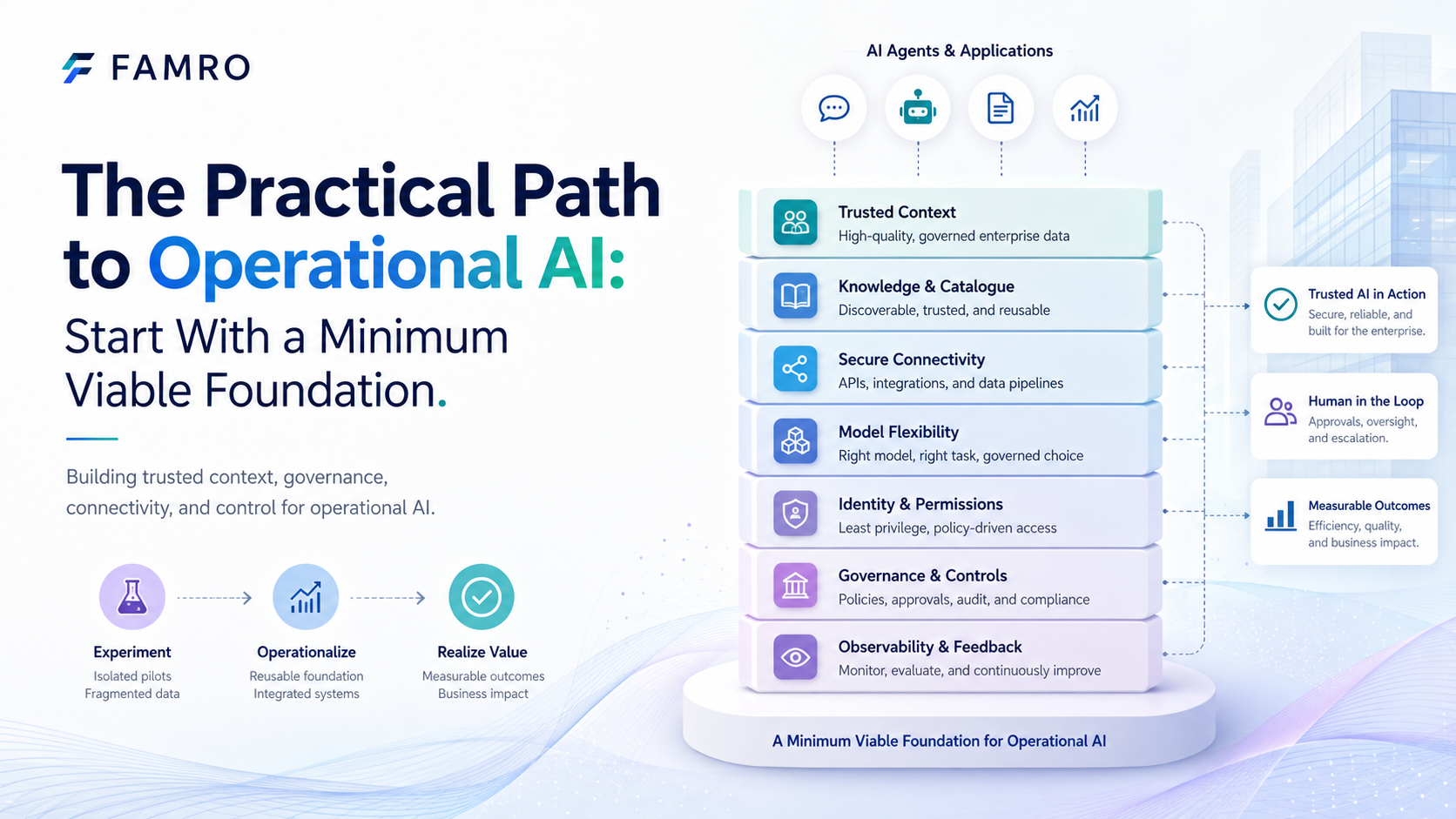
The following seven capabilities provide a practical baseline for moving agentic AI from experimentation toward production.

They do not need to reach maximum maturity on day one. However, each should be addressed sufficiently to avoid the integration, security, ownership, and governance gaps that frequently prevent promising AI pilots from scaling.

1. A Priority Business Domain

Start with one clearly bounded workflow tied to measurable business value.

Examples might include:

  • Employee IT support
  • Customer service case resolution
  • Procurement exception handling
  • Financial reconciliation
  • Sales proposal preparation
  • Security investigation support
  • Equipment maintenance coordination

The important point is not simply to identify an AI use case. It is to define the business domain surrounding it.

Which teams own the process? Which systems participate? Which information is authoritative? Which decisions can the AI recommend? Which actions can it execute? When must a human intervene?

A bounded domain prevents the initial architecture from becoming an open-ended enterprise AI program before value has been demonstrated.

It also creates a controlled environment for measuring outcomes such as resolution time, cost per transaction, employee effort, process throughput, error reduction, or customer experience.

2. Trusted Context

An agent cannot operate reliably when it lacks the information required to understand the situation.

Trusted context can include:

  • Customer and account records
  • Product information
  • Policies and procedures
  • Contracts
  • Operational telemetry
  • Transaction histories
  • Knowledge articles
  • Approval states
  • Organizational rules

This context may be structured or unstructured.

The objective is not merely retrieval. AI must receive enough business meaning to distinguish authoritative information from drafts, obsolete records, incomplete data, or content that applies to another geography or business unit.

That distinction becomes critical once AI can act.

IBM gives the example of agents requiring governed, real-time enterprise context rather than raw access to fragmented data. Without business meaning, governance, lineage, and operational state, technically capable models can still produce unsafe execution.

3. A Knowledge and Catalogue Layer

Enterprise data cannot help an agent if the agent cannot discover or interpret it.

A knowledge and catalogue layer makes relevant information machine-discoverable through capabilities such as:

  • Metadata
  • Business definitions
  • Classification
  • Indexing
  • Semantic relationships
  • Lineage
  • Ownership
  • Data quality indicators
  • Search and retrieval interfaces

This is particularly important for information that historically lived outside formal data platforms: policies, PDFs, engineering documentation, operating procedures, contracts, support knowledge, and departmental repositories.

The catalogue does not need to represent every data asset in the enterprise before the first AI workflow goes live.

Start with the assets required by the target domain.

4. Secure Connectivity Across Systems and Clouds

Enterprise AI rarely operates inside a single platform.

A typical workflow may span cloud applications, internal APIs, SaaS services, databases, legacy systems, document repositories, and on-premises infrastructure.

Operational AI therefore requires a secure integration layer that allows agents to access capabilities where they already exist.

That may include:

  • APIs
  • Integration platforms
  • Event streams
  • Secure connectors
  • Workflow engines
  • Model Context Protocol interfaces
  • Service orchestration

The architectural objective should be controlled connectivity rather than compulsory centralization.

Modern enterprise approaches increasingly emphasize governed access across hybrid environments instead of forcing every system and dataset into a new AI-specific silo.

5. Model Flexibility

Business workflows should not become unnecessarily coupled to one model.

Different workloads may require different combinations of:

  • Reasoning capability
  • Latency
  • Context capacity
  • Deployment location
  • Data residency
  • Cost
  • Multimodal capability
  • Specialized domain performance

Separating workflow orchestration from the model layer gives technology leaders the ability to change models without redesigning the business process around them.

This is particularly important in a market where model capabilities, economics, and deployment options continue to change rapidly.

Model flexibility is therefore not simply vendor optionality. It is an architectural control against unnecessary technical lock-in.

6. Identity, Access, and Permissions

An AI agent should never possess unlimited access simply because it is acting on behalf of an authorized employee.

Technology teams must explicitly define:

  • Who the user is
  • Which agent is operating
  • What resources it can access
  • Which actions it can execute
  • Which actions require approval
  • How privileges change by workflow or context

For example, a financial agent may be allowed to analyze invoices and prepare a reconciliation but prohibited from releasing a payment without human approval.

An IT operations agent may investigate an incident automatically but require elevated authorization before restarting production infrastructure.

This requires least-privilege access, role-based controls, agent-specific identities, secrets management, and clearly defined action boundaries.

Governance cannot be a policy document applied after deployment. For operational AI, it must become part of runtime behavior.

7. Observability and Auditability

Once agents can take actions, enterprises must be able to reconstruct what happened.

That requires visibility into:

  • Information retrieved
  • Sources consulted
  • Tools called
  • Execution paths
  • Model interactions
  • Actions performed
  • Failures and retries
  • Approval requests
  • Human interventions

Observability supports debugging and optimization, but its importance is broader than technical troubleshooting.

It enables security teams to investigate unexpected behavior, compliance teams to verify controls, process owners to understand outcomes, and technology leaders to determine whether the AI system is actually improving the workflow.

NIST's AI RMF emphasizes ongoing governance, measurement, and management of AI risk across the lifecycle rather than treating risk assessment as a one-time predeployment exercise.

Building the Foundation Incrementally

The seven capabilities above should not become another multi-year transformation checklist.

A more practical implementation sequence is:

  1. Choose one high-value workflow.
  2. Define the bounded data and application domain supporting it.
  3. Expose the minimum trusted context required.
  4. Connect the necessary systems through governed interfaces.
  5. Establish agent identity and least-privilege access.
  6. Add human approval to high-impact decisions or actions.
  7. Instrument execution for auditing and performance measurement.
  8. Measure business outcomes and operational risk.
  9. Reuse the resulting foundation for the next workflow.

Consider an enterprise starting with an AI agent for internal IT service requests.

The first implementation might connect only the service-management platform, device inventory, approved knowledge articles, identity directory, and a small library of automation workflows.

If the agent reliably resolves more requests without increasing security risk, the organization can extend the same foundation into onboarding, software provisioning, infrastructure support, or security operations.

Each successful workflow adds reusable context, integrations, controls, and operating experience.

Over time, isolated AI projects become a common enterprise capability.

What Technology Leaders Should Measure

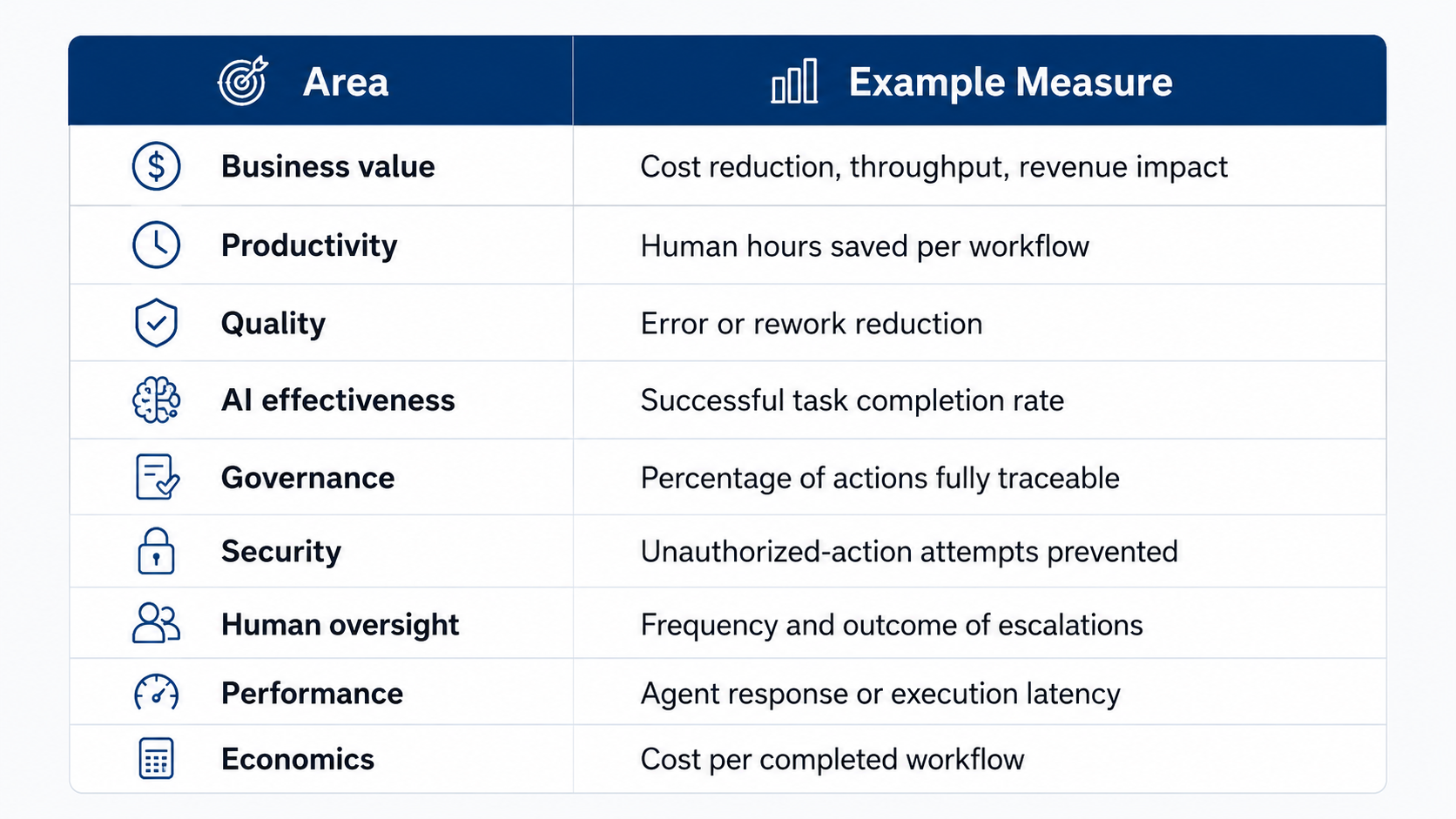
The success of a minimum viable foundation should be evaluated in operational—not purely technical—terms.

Useful measures include:

What Technology Leaders Should Measure

The objective is not to prove that the AI model works.

It is to prove that the AI-enabled business process works.

Key Takeaways for CTOs and Technology Strategy Leaders

  • Operational AI requires business context, connectivity, governance, identity, and observability—not only capable models.
  • Enterprises do not need a perfectly unified data estate before beginning.
  • Start with one high-value, bounded business domain.
  • Make the necessary data accessible and trustworthy rather than attempting to perfect everything.
  • Keep models interchangeable where practical.
  • Treat identity and permissions as first-class architectural components.
  • Make every significant agent action observable and auditable.
  • Expand the foundation only after measurable operational value has been demonstrated.

Conclusion

Enterprises do not need a fully mature AI architecture before moving from experimentation into operational AI.

They need enough foundation to operate one important workflow safely and measurably.

That means establishing trusted context, discoverable knowledge, secure connectivity, model flexibility, appropriate permissions, and end-to-end observability around a clearly bounded business domain.

From there, the organization can expand one workflow, one dataset, one integration, and one operational capability at a time.

This incremental approach keeps AI investment tied to measurable business outcomes while avoiding the opposite extremes of uncontrolled experimentation and endless architectural preparation.

For technology leaders, the strategic objective should therefore be clear: build the minimum foundation required to create operational value today, while ensuring every capability can become part of a larger enterprise AI architecture tomorrow.

FAMRO helps organizations design the architecture, integrations, data foundations, governance controls, and AI-enabled workflows required to move from AI proofs of concept into production-ready enterprise capabilities.

To help organizations get started, we offer a free initial consultation focused on your operational AI foundation and agentic AI roadmap—no obligation, no generic pitch.

If your organization is investing in enterprise AI and wants confidence—not guesswork—now is the time to establish the foundation that turns experimentation into operational value.

🌐 Learn more: Visit Our Homepage

💬 WhatsApp: +971-505-208-240

Frequently Asked Questions

Does operational AI require all enterprise data to be centralized?

No. AI can work across distributed environments if relevant data is securely discoverable and accessible through governed interfaces. Centralizing every source before deployment can unnecessarily delay value.

How mature must our data governance be before deploying AI agents?

Governance must be sufficient for the specific workflow. Technology teams should know which sources are authoritative, who owns the data, what the agent may access, and which actions require control. Maturity can increase as deployment expands.

Should enterprises standardize on one AI model?

Usually not at the architectural level. Keeping workflows reasonably independent from individual models allows teams to optimize for performance, security, cost, residency, and future capabilities.

Where should an enterprise begin?

Choose one workflow with clear business ownership, measurable outcomes, accessible data, and manageable operational risk. Use it to establish reusable integration, governance, identity, and observability patterns.