
Enterprise agentic AI stopped being a prompt experiment and became an architecture problem.

Enterprises already know how to produce convincing demos with a model, a few tools, and some retrieval. The hard part is making those systems secure, traceable, governable, and economically predictable in production.

Why This Playbook Matters

Over the last two years, many enterprises ran the same experiment: connect a large language model to a few tools, add retrieval, and watch it behave like an agent. The demos looked promising, but production questions arrived immediately.

Security asked how the model authenticates to downstream systems. Legal asked where outputs came from. Finance asked why inference spend looked like a second cloud bill. Operations asked how to debug failures spanning models, tools, and multiple data sources.

The good news is that the architecture is maturing. A handful of concrete shifts now make it possible to standardize, govern, and scale agentic systems instead of treating them like fragile prototypes.

The 2026 Default Priorities

MCP
Shared tool contract
State
Explicit orchestration
Trace
Provenance and audits
Budget
Reasoning economics
Governable Observable Multimodal Scalable

The Inflection Point: Three Shifts That Turned Agents into Systems

1. A common connector layer for tools and data

Early prototypes were fragile because every tool connection was custom. Standardized connectivity through MCP reduces that integration tax and creates a cleaner boundary for access control, logging, and security review.

Enterprise implication: standard connectors make standard controls possible.

2. Agents became processes, not improvisations

Mature deployments are replacing open-ended agent loops with explicit orchestration: graphs, states, retries, timeouts, approvals, and human checkpoints. This is the difference between experimentation and an operating model.

3. RAG 2.0 became a subsystem, not a feature

Vector search alone is not enough for production knowledge workflows. Hybrid retrieval, reranking, GraphRAG, and agentic retrieval patterns are emerging because enterprise questions often require nuance, structure, and multi-hop evidence.

Enterprise implication: retrieval now needs its own SLOs, tuning, evaluation, and traceability.
Why Observability and Provenance Became Non-Negotiable

In one-shot question-answering, the core risk was hallucination. In multi-step agentic systems, the real question is: where in the chain did the system fail, and how do you stop that class of failure from recurring?

That is why traceability and provenance have become first-class concerns. Enterprises need to follow how evidence moves through intermediate steps, not just judge whether the final answer sounds plausible.

  • No trace means no accountability.
  • No provenance means no defensible audit position.
  • No step-level visibility means reliability work stays guess-based.

Multimodal and Inference Budgets Changed the Operating Surface

Enterprise AI is no longer mostly text. Claims, field work, support, and operations increasingly involve images, audio, video, and other non-text inputs. That increases value, but it also expands the governance surface area.

At the same time, more systems are improving outcomes by spending more compute at inference time: verifier loops, search strategies, tool use, and self-consistency techniques. That creates a new product and policy question: which workflows deserve more reasoning spend, and which must stay fast and bounded?

More reasoning is not automatically better. Enterprises need policy around latency, cost, and allowed failure modes.

Need a Practical Enterprise AI Architecture Review?

FAMRO helps teams move from agent demos to production-grade systems with grounded retrieval, traceability, governance, and cost-aware operating models.

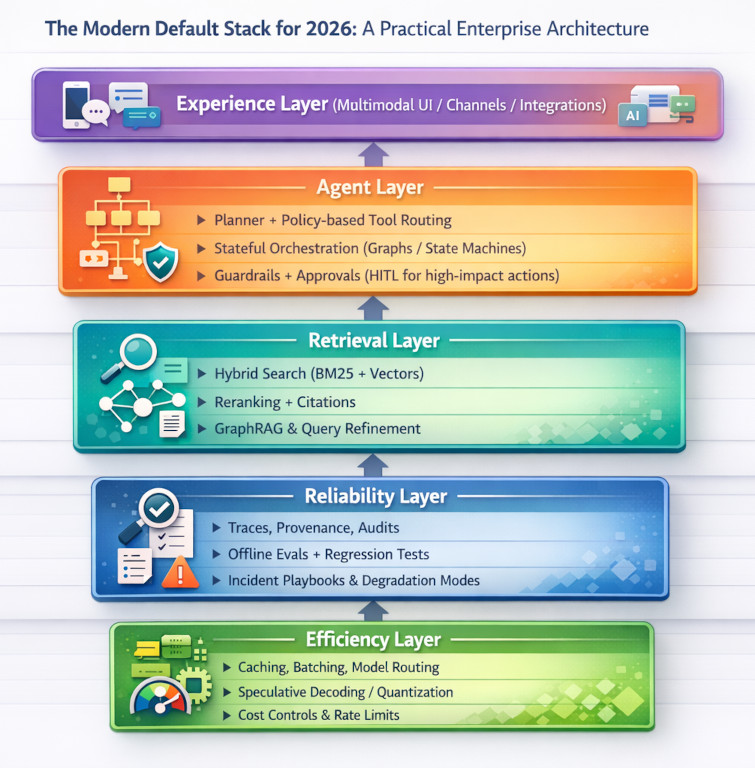
The Modern Default Stack for 2026

A dependable enterprise stack now looks less like a prompt wrapper and more like a layered software system.

  • Agent layer: graph-based or multi-agent orchestration with bounded states and approvals.
  • Retrieval layer: hybrid search and reranking by default, with GraphRAG or agentic retrieval when questions require structure.
  • Reliability layer: provenance tracing, step-level debugging, and hallucination localization.
  • Efficiency layer: latency, caching, batching, and hardware-aware inference optimization.

The Enterprise Operating Model That Actually Scales

The production challenge is not getting a model to do something clever once. It is getting that system to behave like enterprise software every day: reliable, traceable, secure, and cost-effective.

That requires future-proof architecture, grounded retrieval, provenance for multi-step workflows, inference efficiency, and governance built into access control, approvals, logging, and evaluation pipelines.

In practice, organizations scale more safely when they treat agentic systems as platform capabilities with ownership, policy, and measurable outcomes instead of as isolated experiments owned by whichever team built the first demo.

Executive Takeaways

  • MCP reduces tool-integration friction and makes governance more repeatable.
  • Agents become enterprise-ready when orchestration is explicit and bounded.
  • RAG 2.0 is a managed retrieval subsystem, not a single vector-search trick.
  • Traceability is required for sensitive workflows, not optional polish.
  • Multimodal AI expands both value and compliance exposure.
  • Inference-time compute must be treated as a policy and unit-economics decision.

Conclusion

In 2026, the winners in enterprise AI will not simply be the teams with the most capable model access. They will be the teams that can turn model capability into reliable operating systems for real work.

FAMRO helps organizations bridge that gap through architecture design, RAG 2.0 implementation, traceability, inference optimization, and governance models that support scale without slowing adoption.

Frequently Asked Questions About Enterprise Agentic AI in 2026

The shift was architectural: standardized tool connectivity, explicit orchestration, grounded retrieval, traceability, and tighter cost control turned agents into systems that can be governed and scaled.
Because MCP reduces custom integration sprawl and gives enterprises a repeatable boundary where access policy, logging, approvals, and control can be enforced consistently.
Because production knowledge workflows need relevance tuning, evaluation, traceability, and structured reasoning. Hybrid retrieval and reranking are now the baseline rather than the exception.
Explicit orchestration, strong identity and governance boundaries, provenance, measurable reliability, and disciplined latency and cost management are the core production requirements.