
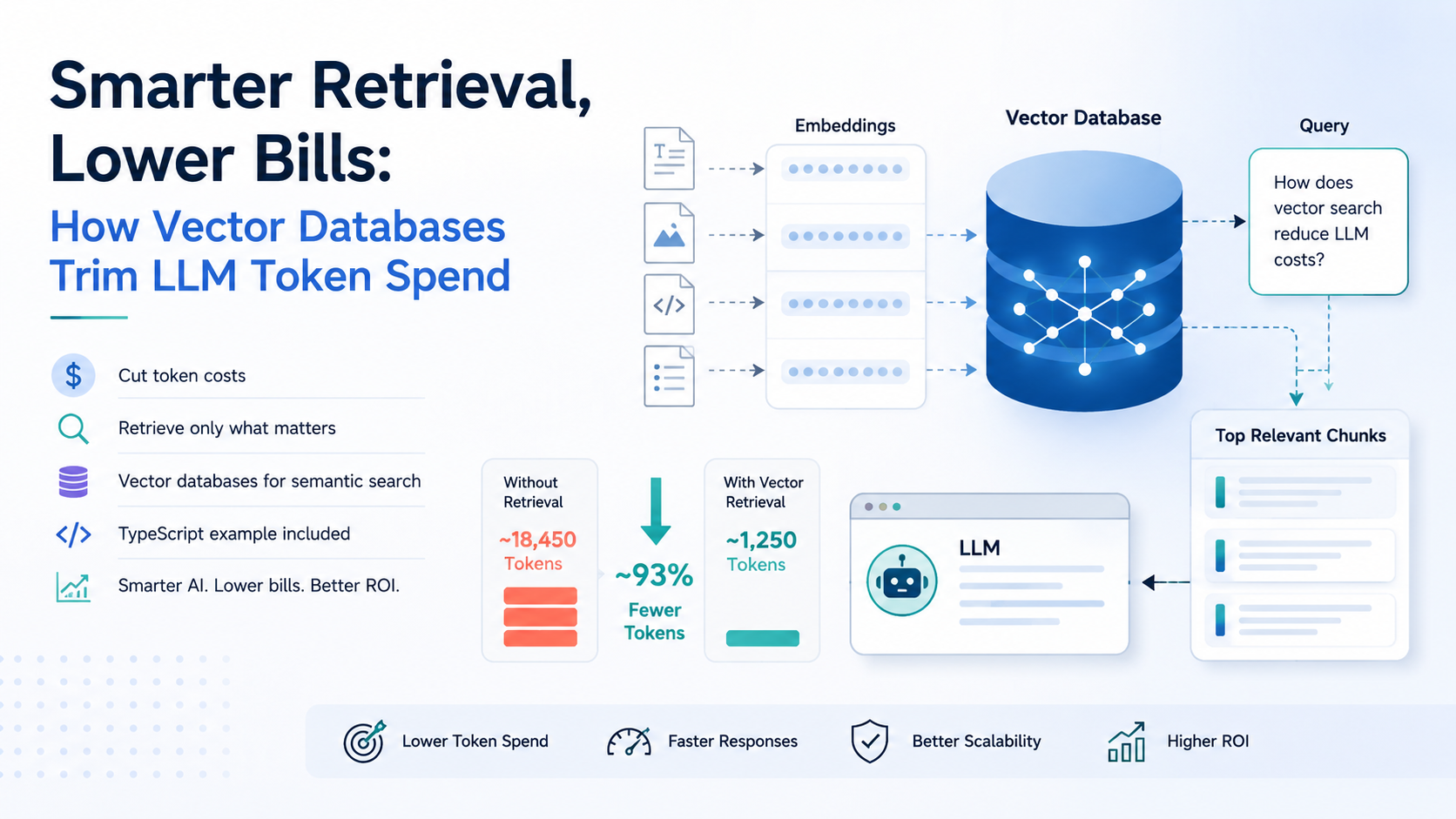
Reduce LLM Token Spend with Smarter Retrieval

This guide explains how AI usage is priced, how vector databases perform semantic retrieval, where they differ from traditional data systems, and how technical teams can implement a vendor-neutral retrieval-augmented generation workflow in TypeScript.

Why LLM Context Becomes a Cost Problem

Large language model costs are often discussed as a model-selection problem: choose a smaller model, negotiate a lower rate, or route simpler requests to a cheaper endpoint. Those decisions matter, but they overlook one of the most controllable cost drivers in production AI systems—the amount of context sent with every request.

An enterprise assistant may have access to thousands of policies, support articles, contracts, product manuals, tickets, and conversation records. Sending all of that material to a model is unnecessary, expensive, and sometimes impossible because of context-window limits.

This is particularly valuable at scale. Saving a few thousand tokens on one request may appear minor. Saving them across millions of requests can materially change the unit economics of an AI feature.
How AI Costing Works Today

Most commercial language-model APIs meter text usage in tokens. A token is a unit produced by a model-specific tokenizer and may represent a complete word, part of a word, punctuation, whitespace, or another text fragment.

  • Long system prompts and few-shot examples
  • Repeated document or policy context
  • Full conversation histories sent on every turn
  • Large document-processing and summarization jobs
  • Verbose tool responses copied into prompts
  • Frequent or duplicated model calls

Request cost ≈ input tokens × input rate + output tokens × output rate + embedding, retrieval, reranking, storage, and infrastructure costs.

For technical leaders, this creates two optimization tracks. The first is model efficiency: selecting an appropriate model and controlling response length. The second is context efficiency: deciding what information genuinely deserves a place in the prompt. Vector retrieval primarily improves the second track.

What Is a Vector Database?

A vector database stores and searches numerical representations of data. These representations, called embeddings, encode characteristics of text, images, audio, code, or other content as arrays of numbers.

An embedding model places items with related meanings near one another in a multidimensional vector space. The sentences “How do I reset my account password?” and “I cannot sign in because I forgot my credentials” use different words, but a useful embedding model should represent them as semantically similar.

  1. Split source content into retrievable chunks.
  2. Create an embedding for each chunk.
  3. Store the vector, original text, and metadata.
  4. Create an embedding for the user's query.
  5. Search for the nearest vectors.
  6. Return the best-matching text to the application.

The vector database does not determine the final answer. It narrows the evidence set. The language model then receives the selected passages and uses them to generate a response.

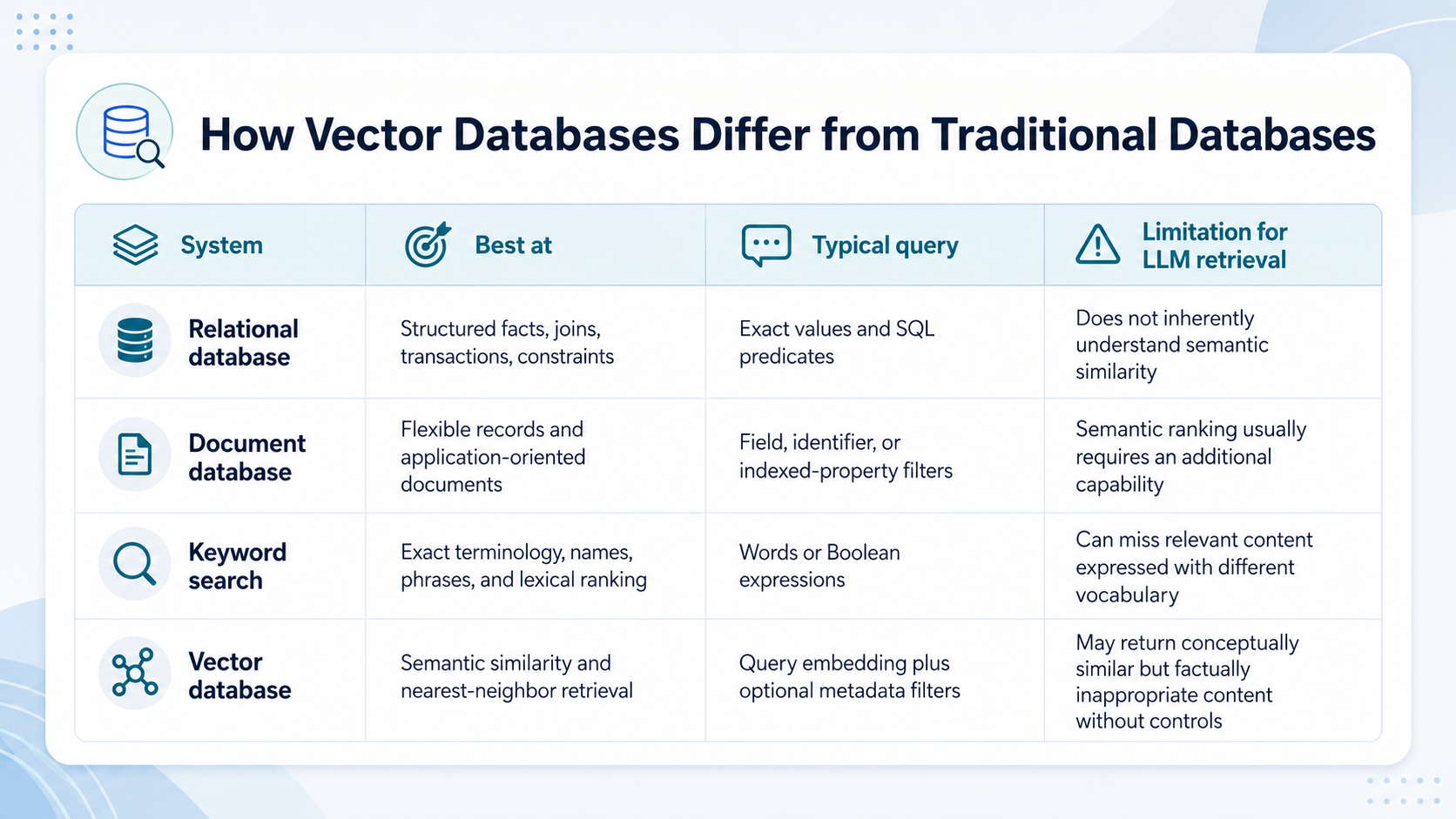
How Vector Databases Differ from Traditional Databases

How Vector Databases Differ from Traditional Databases

How Vector Databases Can Reduce AI Token Costs

The token-saving mechanism is simple: retrieve a small evidence set instead of sending the entire potential evidence set.

  • Chunking: creates focused retrieval units.
  • Top-k limits: cap the number of passages returned.
  • Relevance thresholds: exclude low-confidence matches.
  • Metadata filters: enforce tenant, date, language, and access boundaries.
  • Reranking: improves ordering after initial retrieval.
  • Deduplication: removes overlapping or repeated evidence.
“Models which combine pre-trained parametric and non-parametric memory for language generation.” Patrick Lewis and co-authors, Retrieval-Augmented Generation for Knowledge-Intensive NLP Tasks

The savings are not automatic. Poor retrieval may omit critical context, causing inaccurate answers or additional model calls that erase the savings. The objective is to minimize irrelevant context while maintaining sufficient evidence for a reliable response.

Working Example with TypeScript

type Metadata = {
  sourceId: string;
  tenantId: string;
  heading?: string;
};

type VectorRecord = {
  id: string;
  text: string;
  embedding: number[];
  metadata: Metadata;
};

type SearchResult = VectorRecord & { score: number };

interface EmbeddingClient {
  embed(texts: string[]): Promise<number[][]>;
}

interface VectorStore {
  upsert(records: VectorRecord[]): Promise<void>;
  search(args: {
    vector: number[];
    topK: number;
    filter: { tenantId: string };
  }): Promise<SearchResult[]>;
}

interface LanguageModel {
  generate(args: {
    system: string;
    prompt: string;
    maxOutputTokens: number;
  }): Promise<string>;
}

interface TokenEstimator {
  count(text: string): number;
}

function chunkDocument(text: string, maxChars = 1800): string[] {
  const paragraphs = text
    .split(/\n\s*\n/)
    .map((value) => value.trim())
    .filter(Boolean);

  const chunks: string[] = [];
  let current = "";

  for (const paragraph of paragraphs) {
    if (paragraph.length > maxChars) {
      if (current) chunks.push(current);

      for (let i = 0; i < paragraph.length; i += maxChars) {
        chunks.push(paragraph.slice(i, i + maxChars));
      }

      current = "";
      continue;
    }

    const candidate = current
      ? `${current}\n\n${paragraph}`
      : paragraph;

    if (candidate.length > maxChars) {
      chunks.push(current);
      current = paragraph;
    } else {
      current = candidate;
    }
  }

  if (current) chunks.push(current);
  return chunks;
}

async function indexDocuments(
  documents: Array<{
    id: string;
    tenantId: string;
    text: string;
  }>,
  embeddings: EmbeddingClient,
  store: VectorStore
): Promise<void> {
  for (const document of documents) {
    const chunks = chunkDocument(document.text);

    if (chunks.length === 0) {
      continue;
    }

    try {
      const vectors = await embeddings.embed(chunks);

      if (vectors.length !== chunks.length) {
        throw new Error(
          `Embedding count mismatch for ${document.id}`
        );
      }

      await store.upsert(
        chunks.map((text, index) => ({
          id: `${document.id}:${index}`,
          text,
          embedding: vectors[index],
          metadata: {
            sourceId: document.id,
            tenantId: document.tenantId
          }
        }))
      );
    } catch (error) {
      console.error("Document indexing failed", {
        documentId: document.id,
        error
      });

      throw error;
    }
  }
}

async function answerQuestion(args: {
  question: string;
  tenantId: string;
  allDocuments: string[];
  embeddings: EmbeddingClient;
  store: VectorStore;
  model: LanguageModel;
  tokens: TokenEstimator;
}): Promise<{
  answer: string;
  retrievedSources: string[];
  fullPromptTokens: number;
  retrievalPromptTokens: number;
  estimatedTokenReductionPercent: number;
}> {
  const question = args.question.trim();

  if (!question) {
    throw new Error("Question is required");
  }

  const [queryVector] =
    await args.embeddings.embed([question]);

  if (!queryVector) {
    throw new Error("Query embedding was not returned");
  }

  const candidates = await args.store.search({
    vector: queryVector,
    topK: 8,
    filter: {
      tenantId: args.tenantId
    }
  });

  const relevant = candidates
    .filter((item) => item.score >= 0.72)
    .slice(0, 4);

  const context = relevant.length
    ? relevant
        .map(
          (item, index) =>
            `[Source ${index + 1}: ${item.metadata.sourceId}]\n${item.text}`
        )
        .join("\n\n")
    : "No sufficiently relevant internal source was retrieved.";

  const system =
    "Answer only from the supplied context. State when the context is insufficient.";

  const retrievalPrompt =
    `Context:\n${context}\n\nQuestion:\n${question}`;

  const fullPrompt =
    `Context:\n${args.allDocuments.join(
      "\n\n"
    )}\n\nQuestion:\n${question}`;

  const retrievalPromptTokens =
    args.tokens.count(system) +
    args.tokens.count(retrievalPrompt);

  const fullPromptTokens =
    args.tokens.count(system) +
    args.tokens.count(fullPrompt);

  const estimatedTokenReductionPercent =
    fullPromptTokens === 0
      ? 0
      : Math.max(
          0,
          Math.round(
            (
              1 -
              retrievalPromptTokens /
                fullPromptTokens
            ) *
              100
          )
        );

  const answer = await args.model.generate({
    system,
    prompt: retrievalPrompt,
    maxOutputTokens: 500
  });

  return {
    answer,
    retrievedSources: relevant.map(
      (item) => item.metadata.sourceId
    ),
    fullPromptTokens,
    retrievalPromptTokens,
    estimatedTokenReductionPercent
  };
}

The comparison reports prompt-size reduction, not guaranteed invoice savings. Actual financial savings depend on the selected model's input rate, cache behavior, embedding charges, retrieval infrastructure, reranking, and any additional requests caused by weak results.

  • Use the target model's tokenizer rather than a character-based production estimate.
  • Batch embeddings and apply bounded concurrency.
  • Add retry policies with exponential backoff for transient failures.
  • Use timeouts and circuit breakers around external dependencies.
  • Make ingestion idempotent and version embeddings when models change.
  • Enforce tenant and authorization filters before returning text.
  • Log retrieved IDs, scores, prompt tokens, latency, and answer outcomes.
  • Evaluate retrieval quality with representative questions before rollout.

Implementation and Cost Considerations

Decision Lower-cost direction Quality or operational risk
Chunk size Smaller chunks Lost context and fragmented evidence
Top-k Fewer results Lower recall
Similarity threshold Higher threshold Relevant but imperfect matches may be rejected
Reranking Skip the reranker Less accurate final ordering
Embedding model Smaller or local model Possible retrieval-quality reduction
Index configuration Lower resource usage Higher latency or lower approximate-search recall
  1. Select one high-volume, knowledge-intensive workflow.
  2. Measure current prompt tokens, model cost, latency, and task success.
  3. Create a representative retrieval evaluation set.
  4. Test chunking, filtering, top-k, thresholds, and hybrid search.
  5. Deploy behind feature controls or an A/B test.
  6. Track total cost per successful answer.
  7. Expand only after quality and financial improvements are demonstrated.

Conclusion

Vector databases can make LLM applications more economical by ensuring that the model receives focused evidence rather than entire documents, knowledge bases, or conversation histories. In well-designed RAG architectures, semantic search, structured filtering, chunking, relevance thresholds, and prompt controls work together to reduce repeated input tokens.

The database is not a cost-saving switch by itself. Savings depend on retrieval accuracy, chunk design, model pricing, embedding costs, index infrastructure, cache behavior, application traffic, and the number of additional calls required when retrieval fails.

For CTOs and technical leads, the most reliable approach is to treat context as an engineered resource. Measure it, budget it, test it, and include it in architecture reviews just as you would compute, storage, and network consumption.

FAMRO helps organizations design and implement production-ready AI and data architectures, including retrieval-augmented generation, vector search, document ingestion, secure knowledge systems, model integration, observability, and AI cost optimization.

Reduce LLM Spend Without Starving the Model of Context

Request a free initial consultation focused on your retrieval architecture and token-cost profile—no obligation and no generic pitch.

Frequently Asked Questions

Do vector databases always reduce LLM costs?

No. They reduce prompt tokens when retrieval replaces larger context payloads without causing excessive retries, missed evidence, or answer-quality failures.

How many chunks should a RAG system retrieve?

There is no universal number. Test top-k values against recall, grounded-answer quality, latency, and token consumption using representative queries.

Can an existing relational database support vector search?

Yes. Some relational databases support vector extensions or native vector types. The choice depends on scale, latency, filtering, operational skills, and availability requirements.

Are embeddings included in LLM token charges?

Embedding generation is generally priced separately from generative-model input and output tokens. Current pricing and billing units vary by provider.

Should conversation history use vector retrieval?

Often. A hybrid memory design can keep recent turns, maintain a compact summary, and retrieve older messages only when they are relevant to the current request.

What should CTOs measure?

Track input and output tokens, retrieved-context size, retrieval latency, relevance, grounded-answer rate, no-answer behavior, retries, and total cost per successful task.