
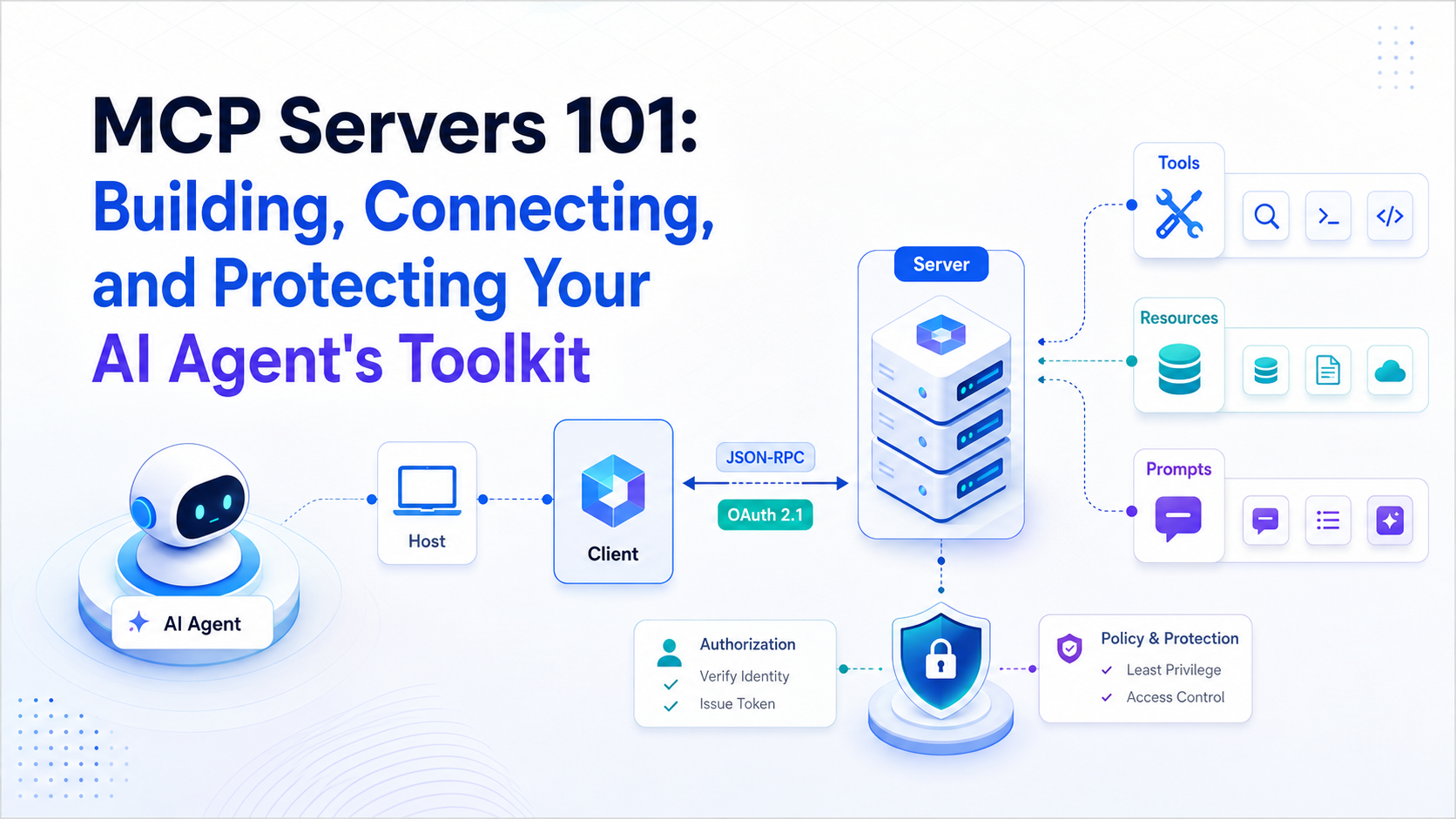
AI Agents and MCP Servers: An Overview
AI agents become commercially useful when they can do more than generate text. A support agent may need to retrieve an account record, a developer agent may inspect a repository, and an operations agent may query monitoring data or create an incident ticket. Each capability traditionally requires a custom integration, authentication flow, request format, and error-handling layer.
The Model Context Protocol, or MCP, standardizes this connection. It gives an AI application a consistent client-server interface for discovering and using external tools, applications, and data sources. Instead of building a proprietary connector for every model and service combination, a team can expose capabilities through an MCP server and connect them to compatible AI hosts.
For startups, the main advantage is modularity. A product team can keep model selection, agent orchestration, and business-system integrations loosely coupled. A database connector, ticketing integration, or internal search service can be developed and secured independently, then made available to multiple AI applications.
Direct answer: An MCP server is an integration boundary that allows an AI agent to discover approved capabilities and invoke them through a standardized protocol. It reduces integration duplication, but it must be treated as a security-sensitive application interface because the connected agent may be able to read data or perform real actions.
A useful architectural principle is to treat every MCP capability as if it were being exposed through a conventional production API. The fact that the caller is an AI agent does not reduce the need for identity, authorization, validation, rate limits, monitoring, and safe failure behavior. In many cases, the unpredictable nature of model-driven tool selection makes those controls even more important.