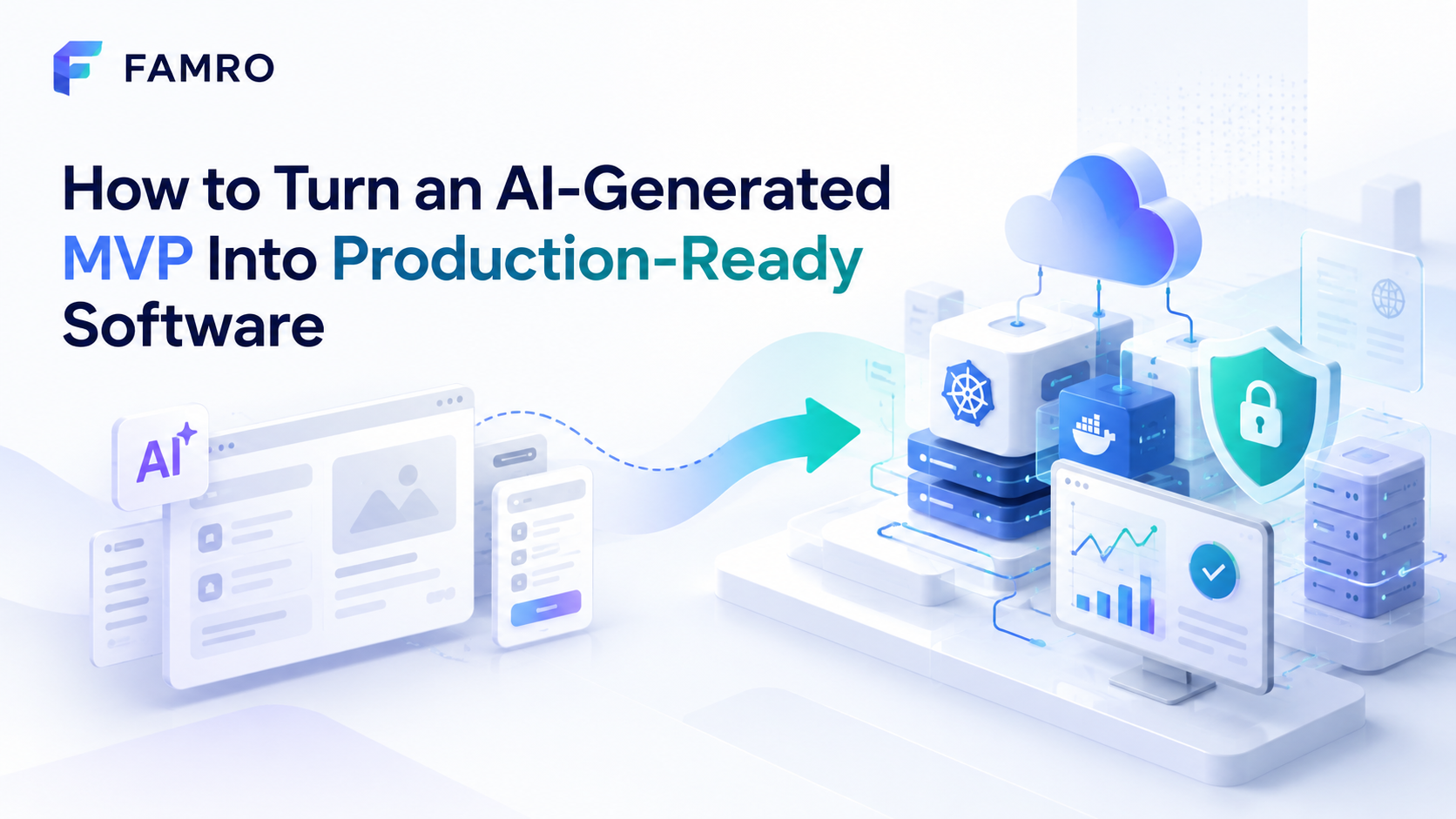
How to Turn an AI-Generated MVP Into Production-Ready Software
Move beyond a working prototype and build secure, scalable, maintainable software ready for real users, real traffic, and long-term growth.
AI tools can help you launch an MVP quickly, but production software needs stronger architecture, security, testing, deployment workflows, observability, and operational ownership. This guide explains how to close that gap without rebuilding everything from scratch.
How to Turn an AI-Generated MVP Into Production-Ready Software
This guide shows how to turn an AI-generated MVP into production-ready software by reviewing architecture, reducing technical risk, improving security, adding automated testing, strengthening CI/CD, preparing cloud infrastructure, and establishing monitoring and operational practices for reliable growth.
AI-assisted development has changed the economics of building an MVP. A founder can now generate interfaces, APIs, database schemas, integrations, and deployment configurations in days rather than months.
That speed is valuable. It can help a SaaS company validate demand before committing significant engineering capital.
But an AI-generated MVP and production-ready software are not the same thing.
Prototype code is typically optimized for one outcome: prove that the idea works. Production software must satisfy a much broader set of requirements around security, reliability, maintainability, scalability, deployment, monitoring, recovery, and engineering ownership.
The right response is usually not to throw the MVP away. It is to preserve the product knowledge it has validated while systematically replacing prototype assumptions with production engineering.
Prototype: Understand What You Actually Built
Before refactoring anything, establish what the AI-generated MVP actually contains.
AI development tools can generate substantial amounts of plausible code quickly. That creates an unusual engineering problem: the application may contain more functionality than anyone on the team fully understands.
Start by mapping:
Core user and business workflows
Application services and modules
Database entities and data flows
External APIs and SaaS dependencies
Authentication and authorization mechanisms
Background jobs and scheduled processes
AI-generated libraries and packages
Hosting and infrastructure configuration
Known shortcuts and unfinished functionality
Identify which workflows customers have actually validated. Those are assets worth preserving.
Then distinguish them from implementation choices that happened simply because an AI tool selected a convenient framework, library, database structure, or architectural pattern.
This matters because generated software can look polished while still carrying hidden assumptions. The existing FAMRO guidance on AI-assisted database design makes a similar distinction: AI is valuable as an acceleration layer, but architectural accountability still belongs with experienced technical leadership.
Architecture Review: Validate the Foundation
The next question is whether the current architecture can support the company you intend to build.
Review the application from both a technical and business perspective.
For an early SaaS product, this does not automatically mean replacing a monolith with microservices. A well-structured modular monolith may be substantially easier to operate than a premature distributed architecture.
Instead, evaluate whether the current design provides clear boundaries around:
Customer and tenant data
Identity and permissions
Billing and subscriptions
Business logic
Integrations
Data ownership
Asynchronous workloads
Administrative functions
Also consider realistic growth. What happens if the product moves from 100 users to 10,000? What changes when enterprise customers request SSO, audit history, regional hosting, data retention controls, integrations, or contractual uptime commitments?
A production architecture should make foreseeable change manageable rather than requiring a redesign every time the business succeeds.
Security Review: Identify Risks Before They Scale
Security is one of the largest differences between a prototype and a production application.
AI-generated code may implement login successfully without implementing production-grade identity security. It may consume secrets from configuration files, trust user-supplied identifiers, expose unnecessary API endpoints, or introduce dependencies that were never reviewed.
A security assessment should examine authentication, authorization, tenant isolation, secrets management, encryption, API security, dependency risk, infrastructure permissions, administrative access, logging, and sensitive-data handling.
This is not theoretical. OWASP's 2025 Top 10 identifies broken access control, security misconfiguration, software supply-chain failures, cryptographic failures, insecure design, authentication failures, and security logging failures among major web-application risks.
Dependency review deserves particular attention in AI-generated projects because generated code can introduce packages indirectly. OWASP recommends tracking dependencies, scanning them for vulnerabilities, controlling changes throughout the software supply chain, and applying least privilege to build and deployment systems.
NIST similarly recommends integrating secure development practices throughout the software lifecycle rather than treating security as a final pre-launch activity.
Refactoring: Replace Prototype Shortcuts
Once the risks are understood, refactor selectively.
The objective is not aesthetic perfection. It is to remove code that creates disproportionate operational or development risk.
Typical priorities include:
Separating business logic from controllers and user-interface code.
Removing duplicated implementations of critical rules.
Breaking oversized modules into understandable components.
Standardizing error handling and validation.
Centralizing configuration and secrets handling.
Pinning and documenting important dependencies.
Improving database migrations and data constraints.
Documenting architectural decisions and critical workflows.
Avoid rewriting functioning components solely because they were AI-generated.
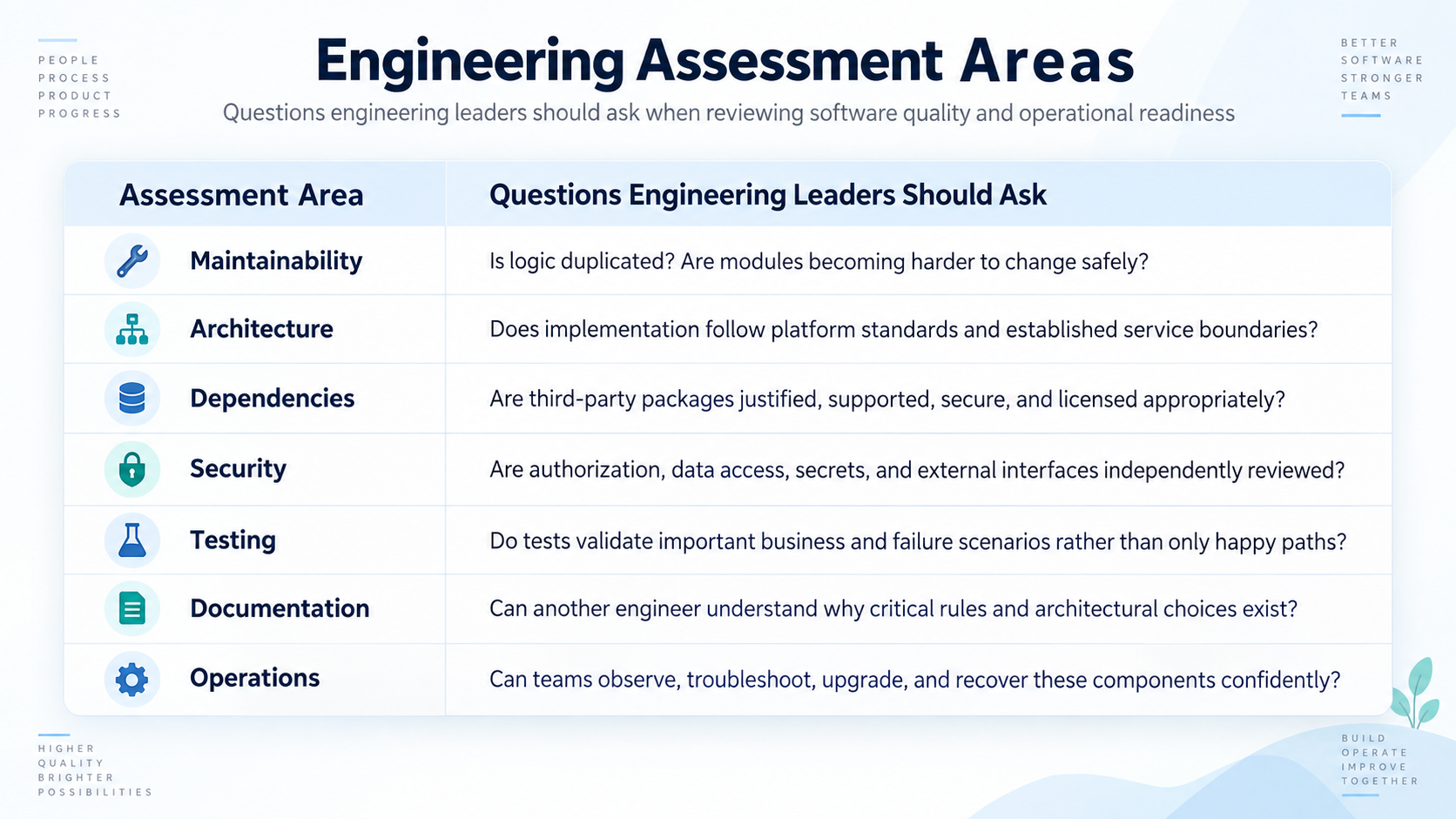
What matters is whether engineers can understand the code, test it, modify it safely, and determine who owns it when something fails.
Testing: Build Confidence in Every Release
A prototype proves that software worked during a demonstration. Automated testing helps prove that it still works after the next hundred changes.
Start with the areas where failure creates the greatest business impact.
For a SaaS application, that may include account creation, permissions, subscription changes, payments, data imports, AI workflows, notifications, integrations, and tenant isolation.
A practical testing model combines:
Unit tests for important business rules
Integration tests for databases, APIs, queues, and external services
End-to-end tests for high-value customer journeys
Security tests for authentication, authorization, dependencies, and exposed interfaces
Performance tests for workloads likely to create bottlenecks
The goal is not maximum test coverage as a vanity metric. The goal is confidence that important functionality can change without silently breaking the business.
Cloud Architecture: Design for Reliability and Scale
Many MVPs begin with whatever hosting arrangement gets the demo online fastest.
Production infrastructure needs deliberate choices.
Define separate development, staging, and production environments. Establish how networking, compute, managed databases, object storage, queues, secrets, backups, domains, certificates, and permissions will operate.
Then define expected failure conditions.
What happens when an application instance fails? What happens when the database reaches capacity? How quickly must data be restored? Can infrastructure be recreated consistently? Who has production access?
For most startups, this does not require elaborate enterprise infrastructure on day one.
It requires explicit infrastructure decisions instead of accidental ones.
Use infrastructure-as-code where practical, maintain least-privilege access, automate backups, and define recovery objectives based on business consequences rather than arbitrary technical targets.
CI/CD: Make Deployment Repeatable
If production deployment depends on an engineer remembering a sequence of terminal commands, deployment risk will increase as the team grows.
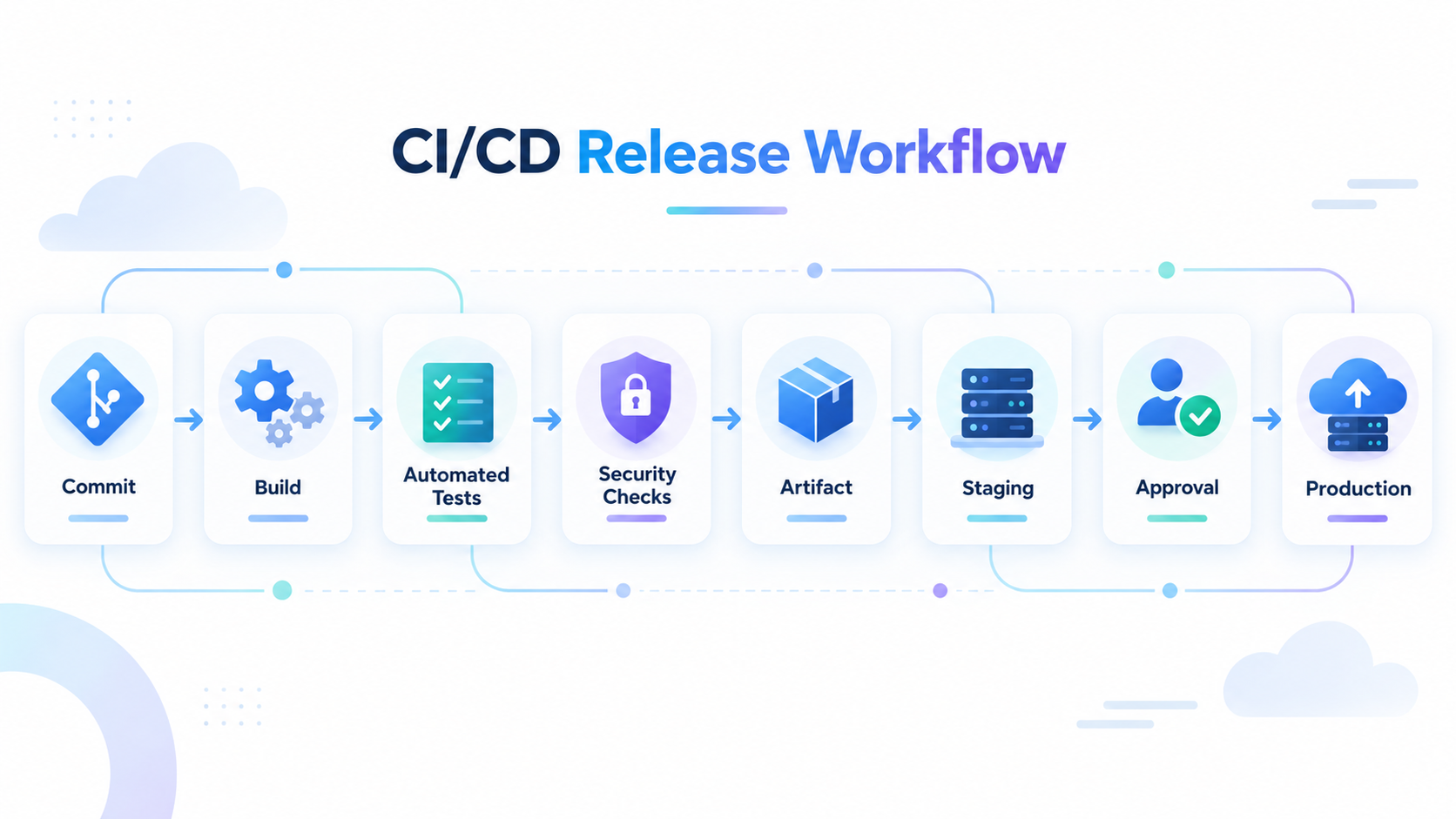
A CI/CD pipeline should create a controlled route from code change to production.
Important releases may also require database migration checks, smoke tests, rollback procedures, or progressive deployment strategies.
Modern deployment platforms can enforce protection rules so production changes depend on automated testing, security checks, operational health, or explicit approval. GitHub, for example, supports protected deployment environments and integration with quality, security, and observability checks.
Avoid keeping long-lived cloud credentials inside CI/CD systems when safer identity mechanisms are available. GitHub's deployment guidance, for example, recommends OpenID Connect for authentication to supported cloud providers.
Monitoring: Make the System Observable
A production system should tell the engineering team when something is wrong before customers begin opening support tickets.
At minimum, establish:
Structured application logs
Centralized error tracking
Infrastructure metrics
API and request performance
Database monitoring
Availability checks
Business-critical transaction monitoring
Actionable alerts
Operational dashboards
Google's Site Reliability Engineering guidance describes four particularly useful signals for user-facing systems: latency, traffic, errors, and saturation.
Those signals provide a strong starting point, but SaaS teams should also monitor business outcomes.
If the infrastructure is healthy while payment processing, onboarding, document generation, or AI inference has stopped working, the product is still experiencing an outage.
Observability therefore needs both technical and business context.
Production: Operate It as a Product, Not a Prototype
Production readiness is not a certificate awarded after a final technical review.
It is an operating discipline.
Before launch, confirm that the organization has clear answers to questions such as:
CISA's Secure by Design guidance makes the broader principle clear: security and reliability should be built into software throughout design and development rather than added after customers inherit the risk.
The same principle applies beyond security.
A production-ready product is one where engineering has converted implicit assumptions into explicit controls.
Key Takeaways for AI and SaaS Founders
An AI-generated MVP can be a highly effective starting point. It should not automatically become the production architecture simply because customers like the product.
Preserve the validated workflows. Review the architecture. Secure the trust boundaries. Refactor the dangerous shortcuts. Add meaningful automated testing. Formalize the infrastructure. Automate delivery. Make the system observable.
Most importantly, assign human engineering ownership.
AI can accelerate implementation. It cannot be accountable for an outage, security incident, corrupted dataset, failed migration, or enterprise customer requirement.
Conclusion
An AI-generated MVP has already accomplished something valuable: it helped turn an idea into something customers can evaluate.
The next stage requires a different engineering objective.
Instead of optimizing primarily for development speed, the organization must begin optimizing for controlled change, security, reliability, maintainability, and operational confidence.
FAMRO helps founders make that transition without unnecessarily discarding the product they have already built. We can assess the existing application and architecture, identify technical and security risks, refactor critical components, strengthen testing, design production cloud infrastructure, implement CI/CD pipelines, and establish monitoring and operational practices suited to continued SaaS growth.
For teams preparing to move beyond the prototype stage, we offer a free initial consultation focused on your MVP-to-production roadmap—no obligation, no generic pitch.
If your AI-generated product has proven the market opportunity and you now need confidence that the engineering can support the business, this is the right time to strengthen the foundation.
What makes an AI-generated MVP different from production-ready software?
An AI-generated MVP is usually optimized to validate an idea quickly, while production-ready software must also address security, reliability, maintainability, scalability, testing, deployment, monitoring, recovery, and clear engineering ownership.
Do you need to rewrite an AI-generated MVP before launching it to production?
Not necessarily. Validated workflows and reliable components can often be preserved while high-risk shortcuts, weak architecture, insecure configurations, and difficult-to-maintain code are selectively refactored.
What should be reviewed before moving an AI MVP into production?
Review the codebase, application architecture, authentication and authorization, dependencies, data flows, testing, cloud infrastructure, CI/CD process, observability, backups, recovery procedures, and ownership of critical systems.
How should security be improved in an AI-generated application?
Assess access control, authentication, tenant isolation, secrets management, encryption, API security, dependency vulnerabilities, cloud permissions, administrative access, logging, and sensitive-data handling throughout the software lifecycle.
What testing does a production-ready SaaS application need?
A practical strategy combines unit tests for business rules, integration tests for services and databases, end-to-end tests for critical customer journeys, security testing, and performance testing for workloads likely to become bottlenecks.
Why are CI/CD and observability important when moving beyond an MVP?
CI/CD makes releases repeatable and controlled, while observability helps teams identify failures through logs, metrics, error tracking, availability monitoring, business signals, dashboards, and actionable alerts.
How can FAMRO help turn an AI-generated MVP into production-ready software?
FAMRO can assess the existing application and architecture, identify technical and security risks, refactor critical components, strengthen testing, design cloud infrastructure, implement CI/CD, and establish production monitoring and operational practices.
Next Step
Want an independent review of your technology, cloud, or AI stack?
FAMRO helps organizations assess architecture, automation, governance, deployment risk, and cloud exposure before those issues slow delivery or create avoidable business risk.
Book a free review
Tell us what you are evaluating. We will review your current setup and help identify
technical risks, cloud issues, automation gaps, and practical next steps.