
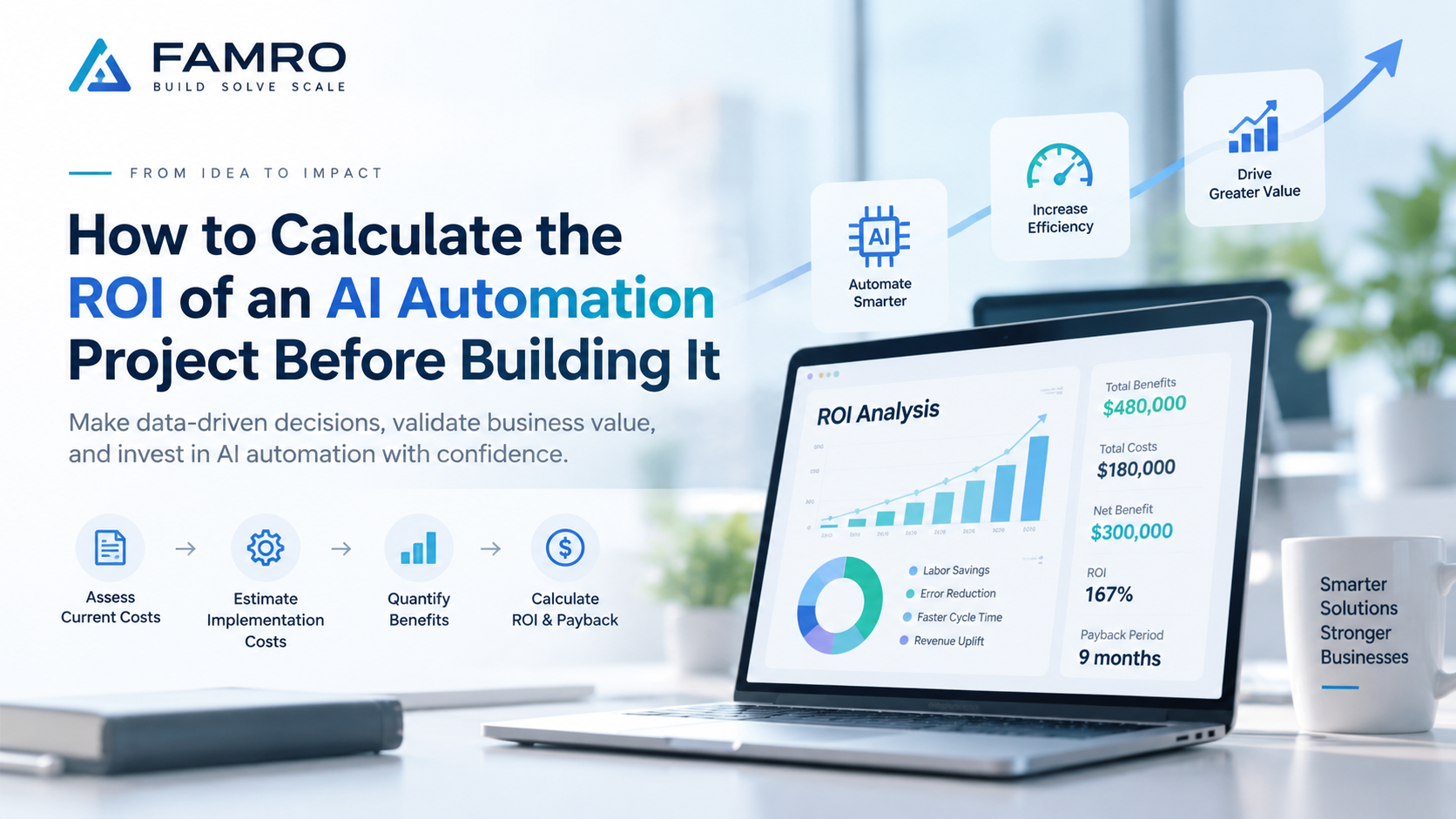
How to Calculate the ROI of an AI Automation Project Before Building It

AI automation can create significant business value, but technical feasibility alone does not guarantee a positive return. This guide explains how to calculate AI automation ROI before development by establishing current workflow costs, estimating implementation and recurring expenses, quantifying realistic benefits, and modeling ROI and payback scenarios. Use it to build a clearer business case and make better-informed AI investment decisions.

Enterprise AI initiatives often begin with a technology question: Can we automate this workflow with AI?

The more important question is: Should we?

A workflow may be technically suitable for AI automation and still be a poor investment. Conversely, an unglamorous process involving document review, data entry, reconciliation, customer requests, or operational approvals may offer substantial measurable value.

That distinction matters as enterprises move from AI experimentation toward financial accountability. Deloitte reports that although AI investment continues to increase, organizations frequently take two to four years to achieve satisfactory ROI on a typical AI use case. McKinsey research similarly finds that workflow redesign is strongly associated with organizations realizing bottom-line impact from generative AI.

Direct answer: To calculate the ROI of an AI automation project before building it, establish the current cost of the workflow, estimate implementation and recurring automation costs, quantify realistic labor savings and other benefits, and compare the resulting annual net benefit with the required investment.

A useful starting formula is:

ROI (%) = (Annual Benefits − Annual Automation Costs − Amortized Implementation Cost) ÷ Investment × 100

For enterprise decisions, however, one percentage is not enough. The business case should also show payback period, capacity released, error reduction, revenue impact, and uncertainty.
How to Calculate the ROI of an AI Automation Project Before Building It

The purpose of a pre-build ROI assessment is not to manufacture a financial justification for an AI project. It is to determine whether the project deserves to exist.

That means starting with the workflow rather than the model.

Map what happens today: transaction volumes, people involved, processing time, exception rates, systems touched, approvals required, errors, delays, and downstream consequences. Then model what realistically changes after automation.

This approach helps enterprises compare AI opportunities using business value rather than technical novelty.

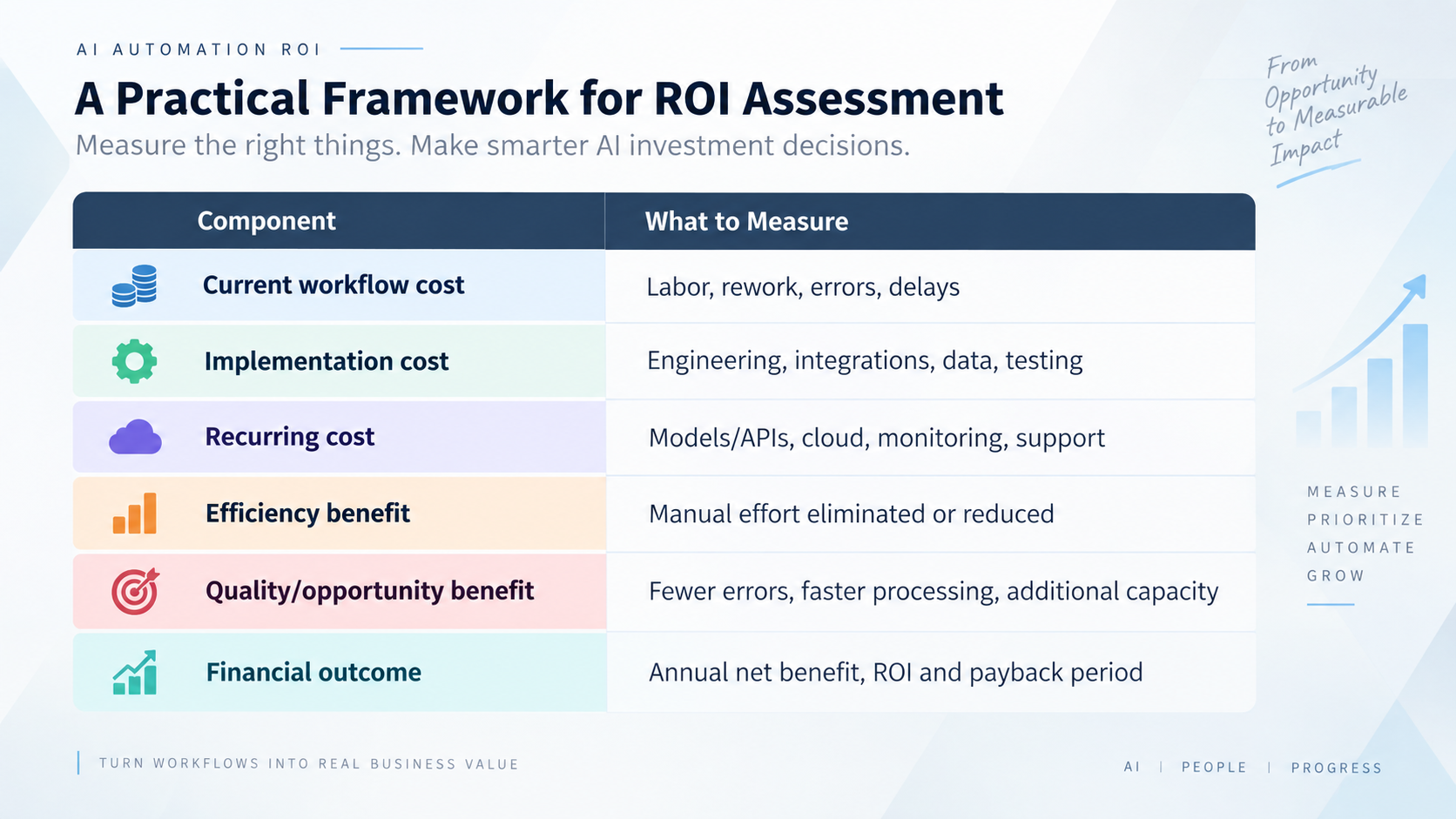
A practical ROI model has six components:

Establish the Current Cost of the Workflow

This financial discipline is increasingly important because AI's total cost extends beyond model usage. Infrastructure, data pipelines, engineering talent, licensing, cloud services, and ongoing operations can all contribute to total cost of ownership.

Establish the Current Cost of the Workflow

You cannot calculate savings without understanding what the organization spends today.

Start with direct labor:

Annual Labor Cost = Annual Employee Hours × Loaded Hourly Cost

Suppose an enterprise processes 80,000 supplier documents annually. Employees spend an average of six minutes reviewing and entering each document.

That represents:

80,000 × 6 minutes = 8,000 hours per year

At a loaded labor cost of $50 per hour:

8,000 × $50 = $400,000 annual labor cost

But stopping there understates the process cost.

Add measurable costs associated with:

  • manual corrections and rework;
  • supervisory review and exception handling;
  • SLA failures and processing delays;
  • duplicate or incorrect transactions;
  • compliance remediation;
  • customer or supplier disputes; and
  • opportunities lost because employees cannot process demand quickly enough.

If $400,000 of labor also produces $60,000 of annual rework and $40,000 of measurable delay-related costs, the baseline is closer to $500,000 per year.

That becomes the economic starting point.

Calculate the Expected Cost of Automation

AI automation has both one-time implementation costs and recurring operating costs.

Initial costs may include workflow discovery, solution architecture, engineering, data preparation, integrations, security reviews, testing, deployment, and change management.

Recurring costs may include model or API consumption, cloud infrastructure, databases, orchestration platforms, monitoring, human review, support, maintenance, retraining or evaluation, and vendor licensing.

This is where simplistic ROI models often fail.

A prototype might cost $40,000 to build, but if production operation requires another $100,000 annually in infrastructure, model usage, monitoring, support, and exception handling, the commercial case is materially different.

AI cost management should therefore consider total cost of ownership, not simply the development invoice. IBM's enterprise AI cost guidance similarly emphasizes connecting cloud, model, infrastructure, data, labor, and vendor costs with business outcomes.

Calculate the Payback Period

Executives frequently find payback easier to compare than an abstract ROI percentage.

The basic calculation is:

Payback Period = Initial Investment ÷ Annual Net Benefit

Assume an automation project requires a $180,000 initial investment.

It generates $300,000 of annual measurable benefits but costs $60,000 per year to operate.

Annual net benefit is therefore:

$300,000 − $60,000 = $240,000

The estimated payback period is:

$180,000 ÷ $240,000 = 0.75 years, or approximately nine months

Payback does not replace ROI, but it answers an important capital-allocation question: How quickly can the enterprise recover the money committed to this initiative?

Estimate Annual Savings

Next, calculate the recurring financial benefit.

If the current workflow costs $500,000 annually and automation reduces measurable process costs by $300,000 while requiring $60,000 in annual operating expense:

Annual Net Savings = $300,000 − $60,000 = $240,000

Keep every major assumption visible.

Do not write “AI will save 70% of operational cost” without showing how that number was derived. Specify transaction volume, handling time, automation rate, exception rate, loaded labor cost, and expected residual manual work.

This makes the business case auditable rather than aspirational.

Measure Capacity Released

One of the most important distinctions in enterprise automation is the difference between capacity released and headcount eliminated.

Suppose automation removes 5,000 hours of repetitive work annually.

At $50 per hour, that represents $250,000 of labor capacity. But unless payroll actually decreases by $250,000, it should not automatically be presented as $250,000 of hard savings.

Instead, determine what happens to those hours.

Employees may use the released capacity to process higher volumes, shorten response times, improve customer service, conduct additional analysis, or perform work previously deferred because teams lacked capacity.

This distinction produces a much more credible executive business case.

Estimate Error Reduction

Automation can create value by improving consistency, but AI does not eliminate errors—it changes their nature.

Measure the existing process first:

Annual Error Cost = Transaction Volume × Error Rate × Average Cost per Error

For example, 100,000 transactions with a 3% error rate and an average remediation cost of $20 create:

100,000 × 3% × $20 = $60,000 annual error cost

If a properly evaluated automation reduces that cost to $20,000, the modeled quality benefit is $40,000.

However, include the cost of new failure modes: incorrect classifications, hallucinated outputs, model drift, integration failures, false positives, and human-review requirements.

NIST's Generative AI Profile emphasizes incorporating AI risk considerations throughout the design, development, use, and evaluation lifecycle. Financial models should therefore budget for appropriate controls rather than assuming perfect autonomous execution.

Quantify Revenue and Opportunity Impact

Some AI projects create value beyond cost reduction.

Faster processing may increase transaction capacity. Faster sales responses may improve conversion opportunities. Reduced onboarding delays may accelerate revenue recognition. Automated service workflows may enable an organization to support more customers without proportional staffing increases.

Keep these benefits separate from hard savings when attribution is uncertain.

A useful business case can therefore distinguish:

Hard savings: demonstrable reductions in expenditure.

Capacity value: employee time available for other productive activities.

Quality value: lower measurable cost of errors and rework.

Opportunity value: potential additional revenue or avoided commercial loss.

McKinsey has reported organizations seeing revenue effects from generative AI within business functions, reinforcing why revenue impact can belong in the business case—but it should be modeled carefully rather than treated as guaranteed.

Build the Overall ROI Case

Once the inputs are available, combine them into a transparent financial model.

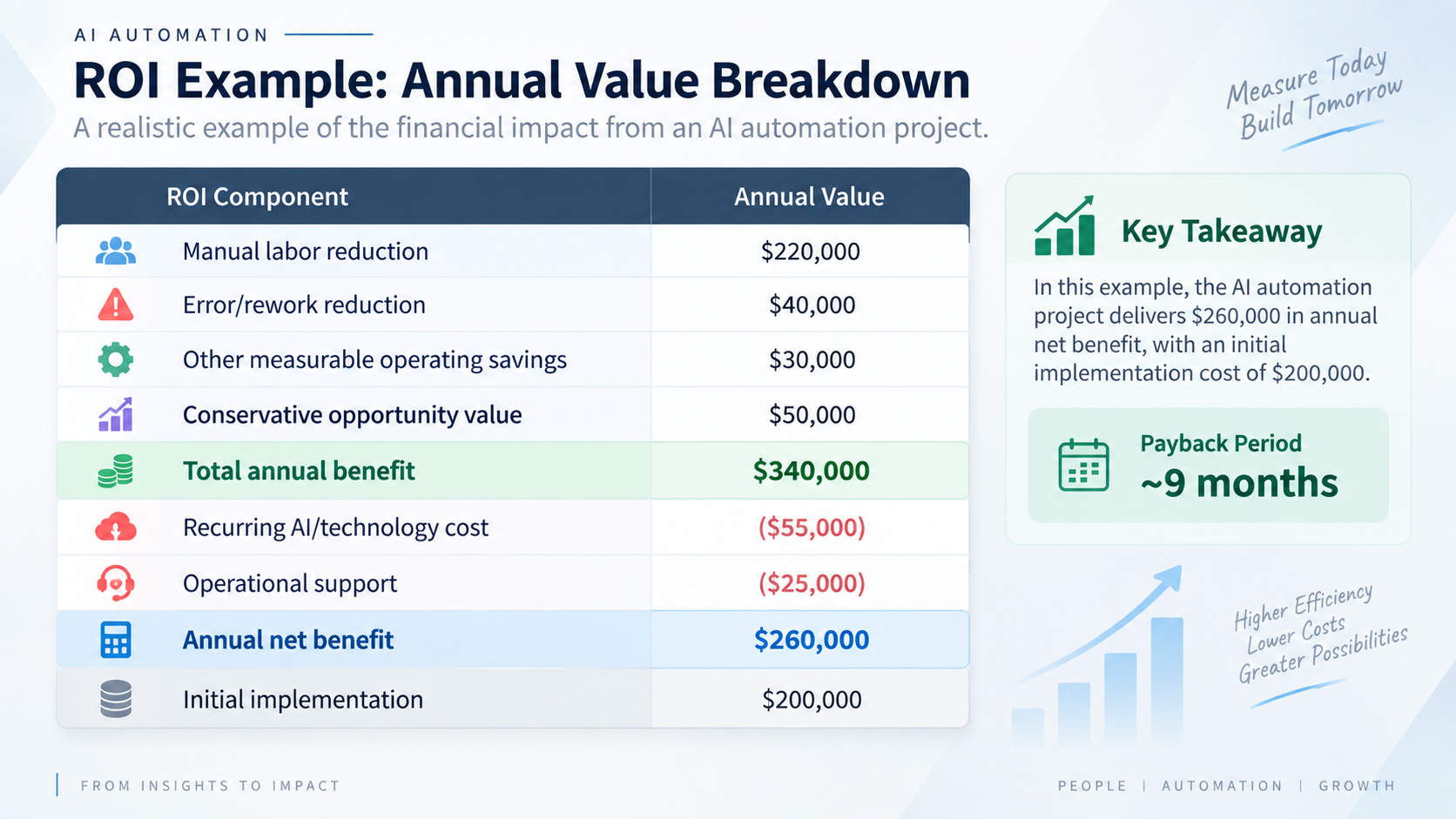
Consider an enterprise workflow with the following expected economics:

Build the overall ROI Case

The first-year benefit after implementation cost would be $60,000, while the simple payback period would be approximately 9.2 months.

For a major enterprise investment, do not rely on one forecast. Model at least three scenarios:

  • Conservative: lower automation rate, higher exceptions, higher operating cost.
  • Expected: evidence-based assumptions considered most realistic.
  • Higher-benefit: stronger adoption, processing efficiency, or opportunity capture.

Scenario modeling makes uncertainty visible instead of burying it inside a single attractive ROI percentage.

Key Takeaways for CTOs and Technology Strategy Leaders

Before approving an AI automation project, enterprise leaders should be able to answer:

  • What does the workflow cost today? Establish the true baseline, including labor, errors, rework, delays, and lost opportunities.
  • What will automation cost? Account for implementation, integrations, infrastructure, AI usage, monitoring, maintenance, and support.
  • Which benefits are actual savings? Separate direct cost reductions from released capacity and potential opportunity value.
  • How quickly will the investment pay back? Calculate annual net benefit, ROI, and expected payback period.
  • Which assumptions could change the business case? Test variables such as automation rate, adoption, transaction volume, AI costs, and implementation complexity.

AI automation should compete for investment on the same basis as other transformation initiatives: measurable economics, controlled risk, and defensible business outcomes.

Conclusion

The strongest AI automation business case is often created before anyone starts building.

FAMRO helps enterprises evaluate workflows before committing budget and engineering resources to implementation. Our AI Workflow & ROI Assessment examines the current process, transaction volumes, labor costs, exception patterns, technical dependencies, integrations, security requirements, human-review needs, and realistic automation potential.

We then translate those findings into a practical business case covering implementation cost, ongoing AI and infrastructure costs, expected efficiency gains, capacity released, error reduction, financial impact, ROI, and payback period.

Just as importantly, the assessment can identify workflows that should not be automated. Avoiding a technically impressive project with weak economics protects capital and engineering capacity for initiatives with stronger measurable value.

This workflow-first approach also aligns with McKinsey research showing that organizations generating value from AI increasingly focus on redesigning how work gets done, rather than simply adding AI tools to existing processes.

Before you build, establish whether the automation deserves to be built.

FAMRO can assess your workflow, identify the highest-value automation opportunities, and build a practical implementation roadmap backed by measurable business outcomes.

🌐 Learn more: Visit Our Homepage

💬 WhatsApp: +971-505-208-240

Frequently Asked Questions

How do you calculate the ROI of an AI automation project?

Start with the current annual cost of the workflow, estimate implementation and recurring automation costs, quantify realistic annual benefits, and compare the resulting net benefit with the investment. Include payback period and scenario analysis alongside the ROI percentage.

What costs should be included in an AI automation ROI calculation?

Include solution design, engineering, data preparation, integrations, security, testing, deployment, model or API usage, cloud infrastructure, monitoring, human review, maintenance, support, licensing, and change management.

How do you calculate the payback period for AI automation?

Divide the initial investment by the expected annual net benefit. For example, a $180,000 investment producing $240,000 in annual net benefit has an estimated payback period of 0.75 years, or about nine months.

Should employee time saved by AI be counted as direct cost savings?

Not automatically. Released employee capacity becomes hard savings only when expenditure actually decreases. Otherwise, measure it separately as capacity that can support higher volumes, faster service, additional analysis, or other productive work.

How should error reduction be included in AI ROI?

Measure the current cost of errors and rework, estimate the expected reduction after automation, and include the difference as a quality benefit. Also account for new AI failure modes and the cost of monitoring and human review.

Why should AI ROI be calculated before development begins?

A pre-build assessment helps determine whether the workflow can generate enough measurable value to justify implementation and operating costs before significant budget and engineering capacity are committed.

What scenarios should an AI automation business case include?

Model conservative, expected, and higher-benefit scenarios. Vary assumptions such as automation rate, exception volume, adoption, transaction volume, implementation complexity, operating costs, and measurable business benefits.