SageMaker HyperPod at a Glance

Amazon SageMaker HyperPod is a managed infrastructure capability within Amazon SageMaker AI for operating long-running clusters of accelerated compute resources. It targets organizations whose AI workloads have outgrown isolated instances or short-lived jobs and now require distributed execution, predictable capacity, resilient operations, and stronger platform governance.

SageMaker HyperPod at a Glance

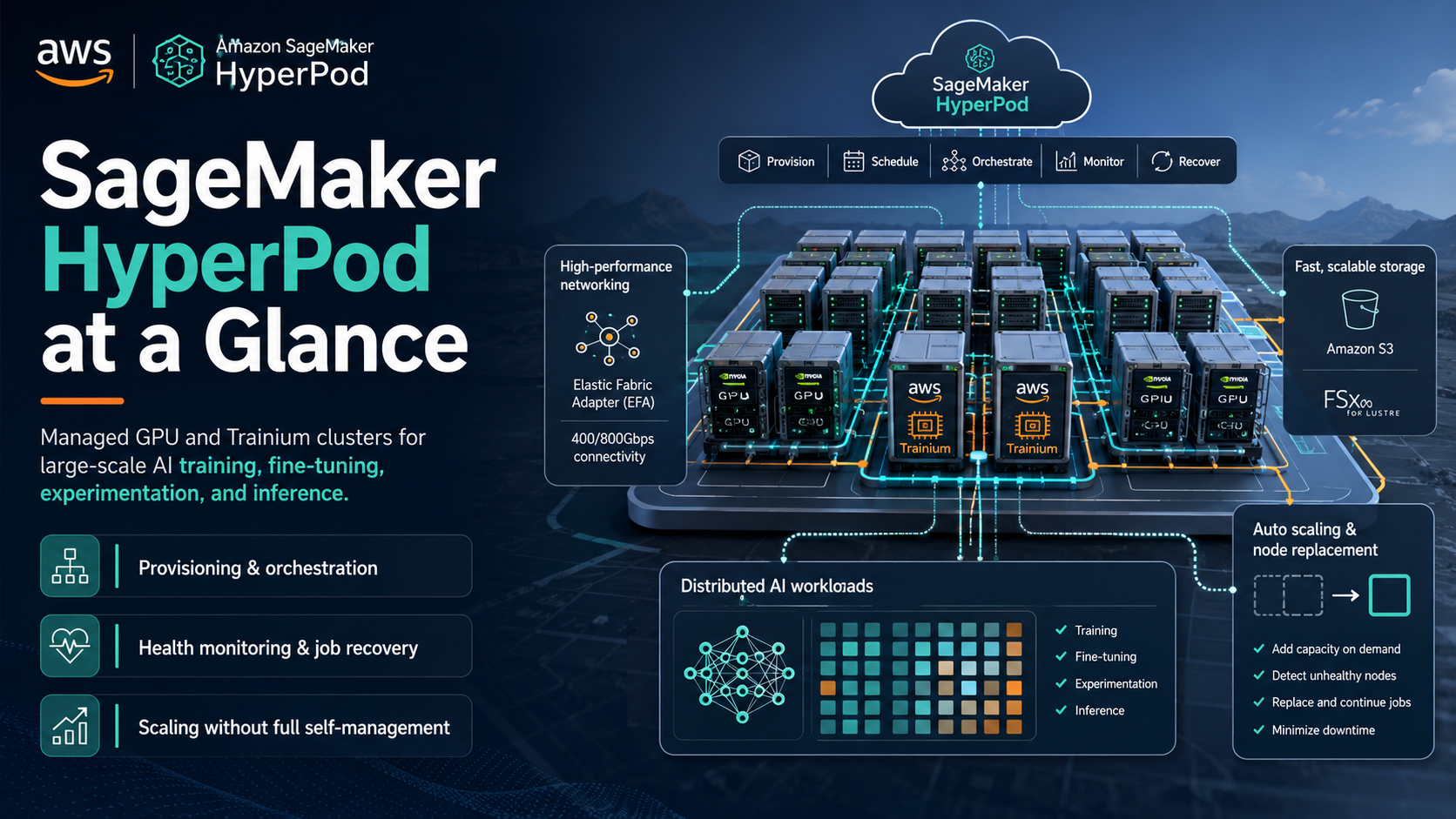
Amazon SageMaker HyperPod is a managed environment for building and operating clusters of GPUs or AWS accelerators such as Trainium. It supports large-scale model pre-training, fine-tuning, experimentation, and inference where workloads must run across many interconnected nodes.

For CTOs, the important distinction is that HyperPod is not merely another way to rent accelerators. It addresses the operating model around those accelerators: cluster provisioning, orchestration, health monitoring, node replacement, job recovery, scheduling, scaling, and integration with networking and high-performance storage.

The business case depends on utilization and avoided disruption. Expensive accelerators create value only while productive work is running. A cluster that waits for capacity, loses days to failed nodes, or requires researchers to debug infrastructure can make model development slower despite impressive theoretical performance.

What Is Amazon SageMaker HyperPod?

HyperPod is a SageMaker AI-managed infrastructure capability for provisioning and operating resilient machine-learning clusters. Organizations retain a cluster-oriented environment while AWS automates significant parts of the underlying infrastructure lifecycle.

HyperPod supports Slurm, the workload manager widely used in high-performance computing, and Amazon Elastic Kubernetes Service. Slurm can suit research teams with batch-oriented distributed training workflows. Amazon EKS may be preferable when an enterprise already uses Kubernetes-based platform engineering, policy enforcement, operators, and cloud-native deployment practices.

Clusters can be customized through lifecycle scripts, container images, libraries, storage integrations, networking, security controls, and workload frameworks. Teams can run distributed technologies such as PyTorch Fully Sharded Data Parallel, DeepSpeed, Ray, and Kubernetes training operators rather than being limited to a narrowly prescribed workflow.

Resilience is a central capability. HyperPod monitors infrastructure health, performs deeper checks for certain failures, replaces or repairs unhealthy nodes, and can resume compatible workloads from checkpoints. This does not eliminate the need for application-level checkpointing, but it reduces the manual recovery work associated with long-running multi-node jobs.

HyperPod can also support production inference on EKS-orchestrated clusters. That creates the possibility of a shared AI platform spanning experimentation, training, fine-tuning, and selected inference workloads, although enterprises should still separate environments and capacity pools where service-level objectives require it.

What Problems Does SageMaker HyperPod Address?

Large distributed clusters amplify routine infrastructure failures. A single unhealthy accelerator, network interface, storage path, or host can interrupt a synchronous workload involving hundreds of devices. Without reliable checkpoints and automated node replacement, organizations may lose substantial compute time.

  • Infrastructure failure and job interruption
  • Accelerator utilization and workload queuing
  • Resource allocation, priority, and topology
  • Cluster configuration, dependencies, and patching
  • Observability and infrastructure health monitoring
  • The specialist burden of operating distributed infrastructure

Platform teams must also manage driver compatibility, accelerator libraries, container images, identity, network isolation, storage performance, logging, metrics, patching, and capacity changes. Each concern is manageable on its own; together, they require specialized HPC, Kubernetes, networking, cloud, and machine-learning expertise.

HyperPod reduces this undifferentiated work, but it does not remove platform responsibility. Enterprises still need workload standards, quotas, cost allocation, model governance, observability, data controls, and incident ownership.

Alternatives and Their Trade-Offs

HyperPod is not automatically the best choice for every enterprise AI program. The right platform depends on workload duration, scale, customization, governance, internal skills, and strategic cloud alignment.

Option Where it fits Primary trade-off
Self-managed GPU or accelerator cluster Organizations needing maximum hardware, scheduler, or networking control Highest operational burden, staffing requirement, and failure-management responsibility
Standard cloud instances Experiments, prototypes, and smaller workloads Teams must assemble orchestration, recovery, scheduling, and governance themselves
SageMaker managed training jobs Discrete jobs that benefit from ephemeral, managed execution Less suitable when teams need a persistent, highly customized shared cluster
General Kubernetes platform Enterprises standardizing most workloads on Kubernetes GPU topology, health management, scheduling, and distributed-training operations remain complex
Third-party AI infrastructure provider Rapid accelerator access, specialized tooling, or multi-cloud procurement Additional vendor dependency, governance integration, data-movement, and portability considerations

The strongest HyperPod fit is usually a sustained program rather than an occasional project. A team running a few fine-tuning jobs each quarter may obtain better economics and simplicity from managed training jobs. A research organization with a constant queue of multi-node workloads can benefit more from persistent capacity, shared scheduling, and automated recovery.

Vendor dependency should be evaluated at several layers: AWS APIs, orchestration choices, storage, networking, accelerator architecture, deployment automation, and operational processes. Using containers, open frameworks, portable checkpoints, infrastructure as code, and clearly documented interfaces can reduce—but not eliminate—switching costs.

How SageMaker HyperPod Pricing Works

HyperPod cost is driven primarily by the resources assigned to the cluster. Variables include accelerator and instance type, AWS Region, operating duration, attached storage, data transfer, networking, orchestration components, observability services, and supporting infrastructure.

  • On-Demand: Flexible consumption without a long-term usage commitment.
  • Spot Instances: Lower-priced capacity for interruption-tolerant workloads where supported and operationally appropriate.
  • SageMaker AI Savings Plans: Discounted eligible usage in exchange for a one-year or three-year hourly spending commitment.
  • Flexible training plans: Reserved accelerated capacity matched to a target timeline, duration, and resource requirement.

CTOs should model total workload cost, not hourly compute rates alone. The model should include utilization, failed-job recovery, checkpoint overhead, idle cluster time, storage throughput, data preparation, engineering support, capacity risk, and the opportunity cost of delayed experiments.

A cheaper instance that extends training, increases failure exposure, or leaves researchers waiting may have a higher total economic cost than a more expensive but better-utilized configuration.

Three Real-World Applications

1. Large-Scale Foundation Model Training

Perplexity used HyperPod for foundation-model training and reported a 40 percent acceleration in training. WRITER adopted HyperPod for distributed training of its Palmyra models, using high-performance instances, Slurm scheduling, Elastic Fabric Adapter networking, and Amazon FSx for Lustre. AWS reports that WRITER accelerated model iteration cycles threefold, reduced training-pipeline failures by 90 percent, and removed manual intervention from workload distribution.

These examples illustrate the enterprise proposition: research teams spend less time diagnosing node failures and coordinating resources, while the platform provides repeatable access to distributed infrastructure.

“SageMaker HyperPod's capabilities, such as robust orchestration, automated health checks, and seamless job recovery, allow us to focus on advancing model development without worrying about cluster management.” — Waseem Alshikh, Co-founder and CTO, WRITER

2. Image and Video Model Development

Diffusion models, video generation, and multimodal systems combine substantial compute demand with heavy storage and network traffic. HyperPod can coordinate multi-node execution while integrating with high-throughput storage and low-latency networking. A persistent cluster can also support a research portfolio rather than requiring teams to rebuild infrastructure for each experiment.

The platform does not solve inefficient model code or poor data pipelines. Organizations must still profile input throughput, communication overhead, memory use, checkpoint frequency, and accelerator utilization.

3. Robotics and Domain-Specific AI

Diligent Robotics used HyperPod to scale work on a vision-language-action model for Moxi, its healthcare delivery robot. Such systems combine visual understanding, language-conditioned reasoning, action planning, simulation data, and domain-specific constraints.

For enterprise robotics, the infrastructure must support more than a single training run. Teams may need repeated fine-tuning, synthetic-data generation, hyperparameter searches, evaluation, safety testing, and deployment optimization. HyperPod can provide the shared compute layer, while the organization remains responsible for validation, operational safety, clinical or industrial governance, and edge deployment.
Conclusion

SageMaker HyperPod can provide substantial enterprise value when AI development depends on sustained, large-scale distributed workloads. Its strongest capabilities are resilient cluster operation, support for Slurm and Amazon EKS, automated infrastructure management, customization, and integration with AWS compute, storage, networking, security, and monitoring services.

  • Workload scale, duration, and continuity
  • Internal HPC, Kubernetes, cloud, and MLOps expertise
  • Security, compliance, governance, and tenancy requirements
  • Capacity certainty and cost predictability
  • Strategic alignment with AWS services and accelerators
  • The long-term AI infrastructure and portability roadmap

A practical assessment should start with a representative workload. Measure accelerator utilization, job completion time, recovery behavior, storage throughput, engineering effort, queue delay, and total cost. Compare those results with the current platform rather than relying only on vendor benchmarks.

FAMRO helps organizations assess, design, and implement cloud and AI infrastructure for distributed training, model fine-tuning, MLOps, governance, performance engineering, and production deployment. We can help determine whether HyperPod is the right strategic platform, design the surrounding AWS architecture, and establish the operational controls needed to move from expensive experiments to reliable production AI.

To help organizations get started, we offer a free initial consultation focused on your enterprise AI infrastructure and SageMaker HyperPod roadmap—no obligation, no generic pitch.

If your organization is investing in large-scale AI and wants confidence—not guesswork—now is the time to act.

🌐 Visit Our Homepage
💬 WhatsApp: +971-505-208-240

References

Frequently Asked Questions

Is SageMaker HyperPod only for training foundation models?

No. HyperPod can support pre-training, fine-tuning, distributed experimentation, multimodal development, and selected inference workloads. Its value is strongest when workloads require persistent, scalable accelerator clusters.

Does HyperPod eliminate the need for platform engineering?

No. AWS manages more of the cluster infrastructure and recovery process, but customers still govern software, data, security, scheduling policies, observability, cost allocation, and workload reliability.

Should enterprises choose Slurm or Amazon EKS?

Slurm often suits HPC-style batch training and research workflows. Amazon EKS may fit organizations with established Kubernetes operations, policy tooling, and container-based AI platforms.

Is HyperPod cheaper than self-managed GPU infrastructure?

Not in every case. The comparison should include utilization, engineering labor, failed-job recovery, idle capacity, storage, networking, procurement risk, and time-to-model rather than compute rates alone.

When is HyperPod probably unnecessary?

It may be unnecessary for small, occasional, single-node, or short-lived workloads that can be handled more simply through managed SageMaker training jobs or standard cloud instances.