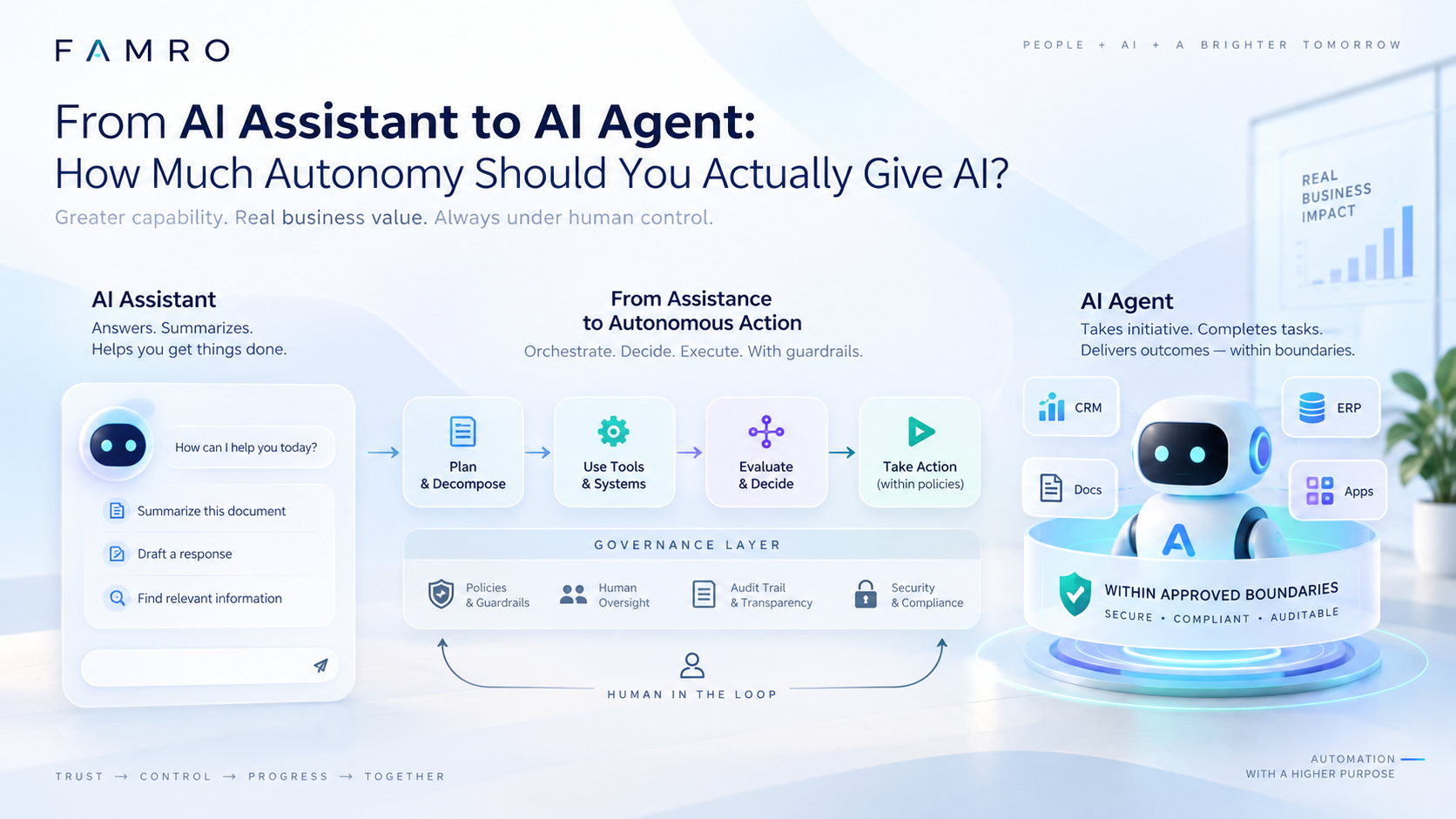
A practical way to govern agents is to classify every AI-enabled workflow according to the authority the system receives.
Level 1: Recommend — AI Suggests an Action
The AI analyzes information and recommends what a person should do.
It may identify a security incident, suggest a supplier, recommend a pricing adjustment, or propose an infrastructure change. However, it cannot perform the action itself.
Example: An AI analyzes cloud utilization and recommends resizing 14 underused virtual machines.
The human remains responsible for deciding and executing.
This level is appropriate for high-consequence decisions where organizations want analytical acceleration without delegating operational control.
Level 2: Prepare — AI Creates the Work, but a Human Approves It
At Level 2, AI goes beyond recommendations and produces a completed artifact.
It might draft:
- A customer response
- A purchase order
- A firewall configuration
- A contract summary
- A database migration
- A change request
- A marketing campaign
A human reviews the output before it reaches another person or production system.
Example: An AI prepares a customer renewal proposal using CRM history and approved pricing rules. The account manager reviews and sends it.
This model can eliminate substantial preparation work without giving AI direct operational authority.
Level 3: Execute With Approval — AI Acts After Confirmation
Here, AI can perform the action—but only after an authorized person confirms it.
The difference from Level 2 is important. The AI is no longer merely creating content. It has credentials and tool access capable of changing another system.
Example: An infrastructure agent identifies a failing service, prepares a remediation plan, and asks an engineer:
Restart service and shift traffic to the healthy region?
After approval, the agent performs the steps automatically.
This can dramatically reduce operational friction while retaining a deliberate control point.
For high-impact actions, Microsoft similarly recommends deterministic approval mechanisms rather than relying only on an agent's judgment about whether approval is necessary.
Level 4: Autonomous Within Guardrails — AI Executes Defined Workflows
At Level 4, the agent acts without routine human confirmation, but its authority is bounded.
This is where agent design becomes an operational governance discipline.
The organization might allow an agent to:
- Issue refunds below $100
- Restart approved application services
- Resolve predefined support requests
- Reorder inventory within fixed thresholds
- Create sandbox environments
- Modify records within an approved dataset
What matters is not simply that the agent is autonomous. It is that autonomy exists inside deterministic boundaries.
A Level 4 agent should have defined permissions, spending thresholds, approved tools, prohibited actions, monitoring, exception handling, audit trails, and an immediate override mechanism.
Microsoft's guidance for autonomous agents specifically emphasizes least privilege, human approval for high-risk actions, observability, auditability, and system-level mechanisms capable of safely pausing or stopping agents.
Level 5: Highly Autonomous Operations — Use Selectively
At Level 5, AI manages substantial portions of an operational process with limited routine human intervention.
Consider an autonomous IT operations system that continuously detects incidents, investigates root causes, executes approved remediations, scales resources, validates recovery, updates tickets, and escalates only unusual cases.
That can produce substantial efficiency.
But Level 5 should not be treated as the inevitable destination of every AI initiative.
Workflows involving large financial transactions, sensitive customer decisions, privileged security actions, legal commitments, regulated processes, or irreversible changes may require permanent human checkpoints.
The more difficult an action is to reverse, the stronger the justification should be for giving AI unilateral authority.