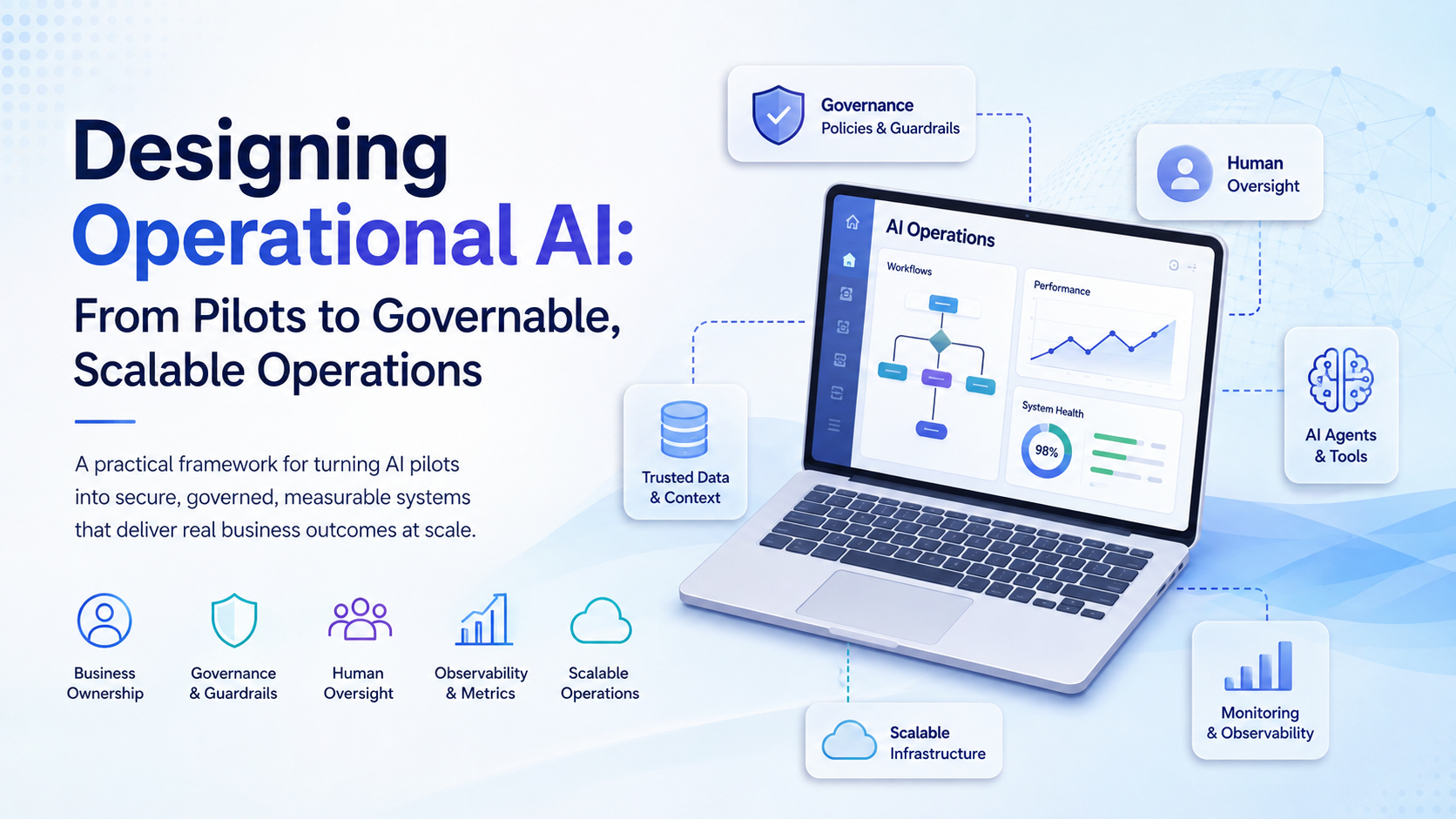
These 9 decisions are better understood as a design framework than as a technology checklist.
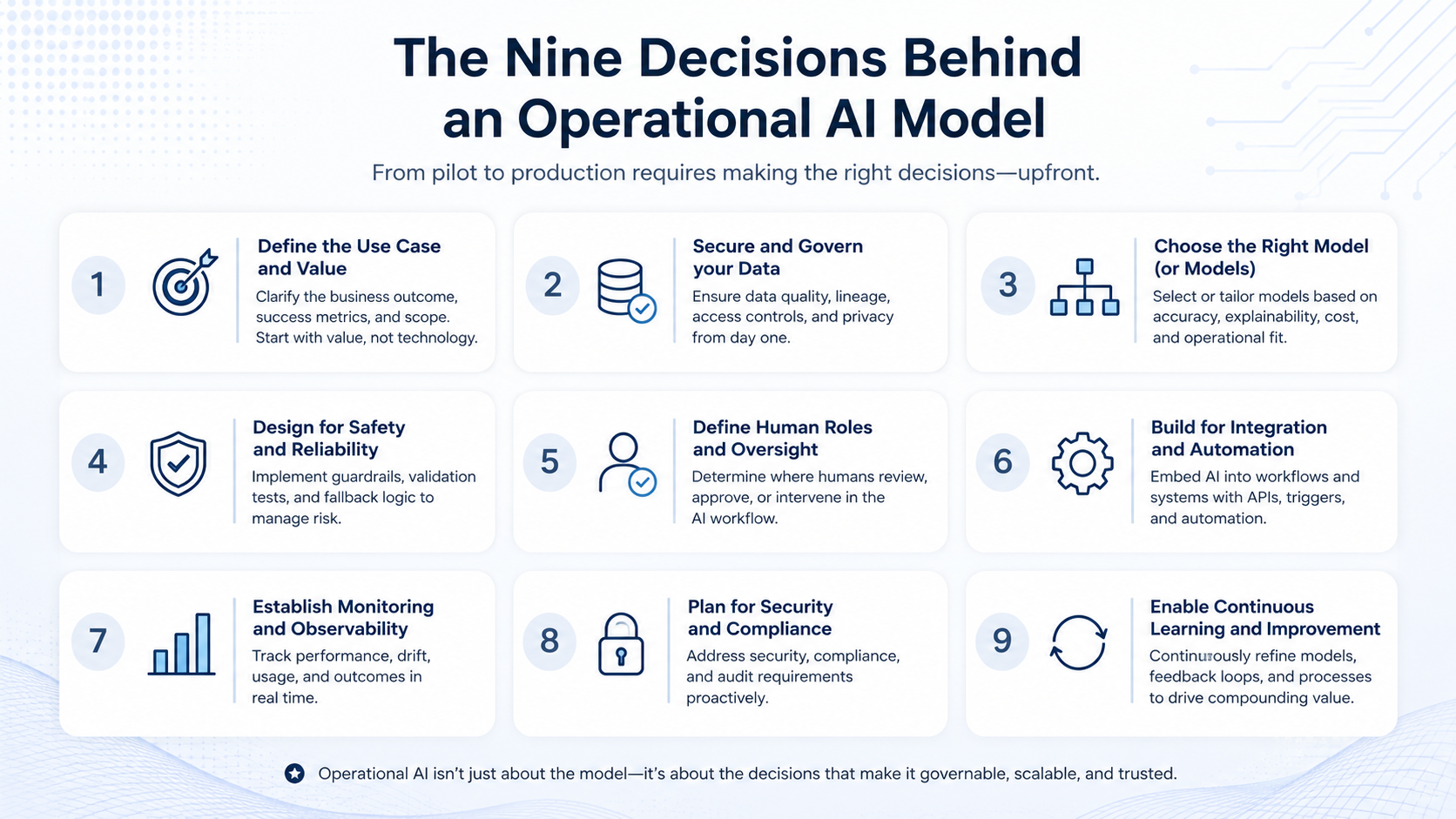
Business Alignment and Context
1. Identify the workflow and define its value
Operational AI starts with the process, not the model.
Leaders need to define what work is being changed, who performs it today and what improvement will matter. Useful measures might include cycle time, processing cost, error rate, employee effort or throughput.
This prevents technically impressive projects from becoming solutions in search of a business problem.
2. Assign clear business ownership
An AI system embedded in finance, service delivery or customer operations ultimately changes a business process. The person accountable for that process should therefore share responsibility for the AI-enabled version.
The framework explicitly recommends making the business process owner accountable from the start, alongside department-level AI champions who can demonstrate practical benefits and encourage adoption.
IT can provide the platform. It cannot own every operational outcome.
3. Connect AI to trusted context
AI becomes significantly more useful when it can reason from verified business information instead of relying primarily on general model knowledge.
That requires identifying the data sources the workflow needs—documents, operational systems, customer records, policies or knowledge repositories—and deciding what constitutes authoritative context.
The goal described in the source is retrieval-based grounding, beginning with the information required for the workflow and expanding as adoption grows.
Architecture, Control and Human Authority
4. Maintain flexibility in the model layer
A business workflow may remain important for years while the preferred model may change several times.
Hard-coding workflow logic around one model or provider creates unnecessary dependency. Instead, organizations should separate orchestration and business rules from the model layer, allowing models to be selected, replaced or optimised without reconstructing the process.
That flexibility can support resilience, cost optimisation and future technology choices.
5. Define permissions and guardrails
An operational agent needs explicit boundaries.
What systems may it access? Which records can it read? What can it modify? Which actions require approval?
The source recommends the least-privilege principle: neither the agent nor its users should receive more access than the task requires.
For CTOs, agent permissions should be treated with the same seriousness as permissions granted to applications, APIs and human users.
6. Establish human-in-the-lead checkpoints
Human involvement should not be added vaguely at the end with a statement that “someone will review the output.”
Teams need to decide where people remain authoritative.
High-impact decisions may require approval. Lower-risk workflows may use exception-based supervision. Drafting workflows may require verification before publication or execution.
The framework's language is useful: even in advanced AI environments, humans remain in the lead by setting goals, establishing rules and retaining authority over high-stakes decisions.
Lifecycle and Performance
7. Manage the agent lifecycle
As adoption grows, organizations need to know what agents exist, who created them, what data they access and whether they are still required.
The source recommends an agent registry, standards for versioning and updating, retirement rules and policy enforcement during deployment. Without those controls, agent sprawl can lead to duplicated functionality, unnecessary cost and security exposure.
8. Measure outcomes, cost and performance
Measurement should begin early, but organizations should avoid demanding enterprise-wide ROI evidence from a narrowly scoped first implementation.
A bounded workflow can initially be evaluated through measures such as completion time, quality, adoption, cost per task or human effort removed.
The important principle is to define success before deployment rather than deciding afterwards which metrics make the project look successful.
9. Monitor and optimise behaviour
Measurement and monitoring are related but different.
As the source puts it, measurement tells you what the agent produced; monitoring tells you how it got there. Production monitoring therefore includes execution paths, tool usage, decision behaviour and escalation patterns.
This distinction becomes increasingly important as agents perform multi-step work rather than simply generating text.