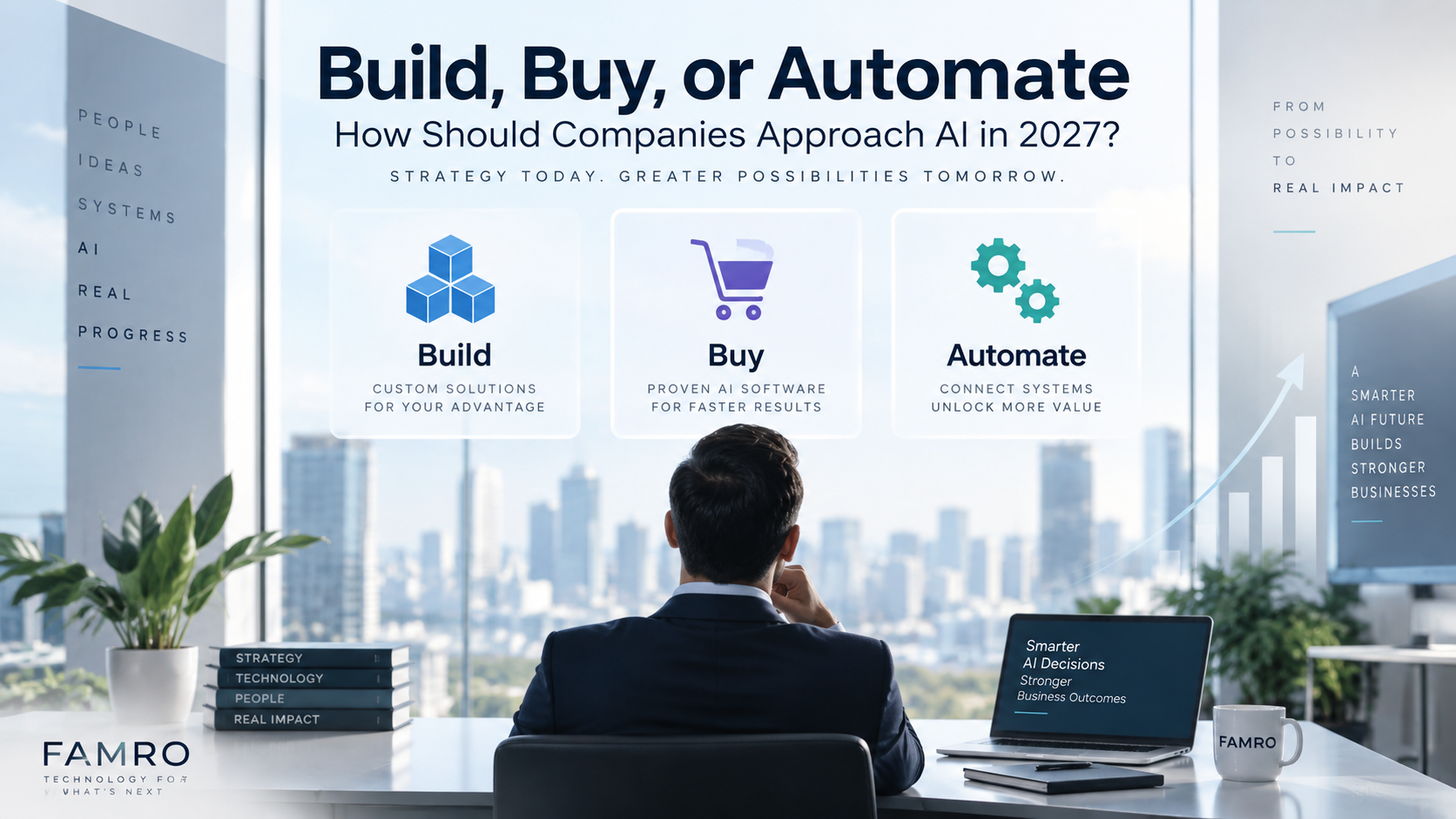
Build, Buy, or Automate: How Should Companies Approach AI in 2027?
The smartest AI investment is not always another AI product.
A practical framework for CTOs, CIOs, founders, and technology leaders deciding when to buy established AI software, build proprietary capabilities, or automate workflows across the systems they already own.
Build, Buy, or Automate: How Should Companies Approach AI in 2027?
Enterprise AI strategy in 2027 is no longer a simple build-versus-buy decision. This guide explains how technology leaders can determine when standardized workflows belong in SaaS, when strategic capabilities justify custom AI development, and when the better investment is an automation layer connecting existing applications, data, AI models, business rules, and human approvals.
Enterprise AI has moved beyond experimentation. The question for technology leaders in 2027 is increasingly not whether to invest in AI, but what level of investment a particular workflow actually deserves.
That distinction matters because AI adoption is already widespread while enterprise-scale value remains uneven. McKinsey reported that 88% of surveyed organizations were using AI in at least one business function in 2025, yet only 7% said AI had been fully scaled across their organizations.
The implication for CTOs, CIOs, founders, and CEOs is straightforward: adding another AI product is not automatically transformation.
Some problems call for established SaaS. Others justify proprietary AI development. A large and often overlooked category needs neither. The underlying applications already exist; the real problem is coordinating systems, data, AI models, and people more effectively.
The AI Investment Decision Is No Longer Just Build vs. Buy
Traditional technology strategy often reduced software decisions to two options: build something internally or buy a commercial product.
AI has expanded that decision.
A business might now:
Purchase an AI-enabled SaaS platform.
Build a proprietary application or AI capability.
Add an automation and integration layer across existing systems.
Combine commercial models, internal data, APIs, workflow engines, and human approvals.
The right approach depends less on how impressive the AI technology is and more on the nature of the workflow.
Consider customer support. A company requiring standard ticket categorization and response assistance may be well served by an existing platform. A company whose proprietary diagnostic process differentiates its service might justify custom development. Another business may already have a CRM, ticketing system, knowledge base, messaging platform, and AI model but still rely on employees to transfer information manually between them. That is primarily an orchestration problem.
The strategic question therefore becomes: Is the company missing a capability, creating a differentiating capability, or struggling to connect capabilities it already owns?
Buy: Use SaaS When the Workflow Is Standardized
Buying is usually the most efficient approach when requirements resemble those of thousands of other organizations.
Examples include meeting transcription, standard document extraction, basic customer-support assistance, CRM enrichment, coding assistance, recruitment administration, and many common productivity workflows.
Established SaaS can provide:
Faster deployment.
Lower initial engineering requirements.
Predictable functionality.
Vendor-managed infrastructure and model updates.
Existing security and administration features.
Faster access to new AI capabilities.
Buying, however, does not eliminate implementation work.
Enterprise buyers still need to evaluate identity integration, APIs, data residency, access controls, auditability, retention policies, model behavior, contractual terms, and whether company data may be used outside the intended environment.
Customization can also become a constraint. A product designed around a generic workflow may handle 80% of a company's requirements exceptionally well while making the final 20% surprisingly difficult.
Recurring licensing costs matter too. A low per-user price can become substantial across thousands of employees, especially when several AI tools overlap.
Buy when standardization is an advantage rather than a limitation.
Build: Invest in Custom AI When the Workflow Creates Competitive Advantage
Custom development becomes more compelling when the workflow itself contributes directly to differentiation.
Workflows built around valuable proprietary datasets.
Operational processes that materially affect margin, speed, or service quality.
Here, ownership can justify the additional investment.
A custom system gives engineering teams greater control over architecture, interfaces, data flows, model selection, observability, and evolution. It can also capture organizational knowledge that generic software cannot represent effectively.
But custom AI creates long-term obligations.
The organization needs engineering capacity, reliable data, evaluation mechanisms, security controls, monitoring, deployment processes, governance, and ongoing maintenance. Models and APIs change. Data distributions change. Business rules change.
NIST's AI Risk Management Framework emphasizes managing AI risk throughout the lifecycle rather than treating governance as a one-time deployment checkpoint. Its Generative AI Profile similarly provides guidance for incorporating trustworthiness and risk controls into AI design, development, deployment, and evaluation.
Building is therefore not simply a development decision. It is a decision to own the capability operationally.
Automate: Integrate Existing Systems When the Problem Is Orchestration
Many organizations do not actually lack software.
They have too much disconnected software.
A typical enterprise workflow may cross a CRM, ERP, document repository, email inbox, ticketing application, database, analytics platform, and approval process. Employees become the integration layer—copying information, requesting updates, checking records, generating documents, and moving tasks between applications.
AI can improve this without replacing the stack.
An automation layer might:
Detect a new request in one system.
Retrieve supporting data from several applications.
Use an AI model to classify or summarize the information.
Apply predefined business rules.
Request human approval for sensitive actions.
Update downstream systems automatically.
Record the complete transaction for audit purposes.
This approach is increasingly important as enterprise technology becomes more fragmented. IBM has specifically highlighted integration and orchestration as barriers to scaling AI across hybrid environments.
The goal is not to automate everything. It is to remove unnecessary handoffs while retaining human control where judgment, compliance, or accountability requires it.
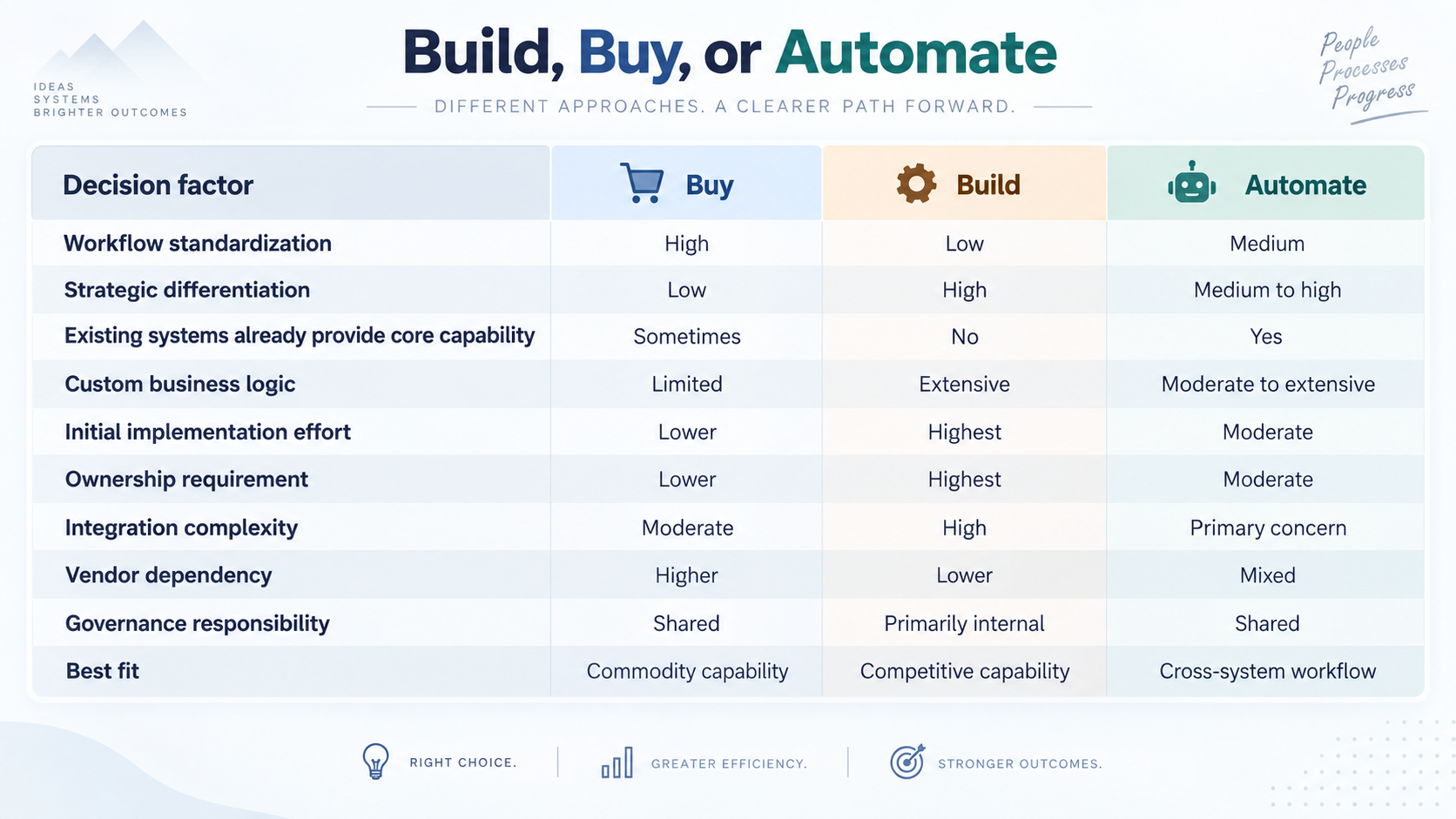
A Practical Build, Buy, or Automate Decision Framework
Technology leaders can evaluate a workflow across several dimensions before selecting an approach.
A useful executive shorthand is:
Buy when an established product already solves a broadly standardized requirement.
Build when the workflow itself creates enough strategic value to justify proprietary investment and long-term ownership.
Automate when the required systems and capabilities largely exist but employees are manually coordinating them.
Data sensitivity, scale, governance, implementation effort, and total cost of ownership should then determine how the chosen architecture is implemented.
Why the Middle Ground Matters
Organizations frequently treat AI projects as a choice between another SaaS subscription and a major custom application.
There is a valuable middle ground.
Focused automation can preserve existing technology investments while adding precisely the workflow behavior that standard products lack.
Imagine a distributor already operating an ERP, CRM, email platform, inventory system, and document repository. Building a replacement operations platform would be expensive and disruptive. Buying another SaaS product may simply introduce another disconnected data silo.
A targeted automation layer could instead capture an incoming order, extract relevant information, validate customer and inventory records, flag exceptions, request approval where required, update the ERP, and notify the customer.
The underlying systems remain in place. The workflow around them improves.
That can be a materially smaller and more controllable transformation.
Evaluating the Business Case Beyond Initial Implementation Cost
Build-versus-buy comparisons often focus too heavily on development cost versus subscription fees.
The more important metric is total operational impact.
Decision-makers should consider:
Software subscriptions and usage-based AI charges.
Integration and API maintenance.
Internal engineering and support requirements.
Vendor dependency and switching costs.
Security and governance overhead.
Employee time spent on manual coordination.
Error and rework costs.
Scalability as transaction volumes increase.
Cost of maintaining duplicate systems.
Financial impact of slow processing.
Manual work has a cost even when it does not appear in an IT budget.
If 30 employees each spend five hours per week transferring information between systems, checking statuses, and preparing repetitive documents, that represents 7,800 working hours annually. Reducing that effort can make a focused automation project economically attractive without requiring dramatic headcount assumptions.
Governance also belongs in the business case. Deloitte's enterprise GenAI research has found that organizations continue to identify risk management and regulatory uncertainty among important barriers to scaling AI.
Key Takeaways for CTOs and Technology Strategy Leaders
The key AI decision for 2027 is not simply whether to build or buy. CTOs should first determine where the organization actually creates differentiated value. Buy mature AI capabilities when the requirement is standardized, build when proprietary workflows, data, or intellectual property create a strategic advantage, and automate when the necessary systems already exist but remain disconnected by manual processes.
The strongest enterprise AI architectures may combine all three approaches: commercial AI services for commodity capabilities, custom development for strategic differentiation, and automation layers that connect applications, data, APIs, AI models, business rules, and human approvals.
Before approving a major AI investment, evaluate the full operating model—not just implementation cost. Integration complexity, governance, security, model evaluation, maintenance, vendor dependency, scalability, and measurable business outcomes should all influence the final architecture.
Conclusion
FAMRO works in the space between purchasing another standalone application and commissioning a large replacement platform.
For organizations with functional systems but inefficient workflows, the objective is often to create a targeted automation and integration layer around the existing technology estate.
That can involve connecting APIs, enterprise applications, databases, AI models, document-processing tools, workflow logic, notifications, and human approval stages into one reliable process.
The value comes from applying AI only where AI adds value.
A deterministic business rule should remain a rule. A high-risk decision may require human approval. AI is useful where interpretation, extraction, classification, summarization, or natural-language interaction can eliminate otherwise manual work.
This produces systems that are easier to govern than uncontrolled AI experimentation and more workflow-specific than generic SaaS.
As IBM Chairman and CEO Arvind Krishna put it, competitive advantage increasingly comes from “purpose-built AI integration that drives measurable business outcomes.”
Should companies build or buy AI solutions in 2027?
Companies should generally buy when the requirement is standardized and established software already solves it effectively. Building becomes more compelling when the workflow creates meaningful competitive advantage, depends on proprietary data, or requires capabilities that generic platforms cannot provide.
When should a company automate instead of building a new AI system?
Automation is often the better option when the required applications and capabilities already exist but employees are manually moving information, checking records, requesting approvals, or coordinating work between disconnected systems.
What factors should companies consider before building custom AI?
Companies should evaluate strategic differentiation, data availability, engineering capacity, security, governance, evaluation requirements, integration complexity, ongoing maintenance, scalability, and total cost of ownership before committing to custom AI development.
What are the advantages of buying AI SaaS?
AI SaaS can provide faster deployment, lower initial engineering requirements, vendor-managed infrastructure, established administration features, predictable functionality, and faster access to new AI capabilities.
What is AI workflow automation?
AI workflow automation connects business applications, data, APIs, AI models, business rules, and human approvals so repetitive multi-system processes can operate with fewer manual handoffs while retaining appropriate controls.
Can companies combine build, buy, and automation strategies?
Yes. Many enterprise architectures combine commercial AI services with proprietary applications, internal data, APIs, workflow engines, deterministic business rules, and human approvals rather than relying on a single approach.
How should companies calculate the business case for AI automation?
Companies should consider more than implementation cost. The business case should include software and AI usage costs, integration maintenance, engineering effort, manual employee time, errors and rework, governance overhead, scalability, vendor dependency, and the financial impact of slow processes.
Want an independent review of your technology, cloud, or AI stack?
FAMRO helps organizations assess architecture, automation, governance, deployment risk, and cloud exposure before those issues slow delivery or create avoidable business risk.
Book a free review
Tell us what you are evaluating. We will review your current setup and help identify
technical risks, cloud issues, automation gaps, and practical next steps.